
ADHD Therapy vs. Executive Function Coaching: How to Choose

Updated: 2 days ago
Last reviewed: 10/11/2026
Reviewed by: Dr. Kiesa Kelly

If you've been searching for "ADHD coach vs. therapist" or "executive dysfunction treatment for adults," you're likely stuck in a specific bind. You know something is not working — tasks are piling up, medication alone is not closing the gap, or therapy is helping your mood but not your Monday morning. You're trying to figure out whether you need a therapist, a coach, both, or something else entirely. The honest answer is that ADHD therapy and executive function coaching do two different jobs, and picking the wrong one can waste months.
This guide walks through what each approach actually does, which type of problem each one fits, a clear decision framework for four common situations, and what to expect in terms of time and cost. It's written for adults navigating this choice — not for clinicians, not for parents of young kids, and not as a sales pitch for one side.
In this article, you'll learn:
How ADHD therapy and executive function coaching differ at the level of what they change
Which type of problem each approach is best suited to solve
A four-scenario decision framework you can apply today
Cost, session structure, and insurance realities for each
When you might reasonably want both at the same time
Questions to ask before you book
Short answer: two different jobs, one skill area
Executive function is the set of brain-based skills that let you start things, hold plans in mind, manage time, regulate attention, and switch between tasks. Researchers consistently describe these skills as a cluster — working memory, inhibition, and cognitive flexibility form the core, with planning, task initiation, and self-monitoring built on top [1]. In ADHD, these skills develop unevenly and operate unreliably, which is why Russell Barkley has argued for decades that ADHD is better understood as a disorder of executive function and self-regulation than as a disorder of attention alone [2].
If ADHD is what's happening in the brain, executive dysfunction is what's happening in your week. Executive function coaching is the intervention most directly aimed at that week — building external scaffolding, workflows, and skills so you can actually do the things you already know you need to do. ADHD therapy, by contrast, is aimed at what's happening inside — the emotional residue of years of executive struggle, the anxiety and depression that often come with it, and the cognitive distortions that make everything harder.
Key takeaway: Coaching works on the gap between what you know and what you do. Therapy works on the emotional and cognitive patterns that widen that gap.
Co-occurrence matters here. A meaningful share of adults with ADHD also meet criteria for at least one anxiety or mood disorder, with recent epidemiological and meta-analytic work placing lifetime co-occurrence rates for anxiety and depression in adult ADHD samples at roughly 40 to 50 percent each [3,4]. That's why many adults end up benefitting from both — not as an upsell, but because they are treating two different layers of the same life.
What ADHD therapy does that coaching doesn't
ADHD therapy is psychotherapy. A licensed clinician — a psychologist, licensed professional counselor, or clinical social worker — treats the mental health side of living with ADHD. The best-studied version for adults is cognitive behavioral therapy adapted for ADHD, with Steven Safren's protocol and Mary Solanto's meta-cognitive therapy forming the primary evidence base [5,6]. Both show meaningful reductions in ADHD symptoms and impairment in randomized controlled trials.
Therapy does several things coaching cannot. It diagnoses and treats co-occurring conditions — depression, generalized anxiety, PTSD, OCD — that amplify executive dysfunction. It addresses the internal stories many adults with ADHD carry: "I'm lazy," "I'm broken," "I can't trust myself to follow through." It works with emotional dysregulation, rejection sensitivity, and the relational patterns that show up in work and family life. A recent meta-analysis of psychosocial interventions for adult ADHD found consistent medium effects for CBT-based approaches on both core symptoms and depression/anxiety outcomes [7]. That dual effect is therapy's specific strength.
Misconception: "A therapist can also be my executive function coach." Sometimes, but usually not in the same session. Insurance-billed therapy has a clinical agenda — symptom tracking, risk assessment, treatment-plan documentation. That agenda does not leave much room for the ten-minute review of last week's calendar, the body-double session, or the workflow teardown that coaching runs on. Some clinicians do both skillfully; many do one well and delegate the other.
Misconception: "Therapy is just talking — it won't help with follow-through." Evidence-based ADHD therapy is structured and skills-based. Safren's CBT protocol, for example, covers organization and planning, reducing distractibility, and cognitive restructuring in a specific sequence [5]. It's not unstructured reflection. But its primary target is symptom reduction and emotional regulation, and the skill-building is typically less intensive than what a dedicated coach provides.
The distinguishing pattern: therapy is the right tool when your biggest cost is emotional, relational, or psychiatric — shame spirals, anxiety about tasks, depression on top of ADHD, trauma stacked underneath, or patterns hurting your relationships.

What executive function coaching does that therapy doesn't
Executive function coaching is skills-and-scaffolding work. A coach helps you build the external systems your brain does not reliably generate on its own: calendars that actually get looked at, task-capture habits, transition rituals, weekly reviews, body-doubling for starting hard tasks, accountability structures that outlast the novelty of any single app. The Dawson and Guare framework — widely used in coaching practice — treats executive function as a set of trainable skills and organizes intervention around specific domains: task initiation, sustained attention, working memory, planning, organization, and metacognition [8].
Coaching differs from therapy in three concrete ways. First, the cadence is different — often shorter, more frequent check-ins during implementation (weekly 30-minute sessions, sometimes supplemented by mid-week text check-ins) rather than a standing 50-minute therapy hour. Second, the content is almost entirely forward-facing: what are you trying to do this week, where are the predictable failure points, what scaffolding needs to be in place by Tuesday. Third, the relationship is collaborative-instrumental rather than clinical — you are co-designing a system with someone whose job is to help you build it and keep it running.
The honesty piece: the peer-reviewed evidence base for adult ADHD coaching is smaller than for ADHD psychotherapy. Most of the well-controlled coaching research comes from school and college populations, with studies like the Evans group's work on EF-focused school interventions and more recent college coaching trials showing improvements in self-reported EF and GPA [9,10]. Adult professional-population coaching studies exist but are fewer and smaller. That does not mean coaching doesn't work — clinically it works well for many adults — but it means you should evaluate a prospective coach on their training, methods, and fit rather than assume a one-size evidence base.
Misconception: "EF coaching is just accountability phone calls." Good coaching includes accountability, but it's built on an assessment of your specific executive function profile and a deliberate plan for building skills and systems. Pure accountability — "did you do the thing? no? okay, do it this week" — is a feature, not the product. The product is durable scaffolding that keeps working when the coach is not on the call.
Misconception: "EF coaching replaces therapy if I have ADHD." It doesn't. Coaching does not treat depression, anxiety, trauma, OCD, or the internal patterns that often co-exist with ADHD. If you start coaching and notice that the real obstacle is not the system but a mood or anxiety pattern underneath it, that's a signal to add therapy — not a signal that coaching failed.
The distinguishing pattern: coaching is the right tool when your biggest cost is operational — starting, sustaining, tracking, finishing, and the distance between your calendar and your actual week.
Key takeaway: Therapy rewires how you feel about the work. Coaching builds the structure that lets the work happen.
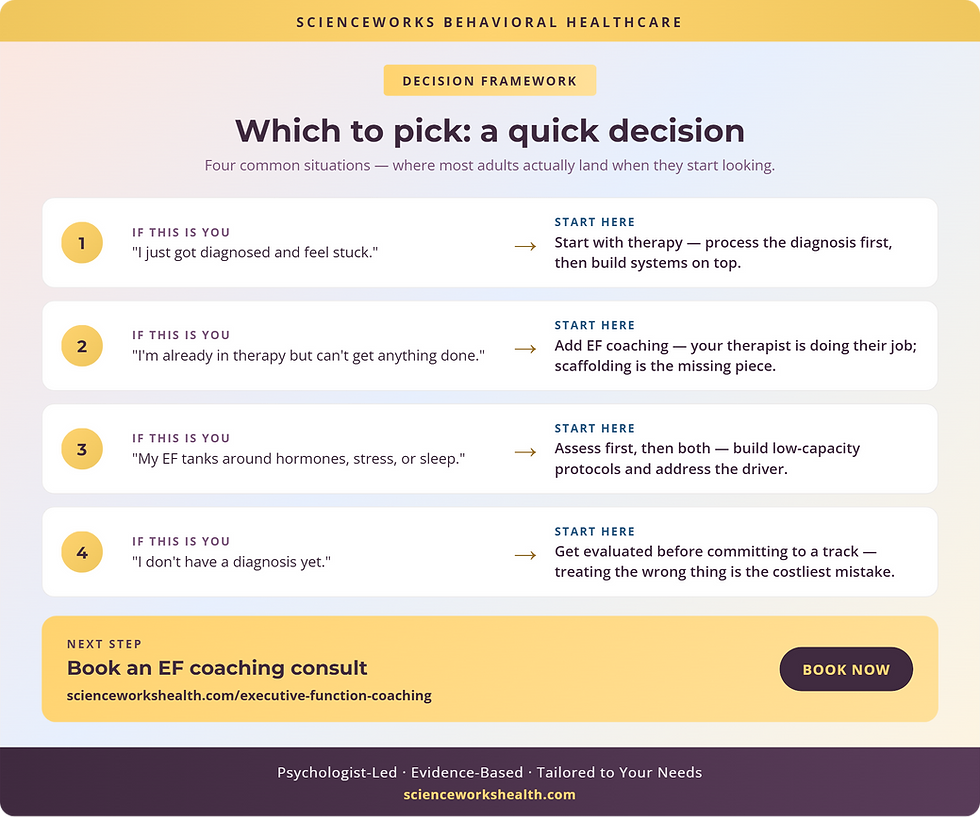
Which to pick: four common scenarios
"I just got diagnosed and feel stuck"
You just finished an adult ADHD evaluation. The diagnosis fits — it explains years of patterns — but you're now sitting with a mix of relief and disorientation. You may be on a new medication that is helping your attention feel steadier, but you still cannot seem to open the email you've been avoiding for a week. You're aware that you "should" be building better systems, and you've downloaded three productivity apps this month, none of which you've used past day four. You don't feel depressed exactly, but you do feel a quiet grief about the years before diagnosis. In this specific state, both approaches have a role — but the most common productive sequence is to start with coaching while the diagnosis is fresh. Medication plus scaffolding tends to produce the fastest functional wins, and those wins often dissolve some of the self-blame that would otherwise need therapy to unwind slowly. If the grief gets heavier rather than lighter over a few months, add therapy then.
"I'm already in therapy but can't get anything done"
You like your therapist. You've done real work there — your anxiety is down, you understand your patterns, you've stopped some of the catastrophizing that used to run your mornings. And yet your desk looks the same as it did a year ago. Tasks slide. Meetings still ambush you. You know exactly what you should be doing, and you keep not doing it. This is the clearest case for adding coaching rather than switching. Your therapist is doing their job — the internal stuff is moving — but the external scaffolding isn't being built in those sessions, because that's not what those sessions are for. Keeping therapy and layering in coaching is often the highest-yield move for this scenario. If budget or time forces a choice, ask your therapist directly whether EF coaching is what you're missing; most will say yes, because they can see the gap from the inside.
"My executive function tanks around hormones, stress, or sleep"
Your capacity is not flat. In a good month, you're organized, starting things on time, and running on systems that seem to work. Then a perimenopausal flare, a bad sleep stretch, a luteal-phase week, or a stressful project sends everything off a cliff. Your systems stop being used, your inbox becomes a threat, and you wonder whether the good weeks were a fluke. This pattern is common — research on ADHD and estrogen, and on the bidirectional relationship between sleep and executive function, supports the idea that EF capacity is dynamic rather than fixed [11,12]. The best fit here is usually coaching focused on building low-capacity protocols — shorter versions of your systems that survive the flare — alongside either therapy or medical evaluation for the underlying driver. If the capacity crashes come with significant anxiety or depression, start therapy in parallel. If they come with a clear physical driver (sleep, hormones, illness), address that too. Our ESQ-R executive function self-report can help you see the shape of the crashes more precisely.
"I don't have a diagnosis yet"
You've never been formally evaluated, but the pattern is obvious enough to you that you're reading this post. You might be self-identifying with ADHD, or you might suspect something else — anxiety, trauma, autism, sleep-driven cognitive issues. The most useful first step here is not a coach or a therapist — it's an evaluation. Coaching without a clear picture of what you're working with can miss the actual problem, and therapy aimed at the wrong target can frustrate both sides. The adult ADHD self-report (ASRS) is a starting screen, not a diagnosis, but the results help you decide whether a full psychological assessment makes sense next. If the screen is clearly negative but the executive function problems are real, that's useful information too — it means a differential evaluation or a direct ESQ-R-based approach may fit better than ADHD-specific treatment.
Key takeaway: If you're not sure what's driving the problem, evaluate before you treat. Treating the wrong thing is the single most expensive mistake in this process.
Cost, time commitment, and what sessions look like
ADHD therapy with a licensed clinician typically runs 50 minutes per session. Cash rates vary by region and credential, but $150 to $300 per session is a common range for psychologists and experienced therapists in 2026. Most clinicians bill insurance, though coverage and copay vary widely. Structured ADHD CBT protocols are typically 10 to 14 sessions, followed by maintenance as needed [5].
Executive function coaching sessions are usually shorter — 30 to 45 minutes — and more frequent in the early phase, sometimes weekly or twice weekly for the first six to eight weeks as systems get built. Coaching is almost universally cash-pay; it is not a licensed mental health service and is not covered by health insurance. Rates vary widely based on the coach's credentials, but $100 to $250 per session is a common range for coaches with clinical or psychology backgrounds.
What a therapy session looks like: review of the past week, identification of patterns or incidents worth working on, a structured intervention (cognitive restructuring, behavioral activation, exposure, skills practice), and sometimes homework. The agenda belongs to the clinician as much as the client, and there's always a clinical lens on safety, mood, and co-occurring conditions.
What a coaching session looks like: review of what you committed to last week, honest assessment of what happened and what tripped you up, updates to the system that let you down, and commitments for the upcoming week. Many coaches incorporate body-doubling — working side-by-side on a stalled task during part of the session — and some offer between-session text check-ins.
Key takeaway: Insurance often helps with therapy but rarely touches coaching. If budget is the constraint, that difference alone shapes the choice.
When you might want both at once
There are specific cases where running therapy and coaching in parallel is worth the cost. If your ADHD is diagnosed and you also meet criteria for a co-occurring anxiety or mood disorder, therapy handles the mood layer while coaching handles the operational layer — and each one makes the other more effective. The anxiety that keeps you from opening your inbox is a therapy target; the absence of a reliable inbox-triage ritual is a coaching target. Working them in parallel prevents the common pattern where one intervention gets blamed for not doing the other's job.
Another good case for both: high-stakes transitions. New job, new baby, move, grad school, business launch. The demand on executive function spikes, and if there's any underlying mood or anxiety vulnerability, it tends to spike too. A short run of coaching plus targeted therapy during the transition is often higher-yield than either alone.
A third case: early recovery from ADHD-adjacent trauma — the accumulated shame and relational fallout from years of untreated ADHD. Trauma-focused therapy can address the weight; coaching keeps the present-day week from being flattened under it. NICE guideline NG87 for adult ADHD specifically recommends combining psychological and non-pharmacological support in a coordinated care plan, and the AACAP and APA framings for adult ADHD management similarly emphasize multi-modal approaches [13,14,15].
Key takeaway: Parallel care is not over-treatment if the two interventions are working on different layers.
Questions to ask before you book
Before paying for either coaching or therapy, ask a handful of concrete questions:
Scope. What specifically are you trained to work on? Is ADHD and executive function your primary area, or a secondary one?
Methodology. What framework or protocol do you use? For therapy: is it CBT for ADHD, Solanto's MCT, another structured approach, or eclectic? For coaching: Dawson and Guare, ICF-accredited EF coaching, clinical-psychology-based, or self-taught?
Evidence base. How do you track whether the work is actually helping? What does "progress" look like in the first eight weeks?
Fit with other care. Can you coordinate with my prescriber, therapist, or coach on the other side? Will you communicate if you spot something out of your scope?
Logistics and cost. Session length, cadence, cancellation policy, between-session contact, cash rate, insurance status, and whether a superbill is available for out-of-network reimbursement.
Exit criteria. What does it look like when we're done? How will we know coaching or therapy has done its job?
A provider who can answer those questions clearly is more likely to be a good fit than one whose answers are vague. Uncertainty on methodology is the biggest red flag for coaching specifically, because the EF coaching field is unregulated and credentials vary widely.
Next step
If you've read this far and you still don't know which to pick, here's a compact decision heuristic:
If your biggest costs are operational — starting, finishing, tracking, following through — start with executive function coaching. If the operational problems are paired with a mood or anxiety layer, add therapy.
If your biggest costs are emotional, relational, or psychiatric — shame spirals, anxiety about tasks, depression, trauma, relationship fallout — start with ADHD therapy. Layer in coaching when the mood layer has lifted enough to build systems.
If both are equally bad and you can manage it, run both in parallel for the first three months. That's often the fastest path through.
If you're not sure whether ADHD is actually the right diagnosis — start with an adult ADHD screener and consider a full psychological assessment before paying for either coaching or therapy.
Our team provides executive function coaching for adults by telehealth wherever you are, and we coordinate with outside therapists and prescribers when parallel care fits better than a single-lane approach. If you'd like to talk through which path fits your situation, you can reach out through our contact page and we'll help you figure out the right starting point — even if that starting point isn't with us.
Frequently Asked Questions
Can a therapist also be an executive function coach?
Yes, some can — especially clinicians with specific ADHD training and a skills-based orientation. But insurance-billed therapy has a clinical agenda that competes with the operational focus coaching needs. If you want both from one person, ask directly whether they run coaching-style sessions in parallel and whether those sessions are billable or cash-pay. Many clinicians only offer one mode.
Does insurance cover ADHD coaching?
Generally no. ADHD coaching is not a licensed mental health service in most states and is not billable under mental health codes. Some employer wellness benefits, HSA/FSA plans, or out-of-network reimbursement paths include coaching with a licensed clinician, but don't assume coverage. Ask for a detailed fee schedule and a sample superbill before you start.
Is ADHD coaching or therapy better for executive function?
For executive-function skills specifically (planning, time use, task initiation, follow-through) coaching is often a better direct fit than therapy, because coaching's structured, skills-based approach matches the problem. But better depends on what is blocking executive function: if the block is emotional (avoidance, perfectionism, demoralization, rejection sensitivity, trauma), therapy first or alongside is usually more effective. The cleanest decision rule: use therapy when the block is emotional or clinical; use coaching when skills are the missing piece.
How do I choose between coaching, therapy, and medication for ADHD?
Choose based on what each modality solves: medication (when appropriate) reduces core ADHD neurobiology including attention, impulsivity, and working memory; therapy treats the emotional and clinical layers including anxiety, depression, trauma, and relationships; coaching builds practical skills and external structure. Most adults benefit from a combination. A thoughtful sequencing is to evaluate medical and clinical factors first (medication and therapy decisions), then add coaching once the clinical picture is stabilizing. None of these substitutes for a thorough evaluation.
What does "scaffolding" mean in executive function coaching?
In executive function coaching, scaffolding means putting external supports and structure around a task — so you can start and finish it — and then gradually removing those supports as the skill becomes more automatic. Common examples include body-doubling, checklists, timers, visual planners, and step-by-step routines. The goal is not to rely on the supports forever; it is to build repeatable systems that make initiation, planning, and follow-through easier over time.
About ScienceWorks
ScienceWorks Behavioral Healthcare is a Tennessee-based, telehealth-forward psychology practice founded by Dr. Kiesa Kelly, a licensed clinical psychologist with more than 20 years of experience in psychological assessment and evidence-based treatment. Our clinical team specializes in adult and adolescent ADHD and autism evaluations, executive function coaching, and evidence-based therapy for anxiety, depression, OCD, trauma, and insomnia. We built the practice to combine rigorous assessment with practical skill-building, so adults navigating ADHD and executive function challenges can get both accurate answers and real-world tools.
Every article on our site is reviewed by a licensed clinician for accuracy before publication. For executive function coaching specifically, we pair a clinical understanding of ADHD and co-occurring conditions with the Dawson and Guare-style skill-building framework, and we coordinate openly with outside therapists, prescribers, and coaches when parallel care fits the client better than a single-lane approach.
References
1. Diamond A. Executive functions. Annu Rev Psychol. 2013;64:135-68. https://pubmed.ncbi.nlm.nih.gov/23020641/
2. Barkley RA. Executive Functions: What They Are, How They Work, and Why They Evolved. Guilford Press. https://www.guilford.com/books/Executive-Functions/Russell-Barkley/9781462505357
3. Katzman MA, Bilkey TS, Chokka PR, Fallu A, Klassen LJ. Adult ADHD and comorbid disorders: clinical implications of a dimensional approach. BMC Psychiatry. 2017;17:302. https://bmcpsychiatry.biomedcentral.com/articles/10.1186/s12888-017-1463-3
4. Choi WS, Woo YS, Wang SM, Lim HK, Bahk WM. The prevalence of psychiatric comorbidities in adult ADHD compared with non-ADHD populations: A systematic literature review. PLoS One. 2022;17(11):e0277175. https://journals.plos.org/plosone/article?id=10.1371/journal.pone.0277175
5. Safren SA, Sprich S, Mimiaga MJ, et al. Cognitive behavioral therapy vs relaxation with educational support for medication-treated adults with ADHD and persistent symptoms: a randomized controlled trial. JAMA. 2010;304(8):875-880. https://jamanetwork.com/journals/jama/fullarticle/186416
6. Solanto MV, Marks DJ, Wasserstein J, et al. Efficacy of meta-cognitive therapy for adult ADHD. Am J Psychiatry. 2010;167(8):958-968. https://doi.org/10.1176/appi.ajp.2009.09081123
7. López-Pinar C, Martínez-Sanchís S, Carbonell-Vayá E, Sánchez-Meca J, Fenollar-Cortés J. Efficacy of nonpharmacological treatments on comorbid internalizing symptoms of adults with attention-deficit/hyperactivity disorder: a meta-analytic review. J Atten Disord. 2020;24(3):456-478. https://doi.org/10.1177/1087054719855685
8. Dawson P, Guare R. Smart but Scattered Guide to Success: How to Use Your Brain's Executive Skills to Keep Up, Stay Calm, and Get Organized at Work and at Home. Guilford Press. https://www.guilford.com/books/Smart-but-Scattered-Guide-to-Success/Dawson-Guare/9781462516964
9. Evans SW, Langberg JM, Schultz BK, et al. Evaluation of a school-based treatment program for young adolescents with ADHD. J Consult Clin Psychol. 2016;84(1):15-30. https://pubmed.ncbi.nlm.nih.gov/26501496/
10. DuPaul GJ, Dahlstrom-Hakki I, Gormley MJ, Fu Q, Pinho TD, Banerjee M. College students with ADHD and LD: Effects of support services on academic performance. Learning Disabilities Research & Practice. 2017;32(4):246-256. https://onlinelibrary.wiley.com/doi/10.1111/ldrp.12143
11. Nigg JT. On the relations among self-regulation, self-control, executive functioning, effortful control, cognitive control, impulsivity, risk-taking, and inhibition for developmental psychopathology. J Child Psychol Psychiatry. 2017;58(4):361-383. https://pubmed.ncbi.nlm.nih.gov/28035675/
12. Hirshkowitz M, Whiton K, Albert SM, et al. National Sleep Foundation's updated sleep duration recommendations: final report. Sleep Health. 2015;1(4):233-243. https://www.sleephealthjournal.org/article/S2352-7218(15)00160-6/fulltext
13. National Institute for Health and Care Excellence. Attention deficit hyperactivity disorder: diagnosis and management (NICE guideline NG87). 2018, updated 2019. https://www.nice.org.uk/guidance/ng87
14. Wolraich ML, Hagan JF Jr, Allan C, et al. Clinical Practice Guideline for the Diagnosis, Evaluation, and Treatment of ADHD in Children and Adolescents. Pediatrics. 2019;144(4):e20192528. https://publications.aap.org/pediatrics/article/144/4/e20192528/81590/Clinical-Practice-Guideline-for-the-Diagnosis
15. Canela C, Buadze A, Dube A, Eich D, Liebrenz M. Skills and compensation strategies in adult ADHD — a qualitative study. PLoS One. 2017;12(9):e0184964. https://journals.plos.org/plosone/article?id=10.1371/journal.pone.0184964
Disclaimer
This article is for informational purposes only and is not a substitute for medical advice, diagnosis, or treatment from a qualified healthcare provider. Reading this content does not create a provider-patient relationship. If you are experiencing a mental health crisis, contact the 988 Suicide and Crisis Lifeline or your local emergency services. Always consult a licensed clinician about your individual situation before making decisions about assessment, therapy, coaching, or medication.