
Adult ADHD Testing in Knoxville, TN | ScienceWorks

Updated: Jul 6
Last reviewed: 05/21/2026
Reviewed by: Dr. Kiesa Kelly
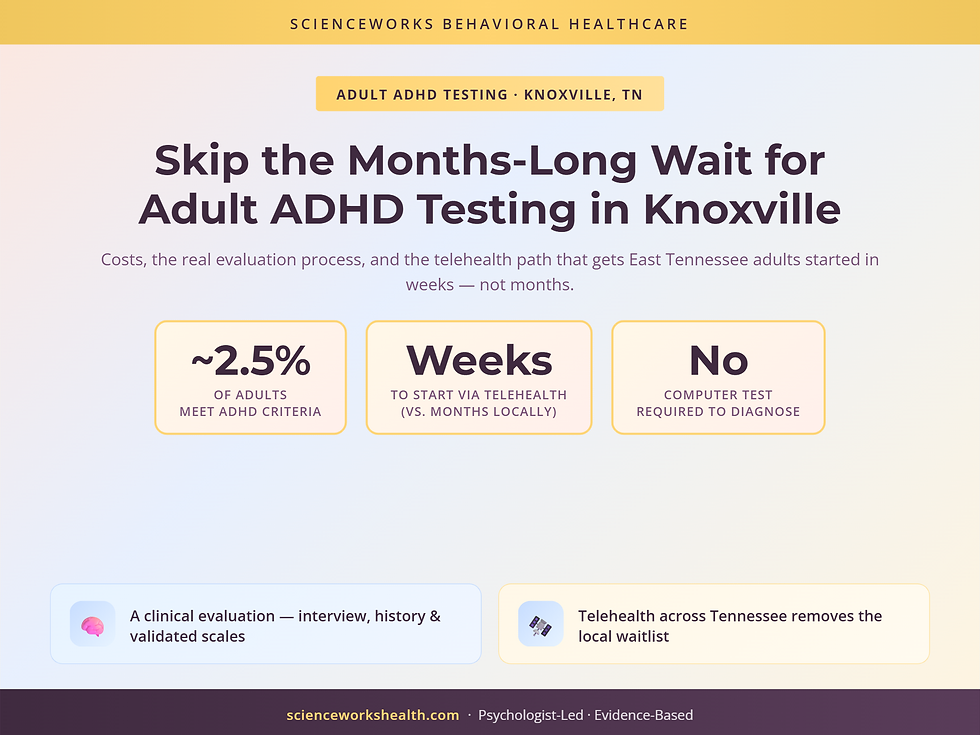
If you have been trying to get tested for ADHD as an adult in the Knoxville area, you have probably hit the same wall most people do: long waitlists, unclear pricing, and no straight answer about what the evaluation actually involves. It is frustrating, and it is the main reason capable adults put off getting answers for years.
This guide lays out what a thorough adult ADHD evaluation includes, what it tends to cost around Knoxville and what changes the price, and — most usefully — how to skip the months-long wait. The aim is to give you a clear path you can act on, not just a description of the landscape.
In this article, you'll learn:
What a complete adult ADHD evaluation actually includes
Why testing waits are so long in Knoxville, and what shortens them
What the evaluation costs and what changes the price
When telehealth ADHD testing is a strong fit for East Tennessee
A screener-first path that gets you moving today
Adult ADHD testing in Knoxville: what to know first
ADHD testing for adults is a structured clinical evaluation, not a single quiz. A licensed clinician reviews your history, uses validated rating scales, and weighs your experiences against established diagnostic criteria. ADHD is more common in adults than many people realize — roughly 2.5% of adults meet criteria for it — and it frequently goes unrecognized until coping strategies stop working [1]. You can see the broader scope of evaluation work on our psychological assessments page.
The single most useful thing to understand: the evaluation itself is not slow. What is slow is getting access to one. Treat the wait and the testing as two separate problems, because the wait is the one you can do the most about.
Does this sound familiar?
Two everyday patterns capture how adult ADHD tends to show up — and why people second-guess it for years.
You do fine in fast-moving meetings because the pressure keeps you engaged, but you miss forms, forget follow-up emails, lose track of time, and cannot reliably start boring tasks until the consequences feel urgent. Your inbox has three half-finished threads, and you know exactly what each one needs — you just cannot make yourself sit down and do it. People describe you as capable but scattered, and you have learned to overfunction in bursts to cover long stretches of inertia.
Or: you got through school on last-minute intensity and a good memory, so no one ever flagged a problem. Then a promotion, a new baby, or a heavier workload removed the slack, and the same strategies stopped working. Now you reread the same paragraph four times, set reminders you then ignore, and end most days drained by how much effort ordinary tasks take. Nothing catastrophic is happening — it just quietly costs you far more than it seems to cost everyone around you.
Three things people get wrong about adult ADHD
A few stubborn beliefs keep adults from pursuing testing. Worth clearing up first.
“If I can focus on things I enjoy, I can't have ADHD.” ADHD is a problem of regulating attention, not a simple lack of it. Many adults with ADHD experience hyperfocus on engaging tasks and then cannot start or sustain attention on boring but necessary ones. The inconsistency is the pattern, not a contradiction of it.
“ADHD is a childhood thing you grow out of.” For a large share of people, ADHD persists into adulthood, and current diagnostic guidance recognizes adult presentations explicitly [2][3]. Symptoms often shift from visible hyperactivity toward inattention, disorganization, and internal restlessness — which is part of why adults get missed.
“Good grades or a good career mean it isn't ADHD.” Plenty of intelligent, hard-working adults compensate for years through sheer effort, structure, and long hours. Diagnosis frequently arrives only after a promotion, a new baby, or a heavier workload overwhelms those compensations. Success does not rule ADHD out; it often just delays the question.
🧠 Key takeaway: ADHD in adults is about inconsistent regulation of attention and effort — not an inability to ever focus, and not something everyone outgrows.
Why ADHD testing waits are long in Knoxville
The bottleneck is supply, not your paperwork. Demand for adult ADHD evaluations has climbed sharply, while the number of clinicians who do thorough adult assessments has not kept pace. Each evaluation takes real clinician time, and many local practices focus on children or have closed their waitlists entirely. The result is that a Knoxville adult calling around may be quoted a wait measured in months.
This is a regional and national pattern, not a Knoxville failing. We explain the mechanics — and the ways around them — in our deeper look at why adult ADHD and autism evaluations have such long waitlists and how to get answers sooner.
⏳ Key takeaway: Long Knoxville waits come from a clinician shortage, not from anything on your end — which is exactly why an alternative path can move so much faster.
What a thorough adult ADHD evaluation includes
A real evaluation gathers several kinds of evidence and weighs them together. Here is what the testing day actually looks like.
Clinical interview and history
The backbone of an ADHD evaluation is a structured interview about your symptoms now and across your life — focus, organization, time management, impulsivity, and how these show up at work and at home. The clinician is looking for a lifelong pattern, not a bad week. Adults are often asked to think back to childhood, because ADHD begins early even when it was never named.
Rating scales
Validated questionnaires give a standardized read on your symptoms. The ASRS adult ADHD screener is a well-studied example, developed with the World Health Organization to measure adult ADHD symptoms reliably [4]. Scales like this support the clinical picture; they do not replace the interview and history.
Optional performance testing
You may have heard of computerized attention tests. These can add objective data in specific cases, but they are optional — an ADHD diagnosis is made clinically, and a thorough evaluation can reach a sound conclusion without them in most adults. If a provider treats a single computer test as the whole evaluation, that is a warning sign, not a feature.

📋 Key takeaway: A complete adult ADHD evaluation is interview plus history plus validated rating scales — performance testing is an optional add-on, never the core.
What ADHD testing costs in the Knoxville area
Cost is the question people most want answered and least often see addressed plainly. The price of an adult ADHD evaluation tracks clinician time and depth, which is why a thorough evaluation costs more than a quick screening visit — and is worth more.
What changes the price
The main drivers are how many validated instruments are used, whether the evaluation also screens for co-occurring conditions like anxiety or depression, the depth of the history-gathering, and how detailed the final report and recommendations are. We keep our pricing transparent and give you a clear quote before you commit. Insurance coverage for adult ADHD evaluation varies widely by plan; many adults pay out of pocket or use partial reimbursement, and we can provide documentation like a superbill so you can check your benefits.
Because cost deserves its own deep dive, we maintain a dedicated guide to how much ADHD testing costs in Tennessee, what changes the price, and what you should get. Read it alongside this page rather than treating any single number as the whole story.
💲 Key takeaway: Price reflects depth — before booking anywhere, confirm the fee includes a written report and recommendations, not just a score.
Telehealth ADHD testing for East Tennessee
Most of an adult ADHD evaluation is interview and questionnaire work, which translates well to secure video. We provide telehealth evaluation across Tennessee, so a Knoxville or wider East Tennessee adult can often begin within weeks instead of joining a long local waitlist. You can meet the clinicians who do this work on our team page.
Telehealth is not automatically right for everyone, so here is a clean decision rule. If your main barriers are the waitlist, travel, or fitting an appointment around work, telehealth is very likely your fastest and most practical path. If you specifically need a component done in person, or you simply focus better in a physical room, an in-person option may suit you despite the longer wait. Whatever you choose, ask the provider which parts of their evaluation are done remotely.
A diagnosis from a thorough telehealth evaluation carries the same clinical weight as an in-person one, and the written report supports accommodations at work or school and gives a prescriber what they need. If ADHD turns out to be part of the picture, the report can also point you toward practical support such as executive-function coaching.
🛰️ Key takeaway: For most East Tennessee adults, telehealth removes the waitlist and travel barriers without lowering the quality or standing of the diagnosis.
Questions to ask before you book
These questions tell you quickly whether an evaluation is thorough or thin:
Scope: Does the evaluation assess ADHD specifically, and will it screen for co-occurring conditions like anxiety or depression if relevant?
Methodology: Do you use a structured interview and validated rating scales, or just a single checklist or computer test?
Developmental history: What history do you gather, and what happens if I do not have childhood records?
Output: What do I receive at the end — a diagnosis, a written report, and specific recommendations I can use for accommodations or a prescriber?
Skipping the wait: a screener-first path
The fastest move is not to wait for a local opening — it is to start. A short, validated screener is a low-pressure first step that tells you whether a full evaluation is warranted and gives a clinician a head start.
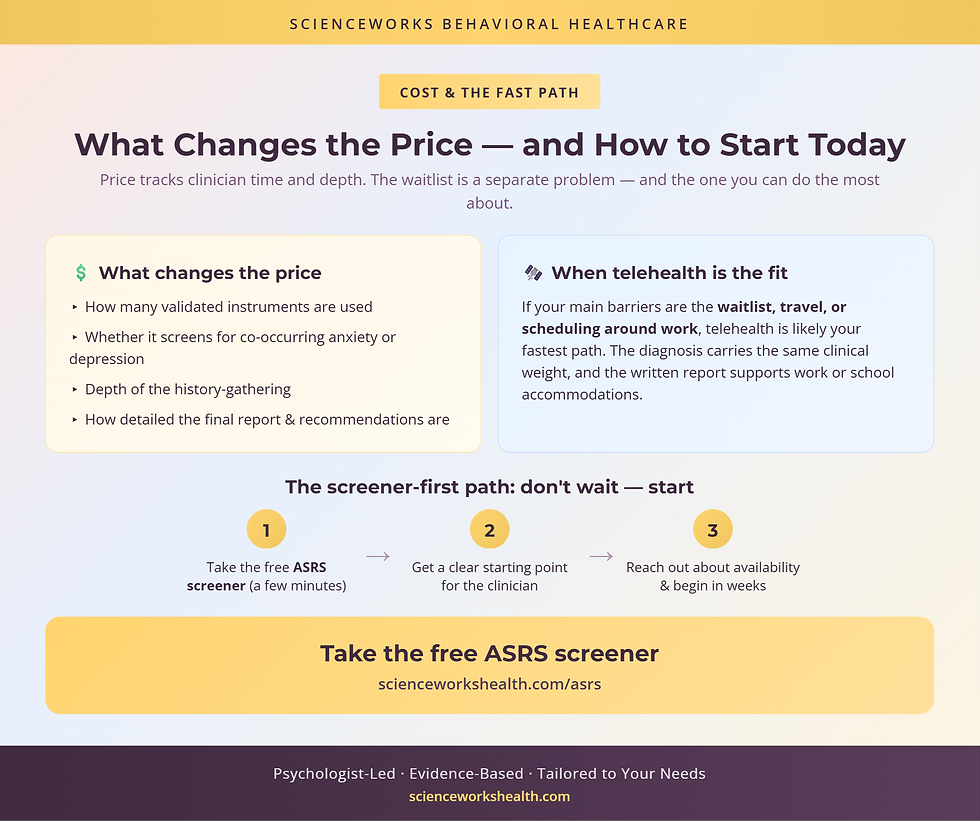
The ASRS screener takes only a few minutes and is a sound starting point. If your results point toward ADHD, you will already have something useful in hand. When you are ready to move from a screener to a real plan, you can reach out to us to ask about current availability.
A structured ADHD evaluation can tell you whether what you're noticing is ADHD, something else, or both — and what would actually help. If the patterns in this guide sound familiar, getting a clear answer is the step that finally lets you act.
Frequently Asked Questions
How can I get ADHD testing faster in Knoxville?
The fastest route is usually to schedule with a provider who has near-term openings rather than waiting for a local in-person slot. Because we offer telehealth evaluation across Tennessee, Knoxville-area adults often start within weeks instead of months. Completing a short screener like the ASRS before intake can also streamline scheduling by giving the clinician a clear starting point.
Do I need performance testing for an adult ADHD evaluation?
Usually not. An ADHD diagnosis is made clinically — through a structured interview, your history, and validated rating scales — not by a computer test. Performance tests can add objective data in some cases, but they are optional and cannot diagnose ADHD on their own. A thorough evaluation can reach a sound conclusion without them in most adults.
Can I get an adult ADHD evaluation in Knoxville without a referral?
In most cases, yes. You can typically book an adult ADHD evaluation directly without a physician referral, though some insurance plans require one for reimbursement. We can tell you what your evaluation involves before you commit, and you can check with your plan about whether a referral affects coverage. Reaching out directly is the quickest way to find out.
Will a telehealth ADHD diagnosis be accepted for work or school accommodations?
A diagnosis from a thorough telehealth evaluation carries the same clinical weight as an in-person one, and you receive a written report you can share with an employer, school, or prescriber. We are psychologists, so we do not prescribe medication, but our documentation supports requests for accommodations and gives a prescriber what they need. Always confirm any specific format your institution requires.
How should I prepare for an adult ADHD evaluation?
Bring examples from daily life — work, home, focus, time management, and organization — across both childhood and now. Any old report cards, past evaluations, or input from someone who knew you growing up can help, though they are not required. Completing the ASRS beforehand and jotting down your main concerns makes the intake more focused and useful.
About ScienceWorks
ScienceWorks Behavioral Healthcare was founded by Dr. Kiesa Kelly, a licensed clinical psychologist with more than 20 years of experience in psychological assessment and evidence-based treatment. Our clinical team evaluates adults and adolescents for ADHD, autism, anxiety, depression, OCD, and trauma, with particular attention to adults whose ADHD was overlooked earlier in life.
We are a telehealth-forward practice serving Tennessee, including Knoxville and the wider East Tennessee region, which lets us offer adult ADHD evaluation without the long in-person waitlists many adults face. Every article we publish is reviewed by a licensed clinician for accuracy before publication, and every evaluation ends with a clear explanation of what was found and concrete next steps.
References
1. Faraone SV, Banaschewski T, Coghill D, et al. The World Federation of ADHD International Consensus Statement: 208 evidence-based conclusions about the disorder. Neurosci Biobehav Rev. 2021;128:789-818. https://www.sciencedirect.com/science/article/pii/S014976342100049X
2. American Psychiatric Association. Diagnostic and Statistical Manual of Mental Disorders, Fifth Edition, Text Revision (DSM-5-TR). https://www.psychiatry.org/psychiatrists/practice/dsm
3. National Institute for Health and Care Excellence. Attention deficit hyperactivity disorder: diagnosis and management (NG87). https://www.nice.org.uk/guidance/ng87
4. Kessler RC, Adler L, Ames M, et al. The World Health Organization Adult ADHD Self-Report Scale (ASRS): a short screening scale for use in the general population. Psychol Med. 2005;35(2):245-256. https://pubmed.ncbi.nlm.nih.gov/15841682/
5. Kooij JJS, Bijlenga D, Salerno L, et al. Updated European Consensus Statement on diagnosis and treatment of adult ADHD. Eur Psychiatry. 2019;56:14-34. https://pubmed.ncbi.nlm.nih.gov/30453134/
6. Song P, Zha M, Yang Q, et al. The prevalence of adult attention-deficit hyperactivity disorder: a global systematic review and meta-analysis. J Glob Health. 2021;11:04009. https://jogh.org/documents/2021/jogh-11-04009.pdf
7. Ostinelli EG, Schulze M, Zangani C, et al. Comparative efficacy and acceptability of pharmacological, psychological, and neurostimulatory interventions for ADHD in adults: a systematic review and component network meta-analysis. Lancet Psychiatry. 2025;12(1):32-43. https://www.thelancet.com/journals/lanpsy/article/PIIS2215-0366(24)00360-2/fulltext
8. Bogdańska-Chomczyk E, Majewski MK, Kozłowska A. ADHD in Adulthood: Clinical Presentation, Comorbidities, and Treatment Perspectives. Int J Mol Sci. 2025;26(22):11020. https://www.mdpi.com/1422-0067/26/22/11020
9. Centers for Disease Control and Prevention. About ADHD. https://www.cdc.gov/adhd/about/index.html
Disclaimer
This article is for informational and educational purposes only and is not a substitute for professional medical advice, diagnosis, or treatment. Reading it does not create a clinician–patient relationship. Screeners such as the ASRS are not diagnostic tools, and ScienceWorks clinicians are psychologists who do not prescribe medication. If you have questions about ADHD, your mental health, or whether an evaluation is right for you, consult a qualified licensed professional.