
Why Adults with Autism Struggle to Sleep — and What Actually Helps
- Kiesa Kelly

- 10 hours ago
- 13 min read
Last reviewed: 06/15/2026
Reviewed by: Dr. Kiesa Kelly

If you are an autistic adult who lies awake for an hour after the lights go out, wakes repeatedly through the night, or feels exhausted all day yet wired the moment your head hits the pillow, you are not failing at sleep. You are running a different nervous system on a schedule built for someone else's. Adult autism and sleep difficulty go together far more often than most people realize, and the reasons are biological — not a matter of trying harder.
This is the frustrating part for many people we work with: you have read the sleep-hygiene checklists, dimmed the screens, cut the caffeine, and still nothing changes. That is because the standard advice was designed for ordinary insomnia, and autistic sleep difficulty is mechanistically different. Understanding why your sleep is hard is the first step toward a plan that actually fits.
In this article, you'll learn:
How common sleep problems are in autistic adults, and what they typically look like
The biology behind autistic sleep difficulty — melatonin timing, the body clock, and sensory load
Three common misconceptions that keep autistic adults stuck
Sensory-aware strategies that work with an autistic nervous system, not against it
How melatonin actually performs, and the safety caveats that matter
When a telehealth evaluation is the right next step
What's going on — the one-paragraph answer
For most autistic adults, the core problem is that the body's sleep timer runs late and weak, and the nervous system stays more easily aroused than it should at night. The hormone melatonin, which normally rises in the evening to signal "time for sleep," tends to arrive later and at lower levels in autistic people, so the brain is not chemically ready for sleep at a conventional bedtime. On top of that, everyday sensory input that others filter out — a humming fridge, a slightly-too-warm room, the texture of the sheets — can keep an autistic nervous system on guard. The combination produces a recognizable pattern: it takes a long time to fall asleep, sleep breaks up across the night, and total sleep ends up short. If this sounds like you, a structured look at your sleep and the conditions behind it is often more useful than another round of generic tips.
How common is this, and what does it look like
Sleep problems are one of the most common health issues in autism. Across studies, an estimated 40 to 83 percent of autistic people report some form of sleep disturbance — a rate well above the general population [1]. In autistic adults specifically, the pattern is consistent: longer time to fall asleep, more and longer night wakings, shorter overall sleep, disrupted circadian rhythm, and more daytime sleepiness [1][2].
These are not minor inconveniences. Poorer sleep quality in autistic adults is linked to lower quality of life, and anxiety, insomnia, and daytime napping each predict worse sleep — which can pull a person into a self-reinforcing loop [2][3]. The bad night feeds the anxious day, the anxious day feeds the next bad night.
Here is what that can look like in practice. You finish work drained, but the moment the house goes quiet you feel oddly alert — your mind sharpens, you start projects at 11 p.m., and "just one more thing" stretches to 1 a.m. You finally fall asleep, then wake at 3 a.m. to a sound no one else would notice, and your body treats it like a fire alarm. Morning arrives far too early; you move through the day under a fog, relying on caffeine and an afternoon nap that, in turn, makes the next night worse.
Or: bedtime arrives and you do everything "right" — dark room, no screens, the same routine as last night. But the seam of the duvet cover sits wrong against your skin, the streetlight edges around the blind, and the radiator ticks. None of it is dramatic. Each one is just enough to keep your system from letting go, and an hour later you are still waiting for sleep that will not come.
🧩 Key takeaway: Autistic sleep difficulty usually combines a late, weak sleep signal with a nervous system that stays easily aroused at night — which is why generic sleep-hygiene advice so often falls short.
Three misconceptions that keep autistic adults stuck
"If I just had better discipline and a stricter routine, I'd sleep fine." In reality, the most common driver of autistic sleep difficulty is biological timing, not discipline. When your internal clock and melatonin signal are genuinely shifted later, forcing an earlier bedtime through willpower mostly produces more time lying awake. The fix is to work with the shifted clock, not to white-knuckle against it.
"Sleep problems are a childhood-autism thing — adults grow out of them." They do not reliably resolve with age. Sleep disturbance is well documented in autistic adults, and for many it persists across the lifespan [1][4]. Treating it as a phase delays help that works.
"Being exhausted all day means I'll crash easily at night." Daytime exhaustion and nighttime alertness frequently coexist precisely because the body clock is shifted. Your biological "evening alertness" peak lands when you are trying to sleep, while the hours your schedule demands you be awake fall during your biological night. Exhaustion and insomnia are not contradictory here — they are two faces of the same timing problem.

Why it happens — the mechanism
This is where autistic sleep difficulty separates from ordinary insomnia. Three biological threads tend to braid together.
The melatonin signal arrives late and runs low
Melatonin is the hormone your brain releases in response to darkness to time your sleep [5]. In autistic people, this signal is frequently altered: studies report lower overall melatonin levels and a delayed rise in the evening — a later dim-light melatonin onset, the moment your body would normally start preparing for sleep [6]. If your melatonin does not climb until well after midnight, a 10 p.m. bedtime is asking your brain to sleep before its own chemistry says it is time.
There is a genetic layer underneath this. The enzyme that converts serotonin into melatonin, ASMT, shows reduced activity in many autistic individuals, and variants in melatonin-pathway and circadian-clock genes have been linked to both autism and the sleep disruption that comes with it [6][7]. The research connecting specific gene variants to specific sleep patterns is still developing and not yet settled, but the broad picture — that autistic sleep biology is genuinely different at the molecular level — is well supported [7].
The body clock itself runs on a shifted, sometimes desynchronized schedule
Beyond melatonin timing, the circadian system — your 24-hour internal clock — is more likely to be delayed or out of sync in autism. Researchers describe a self-reinforcing loop in which circadian desynchronization worsens sleep, and poor sleep further destabilizes the clock [3]. This is why a circadian rhythm sleep problem can be mistaken for plain insomnia: the surface complaint ("I can't sleep") is the same, but the underlying clock is shifted rather than simply over-aroused.
Sensory hyper-reactivity keeps the nervous system on alert
The third thread is sensory. In a study of more than 600 autistic adults, insomnia severity was directly associated with sensory hyper-reactivity — particularly to light and general sensory input [8]. There is a neat mechanistic link here: heightened sensitivity to bright light can lead to light avoidance during the day, which weakens the very light signal your body clock needs to stay anchored, while at night, sounds and textures that a non-autistic nervous system filters out keep an autistic one aroused and unable to power down [8].
🌙 Key takeaway: Three mechanisms stack up — a delayed, low melatonin signal; a shifted body clock; and sensory sensitivity that keeps you alert. The distinguishing pattern from ordinary insomnia is that the problem is partly in the timing and the senses, not only in arousal.
What actually helps
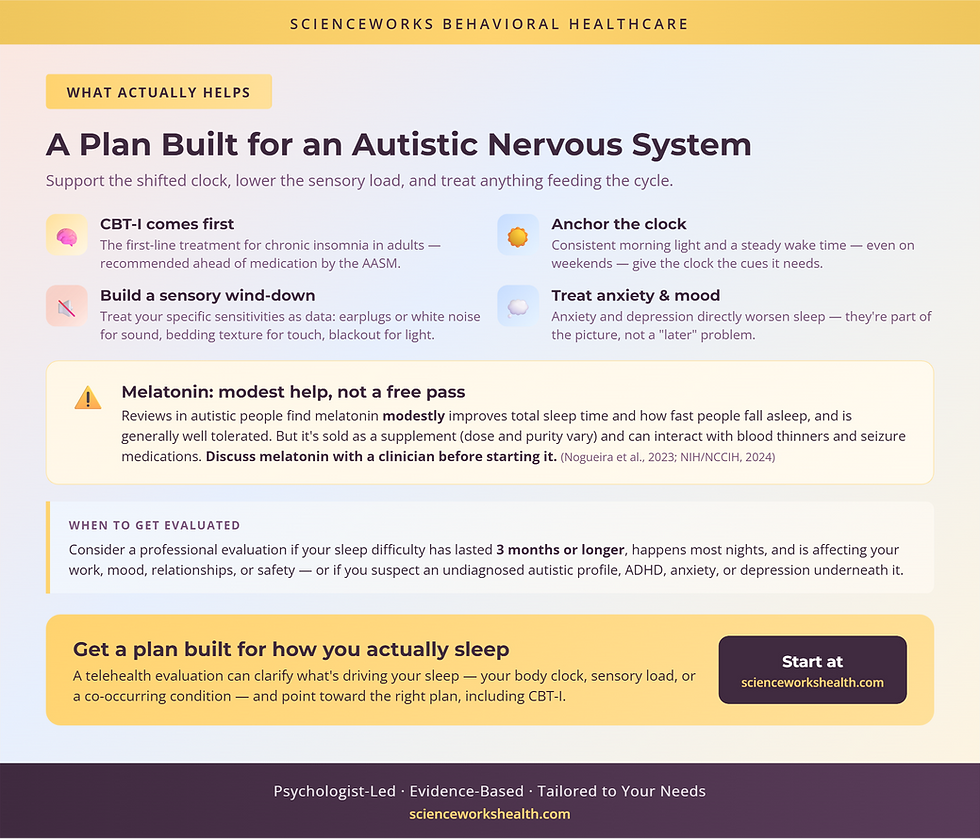
Because the mechanism is different, the help is too. The goal is to support the shifted clock, lower the sensory load, and treat anything feeding the cycle.
Evidence-based options
Behavioral therapy for insomnia comes first. Cognitive behavioral therapy for insomnia (CBT-I) is the first-line, evidence-based treatment for chronic insomnia in adults, recommended ahead of medication by the American Academy of Sleep Medicine [9]. Its core components — stimulus control, sleep restriction, and consolidating your time in bed — work on the clock and the sleep drive rather than just the symptoms. Early work adapting acceptance-based and behavioral insomnia therapy specifically for autistic adults is promising, though still at the pilot stage [10]. CBT-I works on the threshold question of whether your sleep meets criteria for chronic insomnia, and what treatment involves.
Anchor your body clock with light and timing. Because the autistic body clock tends to drift late, consistent morning light exposure and a steady wake time (even on weekends) are among the most powerful levers you have. You are not forcing an earlier bedtime by willpower; you are giving your clock the light and timing cues it needs to shift gradually.
Build a sensory wind-down, not just a screen-free one. A sensory-aware routine treats your specific sensitivities as data. If sound keeps you up, that might mean earplugs, a white-noise machine, or a fan to mask irregular noises. If touch matters, it might mean different bedding textures or a weighted blanket. If light is the trigger, blackout curtains and warm low lighting in the last hour. The point is to remove the specific inputs your nervous system flags, rather than following a one-size-fits-all checklist.
Treat the anxiety and mood that ride along. Anxiety and depression are common in autistic adults and directly worsen sleep [2]. If your mind races at night or low mood is dragging on your days, those are not separate problems to deal with "later" — they are part of the sleep picture. A brief, validated check like the GAD-7 for anxiety or the PHQ-9 for depression can help you and a clinician see what else may be keeping you awake. (These are screeners, not diagnoses — a starting point for a conversation.)
What to be cautious of
Melatonin can help, but it is not a free pass. Reviews in autistic people find that melatonin modestly improves total sleep time and how quickly people fall asleep, and that it is generally well tolerated [11]. That is genuinely useful. But two cautions matter. First, melatonin in the United States is sold as a dietary supplement, which means it is regulated less strictly than medication — independent testing has repeatedly found that the actual melatonin content can differ substantially from the label [5]. Second, it can interact with other medicines; people taking blood thinners or who have epilepsy, in particular, should only use melatonin under medical supervision [5]. Please discuss melatonin with a clinician before starting it — individual variation and drug interactions are real, and the right dose and timing for an autistic body clock are not always the dose on the bottle.
Skip sleeping pills as a first move, and skip naps as a fix. Sedatives do not address the underlying clock or sensory drivers and carry their own risks. And while an afternoon nap is tempting after a bad night, habitual napping is linked to worse sleep and more daytime dysfunction in autistic adults [2] — it tends to deepen the loop rather than break it.
🔆 Key takeaway: The strongest plan usually pairs CBT-I and a clock-anchoring light-and-timing routine with a sensory-aware wind-down — with melatonin, if used at all, treated as a clinician-guided add-on rather than the whole plan.
How this connects to ADHD sleep problems
If you are autistic and have ADHD — a common combination — your sleep picture may have two overlapping engines. ADHD carries its own pattern of delayed sleep timing and trouble winding down, and sleep disturbance is well documented across both conditions [12]. The mechanisms differ in flavor: autistic sleep difficulty leans heavily on sensory load and a shifted clock, while ADHD sleep difficulty often centers on a racing, hard-to-quiet mind and difficulty disengaging from stimulating activity. If both feel true for you, it is worth reading our companion guide on why adults with ADHD struggle to wind down, and considering an evaluation that looks at both together rather than one in isolation.
When to get evaluated
Consider a professional evaluation if your sleep difficulty has lasted three months or longer, happens most nights, and is affecting your work, mood, relationships, or safety (for example, drowsy driving). It is also worth getting evaluated if you suspect an undiagnosed autistic profile is sitting underneath the sleep problem, if anxiety or depression seem tangled up in it, or if you have already tried the standard fixes without lasting change.
If you are weighing an evaluation, here are questions worth asking any provider:
Scope: Will the evaluation look at my body clock and circadian timing, not just my sleep habits — and will it consider whether autism, ADHD, anxiety, or depression are contributing?
Methodology: How do you account for sensory sensitivity and an autistic nervous system when you assess sleep and recommend changes?
Developmental history: What history will you gather about my lifelong sleep patterns, especially if I do not have childhood records?
Output: What will I actually leave with — specific, sensory-aware recommendations and a treatment plan, or just a label?
Telehealth fit: Can this be done over telehealth, and is CBT-I available that way if it is the right next step?
A good evaluation resolves the question you came in with — why is my sleep like this, and what specifically will help — rather than handing you another generic checklist. Our specialized therapy services and structured mental health screening are built to start exactly there.
Next step — getting support
You have lived inside this pattern long enough to know the checklists do not fix it. The reason is not a lack of effort; it is that an autistic nervous system, on a shifted clock, carrying a heavier sensory load, needs a plan built for that — and those plans exist. The combination of clock-anchoring routines, sensory-aware wind-downs, CBT-I, and treating the anxiety or mood in the mix helps a great many autistic adults sleep meaningfully better.
Considering an autism evaluation?
An adult autism evaluation accounts for masking and lifelong compensation — not just the older, narrower picture — so the results reflect how autism actually shows up for you.
Frequently Asked Questions
Why do autistic adults struggle to fall and stay asleep?
Autistic adults often have a later, weaker melatonin signal and a body clock that runs on a delayed schedule, so the brain is not chemically ready for sleep at a conventional bedtime. Sensory sensitivity adds to this: sounds, light, and textures that others tune out can keep the nervous system on alert. The result is longer time to fall asleep, more night waking, and shorter sleep overall.
Does melatonin help autistic adults sleep, and is it safe?
Melatonin can modestly help with falling asleep faster and sleeping a bit longer, and reviews in autistic people report it is generally well tolerated. But melatonin is sold as a supplement, so dose and purity vary, and it can interact with blood thinners, seizure medications, and others. Please discuss melatonin with a clinician before starting it, rather than treating it as a routine over-the-counter fix.
How is autistic sleep difficulty different from ordinary insomnia?
Ordinary insomnia is usually trouble sleeping despite an otherwise typical body clock and sensory system. Autistic sleep difficulty more often involves a genuinely shifted circadian rhythm, a delayed melatonin signal, and sensory sensitivity that keeps the nervous system aroused. That distinction matters because the fix is not only better habits but also working with the shifted clock and reducing sensory load.
Can a telehealth evaluation help with sleep and the conditions behind it?
Yes. A telehealth evaluation can clarify whether a sleep problem is driven by a delayed body clock, sensory sensitivity, co-occurring anxiety or depression, or an undiagnosed autistic profile, then point toward the right plan. CBT-I, the first-line treatment for chronic insomnia, can be delivered well over telehealth, and the conditions feeding poor sleep can be assessed in the same process.
Is daytime exhaustion with nighttime alertness normal in autism?
Feeling exhausted all day but wired at night is a common pattern when the body clock is shifted later. Your peak alertness arrives in the evening, just as you are trying to wind down, while the morning hours your schedule demands fall during your biological night. This is a circadian-timing problem, not a willpower problem, and it often responds to light timing, a steadier schedule, and treating any anxiety in the mix.
About the Author
Dr. Kiesa Kelly is a licensed clinical psychologist and the founder of ScienceWorks Behavioral Healthcare, with more than 20 years of experience in psychological assessment and evidence-based treatment. Her background spans neurodevelopmental and adult psychological evaluation, including autism and ADHD assessment in adults, where masking and lifelong compensation are central to getting the picture right.
Dr. Kelly's clinical work emphasizes the overlap between neurodevelopmental profiles and the conditions that travel with them — sleep, anxiety, and mood — and translating assessment into concrete, usable plans rather than labels. She leads ScienceWorks's telehealth-forward practice serving adults and adolescents across Tennessee, where every article is reviewed by a licensed clinician for accuracy before publication.
References
1. Morgan B, Nageye F, Masi G, Cortese S. Sleep in adults with Autism Spectrum Disorder: a systematic review and meta-analysis of subjective and objective studies. Sleep Med. 2020;65:113-123. https://www.sciencedirect.com/science/article/abs/pii/S1389945719302576
2. Sullivan EC, Halstead EJ, Ellis JG, Dimitriou D. Anxiety, Insomnia, and Napping Predict Poorer Sleep Quality in an Autistic Adult Population. Int J Environ Res Public Health. 2021;18(18):9883. https://www.ncbi.nlm.nih.gov/pmc/articles/PMC8469045/
3. Carmassi C, Palagini L, Caruso D, et al. Systematic Review of Sleep Disturbances and Circadian Sleep Desynchronization in Autism Spectrum Disorder: Toward an Integrative Model of a Self-Reinforcing Loop. Front Psychiatry. 2019;10:366. https://www.ncbi.nlm.nih.gov/pmc/articles/PMC6581070/
4. Deserno MK, Borsboom D, Begeer S, Geurts HM. The Impact of Sleep Quality on Quality of Life for Autistic Adults. Res Autism Spectr Disord. 2021;88:101846. https://pmc.ncbi.nlm.nih.gov/articles/PMC8442542/
5. National Center for Complementary and Integrative Health (NIH). Melatonin: What You Need To Know. Updated May 2024. https://www.nccih.nih.gov/health/melatonin-what-you-need-to-know
6. Galli J, Loi E, Visconti LM, et al. Melatonin Rhythm and Its Relation to Sleep and Circadian Parameters in Children and Adolescents With Autism Spectrum Disorder. Front Neurol. 2022;13:813692. https://www.frontiersin.org/journals/neurology/articles/10.3389/fneur.2022.813692/full
7. Yang Z, Matsumoto A, Nakayama K, et al. Investigating the contributions of circadian pathway and insomnia risk genes to autism and sleep disturbances. Transl Psychiatry. 2022;12:481. https://www.nature.com/articles/s41398-022-02188-2
8. Hohn VD, de Veld DMJ, Mataw KJS, van Someren EJW, Begeer S. Insomnia Severity in Adults with Autism Spectrum Disorder is Associated with Sensory Hyper-Reactivity and Social Skill Impairment. J Autism Dev Disord. 2019;49(5):2146-2155. https://www.ncbi.nlm.nih.gov/pmc/articles/PMC6483941/
9. Edinger JD, Arnedt JT, Bertisch SM, et al. Behavioral and psychological treatments for chronic insomnia disorder in adults: an American Academy of Sleep Medicine clinical practice guideline. J Clin Sleep Med. 2021;17(2):255-262. https://jcsm.aasm.org/doi/10.5664/jcsm.8986
10. Pavlopoulou G, Burns C, Findlater A, et al. ACT-i, an insomnia intervention for autistic adults: a pilot study. Behav Cogn Psychother. 2023;51(2):146-160. https://pubmed.ncbi.nlm.nih.gov/36537291/
11. Nogueira HA, de Castro CT, da Silva DCG, Pereira M. Melatonin for sleep disorders in people with autism: Systematic review and meta-analysis. Prog Neuropsychopharmacol Biol Psychiatry. 2023;123:110695. https://pubmed.ncbi.nlm.nih.gov/36584862/
12. Wynchank D, Bijlenga D, Beekman AT, Kooij JJS, Penninx BW. Adult Attention-Deficit/Hyperactivity Disorder (ADHD) and Insomnia: an Update of the Literature. Curr Psychiatry Rep. 2017;19(12):98. https://www.ncbi.nlm.nih.gov/pmc/articles/PMC8534229/
13. Wong M, Robertson C, Loomes R, et al. Sleep and Autism: Current Research, Clinical Assessment, and Treatment Strategies. Curr Psychiatry Rep. 2024. https://pmc.ncbi.nlm.nih.gov/articles/PMC11046719/
14. Smith E, Sweeney L, Halstead EJ, et al. Experiences of and treatment preferences for insomnia in autistic adults: An Interpretative Phenomenological Analysis. Sleep Med. 2024;124:1-9. https://www.sciencedirect.com/science/article/pii/S1389945724003812
Disclaimer
This article is for informational and educational purposes only and is not a substitute for professional medical or psychological advice, diagnosis, or treatment. Reading it does not create a clinician-patient relationship. Do not start, stop, or change any medication or supplement — including melatonin — without consulting a qualified clinician who knows your situation. If you are in crisis or thinking about harming yourself, call or text 988 (the Suicide and Crisis Lifeline) or go to your nearest emergency department.