
Cognitive Changes After 50: Is It ADHD or Early Dementia?

Updated: Aug 27
Last reviewed: 06/03/2026
Reviewed by: Dr. Kiesa Kelly
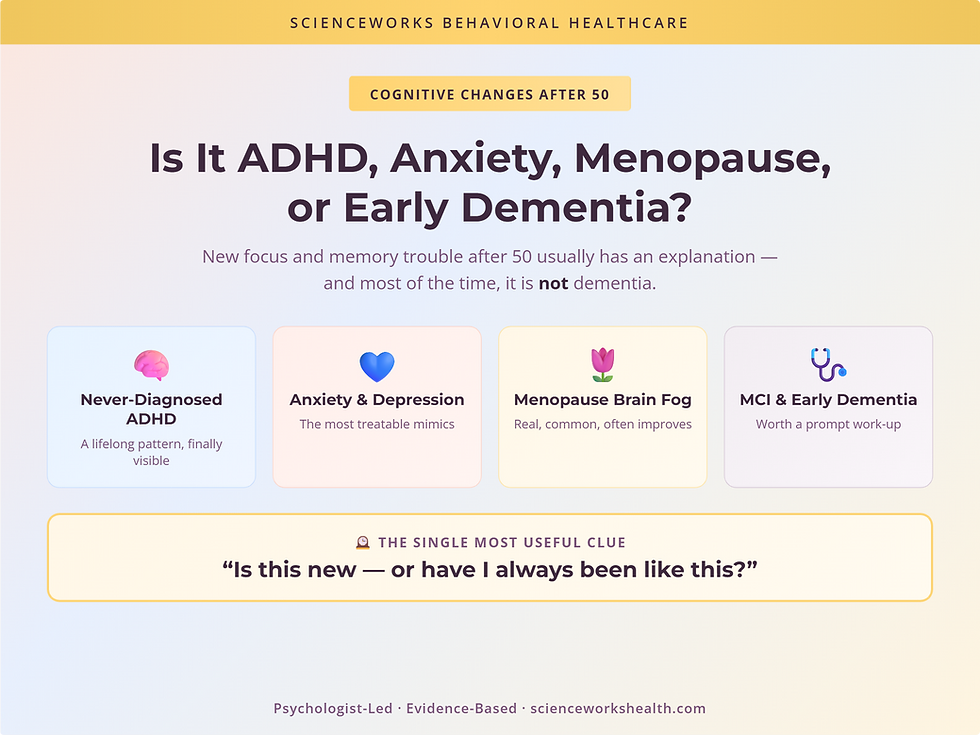
You misplace your keys, blank on a colleague's name, walk into a room and forget why, and lose the thread halfway through a sentence. After 50, moments like these can stop feeling like ordinary forgetfulness and start feeling like a warning. If a quiet voice has started asking whether this is the beginning of dementia, you are not overreacting, and you are also not alone. This is one of the most common worries we hear from adults in midlife.
Here is the reassuring part, and the honest one: new focus and memory trouble after 50 has several possible explanations, and most of them are not dementia. Some are entirely treatable. The single most useful clue is not any one symptom. It is the timeline of the change.
In this article, you'll learn:
Why the question "is this new, or have I always been like this?" matters more than any single symptom
How four common culprits — never-diagnosed ADHD, anxiety and depression, hormonal brain fog, and early dementia — actually differ
Other reversible causes worth ruling out, like sleep, medications, and thyroid problems
The red flags that mean you should seek a medical evaluation soon
What a cognitive or psychological evaluation can and cannot tell you
A quick but important note before we start. This article is educational. It is not a way to diagnose yourself, and it is not a substitute for a professional evaluation. Memory and thinking concerns after 50 deserve to be looked at by a qualified clinician — and as you will see, the right first step is often your physician. If you are weighing whether a structured evaluation is your next move, our overview of psychological assessments for adults explains what that process involves.
Short answer: the timeline is the key clue
When someone in midlife describes new trouble with focus and memory, the most important question we ask is simple: is this new, or have you always been like this?
That one question does a lot of work. Conditions that have been present your whole life, like ADHD, produce a long, consistent history — you can trace the scattered, disorganized, easily-distracted pattern back through your twenties, your school years, your childhood, even if no one ever gave it a name. A genuine decline is different. It is a change away from your own baseline, often over weeks or months, in someone who used to manage just fine.
That distinction is the spine of this whole article. A lifelong pattern points one direction. A true new change points another. And several of the most common causes of new midlife cognitive complaints — stress, low mood, poor sleep, hormonal shifts — sit in the treatable, reversible middle. The job of an evaluation is to sort out which of these is driving your experience, and you do not have to make that call alone.
Key takeaway: 🕰️ The timeline — lifelong and steady versus genuinely new and changing from your own baseline — is the most useful single clue, and it is the thread that runs through everything below.
The four common culprits — and how they differ
Most after-50 cognitive worries trace back to one of four sources, often in combination. Here is how they tend to show up, and where they part ways.

Lifelong ADHD that was never diagnosed
ADHD is a neurodevelopmental condition, which means it is present from childhood by definition — current diagnostic criteria require that several symptoms were present before age 12 [1]. It does not begin at 55. But it is very often recognized for the first time in midlife, especially in women whose ADHD was missed for decades and in people who were bright enough, or anxious enough, to compensate for years [2]. When the scaffolding that held things together — a structured job, a partner who tracked the calendar, sheer adrenaline — falls away, the underlying pattern becomes visible.
The mechanism here is not memory loss. It is inconsistent attention regulation and executive-function strain — the kind of executive-dysfunction pattern that makes starting and finishing hard long before anyone calls it a memory problem. In ADHD, the trouble looks like knowing exactly what you need to do and being unable to start until urgency forces it, losing the thread because three other thoughts arrived at once, or "forgetting" an appointment that was never really encoded because your attention was elsewhere when it was made.
Consider a worked example. You have always been the person with ten browser tabs open in your head. At work you do fine in fast meetings because the pressure keeps you switched on, but you miss follow-up emails, lose track of time, and cannot make yourself start the boring report until the night before it is due. Your desk has three half-finished projects, and you know precisely what each one needs — you just cannot sit down and do it. People describe you as capable but scattered, and you have spent years overfunctioning in bursts to cover for long stretches of inertia. Crucially, if you look back honestly, this has been true your whole adult life. It did not arrive last spring.
Or: you have always read the same paragraph three times before it sticks, always relied on lists and alarms, always felt that other people's brains came with a quieter background channel than yours. The volume has gone up in midlife as demands piled on and estrogen shifted, but the station has been broadcasting since childhood.
A misconception worth correcting directly here: if you were a high achiever, it cannot be ADHD. In reality, plenty of people with ADHD compensate successfully for years through intelligence, effort, and external structure; late recognition is common precisely because compensation eventually runs out [2]. A high-functioning history does not rule ADHD out. If the lifelong pattern sounds familiar, a self-report screener like the ASRS for adult ADHD can be a useful starting point — though a screener is a signal, never a diagnosis.
The distinguishing pattern: ADHD costs are lifelong and task-based — starting, sustaining, finishing, and tracking — with a history you can trace back for decades, not a change from a recent baseline.
Anxiety and depression — the most treatable mimics
This is the group we most want you to hold onto, because it is common, frequently missed, and highly treatable. Anxiety and depression are among the most powerful "mimics" of cognitive decline in midlife. Both can blunt concentration, slow processing, and disrupt the kind of focused attention that memory depends on — when you are anxious or depressed, information often never gets encoded well enough to recall later, so it feels like a memory problem when it is really an attention-and-encoding problem [3].
Depression in particular can produce what clinicians historically called "pseudodementia" — cognitive symptoms severe enough to look like dementia that lift substantially when the mood disorder is treated [4]. The mechanism differs from a true degenerative process: in depression, the thinking trouble tracks with mood, energy, and motivation, tends to come with low mood or loss of interest, and the person is usually distressed about and acutely aware of their lapses. In early dementia, by contrast, insight is often reduced — the people around you may worry more than you do.
A worked example. Over the past few months you have felt flat and tired. You read but nothing lands. You walk into the kitchen and forget the errand, lose your train of thought mid-conversation, and have started to wonder, with a cold drop in your stomach, whether your mind is slipping. But you are also sleeping poorly, dreading Mondays, and have stopped calling friends back. Here the cognitive symptoms are riding on top of a mood change — and treating the depression often clears much of the fog.
Or: a wave of health anxiety itself becomes the problem. You read an article about early dementia, start monitoring every normal lapse, and the hypervigilance and worry consume exactly the attentional bandwidth you need to remember things — which produces more lapses, which fuels more worry. Anxiety does not just coexist with the forgetfulness; it manufactures some of it.
Because these are so treatable, they are worth screening for early. Brief, validated tools like the PHQ-9 for depression and the GAD-7 for anxiety help clarify whether mood or worry is part of the picture. The distinguishing pattern: anxiety and depression costs are mood-linked and often reversible — the thinking trouble rises and falls with how you feel, and frequently lifts when the underlying condition is treated.
Perimenopause, menopause, and hormonal brain fog
Brain fog during perimenopause and menopause is real, common, and frequently dismissed. Many people moving through this transition report word-finding lapses, slower processing, and trouble with focus and memory, and research connects these changes to fluctuating and declining estrogen, which influences brain regions involved in memory and attention [5][6]. You are not imagining it, and it is not a character flaw.
What is reassuring is the trajectory. For most people, menopause-related cognitive changes are mild and tend to stabilize rather than steadily worsen; some functions recover after the transition [6]. This is mechanistically different from a neurodegenerative process, which by definition progresses. The fog tends to fluctuate with sleep, hot flashes, stress, and mood — all of which the hormonal transition also disrupts, which is part of why the cognitive effects can feel so pronounced. For people who are also neurodivergent, the hormonal shift can amplify other changes too, including sensory overload during perimenopause.
A worked example. You are 51, your periods have become unpredictable, and you are not sleeping through the night. During the day you grope for words you have known forever, lose your place in a sentence, and feel half a step behind in meetings where you used to be sharp. It is worst on the nights you barely slept and the days a hot flash derails you. Over the year, it has not marched steadily downhill — it ebbs and flows. That fluctuating, sleep-and-symptom-linked pattern is far more consistent with the menopausal transition than with a degenerative one.
A misconception to correct: menopause brain fog means my brain is permanently declining. For most people it does not; the changes are usually mild and often improve [6]. That said, because the symptoms overlap with other causes, hormonal brain fog is worth discussing with a clinician rather than self-diagnosing — particularly if it is clearly worsening rather than fluctuating. The distinguishing pattern: hormonal cognitive change is fluctuating and transition-linked — it tracks with sleep, hot flashes, and hormonal shifts, and tends to stabilize rather than progress.
Mild cognitive impairment and early dementia
This is the possibility that brings most people to the question in the first place, so let us be both honest and careful about it.
Mild cognitive impairment (MCI) describes a genuine, measurable decline in memory or thinking that is greater than expected for someone's age but not severe enough to interfere significantly with everyday independence [7]. Dementia involves a more substantial decline that does interfere with daily life. The crucial feature of both — and the through-line of this article — is that they represent a change from the person's own previous baseline, typically progressing over time. This is the opposite of a lifelong, stable pattern.
What pushes the picture toward a degenerative cause, rather than a mimic, tends to be a combination of features: forgetting recent conversations or events, not just names and where you put things; repeating yourself without realizing it; getting lost in familiar places; trouble performing tasks you have done competently for years; word-finding or naming difficulty that goes beyond the occasional tip-of-the-tongue moment; changes in judgment, personality, or behavior; and — importantly — other people noticing the change, sometimes before you do [7][8].
We are deliberately not turning that into a self-scoring checklist, and here is why it would be harmful to. A worried person can read symptoms into normal lapses and spiral, or, just as dangerously, can talk themselves out of a real change that deserves prompt attention. Distinguishing normal age-related forgetfulness from MCI from early dementia requires clinical judgment, structured testing, and a medical work-up to rule out reversible causes — it is genuinely not something to do alone at your kitchen table.
A misconception to correct plainly: memory problems after 50 mean dementia. Most do not. Many causes are treatable or reversible, and even MCI does not inevitably progress to dementia — some people remain stable and some improve once a reversible contributor is addressed [7]. The right response to this possibility is not panic and not dismissal. It is evaluation. The distinguishing pattern: MCI and early dementia are new, progressive, and baseline-changing — a genuine decline from how you used to be, often noticed by others, that tends to worsen over time rather than fluctuate or hold steady.
The single most useful question: "is this new, or have I always been like this?"
If you take one thing from this article, take this question — because it is the practical engine behind everything above.
Lay your history honestly against it. If the scattered, distractible, disorganized pattern has been with you since school and your twenties and thirties, and midlife has simply turned the volume up, that points strongly toward a long-standing condition like ADHD that compensation finally stopped covering. If, instead, you can identify a real shift away from how your mind used to work — a new difficulty in someone who used to manage easily, especially one that is progressing — that is the pattern that warrants a prompt medical evaluation rather than reassurance.
Here is a decision heuristic you can apply before you leave this page:
Lifelong and steady → more consistent with never-diagnosed ADHD or a stable trait. Worth a thorough assessment, but not an urgent medical alarm.
New, fluctuating, and tied to mood, sleep, or hormones → more consistent with a treatable mimic (anxiety, depression, menopause, sleep loss). Highly worth addressing, often very responsive to treatment.
New, progressive, and changing your baseline — especially if others notice → see a physician promptly to begin a proper work-up. This is the pattern that should move quickly.
If two of these feel true at once — say, lifelong ADHD and a newer change — do not talk yourself out of that. Co-occurrence is common, and the most honest next step is an evaluation that can hold both possibilities at the same time.
Key takeaway: 🧭 "Is this new, or have I always been like this?" is the question that turns a vague fear into an actionable direction — and it is the question a good evaluation is built to answer.
Other reversible causes worth ruling out
Before anyone concludes a cognitive change is degenerative, a careful clinician rules out the unglamorous, common, and often reversible contributors. These are easy to overlook and frequently the whole story.
Sleep. Chronic poor sleep and untreated sleep disorders, including sleep apnea, impair attention, memory consolidation, and processing speed — and insomnia becomes more common in midlife. Cognitive symptoms driven by sleep loss can mimic far more serious problems and often improve substantially when sleep is treated [9]. If sleep is part of your picture, our overview of insomnia and sleep evaluation explains the options.
Medications. A number of commonly prescribed medications — certain sleep aids, some antihistamines, anticholinergic drugs, and others — can blunt cognition, and the risk rises with age and with the number of medications taken [10]. A medication and supplement review with your prescriber or pharmacist is one of the highest-yield, lowest-risk steps available.
Thyroid and other medical causes. An underactive thyroid, vitamin B12 deficiency, and other medical conditions can produce cognitive symptoms that resolve with treatment — which is exactly why a medical work-up, often including bloodwork, is a standard part of evaluating new cognitive complaints [8].
Stress and overload. Sustained stress and a genuinely overloaded life shrink the attentional bandwidth that memory depends on. This is not "all in your head" in any dismissive sense; it is a real, physiological drain on the systems you use to focus and remember.
The reason this section matters is harm avoidance in both directions: missing a reversible cause means someone suffers needlessly, and assuming dementia when the real culprit is a medication or untreated apnea causes unnecessary fear.
Key takeaway: 🔍 Sleep, medications, thyroid, and stress are common, reversible drivers of midlife cognitive complaints — and ruling them out is a routine, important part of any responsible evaluation.
When to seek evaluation now: the red flags that change the urgency
Most causes on this page are not emergencies, and most are better helped by a thoughtful evaluation than by panic. But some patterns mean you should move sooner rather than later. Think of these as reasons to make an appointment soon, not as a test to grade yourself on.

Seek a timely medical evaluation if you notice:
Getting lost in familiar places, or confusion about where you are or how you got there
Trouble with familiar tasks you have done competently for years — managing money, following a recipe, operating a device you know well
Word-finding or naming decline that goes well beyond the occasional tip-of-the-tongue moment, or trouble following and joining conversations
Personality, mood, or behavior changes, including new apathy, suspiciousness, or uncharacteristic judgment lapses
A clear, progressive worsening over weeks to months, rather than a stable lifelong pattern or a fluctuating one
Other people noticing before you do, or becoming worried about your memory or thinking [7][8]
If any of these fit, the right move is to start with your physician. They can begin the medical work-up — reviewing medications, checking for thyroid, B12, and other reversible causes, and deciding whether bloodwork, brain imaging, or a referral for detailed cognitive testing is warranted. None of this is something to attempt to sort out alone, and acting promptly keeps every door open, including the treatable ones.
Key takeaway: 🚦 These red flags are about urgency, not self-diagnosis — they mean "see a doctor soon," and starting with your physician is almost always the right first step.
What a cognitive or psychological evaluation can — and can't — tell you
It helps to know what an evaluation actually delivers, so your expectations match reality.
A psychological or neuropsychological evaluation measures memory, attention, language, processing speed, and executive function in structured detail. It can describe the pattern and severity of any changes, compare your performance to what is expected for your age and background, help distinguish lifelong patterns like ADHD from a newer decline, and clarify how much mood, anxiety, or sleep may be contributing. That pattern is genuinely useful — it turns "something feels off" into specific, actionable information.
Here is the scope we want to be transparent about. A psychological evaluation on its own does not diagnose dementia or pinpoint its medical cause. Diagnosing MCI or dementia also requires a medical work-up to rule out reversible causes and, when appropriate, imaging or other tests — work that lives with your physician or a neurologist [8]. As a psychology practice, we provide the detailed cognitive and psychological assessment piece, and we coordinate with or refer to medical providers when a medical cause needs to be ruled out. A complete picture usually takes both. Our adult ADHD and related assessments are one part of that puzzle when a lifelong attention pattern is in question.
If you are considering an evaluation, here are concrete questions you can ask any provider before you book:
Scope: Does the evaluation assess the full picture — attention, memory, mood, and lifelong patterns — or only one of these?
Methodology: How does the evaluation tell a lifelong pattern like ADHD apart from a new decline, and how does it account for the way I have compensated over the years?
Developmental history: What childhood or earlier-life history do you gather, and what happens if I do not have old records?
Medical coordination: If a medical cause like thyroid, B12, medication effects, or early dementia needs ruling out, do you coordinate with my physician or refer me, or do I need to arrange that separately?
Output: When it is finished, what do I actually receive — a clear explanation of the pattern and specific, usable recommendations, not just a label?
Asking these protects you and helps you find the right fit. They also reflect what competent assessment of midlife cognitive change should involve.
Next step — get clarity with an evaluation
If you have read this far, you are probably holding two things at once: a real worry, and a real wish to stop guessing. Both are reasonable. The honest summary is that new focus and memory trouble after 50 usually has an explanation that is not early dementia — and even when a degenerative cause needs ruling out, the path forward is the same. You do not diagnose this from a blog post or a checklist. You bring it to a professional, often starting with your physician for the medical piece, and let a structured evaluation turn the fear into a clear direction.
Perimenopause changing how your brain works?
When perimenopause meets ADHD or autism, the overlap is real — an evaluation that holds the hormonal and neurodivergent pieces together can make sense of what's shifting.
Frequently Asked Questions
Is forgetfulness after 50 always a sign of dementia?
No. Most cognitive complaints after 50 are not dementia. New focus and memory trouble after 50 has several common explanations, including never-diagnosed ADHD, anxiety, depression, poor sleep, thyroid problems, medication effects, and hormonal changes in perimenopause and menopause. Many of these are treatable or reversible. The pattern that warrants prompt medical evaluation is a genuine, progressive change from your own previous baseline, especially when other people notice it.
How do I know if it's lifelong ADHD or a new cognitive decline?
The most useful question is whether this is new or lifelong. ADHD is a neurodevelopmental condition present since childhood, so the pattern of distraction, disorganization, and trouble finishing tasks would have been there for decades, even if it was never named. A genuinely new decline from your own baseline, such as forgetting recent conversations or getting lost in familiar places, is different and should be evaluated by a clinician promptly. A professional evaluation can sort this out; this article cannot diagnose you.
Can menopause cause brain fog that feels like memory loss?
Yes. Many people in perimenopause and menopause report brain fog, word-finding lapses, and slower processing, and research links this to hormonal changes affecting memory and attention. For most people these changes are mild and tend to stabilize over time rather than steadily worsening. Because the symptoms can overlap with other causes, it is worth discussing them with a clinician rather than assuming the cause, especially if they are getting worse.
What cognitive symptoms after 50 mean I should see a doctor soon?
See a doctor promptly if you get lost in familiar places, struggle with tasks you have done for years, have word-finding or naming trouble beyond an occasional tip-of-the-tongue moment, show personality or judgment changes, decline noticeably over weeks to months, or if people close to you notice the change before you do. These are reasons for a timely medical evaluation, not a checklist to diagnose yourself. Start with your physician, who can screen for reversible medical causes.
Does a psychological evaluation diagnose dementia?
A psychological or neuropsychological evaluation measures memory, attention, language, and other thinking skills in detail and can describe the pattern and severity of any changes. On its own it does not diagnose dementia. Diagnosing dementia or mild cognitive impairment also requires a medical work-up to rule out reversible causes, often including bloodwork and sometimes brain imaging. We coordinate with your physician or a neurologist when a medical cause needs to be ruled out.
About the Author
Dr. Kelly's background centers on psychological assessment across the lifespan, with particular depth in attention, executive function, and differential diagnosis — the exact territory where a lifelong pattern has to be told apart from a new change. Her clinical training spans more than two decades of work with adults and adolescents, and her assessment practice focuses on building a clear, individualized picture rather than handing someone a label.
Dr. Kelly is a licensed clinical psychologist (PhD), not a physician. For concerns that may involve a medical cause — including the work-up for mild cognitive impairment or dementia — she coordinates with and refers to medical providers, so that cognitive and medical evaluation work together. Every article on this site is reviewed by a licensed clinician for accuracy before publication.
References
1. American Psychiatric Association. Diagnostic and Statistical Manual of Mental Disorders, Fifth Edition, Text Revision (DSM-5-TR) — Attention-Deficit/Hyperactivity Disorder. https://doi.org/10.1176/appi.books.9780890425787
2. Faraone SV, Banaschewski T, Coghill D, et al. The World Federation of ADHD International Consensus Statement: 208 Evidence-based conclusions about the disorder. Neuroscience & Biobehavioral Reviews. 2021;128:789-818. https://doi.org/10.1016/j.neubiorev.2021.01.022
3. Rock PL, Roiser JP, Riedel WJ, Blackwell AD. Cognitive impairment in depression: a systematic review and meta-analysis. Psychological Medicine. 2014;44(10):2029-2040. https://doi.org/10.1017/S0033291713002535
4. Brodaty H, Connors MH. Pseudodementia, pseudo-pseudodementia, and pseudodepression. Alzheimer's & Dementia: Diagnosis, Assessment & Disease Monitoring. 2020;12(1):e12027. https://doi.org/10.1002/dad2.12027
5. Maki PM, Jaff NG. Brain fog in menopause: a health-care professional's guide for decision-making and counseling on cognition. Climacteric. 2022;25(6):570-578. https://doi.org/10.1080/13697137.2022.2122792
6. Greendale GA, Karlamangla AS, Maki PM. The menopause transition and cognition. JAMA. 2020;323(15):1495-1496. https://doi.org/10.1001/jama.2020.1757
7. Petersen RC, Lopez O, Armstrong MJ, et al. Practice guideline update summary: Mild cognitive impairment — Report of the Guideline Development, Dissemination, and Implementation Subcommittee of the American Academy of Neurology. Neurology. 2018;90(3):126-135. https://doi.org/10.1212/WNL.0000000000004826
8. National Institute on Aging. Assessing cognitive impairment in older patients. https://www.nia.nih.gov/health/talking-older-patients-about-cognitive-problems/assessing-cognitive-impairment-older-patients
9. National Institute on Aging. A good night's sleep. https://www.nia.nih.gov/health/sleep/good-nights-sleep
10. Alzheimer's Association. 10 Early Signs and Symptoms of Alzheimer's and Dementia. https://www.alz.org/alzheimers-dementia/10_signs
Disclaimer
This article is for informational and educational purposes only. It is not medical advice, a diagnosis, or a substitute for evaluation by a qualified professional. Memory and cognitive concerns after 50 should be assessed by a licensed clinician, and concerns that may have a medical cause should be discussed with your physician. ScienceWorks Behavioral Healthcare provides psychological and cognitive evaluation; we coordinate with or refer to medical providers when a medical work-up is needed. If you are experiencing a medical emergency, call 911 or go to your nearest emergency room.