
Executive Function Coach vs Therapist: Which Do You Need?

Updated: 20 hours ago
Last reviewed: 03/28/2026
Reviewed by: Dr. Kiesa Kelly
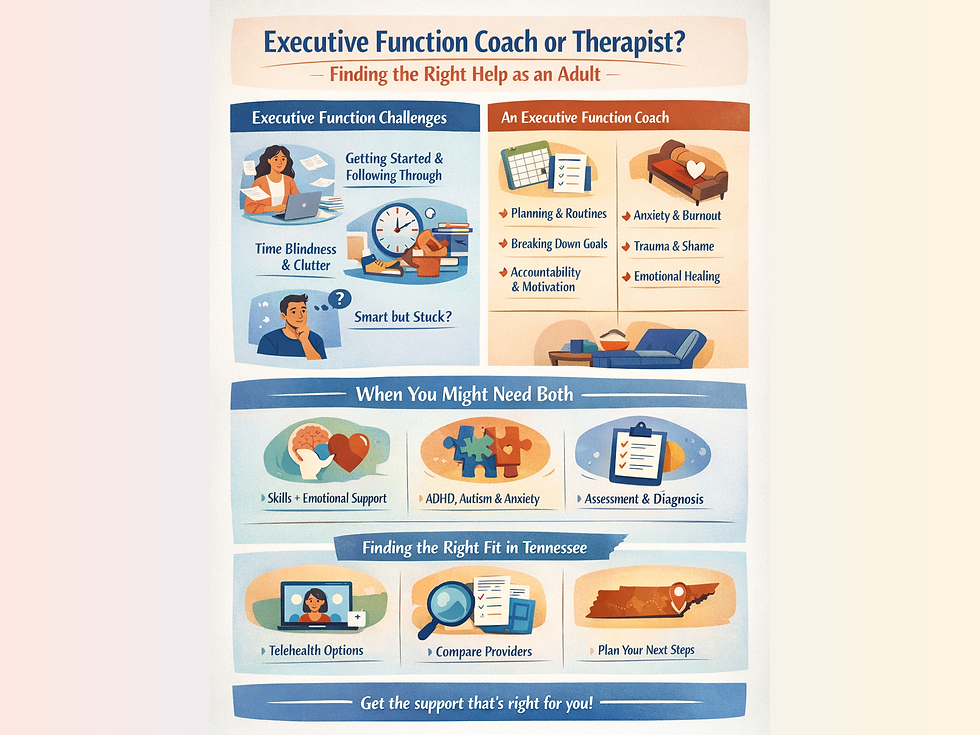
If you are trying to decide between an executive function coach and a therapist, the most useful question is not which title sounds better. It is which kind of help matches the problem you are actually living with. Some adults mostly need structure and accountability. Others need treatment for anxiety, shame, trauma, depression, burnout, or shutdown around tasks. Many need both, and sometimes the first step is assessment.[1-3]
In this article, you’ll learn:
what executive function struggles can look like in adult life
what coaching is usually best at
what therapy is usually best at
when assessment matters more than either one
how to think through next steps in Tennessee without getting overwhelmed
🧭 Key takeaway: The right fit depends on whether you need implementation, clinical treatment, diagnostic clarity, or a combination.
What Executive Function Struggles Can Look Like in Adult Life
Starting tasks, prioritizing, and following through
Executive function problems often sound like, “I know what to do, but I still cannot start.” Adults with ADHD commonly describe procrastination, poor planning, forgetting daily tasks, and trouble finishing projects.[1] In real life, that may mean avoiding one email until it becomes five, or staring at the dishes all evening without starting.
If you want a structured first look, an adult ADHD screener can help you notice whether attention and follow-through patterns are part of the picture, but it cannot diagnose ADHD by itself.[1,3]
Time blindness, clutter, and overwhelm
Many adults experience the problem as time slipping, clutter growing, and every task somehow turning into ten tasks. A calendar may exist but not feel real, and a to-do list may still not tell you what matters first.[1]
A tool like the Executive Skills Questionnaire can help you sort out whether the bigger issue is initiation, working memory, flexibility, self-monitoring, or time management.
Why smart, capable adults often feel confused by the gap
One of the hardest parts is the gap between what you know and what you can do consistently. Smart, caring, high-achieving adults often compensate with perfectionism, overwork, or last-minute adrenaline until the system becomes unsustainable. That gap is often treated like a character issue when it is really a support mismatch.[1,3]
🧠 Key takeaway: Struggling with follow-through does not mean you are lazy. It often means your current supports are not built for how your brain works.
What an Executive Function Coach Typically Helps With
Planning systems, routines, and accountability
CHADD describes ADHD coaching as a practical intervention that targets planning, time management, goal setting, organization, and problem solving.[2] In practice, an executive functioning coach helps you build systems you can actually use.
In our executive function coaching for adults, we focus on routines, reminders, accountability, and strategies that fit your actual circumstances.[7]
Breaking goals into doable steps
Coaching is especially useful when your goals are too big to act on as written. “Get organized” is vague. “Open the mail for ten minutes, sort only bills, and stop” is doable. “Fix mornings” becomes “set out medication, keys, and lunch the night before.”
That kind of scaffolding helps when you mostly need structure rather than psychotherapy.[2,7]
When coaching is a good fit
Coaching is often a good fit when you already have a decent sense of what is happening and mostly need help doing what you already know you want to do. A common misconception is that coaching is “less serious” support. It is not. It is simply a different role. Another misconception is that coaching can diagnose or treat mental health conditions. That usually falls outside coaching’s job.[2,3]
🛠️ Key takeaway: Coaching is strongest when the main barrier is execution. If you mostly need systems, habits, and accountability, it may be the right lane.
What a Therapist Typically Helps With
Anxiety, shame, burnout, and emotional regulation
Therapy becomes more important when the problem is not only disorganization, but also dread, panic, self-criticism, or emotional overload. CBT-based interventions can improve both core ADHD symptoms and associated emotional symptoms in adults with ADHD.[4-5]
If unfinished tasks quickly turn into shame spirals or shutdown, an executive function therapist may be a better fit than coaching alone.[4-5,9]
Patterns rooted in trauma, perfectionism, or chronic stress
Sometimes what looks like ADHD is ADHD. Sometimes it is anxiety, depression, trauma, sleep disruption, burnout, or several of those together. Good care has to consider symptom history, overlap, and differential diagnosis rather than assuming procrastination always means ADHD.[3,5]
When executive function issues are affecting mental health
Therapy is often the better first step when executive dysfunction is shrinking your world: conflict at home, dread around work, repeated shutdown, or hopelessness. If you are not sure what is driving the pattern, a formal psychological assessment can help sort through overlapping possibilities and create a clearer roadmap.[3,8]
💛 Key takeaway: When executive dysfunction is tangled up with fear, trauma, depression, or severe overwhelm, therapy is often the central treatment, not an optional extra.
When You May Need Both
Skills support plus deeper emotional work
Many adults do best with both. Therapy can help with anxiety, shame, OCD, trauma, depression, or burnout. Coaching can then help you turn insight into routines and follow-through.[2,4,7,9]
ADHD, autism, anxiety, and overlap
Overlap is common. ADHD frequently co-occurs with anxiety, and autism and ADHD also commonly occur together.[5-6]
Why support does not have to be one-size-fits-all
Needing both does not mean you are “too complicated.” It usually means your difficulties have both a practical side and an emotional side. Another misconception is that choosing therapy means you “failed” at coaching, or choosing coaching means your distress is not real. Neither is true.
🔄 Key takeaway: Skills support and emotional treatment often work best together when both are part of the problem.
Questions to Ask Before Choosing Support
Do you need strategy, diagnosis, treatment, or all three?
Before you book with anyone, ask yourself what you want most from the next step: tools for this week, diagnostic clarity, treatment, or some combination.
Someone searching for executive function coaching Tennessee support may actually need therapy first. Someone looking for an ADHD therapist Tennessee provider may actually need assessment before treatment.[3,8]
Is the provider neurodiversity-affirming?
A good fit is not only about credentials. You also want someone who understands that support should reduce shame, not increase it.
Do they understand adult ADHD, autism, and burnout?
Ask how they think about overlap and what they do when symptoms could reflect ADHD, autism, anxiety, trauma, sleep issues, or chronic stress.
Red Flags That Coaching Alone May Not Be Enough
You shut down when tasks feel loaded or threatening
If the issue is not simply “I forget,” but “I panic, freeze, or avoid,” coaching alone may not be enough. When a task feels dangerous to your nervous system, treatment often needs to address the emotional meaning of the task, not only the task itself.[4-5]
Shame, panic, or depression keeps interfering
If every missed deadline turns into self-attack, dread, or exhaustion, therapy deserves serious consideration. Coaching can support change, but it is not a substitute for clinical care when mental health symptoms are driving the impairment.[3-5]
You need assessment or clinical treatment, not just accountability
Coaching is not designed to provide diagnosis, formal treatment, or documentation. If you need accommodations, diagnostic clarity, medication discussions with a prescriber, or a careful differential diagnosis, start by looking at assessment and therapy first.[3,8]
📍 Key takeaway: When the problem carries panic, depression, trauma, or diagnostic uncertainty, accountability alone usually is not the full answer.
Finding the Right Fit in Tennessee
Telehealth options for therapy and support
If you live in Tennessee, telehealth can make this easier. Our therapy services are available by telehealth in Tennessee, and our coaching services are also available remotely.[7,9-10]
How to compare providers without getting overwhelmed
Do not compare ten providers at once. Narrow the decision to three questions: Do they understand the problem, explain their role clearly, and offer logistics that fit your life?
You can keep it simple by reviewing one team page and one service page before deciding whether to reach out.
What next steps can look like
If you mostly need implementation, an executive function coach may be the most helpful starting point. If you are carrying shame, panic, trauma, or burnout, therapy may be the better first move. If you are genuinely unsure what explains the pattern, assessment may save you time and second-guessing.
If you want help sorting that out, you can reach out for a free consultation and start with the question you actually have: “Do I need strategy, diagnosis, treatment, or some combination?” That is often the clearest place to begin.[8-10]
Frequently Asked Questions
Can an executive function coach help adults with ADHD, or do I need a therapist?
It depends on what you're trying to address. An executive function coach works on skill-building — time management, planning, organization, task initiation — using structured, goal-directed sessions. A therapist addresses the emotional and psychological patterns underneath those challenges, including rejection-sensitive dysphoria, shame, anxiety, or trauma. Many adults with ADHD benefit most from both: coaching to build practical systems and therapy to address what makes those systems hard to use consistently.
What does an executive function coach actually do in sessions?
An executive function coach typically works with you to identify your specific executive function challenges — whether that's task initiation, working memory, emotional regulation, or time blindness — and then builds practical strategies tailored to how your brain works. Sessions often involve reviewing what worked and what didn't from the previous week, troubleshooting specific situations, and practicing new approaches. Unlike therapy, coaching does not address trauma, mental health diagnoses, or the deeper emotional roots of behavior.
Is executive function coaching covered by insurance?
In most cases, no. Executive function coaching is not a licensed clinical service and is generally not billable to health insurance in the way that therapy is. Some employers offer it through professional development or employee assistance programs, and some clients use HSA/FSA funds depending on how their plan defines eligible expenses. Costs vary widely depending on the coach's credentials and format (individual vs. group). This is different from therapy, which can be billed under mental health benefits when provided by a licensed clinician.
How do I know if I need executive function coaching, therapy, or both?
A useful starting point is asking: are the obstacles primarily skill-based (I don't know how to organize my time effectively) or emotional and psychological (I know what I should do but anxiety, shame, or trauma patterns get in the way)? If it's mostly the former, coaching is a good fit. If the emotional layer is significant — if you're experiencing anxiety, depression, trauma responses, or significant relationship distress alongside the executive function challenges — therapy should be part of the picture. Many adults find a combination most effective.
About ScienceWorks
Dr. Kiesa Kelly is a clinical psychologist and owner of ScienceWorks Behavioral Healthcare. Her background includes a PhD in Clinical Psychology with a concentration in Neuropsychology from Rosalind Franklin University of Medicine and Science, along with clinical training at the University of Chicago, the University of Wisconsin, the University of Florida, and Vanderbilt University.[11]
Her work includes psychological assessment and therapy for adults navigating ADHD, autism, OCD, trauma, and related concerns. She provides telehealth services in Tennessee and other participating states.[11]
References
National Institute of Mental Health. ADHD in Adults: 4 Things to Know. Available from: https://www.nimh.nih.gov/health/publications/adhd-what-you-need-to-know
Children and Adults with Attention-Deficit/Hyperactivity Disorder. Coaching. Available from: https://chadd.org/about-adhd/coaching/
National Institute for Health and Care Excellence. Attention deficit hyperactivity disorder: diagnosis and management (NG87). Available from: https://www.nice.org.uk/guidance/ng87
Liu CI, Hua MH, Lu ML, Goh KK. Effectiveness of cognitive behavioural-based interventions for adults with attention-deficit/hyperactivity disorder extends beyond core symptoms: a meta-analysis of randomized controlled trials. Psychol Psychother. 2023;96(3):543-559. Available from: https://doi.org/10.1111/papt.12455
Quenneville AF, Kalogeropoulou E, Nicastro R, Weibel S, Chanut F, Perroud N. Anxiety disorders in adult ADHD: A frequent comorbidity and a risk factor for externalizing problems. Psychiatry Res. 2022;310:114423. Available from: https://doi.org/10.1016/j.psychres.2022.114423
Hours C, Recasens C, Baleyte JM. ASD and ADHD Comorbidity: What Are We Talking About? Front Psychiatry. 2022;13:837424. Available from: https://doi.org/10.3389/fpsyt.2022.837424
ScienceWorks Behavioral Healthcare. Executive function coaching. Available from: https://www.scienceworkshealth.com/executive-function-coaching
ScienceWorks Behavioral Healthcare. Psychological assessments. Available from: https://www.scienceworkshealth.com/psychological-assessments
ScienceWorks Behavioral Healthcare. Specialized therapy. Available from: https://www.scienceworkshealth.com/specialized-therapy
ScienceWorks Behavioral Healthcare. Contact. Available from: https://www.scienceworkshealth.com/contact
ScienceWorks Behavioral Healthcare. Dr. Kiesa Kelly. Available from: [https://www.science
Disclaimer: This article is for educational purposes only and is not a substitute for medical, psychological, or mental health advice, diagnosis, or treatment. Reading this content does not create a therapist-client or coaching relationship. If you are in distress or need clinical support, contact a licensed mental health professional or call 911 in an emergency.