
Adult ADHD Testing Cost: Price Ranges & What Drives It

Updated: Oct 12
Last reviewed: 10/12/2026
Reviewed by: Dr. Kiesa Kelly
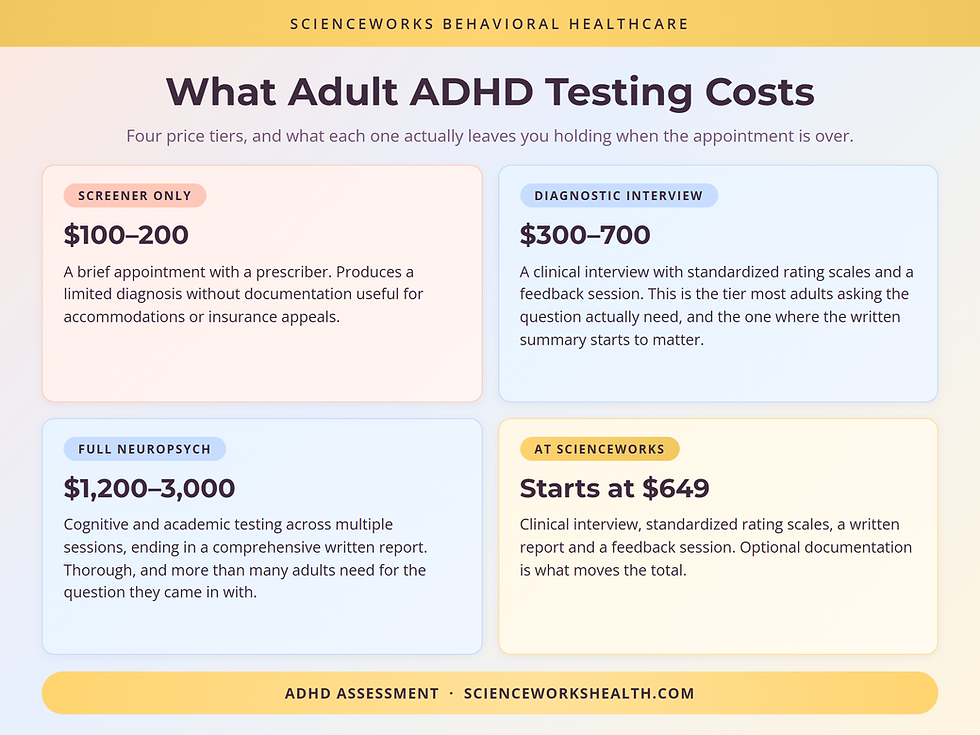
If you are searching “how much does ADHD testing cost,” you are usually trying to solve two problems at once: what you will pay, and whether what you get will actually be useful. For adults, the price can range from a quick screening fee to a fuller diagnostic assessment with interviews, rating scales, feedback, and written documentation. In our assessment process, adult ADHD evaluation starts at $1,099, and the total goes up only when you add optional documentation such as a diagnostic letter, a full report, or accommodation paperwork.[1]
In this article, you’ll learn:
why adult ADHD assessment cost varies so much
what may or may not be included in the fee
which questions help you compare providers fairly
when a lower-cost screener can be enough
when a full diagnostic assessment is worth the extra expense
💡 Key takeaway: The number on the website matters, but what that number buys you matters more. A lower price is not always cheaper in the long run if you still need a second evaluation later.
How Much Does ADHD Testing Cost? Why the Answer Varies So Much
The biggest reason prices vary is that “ADHD testing” can mean very different things. Sometimes people use it to mean a brief questionnaire or a first-pass screen. Other times they mean a formal diagnostic assessment that reviews your history, current functioning, impairment, and overlap with other conditions.[2-5]
A quick adult ADHD screener can be useful when you are trying to decide whether ADHD is worth exploring at all. But best-practice guidance does not treat a rating scale as a stand-alone diagnosis. Adult evaluation usually requires a broader clinical history, functional assessment, and consideration of other explanations.[2-5]
Screening vs full diagnostic assessment
A screener is usually brief, inexpensive, and easy to complete. Its job is to flag a pattern that may deserve more attention. That is helpful, but limited. A positive screen does not prove ADHD, and a negative one does not always rule it out.[3,5]
A full assessment asks harder and more useful questions. Did the pattern begin in childhood? Does it show up across more than one setting? How much is it affecting work, school, relationships, daily living, or self-esteem? Could sleep problems, anxiety, trauma, depression, substance use, or another neurodevelopmental condition explain the same symptoms better?[2-4]
That extra work takes time and training. It also tends to be the difference between “this sounds possible” and “this is the best-supported clinical explanation.” On our psychological assessments page, we break the process into steps rather than charging one large upfront fee, which helps make the scope clearer before you commit.[1]
Adult vs child evaluations
Adult assessments and child evaluations can overlap, but they are not identical. For children, teachers, caregivers, and school observations often provide a large part of the picture. For adults, the clinician usually has to reconstruct developmental history, understand current responsibilities, and evaluate how symptoms show up in work, higher education, home life, and relationships.[3,4]
Adult assessment can also be more complex because many adults have developed coping strategies that hide the problem on the surface. You may look capable from the outside while spending enormous effort to stay afloat. That can make the interview, records review, and differential diagnosis more important, not less.[3,4]
🧩 Key takeaway: Adult ADHD is not just “childhood ADHD, but older.” History still matters, but adult masking, burnout, and overlap conditions can make assessment more nuanced.
What may be included in the cost
When you compare fees, it helps to look past the headline number and ask what the package actually contains. A meaningful adult evaluation often combines several pieces rather than a single appointment.[1-4]
Clinical interview
The interview is the backbone of the assessment. This is where a clinician learns how attention, impulsivity, organization, follow-through, and internal restlessness show up in your real life. It is also where they ask about childhood patterns, school history, work performance, coping strategies, medical history, and current stressors.[2-4]
In our assessment pathway, the clinical interview and the diagnostic interview are separate steps. That structure is one reason our starting fee is not just “one appointment” in disguise.[1]
Rating scales and records review
Rating scales are useful tools, especially when they are interpreted in context. They can quantify symptom patterns, but guidelines caution against making the diagnosis from scales alone.[3,4]
That is why many adult assessments also include review of prior records, collateral details when available, and other screeners that help sort out overlap. Our mental health screening library shows how these tools can support self-understanding, while also making clear that screening tools do not replace diagnosis.
A practical example: someone with chronic sleep loss may endorse forgetfulness, poor focus, and mental fog on an ADHD screener. Someone with trauma may report restlessness, distractibility, and shutdown under pressure. On paper, both can look ADHD-like. The clinician’s job is to figure out whether that is the best explanation or only one possibility.[3,4]
Feedback session and written recommendations
Feedback is where the assessment becomes usable. A good feedback session should help you understand not only the label, but the reasoning: why ADHD fits, why another explanation does not fit as well, and what next steps make sense.[1-4]
Written documentation may cost extra, and that is not always a red flag. The question is whether the documentation is optional, what format it takes, and whether it is enough for your purpose. In our process, the standard path includes an initial feedback session, while a diagnostic letter, full report, and accommodation letter are separate add-ons because not everyone needs the same level of documentation.[1]
That distinction matters. Someone seeking medication coordination may need a concise diagnostic letter. Someone requesting workplace or academic accommodations may need fuller clinical documentation. Someone mainly seeking self-understanding may not need the longest report at all.
📋 Key takeaway: Written reports often change the price more than screening does. Before you pay for more documentation, be clear about who needs to read it and what it needs to accomplish.

What questions to ask before booking
You do not need to become an expert before making a good decision. A short list of practical questions can reduce a lot of confusion.
What is included?
Ask whether the quoted price includes intake, rating scales, interview time, feedback, and any written documentation. Also ask whether the provider charges a flat fee or a step-by-step fee. For self-pay or uninsured care, you can request a good faith estimate of expected charges; CMS says this estimate should be itemized and include expected charges for scheduled services.[6]
A common misconception is that a cheaper quote is automatically a better deal. Sometimes it is. Other times it is only the first step in a longer, more expensive chain.
Will I receive a written summary?
Ask exactly what you will leave with. Is it verbal feedback only? A brief diagnostic letter? A full report with interpretation and recommendations? If you think you may need documentation for medication management, school, work, or other providers, ask that before booking rather than after the evaluation is complete.[1]
A practical example: a lower-cost assessment may feel attractive until you realize it does not produce the kind of letter your prescriber, college, or employer is asking for. Paying twice is usually more frustrating than paying thoughtfully once.
How are overlap conditions considered?
This is one of the most important questions you can ask. ADHD shares symptoms with anxiety, depression, trauma, sleep problems, substance use, and other neurodevelopmental conditions. Adult best-practice guidance specifically recommends differential diagnosis and broader clinical history rather than a one-test approach.[2-4]
That question also helps you compare providers without getting stuck on price alone. A more careful evaluation can save time when the real issue is not ADHD by itself, but ADHD plus another pattern that also needs attention.
For some adults, the next step after diagnosis may include therapy, medication coordination, or practical supports such as executive function coaching. The more clearly the assessment separates the problems, the more useful those next steps become.
🔎 Key takeaway: Differential diagnosis is not an “extra.” It is part of what makes an ADHD assessment worth trusting.
When a lower-cost screener is enough and when it is not
A lower-cost option can be enough when your question is still preliminary. You may simply be trying to decide whether ADHD is worth exploring, whether your struggles are common enough to bring up with a clinician, or whether a formal consultation makes sense. In that stage, a screener can be a smart first step.[3,5]
A screener is usually not enough when you need a diagnostic opinion, documentation, or help separating ADHD from lookalike conditions. It is also not enough when your symptoms have a high-stakes impact on medication decisions, work accommodations, school accommodations, disability paperwork, or treatment planning.[2-4]
Another misconception is that a higher fee automatically means a better evaluation. Not necessarily. The better question is whether the process matches your goal. A thoughtful, targeted assessment can be more useful than a bloated package you do not need. At the same time, an unrealistically cheap “diagnosis” can be expensive if it leaves major questions unanswered.
Insurance can help in some situations, but it is not wise to assume that insurance will either solve everything or cover nothing. Benefits vary by network status, deductible, authorization rules, and the exact service being billed. That is why it helps to ask about both coverage and out-of-pocket cost before the first appointment, not after.
A practical summary before you book
Adult ADHD assessment cost is really about scope. A brief screener costs less because it answers a smaller question. A formal assessment costs more because it is doing more work: gathering history, evaluating impairment, considering overlap, providing feedback, and sometimes producing written documentation.[1-6]
To make a solid decision, start with your actual goal. Do you want a first-pass screen, a clinical answer, or paperwork you can use with another professional or institution? Once you know that, pricing becomes much easier to compare.
A calm next step is to review our assessment process and use our contact page to ask for a free consultation and a more concrete estimate for your situation. That keeps the decision practical: you get a clearer picture of both cost and fit before moving forward.
💬 Key takeaway: The best ADHD evaluation is not the cheapest or the most expensive one. It is the one that answers the question you actually need answered.
Frequently Asked Questions
How much does an ADHD test for adults typically cost?
Adult ADHD testing costs vary by evaluation type. Brief clinical assessments (interview, rating scales, feedback) typically run $300–600. Comprehensive neuropsychological evaluations — including cognitive testing, executive function measures, and a detailed written report — range from $1,200 to $3,000+. ScienceWorks adult ADHD evaluations start at $1,099 and include a clinical interview, standardized rating scales, a diagnostic interview, and a feedback session, with written reports priced separately. Cost depends on complexity and what the evaluation is designed to clarify.
Is getting an ADHD diagnosis expensive, and what drives the cost?
ADHD diagnosis ranges from a $150–200 clinical interview to a multi-session neuropsychological battery at $2,000–3,000. What drives the difference: number of tests administered, evaluator training level (psychologist vs. prescriber vs. psychiatrist), whether a written report is included, and whether differential diagnosis work is needed — ruling out anxiety, learning disabilities, or processing issues. Brief assessments work for clear presentations; complex cases benefit from a fuller battery to avoid misdiagnosis.
Does ADHD testing cost money even with insurance?
Yes, typically. Even with insurance coverage, ADHD evaluation usually involves a deductible, copay, or coinsurance portion. Coverage varies significantly: some plans cover psychological testing under mental health benefits, others require prior authorization, and some exclude neuropsychological testing. HSA and FSA funds can offset out-of-pocket costs. Always verify benefits before scheduling — ask specifically whether ‘psychological testing’ and ‘diagnostic interview’ CPT codes are covered under your plan.
How do ADHD testing costs compare between evaluation types?
Screener-only appointments at a prescriber can cost $100–200 but produce a limited diagnosis without documentation useful for accommodations or insurance appeals. A clinical diagnostic interview with rating scales and feedback runs $300–700. A full neuropsychological evaluation with cognitive and academic testing runs $1,200–3,000 and produces a comprehensive report. The right level depends on your situation: adults who need workplace accommodations, academic documentation, or clarity on complex presentations typically benefit from the fuller evaluation.
Do you have to pay out of pocket to get tested for ADHD?
Not always. Some insurance plans cover ADHD evaluation when a referring provider documents medical necessity; others cover only brief diagnostic interviews, not comprehensive psychological testing. Community mental health centers and university training clinics often offer sliding-scale rates. Out-of-pocket payment is common for comprehensive neuropsychological evaluations, which most plans don’t fully cover. Superbills from out-of-network providers may allow partial reimbursement — ask about this option when verifying benefits.
About the Author
Dr. Kiesa Kelly is a clinical psychologist and founder of ScienceWorks Behavioral Healthcare. Her background includes a PhD and MS in Clinical Psychology from Rosalind Franklin University of Medicine and Science, with a concentration in neuropsychology.[7]
Her postdoctoral training included an NIH National Research Service Award fellowship at Vanderbilt University and the University of Florida focused in part on ADHD-related research and neuropsychological work. She also provides neuroaffirming ADHD and autism assessments for adults and older teens through ScienceWorks.[1,7]
References
ScienceWorks Behavioral Healthcare. Psychological assessments [Internet]. Available from: https://www.scienceworkshealth.com/psychological-assessments
American Academy of Family Physicians. Adult ADHD: assessment and diagnosis [Internet]. Available from: https://www.aafp.org/family-physician/patient-care/prevention-wellness/emotional-wellbeing/adhd-toolkit/assessment-and-diagnosis.html
American Academy of Family Physicians. Attention-deficit/hyperactivity disorder in adults [Internet]. 2024 Aug 1. Available from: https://www.aafp.org/pubs/afp/issues/2024/0800/attention-deficit-hyperactivity-disorder-adults.html
National Institute for Health and Care Excellence. Attention deficit hyperactivity disorder: diagnosis and management (NG87) [Internet]. Available from: https://www.nice.org.uk/guidance/ng87/chapter/Recommendations
Ustun B, Adler LA, Rudin C, Faraone SV, Spencer TJ, Berglund P, et al. The World Health Organization Adult Attention-Deficit/Hyperactivity Disorder Self-Report Screening Scale for DSM-5. JAMA Psychiatry. 2017;74(5):520-527. Available from: https://doi.org/10.1001/jamapsychiatry.2017.0298
Centers for Medicare & Medicaid Services. What is a good faith estimate? [Internet]. Available from: https://www.cms.gov/medical-bill-rights/help/guides/good-faith-estimate
ScienceWorks Behavioral Healthcare. Kiesa Kelly, PhD [Internet]. Available from: https://www.scienceworkshealth.com/kiesakelly
Disclaimer
This article is for informational purposes only and does not provide medical, psychological, or legal advice. Reading it does not create a clinician-patient relationship. Assessment fit, cost, insurance coverage, and documentation needs vary by person and provider. For advice about your situation, consult a qualified licensed professional and confirm pricing and coverage details before booking.