
Mental Health Screener vs Full Evaluation: What PROMIS-29 Tells You

Updated: 1 day ago
Last reviewed: 10/12/2026
Reviewed by: Dr. Kiesa Kelly
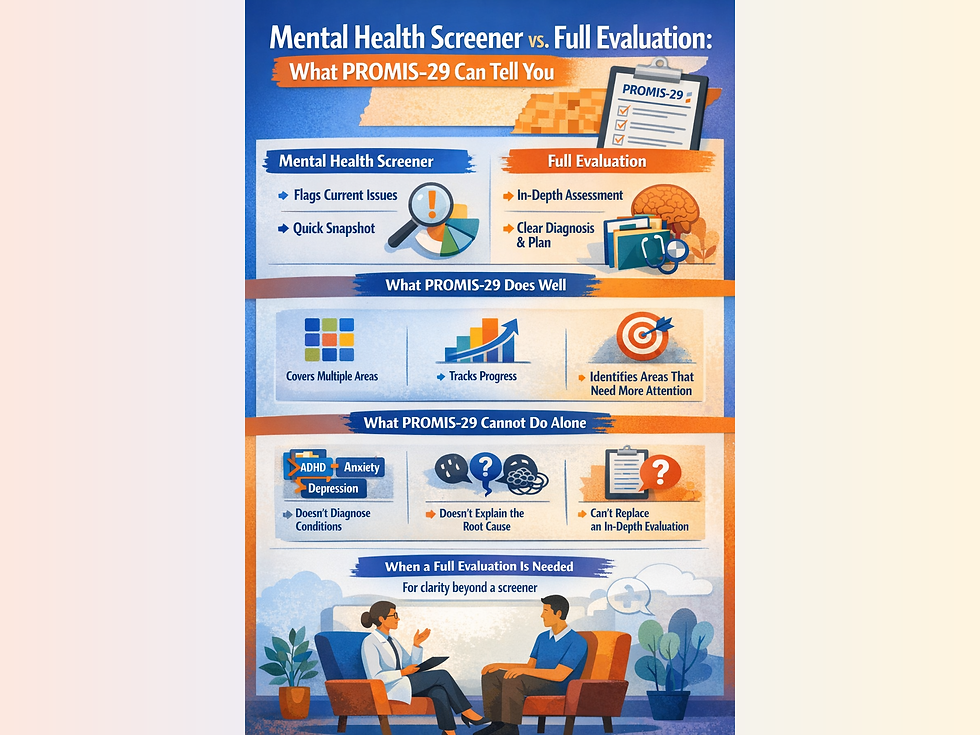
When you are trying to answer a mental health screener vs evaluation question, it helps to start with what each tool is built to do. PROMIS-29 is a broad health questionnaire that can show patterns across mood, sleep, pain, fatigue, daily functioning, and social participation. What it cannot do by itself is settle a diagnosis, explain root cause, or replace the kind of careful interpretation that comes from a full assessment. [1][4][5]
In this article, you’ll learn:
what a screener can do well
what a full evaluation adds
why PROMIS-29 is useful but limited
when a questionnaire may be enough for the moment
when diagnostic clarity usually calls for a fuller assessment
Mental Health Screener vs Evaluation: The Short Answer
A screener is meant to flag concerns and guide next steps. A full evaluation is meant to answer a diagnostic question more carefully by adding history, context, clinical interview, and professional interpretation. PROMIS-29 is strongest in that first role, though it can still be very useful inside a broader assessment process. [1][2][3]
🧭 Key takeaway: A screener helps you notice a pattern. An evaluation helps you understand what that pattern most likely means.
What a Mental Health Screener Is Designed to Do
Flag patterns worth noticing
A screener is usually a first-step tool. On our mental health screeners page, we include measures that can help you notice whether symptoms or functional strain may be showing up in a meaningful way. That matches the broader purpose of mental health screening: to check for signs that may need more attention, not to deliver a final answer. [1][8]
Give a snapshot of current functioning
PROMIS-29 is especially useful when you want a broad snapshot rather than a narrow yes-or-no answer. It looks across several domains at once, which can be more informative than focusing on only one symptom area. In a health questionnaire vs assessment decision, that is often the value of the questionnaire: it shows you where daily life currently feels most strained. [4][5][6]
Help guide next steps, not settle every question
Mental health screening is usually used to help decide whether more testing, treatment, or specialist follow-up makes sense. In other words, screening vs diagnosis is not an either-or choice. Screening helps guide the path toward diagnosis when that level of clarity is needed. [1][3]
📝 Key takeaway: Screeners are good at helping you ask better questions. They are not designed to answer every diagnostic question by themselves.
What a Full Evaluation Adds
History, context, and clinical interpretation
A full evaluation adds the part a questionnaire cannot supply on its own: your timeline, your context, and a clinician’s interpretation of how symptoms fit together. Diagnostic work generally involves medical and psychological history, symptom review, and broader evaluation when needed. On our psychological assessments page, we explain that we start with a free consultation and build the assessment around the referral question using screeners and evidence-based interviews. [2][3][9]
Sorting out overlap between possible concerns
This matters because many symptoms overlap. Trouble concentrating may reflect ADHD, anxiety, depression, poor sleep, chronic pain, trauma, burnout, or some combination. A good evaluation helps sort out whether several concerns are present at once, whether one problem is driving another, or whether a look-alike condition needs to be ruled out. [1][2][3]
Connecting symptoms to diagnosis, treatment planning, or accommodations when appropriate
Sometimes you do not just want a snapshot. You need diagnostic clarity for treatment planning, medication discussions, school or workplace accommodations, or a long-standing question that has never been answered well. If you are looking for a diagnostic evaluation in Tennessee for that kind of clarity, a fuller assessment is usually the better fit than a questionnaire alone. [2][3]
📌 Key takeaway: A full evaluation does more than describe symptoms. It helps connect those symptoms to the most useful next step.
What the PROMIS-29 Does Well
Captures multiple areas at once
PROMIS-29 includes seven 4-item domains plus a separate pain intensity rating. The official PROMIS profile materials describe these domains as anxiety, depression, fatigue, pain interference, physical function, sleep disturbance, and ability to participate in social roles and activities, along with pain intensity. That broad reach is one reason the measure can be so helpful when several parts of life feel affected at once. [5][6]
Helps identify which domains may need more attention
On our PROMIS-29 screener page, we describe one of the measure’s biggest strengths well: the goal is to see the pattern. For example, someone may score near average in mood but show more strain in fatigue and sleep. Someone else may show more interference in anxiety and social participation. That pattern is often more informative than any single symptom score by itself. [6][8]
Can be useful for baseline measurement and progress tracking
PROMIS was designed for use across conditions and clinical settings, and the platform is intended to support communication between patients and clinicians. PROMIS-29 summary scores have also been studied as a way to assess change over time, which is why the measure can be useful for baseline measurement and progress tracking. [4][7]
📊 Key takeaway: PROMIS-29 shines when you want a broad, structured picture of current functioning and a way to watch whether that picture changes.
What the PROMIS-29 Cannot Do on Its Own
It does not diagnose ADHD, anxiety, depression, or other conditions by itself
This is one of the most important limits to understand. A screening tool can show signs that a disorder may be present, but more testing is usually needed to diagnose or rule out a specific condition. Even APA assessment measures are described as tools for initial interviews, further clinical evaluation, and monitoring rather than stand-alone diagnosis. [1][3]
It does not explain root cause
PROMIS-29 can tell you that a domain stands out. It cannot tell you why. High fatigue, low social participation, or elevated anxiety scores can come from many different contributors, and diagnosis often requires a fuller history plus clinical judgment about what else may be affecting the picture. [2][3]
It cannot replace a careful clinical conversation
A questionnaire does not know which symptoms are new, which have been present for years, which are tied to a medical issue, or which started after a major life change. That is why a careful conversation still matters. Even a narrower tool like our GAD-7 anxiety screener is most useful when its results are interpreted in real-life context rather than treated like a verdict. [1][2][3]
⚠️ Key takeaway: PROMIS-29 is a strong screener, not a stand-alone diagnosis tool. Its value depends on how thoughtfully the results are interpreted.
When a Screener May Be Enough for the Moment
You want a broad snapshot of what feels hardest right now
Sometimes your question is simple: What seems to be hitting me hardest right now? In that situation, PROMIS-29 may be enough for the moment. For example, after a stressful medical stretch, you may mainly want to see whether sleep, fatigue, pain, or mood look most affected before deciding what kind of support to seek. [4][5][6]
You are beginning to explore whether support might help
A screener can also be a low-pressure starting point if you are not ready for a full assessment yet. You might want a clearer view of your mental health screening results before deciding whether therapy, medical follow-up, or a fuller evaluation would be useful. That is an appropriate use of screening. [1][8]
The next step is simple and clear
If one domain clearly stands out and the next step is straightforward, a screener may do what you need for now. For instance, if sleep disturbance and fatigue are the obvious problem areas and your main goal is to start a focused conversation with a provider, a broad screener may be enough to get that process moving. [1][4]
When a Full Evaluation Makes More Sense
Your symptoms overlap across several areas
If attention problems, anxiety, trauma history, burnout, low mood, pain, and sleep issues are all in the picture, a screener can tell you that life feels hard without telling you how those pieces fit together. That is where a fuller evaluation becomes more helpful. [2][3]
You need diagnostic clarity
If the question is not just “How am I doing?” but “What is actually going on?” a full assessment usually makes more sense. That is especially true when the result may affect treatment choices, documentation, accommodations, or how you understand a long-standing pattern. Our ADHD and autism assessment options are offered by secure telehealth for adults and older teens across Tennessee and in other PSYPACT states (the 40 states and DC that let psychologists see clients by telehealth across state lines), when that referral question is the right fit. [10]
You are trying to understand a long-standing pattern, not just current stress
PROMIS-29 is strong at showing how things are going now. A full evaluation is better when the real question stretches across years: childhood patterns, masking, repeated misunderstandings, accommodations needs, or a concern that has never felt fully explained. That kind of question usually needs more than a one-time symptom snapshot. [2][3]
🧠 Key takeaway: The more your question is about long-term meaning, overlap, or formal clarity, the more likely it is that an evaluation will help more than a screener.
How to Use PROMIS-29 Results Wisely
Start with the standout domains
Begin with the areas that seem furthest from your usual functioning or that interfere most with daily life. PROMIS-29 is most helpful when you read it as a domain pattern rather than a pass-fail result. [6][8]
Pair the results with your real-life experience
Ask yourself whether the scores match what day-to-day life actually feels like. If they do, that can help you prioritize where to start. If they do not, that mismatch is useful too, because it gives a clinician something important to explore rather than ignore. [3][4]
Let the screener guide questions, not define your whole story
The best use of PROMIS-29 is often to bring it into a bigger conversation. You can ask what might explain the pattern, what else should be ruled out, and whether a symptom-focused next step or a fuller evaluation would make more sense. PROMIS-29 vs full evaluation is not really a competition. They answer different questions. [1][3][4]
If you are trying to decide which path fits your situation, we can help you think that through. You can reach out for a free consultation to talk through whether a broad screener, therapy, coaching, or a more formal assessment would be the most useful next step. [11]
✅ Key takeaway: Let the screener inform the conversation, not become the whole conclusion. A useful next step is the one that matches the question you are actually trying to answer.
Frequently Asked Questions
What's the difference between a mental health screener and a full evaluation?
A screener is a first-step tool designed to flag patterns that may warrant further attention — not to deliver a diagnosis. A full evaluation adds what a questionnaire can't: your timeline, developmental history, differential diagnosis, and a clinician's interpretation of how symptoms fit together. PROMIS-29 is a strong screener that shows you where daily life is most strained across seven domains, but it cannot tell you why those domains are affected or what the explanation most likely is.
Can the PROMIS-29 diagnose depression, anxiety, or ADHD?
No. The PROMIS-29 is a health questionnaire, not a diagnostic tool. It can show which of seven domains — anxiety, depression, fatigue, pain interference, physical function, sleep disturbance, and social participation — look most strained right now. A screening tool can identify who may need further assessment, but more testing is required to diagnose or rule out a specific condition. The value of the PROMIS-29 is the pattern it reveals, not the label it provides.
When is a screener enough versus when do you need a full evaluation?
A screener may be enough when you want a broad snapshot of current functioning, you're beginning to explore whether support might help, or the next step is simple and clear. A full evaluation makes more sense when symptoms overlap across several areas, you need diagnostic clarity for treatment planning or accommodations, or your question stretches across years rather than current stress. Long-standing patterns — masking, childhood concerns, repeated misunderstandings — typically need more than a one-time snapshot.
About ScienceWorks
Dr. Kiesa Kelly is the owner and psychologist at ScienceWorks Behavioral Healthcare. Her work includes therapy and assessment, and her background includes university teaching. [12]
Dr. Kelly’s clinician page also lists NIH-funded and Tennessee Board of Regents-funded grant work in psychology and education. She reviews ScienceWorks educational content to help keep it clinically grounded and reader-friendly. [12]
References
MedlinePlus. Mental health screening. Available from: https://medlineplus.gov/lab-tests/mental-health-screening/
MedlinePlus. Mental disorders. Available from: https://medlineplus.gov/mentaldisorders.html
American Psychiatric Association. DSM-5-TR online assessment measures. Available from: https://www.psychiatry.org/psychiatrists/practice/dsm/educational-resources/assessment-measures
HealthMeasures. PROMIS. Available from: https://www.healthmeasures.net/explore-measurement-systems/promis
HealthMeasures. PROMIS adult profile measure differences. Available from: https://www.healthmeasures.net/images/PROMIS/Differences_Between_PROMIS_Measures/PROMIS_Adult_Profile_Measure_Differences_16Sept2024.pdf
HealthMeasures. PROMIS adult profile instruments scoring manual. Available from: https://www.healthmeasures.net/images/PROMIS/manuals/Scoring_Manual_Only/PROMIS_Adult_Profile_Scoring_Manual_15July2025.pdf
Hays RD, Spritzer KL, Schalet BD, Cella D. PROMIS-29 v2.0 profile physical and mental health summary scores. Qual Life Res. 2018;27(7):1885-1891. Available from: https://doi.org/10.1007/s11136-018-1842-3
ScienceWorks Behavioral Healthcare. PROMIS-29. Available from: https://www.scienceworkshealth.com/promis-29
ScienceWorks Behavioral Healthcare. Psychological assessments. Available from: https://www.scienceworkshealth.com/psychological-assessments
ScienceWorks Behavioral Healthcare. ADHD and autism assessments for adults and older teens in Tennessee. Available from: https://www.scienceworkshealth.com/info/adhd-and-autism-assessments-for-adults-and-older-teens-in-tennessee
ScienceWorks Behavioral Healthcare. Contact. Available from: https://www.scienceworkshealth.com/contact
ScienceWorks Behavioral Healthcare. Kiesa Kelly. Available from: https://www.scienceworkshealth.com/kiesakelly
Disclaimer
This article is for informational purposes only and is not a substitute for diagnosis, treatment, or individualized mental health care. Reading this article does not create a clinician-client relationship. If you are in immediate danger or need urgent support, call 911 or go to the nearest emergency room.