
Motivational Interviewing and Ambivalence in Substance Use

Updated: Sep 2
Last reviewed: 09/02/2026
Reviewed by: Dr. Kiesa Kelly

If you are looking into motivational interviewing for substance use, there is a good chance you do not want a lecture. You may already know something needs to change, but still feel unsure, defensive, embarrassed, or simply tired of being pushed. That is exactly the kind of situation MI was built for. Motivational interviewing is a collaborative, person-centered counseling style that helps you work through ambivalence instead of treating it like failure. [1][2]
In this article, you’ll learn:
what motivational interviewing is and what it is not
who tends to benefit most from this treatment style
why ambivalence is a normal part of change
what MI sessions usually feel like in real life
how MI can be combined with CBT and other substance-use treatment approaches
what early progress may look like before everything feels “fixed”
🌱 Key takeaway: If pressure has made you shut down, MI may feel different because it starts with collaboration, not confrontation. [1][5]
What Motivational Interviewing for Substance Use Is
Motivational interviewing is not about talking you into change from the outside. It is about helping you hear yourself more clearly from the inside. In MI, a therapist listens carefully, asks strategic open questions, reflects back what they hear, and helps you notice the gap between what matters to you and what your substance use is costing you. The goal is not to “give” you motivation. The goal is to help you strengthen your own reasons for change. [1][2][5]
That matters because many people with substance-use concerns already know the risks. The problem is not always lack of information. Often, it is being pulled in two directions at once: relief now versus consequences later, numbness versus connection, habit versus values, fear versus hope. [1]
If you are trying to picture how this kind of respectful, individualized care fits into a broader plan, our specialized therapy approach may be a helpful starting point.
Who This Is For
People who feel ambivalent about change
This is one of the clearest fits for MI. Maybe part of you wants to cut back, stop, or get help, while another part still sees substance use as relief, routine, protection, or the only reliable off-switch. MI does not treat that split like hypocrisy. It treats it like useful clinical information. [1][5]
A simple example: you may know alcohol helps you unwind after work, while also knowing it is hurting your sleep and creating tension at home. Both sides are real. MI makes room for both, then helps you sort out which direction you actually want your life to move.
People who do not respond well to pressure or confrontation
Some people shut down when they feel judged. Others argue, avoid, miss appointments, or say what they think they are “supposed” to say. That does not necessarily mean they do not care. It may mean the approach is creating more resistance than readiness. SAMHSA specifically notes that confrontational approaches can increase resistance and discord, while motivational approaches explore ambivalence in a compassionate, nonjudgmental way. [1]
This can be especially important if substance use overlaps with fear, shame, or a trauma history. When that is part of the picture, a more respectful pace often helps. Our trauma therapy page explains more about how we think about safety, trust, and overwhelm in treatment.
People who know something needs to change but feel stuck
You do not have to arrive fully ready, fully certain, or fully committed for MI to be useful. In fact, it is often especially relevant when readiness is low or mixed. [1][2]
Sometimes the stuck point is not only substance use. Depression, anxiety, trauma, sleep problems, or burnout may be part of what keeps the cycle going. If you are not even sure how broad the picture is yet, our mental health screening tools can be a low-pressure way to organize what you have been noticing.
🧭 Key takeaway: MI is often a good fit when you are not at “I’m ready” yet, but you are no longer comfortable pretending nothing is wrong. [1][2]
Why Ambivalence Is Not the Same as Failure
Ambivalence is one of the central ideas in MI, and it is often misunderstood. Ambivalence does not mean you are lazy, manipulative, unserious, or “in denial.” It means two different motivations are active at the same time. SAMHSA describes ambivalence about changing substance use as natural and warns against interpreting it as denial or resistance in a way that creates more discord. [1]
That distinction matters. If a therapist assumes your mixed feelings are just excuses, the conversation gets smaller and more defensive. If they understand ambivalence as normal, the conversation gets more honest.
Another way to say it: the fact that substances still do something for you is not proof that change is impossible. It is simply part of the map. MI helps you name the short-term payoff without pretending the long-term cost is not there.
💬 Key takeaway: Ambivalence is not a moral flaw. In MI, it is often the doorway into a more honest, effective treatment conversation. [1][5]
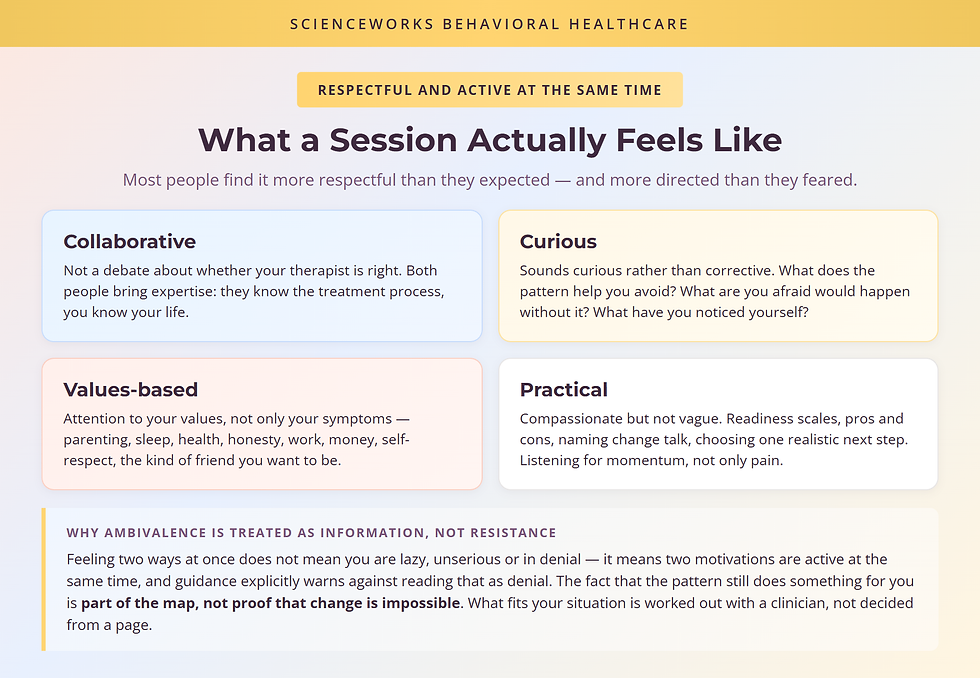
What MI Sessions Actually Feel Like
Many people are relieved to learn that MI usually feels more respectful than they expected.
Collaborative
MI is not a power struggle. The session is not supposed to become a debate about whether your therapist is right. SAMHSA describes MI as a collaborative partnership in which both people bring important expertise: the clinician knows the treatment process, and you know your life. [1]
Curious
A good MI session often sounds curious rather than corrective. The therapist may ask permission before getting into substance use directly. They may explore what substances help you avoid, what you are afraid would happen without them, and what concerns you have noticed yourself. The point is not to corner you. It is to understand the pattern well enough to loosen it. [5]
Values-based
MI pays attention to your values, not just your symptoms. You might talk about parenting, sleep, health, honesty, work, money, self-respect, or the kind of partner or friend you want to be. The work is often about noticing when your current pattern is colliding with what matters most to you. [2]
Practical
MI is compassionate, but it is not vague. Sessions may include readiness scales, pros-and-cons work, identifying change talk, or choosing one small next step that feels realistic. The therapist is not just listening for pain. They are also listening for momentum. [1][5]
If you are in Tennessee and want to see how one of our clinicians describes this style in substance-use work, Ryan Robertson lists motivational interviewing alongside CBT and other supports for substance use concerns.
🤝 Key takeaway: MI should feel respectful and active at the same time. It is not a lecture, but it is also not just venting without direction. [1][5]
Motivational Interviewing vs Being “Confronted” Into Change
This difference matters more than people think.
MI is not about shaming you, catching you in contradictions, pushing you to admit defeat, or trying to break down your defenses. It does not assume resistance is your identity. SAMHSA specifically frames resistance as an expression of ambivalence rather than a fixed client trait. [1]
But MI is also not passive. It is not a therapist nodding along while nothing changes. It is a strategic style with a direction: helping you move toward behavior that fits your goals more closely. [1]
So if confrontational treatment has made you wary, that reaction makes sense. And if you worry that a gentler style means “nobody will challenge me,” that is not quite right either. Good MI still asks hard questions. It just does so in a way that protects dignity and autonomy.
When MI Is Combined With CBT or Other Substance-Use Treatment Approaches
MI is often used alongside other evidence-based approaches rather than replacing them. SAMHSA notes that MI is compatible with CBT and other standard substance-use treatment approaches, and may be blended to support engagement, resolve ambivalence, and strengthen follow-through. [1]
That combination makes clinical sense. MI can help with willingness, clarity, and commitment. CBT can help with triggers, routines, thought patterns, cravings, and coping strategies once you are ready to practice specific changes.
For example, someone might use MI first to sort through mixed feelings about cutting down, then use CBT tools to plan for high-risk times of day, practice alternatives to using, and respond differently to urges. Another person might move back and forth between the two depending on the week. Motivation is not always linear, and treatment does not have to be rigid to be effective.
🛠️ Key takeaway: MI often helps open the door to change, while CBT and other supports help you walk through it. [1][3][4]
What Early Progress Can Look Like
Early progress in MI does not always look dramatic. It may look quieter than that.
It can look like:
answering more honestly instead of saying what sounds acceptable
feeling less defensive when substance use comes up
being able to name both the payoff and the cost of using
taking one concrete step, like changing a routine, removing one trigger, or accepting a referral
starting to talk more about what you want your life to move toward, not only what you want to avoid
That kind of change matters. In MI terms, early progress often shows up as more change-oriented language, clearer values, and a stronger sense that the next step belongs to you. [1][5]
If you want a broader sense of who on our team works with overlapping concerns like trauma, anxiety, insomnia, and neurodivergence, you can meet our clinicians.
Ready to Explore Change Without Shame or Pressure?
If you feel torn about your substance use, you do not need to wait until you are completely certain before talking to someone. Ambivalence is not a sign that therapy would fail. It is often the exact reason a collaborative approach can help.
For readers in Tennessee, our therapy services are delivered by telehealth, and Ryan Robertson’s clinician page specifically includes substance use and motivational interviewing among his treatment areas. [6][7]
If you want to talk through fit before committing to treatment, you can request a free consultation. We will use that conversation to understand what feels stuck, what kind of support might fit best, and whether this style of care makes sense for you right now. [8]
⏳ Key takeaway: You do not need perfect readiness to begin. Often, the next helpful step is simply a conversation that does not shame you for being unsure. [1][8]
Frequently Asked Questions
What is motivational interviewing and how does it work?
Motivational interviewing is a collaborative, goal-oriented communication style developed by William Miller and Stephen Rollnick to strengthen a person's own motivation for change. The foundational insight is that people are often ambivalent about change rather than simply resistant. MI's goal is not to convince or persuade but to elicit and strengthen the person's own reasons for change, through four core processes: Engaging, Focusing, Evoking, and Planning.
Does motivational interviewing actually work for substance use?
The evidence base is substantial. Across numerous randomized controlled trials and meta-analyses, MI has been associated with reduced alcohol and drug use across multiple substances, increased treatment engagement and retention, and enhanced effectiveness when combined with other treatments such as CBT. MI is particularly effective in early treatment stages or when ambivalence is high. Research also supports brief MI interventions of one to four sessions in medical and other settings.
What are the four core processes of motivational interviewing?
The four core processes are: Engaging—establishing a working relationship built on trust and mutual respect; Focusing—collaborating on a shared agenda for what to work on; Evoking—drawing out the person's own motivation and reasons for change; and Planning—developing a specific plan when the person is ready. These are guided by key skills: open-ended questions, affirmations, reflections, and summaries (OARS), and by an overall spirit of partnership, acceptance, compassion, and evocation.
About ScienceWorks
Dr. Kiesa Kelly is the founder of ScienceWorks Behavioral Healthcare and a psychologist with training in clinical psychology and neuropsychology. She earned her PhD in Clinical Psychology, with a concentration in Neuropsychology, from Rosalind Franklin University of Medicine and Science. [9]
Her background includes practica, internship, and an NIH-funded postdoctoral fellowship at the University of Chicago, the University of Wisconsin, the University of Florida, and Vanderbilt University. Her current work includes therapy and psychological assessment, with additional training listed in OCD, trauma, insomnia, and neuroaffirming assessment approaches. [9]
References
Substance Abuse and Mental Health Services Administration. TIP 35: Enhancing Motivation for Change in Substance Use Disorder Treatment [Internet]. Rockville (MD): SAMHSA; 2019. Available from: https://library.samhsa.gov/sites/default/files/tip-35-pep19-02-01-003.pdf
Substance Abuse and Mental Health Services Administration. Using Motivational Interviewing in Substance Use Disorder Treatment [Internet]. Rockville (MD): SAMHSA; 2020. Available from: https://library.samhsa.gov/sites/default/files/PEP20-02-02-014.pdf
Cochrane. Does motivational interviewing help people reduce their use of alcohol, drugs, or both? [Internet]. 2023. Available from: https://www.cochrane.org/evidence/CD008063_does-motivational-interviewing-help-people-reduce-their-use-alcohol-drugs-or-both
Lundahl B, Burke BL, Tollefson D, Kunz C, Brownell C. A meta-analysis of motivational interviewing: twenty-five years of empirical studies. Res Soc Work Pract. 2010;20(2):137-160. Available from: https://doi.org/10.1177/1049731509347850
Centers for Disease Control and Prevention. Conversation Starter: Motivational Interviewing to Help Your Patients Seek Treatment [Internet]. 2024. Available from: https://www.cdc.gov/overdose-prevention/media/pdfs/2024/07/Conversation-Starter-Motivational-Interviewing.pdf
ScienceWorks Behavioral Healthcare. Ryan Robertson [Internet]. Available from: https://www.scienceworkshealth.com/ryan-robertson
ScienceWorks Behavioral Healthcare. Specialized Therapy [Internet]. Available from: https://www.scienceworkshealth.com/specialized-therapy
ScienceWorks Behavioral Healthcare. Contact [Internet]. Available from: https://www.scienceworkshealth.com/contact
ScienceWorks Behavioral Healthcare. Kiesa Kelly, PhD [Internet]. Available from: https://www.scienceworkshealth.com/kiesakelly
Disclaimer
This article is for informational purposes only and is not medical advice, diagnosis, or treatment. Reading it does not create a therapist-client relationship. If you are in immediate danger or need urgent support, call 911, go to the nearest emergency room, or contact a local crisis resource right away.