
OCD Treatment Options: ERP, I-CBT, ACT & Medication

Updated: Aug 31
Last reviewed: 08/26/2026
Reviewed by: Dr. Kiesa Kelly
If you are trying to understand ocd treatment, you are probably not looking for jargon. You want to know what actually helps, what the different therapy names mean, and how medication may or may not fit. The good news is that there are evidence-based options. The harder part is finding a therapist who can explain them clearly and tailor them to the way your OCD actually works.[1][2]
In this article, you’ll learn:
what effective OCD treatment is usually trying to change
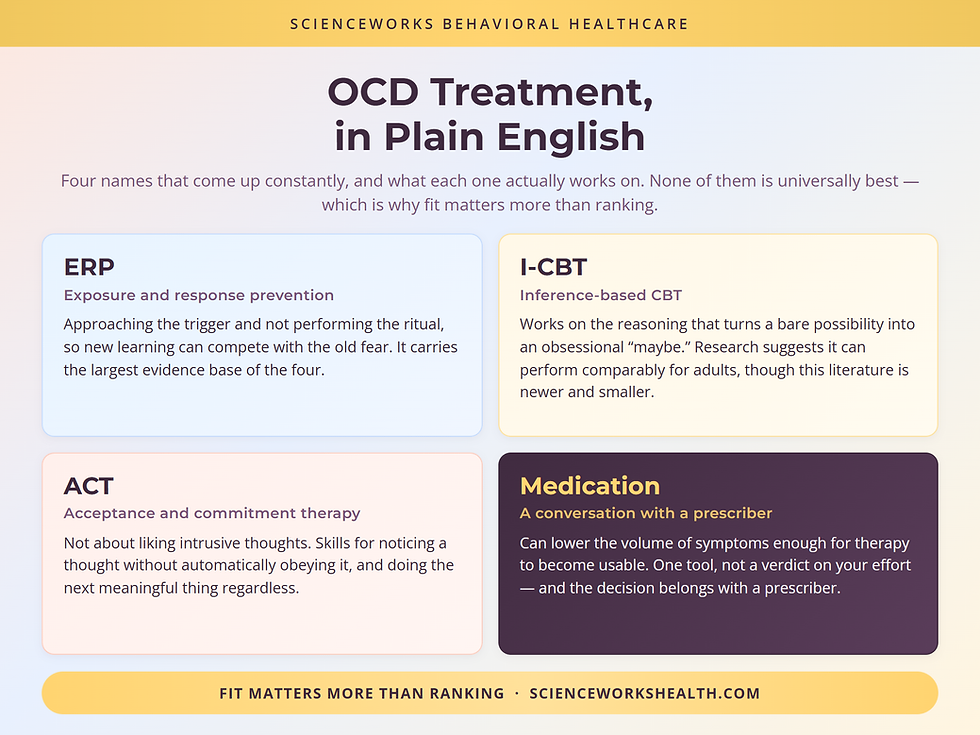
how ERP, I-CBT, and ACT differ from each other
when medication support may make sense as part of care
what people often misunderstand about OCD therapy
how to look for online OCD therapy in Tennessee
What Effective OCD Treatment Usually Includes
Why reassurance alone usually does not fix OCD
OCD usually runs on a loop: an intrusive thought, image, sensation, or doubt shows up; anxiety spikes; then you do something to feel safer. That “something” may be visible, like washing or checking, or invisible, like mentally reviewing, confessing, Googling, asking a partner for certainty, or repeating a phrase in your head. Relief may come fast, but it usually does not last. The brain learns, again, that the obsession must have been important because you treated it like an emergency.[1][2]
🧠 Key takeaway: Short-term relief can accidentally keep OCD going. Reassurance often lowers distress for a moment while strengthening the rule that you must solve the doubt before you can move on.
A practical example: you worry that you offended someone in a text. You ask three people whether the message sounded rude, reread the thread ten times, and feel better for twenty minutes. Then the doubt comes back. Evidence-based care does not just comfort that fear in the moment. It helps you step out of the whole cycle. If you want a clearer overview of how we structure support around that cycle, our OCD therapy page gives a practical snapshot of the approaches we use.
What evidence-based treatment aims to change
Good treatment is not mainly about proving your thought is false. It is about changing how you respond when OCD demands certainty, relief, or control. That often means reducing rituals, reducing avoidance, building willingness to feel uncertainty, and helping you return to ordinary life even when your mind is noisy. Progress is usually measured by less time lost, less ritualizing, better functioning, and less fear-driven decision-making, not by “never having intrusive thoughts again.”[1][2]
🧭 Key takeaway: The target is usually not the thought itself. The target is the pattern of ritualizing, avoidance, and over-engagement that makes the thought stickier.
It can also help to track symptoms in a structured way instead of relying only on a vague sense of whether a week felt “good” or “bad.” A tool such as the OCD symptom screener can help put severity, interference, and treatment goals into words.
Why treatment should feel collaborative, not shaming
People with OCD are often deeply conscientious. Many already feel embarrassed by their thoughts, rituals, or avoidance. Effective therapy should not add shame to that.
Even ERP, which asks you to face what OCD tells you to avoid, is supposed to be collaborative and paced. The point is not to overwhelm you, catch you doing treatment “wrong,” or force a dramatic exposure for the sake of it. The point is to help you build new learning with a therapist who understands the difference between courage and coercion.[1]
🤝 Key takeaway: OCD therapy should feel active, but it should not feel humiliating. A strong treatment plan is structured and challenging while still being respectful, thoughtful, and consent-based.
ERP for OCD
What exposure and response prevention means
Exposure and response prevention, or ERP, is the best-known behavioral treatment for OCD. “Exposure” means intentionally approaching a trigger, image, thought, memory, object, or situation that OCD usually treats as dangerous. “Response prevention” means resisting the ritual, reassurance, checking, avoidance, or mental neutralizing that you would normally use to get relief.[1][2]
That does not always mean touching a dirty surface or doing the biggest fear first. ERP can be imaginal, in vivo, interoceptive, brief, gradual, values-based, and carefully planned. A therapist might help someone with contamination OCD touch a doorknob and delay washing. For harm OCD, the work might involve writing or reading a feared script without mentally canceling it. In our specialized therapy services, we describe this kind of matching process as part of building treatment around your actual symptoms rather than a generic anxiety template.
How ERP helps reduce fear and ritualizing
ERP works by helping your brain learn that anxiety, uncertainty, disgust, or incompleteness can be tolerated without performing the ritual. Over time, triggers often lose some of their grip, and the urge to ritualize becomes less automatic. Just as important, you learn that you can function while uncomfortable. That is a big shift for OCD, which usually says life cannot continue until the doubt is resolved.[1][2]
A second example: someone with relationship OCD keeps checking internally whether they “really” love their partner and keeps asking friends whether the relationship sounds right. In ERP, the work may include noticing those urges, refusing the reassurance ritual, and continuing with the evening anyway. The win is not perfect certainty. The win is no longer organizing your life around the obsession.
What people often misunderstand about ERP
One common misunderstanding is that ERP means “flooding” people with their worst fear. Another is that ERP is basically just white-knuckling distress. A third is that ERP only works if you feel instantly less anxious. None of those are good descriptions. ERP is usually more thoughtful than that. It is built around learning, repetition, prediction testing, and reducing rituals. Anxiety may come down during an exposure, but the bigger goal is learning that you do not need compulsions in order to cope.[1][2]
🪜 Key takeaway: ERP is not about being cruel to yourself. It is about practicing a different response long enough that OCD stops acting like the boss.
I-CBT for OCD
The role of inferential confusion and doubt
Inference-based CBT, or I-CBT, focuses on the reasoning process that feeds obsessional doubt. A central idea is inferential confusion: getting pulled away from what is directly happening in the present and into a feared possibility that feels subjectively real. Instead of starting with “What evidence do I have right now?” OCD starts with “But what if, despite appearances, the terrible possibility is true?”[4][5]
🔍 Key takeaway: I-CBT targets the story-making part of OCD. It pays close attention to how the mind moves from ordinary uncertainty into obsessional doubt.
For some people, that description lands immediately. They may notice that the problem is not only fear, but a very specific style of reasoning: distrusting the obvious, privileging remote possibilities, and getting lost in imagined scenarios that feel urgent.
How I-CBT differs from ERP
ERP and I-CBT overlap in an important way: both are trying to loosen OCD’s hold. But they do it through somewhat different doors. ERP emphasizes new learning through approaching triggers and dropping rituals. I-CBT emphasizes identifying and undoing the faulty inferential process that turns a possibility into an obsessional “maybe.” Recent research suggests I-CBT can perform comparably to CBT for OCD in adult samples, but the I-CBT literature is still newer and smaller than the ERP literature.[4][5]
That does not make one universally better than the other. It means fit matters. Some people respond well to direct exposure work. Others connect more readily with a cognitive approach that helps them step out of obsessional reasoning before the ritual loop fully takes over.
Who may connect with this approach
I-CBT may especially appeal to people who find ERP too threatening at first, people whose OCD is heavily doubt-based, or people who feel that their symptoms start with a persuasive internal narrative rather than a clear external trigger. It has been studied primarily in adults so far, which is worth keeping in mind when comparing options.[4][5]
If you are trying to sort out therapist fit, it helps to look for clear training and approach information rather than broad claims about treating “anxiety.” On our team page, you can see which clinicians list ERP, I-CBT, and ACT among their approaches, and Dr. Kiesa Kelly’s professional background includes graduate and postdoctoral training relevant to OCD care.
ACT and Other Supportive Approaches
Using willingness, values, and defusion skills
Acceptance and Commitment Therapy, or ACT, does not ask you to like intrusive thoughts. It teaches skills for noticing thoughts without automatically obeying them.
Common ACT ideas include willingness, defusion, present-moment awareness, and values-guided action. In plain English, that can look like noticing “my mind is telling the contamination story again,” making room for the anxiety, and still doing the next meaningful thing instead of launching into a ritual.[6][7]
How ACT may support ERP-based work
ACT is often useful because it gives language and skills for the emotional part of ERP. If ERP asks you to face the trigger and drop the ritual, ACT can help you stay with the discomfort more flexibly. It can make space for thoughts like “I hate this and I can still do it” or “certainty is not available right now, but I still want to act like the kind of parent, partner, student, or professional I want to be.” The evidence base for ACT in OCD is promising, but it is still smaller than the ERP literature, so it is best thought of as supportive or complementary rather than a replacement for every case.[6][7]
🪶 Key takeaway: ACT can be especially helpful when OCD treatment stalls around avoidance of feelings. It helps you practice willingness without turning that willingness into another ritual.
Why coping skills are not the same as compulsions
People with OCD often get confused here, understandably. A coping skill is meant to help you stay present and continue living. A compulsion is meant to make you certain, neutralize danger, or guarantee relief. On the surface, the behaviors can look similar.
The difference is function. Taking one slow breath so you can stay in the exposure is different from breathing in a fixed way until you feel “just right.” Naming a thought is different from analyzing it until the anxiety disappears.[1][6]
When Medication May Be Part of Treatment
Common reasons someone may consider medication support
Medication can be worth discussing when OCD symptoms are severe, when rituals are consuming large parts of the day, when depression or panic is making therapy harder to use, or when someone has had limited progress despite a well-delivered therapy approach. In OCD care, that often means a conversation about SSRIs with a prescriber. Medication is not a character test, and using it does not mean you “failed” therapy.[1][2]
💊 Key takeaway: Medication support can lower the volume of symptoms enough for therapy to become more usable. It is one tool, not a verdict about your effort or strength.
Therapy and medication can work together
Therapy and medication are not opposites. For some people, the combination is more useful than either one alone, especially when symptoms are intense or progress has plateaued. Medication may reduce symptom load enough that ERP or other structured treatment becomes easier to engage with, and therapy can help you build lasting behavioral change rather than depending on symptom relief alone.[1][2][3]
Why medication decisions belong with a prescriber
A therapist can help you think about when a medication conversation might be worth having. A prescriber is the person who should assess what medication options fit your history, side effects, other conditions, and goals. That matters because OCD medication treatment often involves details about dosing, duration, interactions, and monitoring that should not be guessed at.[1][2]
How to Choose the Right OCD Therapist
Questions to ask about ERP and OCD experience
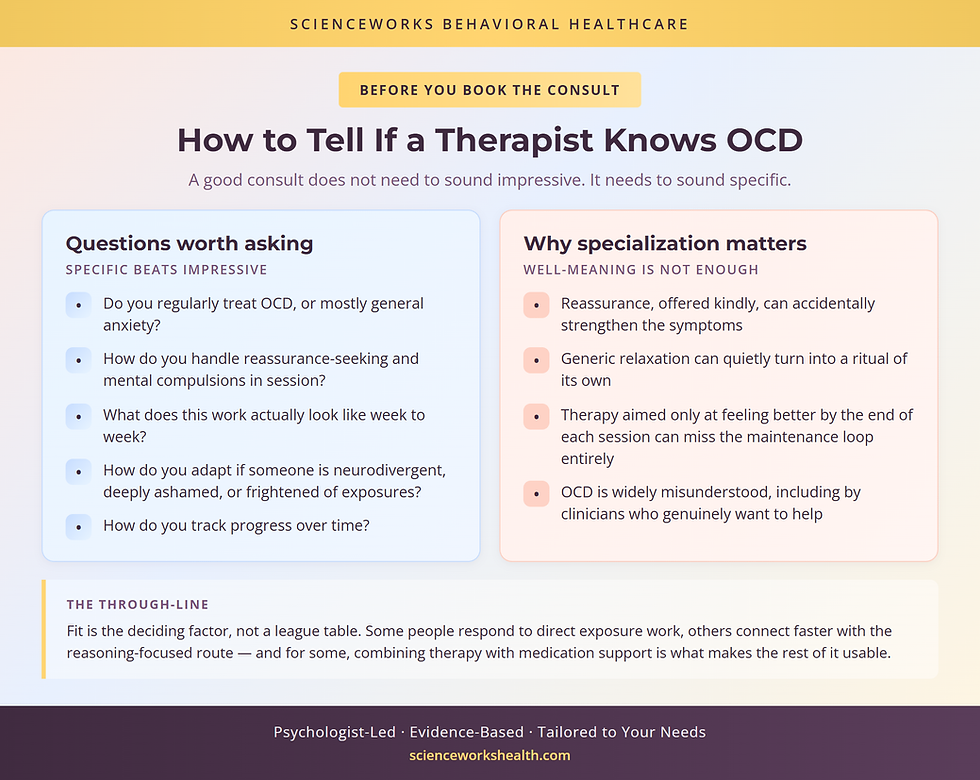
A good OCD consult does not need to sound fancy, but it should sound specific. Helpful questions include:
Do you regularly treat OCD, or mostly general anxiety?
How do you handle reassurance-seeking and mental compulsions in session?
What does ERP or I-CBT actually look like in your work?
How do you adapt treatment if someone is neurodivergent, highly ashamed, or initially scared of exposures?
How do you track progress over time?
Why specialization matters for OCD
OCD is often misunderstood, even by well-meaning clinicians. Reassurance can accidentally strengthen symptoms. Generic relaxation can become a ritual. Talk therapy that focuses only on feeling better after every session can miss the actual maintenance loop. Specialization matters because OCD treatment usually works best when the therapist understands obsessions, mental compulsions, avoidance, reassurance, and the difference between support and accommodation.[1][2]
Finding online OCD therapy in Tennessee
If you are looking for online OCD therapy Tennessee options or an ERP therapist Tennessee search keeps leaving you with vague profiles, focus less on marketing language and more on concrete fit. Look for clear mention of OCD-specific methods, how telehealth sessions are structured, and whether the clinician can explain why they would choose ERP, I-CBT, ACT-informed work, or a combination.
If you are still in the early sorting-out stage, our mental health screening tools may help you organize what you are noticing. If you already know OCD is the main issue and want to talk through fit, you can contact us to ask practical questions about online care in Tennessee.
When you strip away the jargon, OCD treatment is really about one central shift: learning how to stop organizing your life around obsessional doubt. ERP does that through approaching triggers and resisting rituals. I-CBT does it by targeting the reasoning process that fuels the doubt. ACT can support the work by helping you make room for discomfort and act from values instead of fear. Medication may also have a place, especially when symptom intensity is making therapy harder to use.
You do not need to pick a treatment by guessing from acronyms alone. You need a plan that makes sense for your symptoms, your pace, and your daily life. If you are weighing next steps, start by asking whether the therapist can explain the OCD cycle clearly, describe what treatment would look like for you, and talk openly about how telehealth, ERP, I-CBT, ACT, and medication support might fit together.
Frequently Asked Questions
What is I-CBT for OCD?
I-CBT stands for Inference-Based Cognitive Behavioral Therapy, a treatment specifically designed for OCD that focuses on the reasoning process underlying obsessions rather than on anxiety reduction through exposure. Instead of building tolerance to feared stimuli, I-CBT helps people identify the faulty inferential reasoning — such as remote possibilities being treated as probable, or distrusting sensory evidence — that generates obsessional doubt in the first place. It is particularly useful when obsessions feel ego-syntonic or when exposure-based approaches have been difficult to tolerate.
What is ACT therapy for OCD?
ACT stands for Acceptance and Commitment Therapy, a third-wave behavioral approach that teaches psychological flexibility — the ability to make room for difficult thoughts and feelings without being controlled by them. For OCD, ACT is used alongside or in place of ERP in some cases, with the focus on defusing from obsessional content, accepting uncertainty, and committing to value-driven action regardless of what the OCD is saying. It is less focused on reducing anxiety or disconfirming feared outcomes and more focused on changing your relationship to the obsessional experience.
Does OCD treatment always require medication?
No. ERP is highly effective as a standalone treatment for many people with OCD and is considered the gold standard psychological intervention. Medication — typically SSRIs at doses higher than those used for depression — is often combined with ERP when OCD is severe, when symptoms are not responding to therapy alone, or when the person prefers combined treatment. For some people, medication reduces symptom intensity enough to make ERP more accessible. Neither medication alone nor therapy alone is universally required.
How is I-CBT different from ERP for OCD?
ERP works by exposing you to triggers and preventing compulsive responses, which builds new learning that feared outcomes do not occur and that anxiety decreases without rituals. I-CBT, by contrast, starts upstream — it targets the inferential reasoning that created the obsession rather than the anxiety response that follows. ERP is better-supported by research and is the first-line recommendation. I-CBT is more often considered when someone has not responded to ERP, finds exposure intolerable, or whose OCD is driven heavily by intrusive doubts about identity or reality rather than anxiety about external harm.
About ScienceWorks
Dr. Kiesa Kelly, PhD, HSP, is a psychologist and founder of ScienceWorks Behavioral Healthcare. Her background includes a PhD in Clinical Psychology with a concentration in Neuropsychology from Rosalind Franklin University of Medicine and Science, an NIH National Research Service Award postdoctoral fellowship at Vanderbilt University and the University of Florida, and graduate training in cognitive behavioral therapy that included exposure and response prevention for OCD.
Her more recent training includes I-CBT training and consultation for OCD-related work. She is also affiliated with professional organizations including the American Psychological Association, the Anxiety and Depression Association of America, the Tennessee Psychological Association, and the Association for Behavioral and Cognitive Therapies.
References
National Institute for Health and Care Excellence. Obsessive-compulsive disorder and body dysmorphic disorder: treatment. NICE guideline CG31. Available from: https://www.nice.org.uk/guidance/cg31
American Psychiatric Association. Treating obsessive-compulsive disorder: quick reference guide based on practice guideline for the treatment of patients with obsessive-compulsive disorder. Arlington (VA): American Psychiatric Association; 2007. Available from: https://psychiatryonline.org/pb/assets/raw/sitewide/practice_guidelines/guidelines/ocd-guide-1410457187493.pdf
Mao L, Hu M, Luo L, Wu Y, Lu Z, Zou J. The effectiveness of exposure and response prevention combined with pharmacotherapy for obsessive-compulsive disorder: a systematic review and meta-analysis. Front Psychiatry. 2022;13:973838. Available from: https://doi.org/10.3389/fpsyt.2022.973838
Wolf N, van Oppen P, Hoogendoorn AW, van den Heuvel OA, van Megen HJGM, Broekhuizen A, et al. Inference-Based Cognitive Behavioral Therapy versus Cognitive Behavioral Therapy for Obsessive-Compulsive Disorder: a multisite randomized controlled non-inferiority trial. Psychother Psychosom. 2024. Available from: https://doi.org/10.1159/000541508
International OCD Foundation. Inference-based cognitive behavioral therapy (I-CBT). Available from: https://iocdf.org/ocd-treatment-guide/i-cbt/
Soondrum T, Wang X, Gao F, Liu Q, Fan J, Zhu X. The applicability of acceptance and commitment therapy for obsessive-compulsive disorder: a systematic review and meta-analysis. Brain Sci. 2022;12(5):656. Available from: https://doi.org/10.3390/brainsci12050656
Philip J, Cherian V. Acceptance and commitment therapy in the treatment of obsessive-compulsive disorder: a systematic review. J Obsessive Compuls Relat Disord. 2021;28:100603. Available from: https://doi.org/10.1016/j.jocrd.2020.100603
Disclaimer
This article is for informational and educational purposes only and is not medical advice, diagnosis, or treatment. Reading it does not create a therapist-client relationship. If you are concerned about OCD symptoms or are considering medication, please consult a qualified licensed clinician or prescriber for individualized care. If you are in immediate danger or need urgent support, call 911 or go to the nearest emergency room.