
Why OCD Feels So Real (Even When You Know It's Irrational)
- Ryan Burns

- Mar 5
- 10 min read
Updated: Aug 7
Last reviewed: 08/07/2026
Reviewed by: Dr. Kiesa Kelly
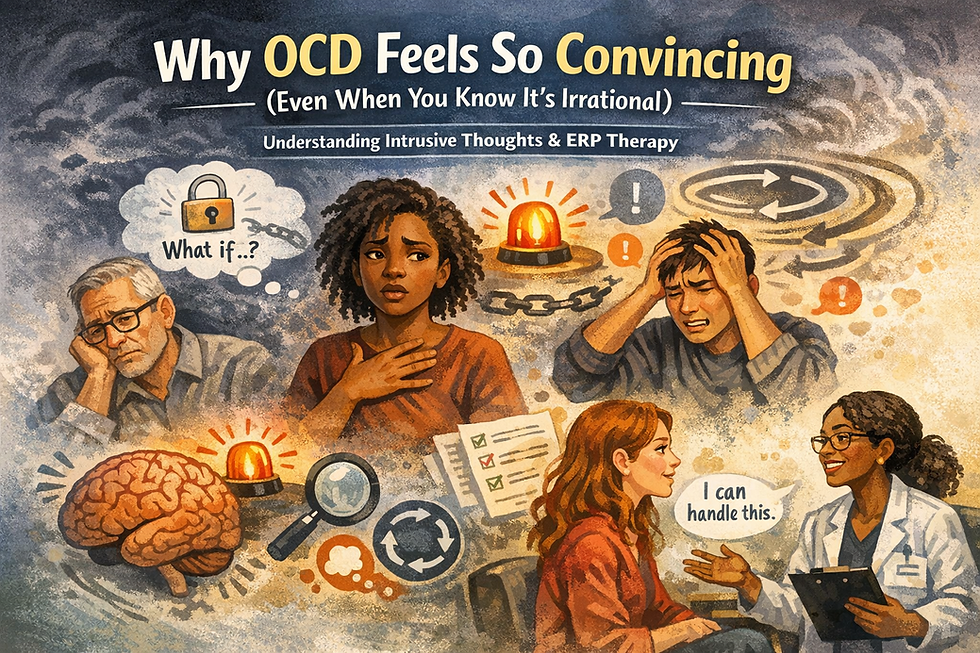
OCD has a frustrating superpower: it can make a thought feel like a warning, a feeling feel like proof, and doubt feel like a problem you must solve right now. That “I know it’s irrational, but it still feels true” experience is a big part of why ocd feels real.
In this article, you’ll learn:
Why OCD thoughts can register like threats instead of “just thoughts”
How anxiety turns attention into a magnifying glass
Why logic and reassurance often backfire
What ERP therapy for intrusive thoughts changes over time
When it’s time to seek specialized OCD support in Tennessee
🧠 Key takeaway: In OCD, the problem isn’t the presence of a thought. It’s the meaning your brain assigns to it and the rituals that follow.
Why OCD Thoughts Feel So Real (Why OCD Feels Real)
The brain’s threat detection system
Your brain is built to detect danger quickly. When the threat system flips on, it creates urgency, pulls your attention toward “risk,” and pushes you toward actions that reduce uncertainty.
In OCD, that alarm can misfire and keep firing. Research points to differences in brain circuits involved in threat appraisal and error signaling, which can make “something is wrong” feel sticky even when you logically disagree.[3]
How anxiety amplifies attention to thoughts
Anxiety doesn’t just feel bad, it changes what your mind prioritizes. When you’re anxious, your brain scans for evidence that the threat is real. With OCD, the scanning often latches onto the thought itself.
You might notice this pattern:
A “what if” pops up.
Your body spikes with anxiety.
Your mind zooms in, looking for certainty.
🧭 Key takeaway: Anxiety makes your brain treat “maybe” like “must solve,” which fuels the ocd doubt cycle.[4]
Why emotional intensity creates a sense of danger
Humans naturally use emotion as information. If you feel terrified or guilty, your brain assumes there’s a good reason.
Unwanted intrusive thoughts are common in the general population. What tends to turn them into OCD is the interpretation: “This thought is meaningful, dangerous, or revealing,” followed by efforts to neutralize it.[1][2]
Emotional Reasoning and False Alarms
“If it feels scary, it must be important”
Emotional reasoning sounds like: “If I feel anxious, something must be wrong.” OCD is especially good at exploiting this shortcut because it targets what you care about most (safety, responsibility, relationships, morality, faith, identity).[2]
How anxiety distorts perception
When your nervous system is activated, your mind gets narrow. You may mistrust memory (“Did I really lock it?”), senses (“Did I wash enough?”), or intention (“What if I secretly want this?”).
A common compulsion here is reassurance seeking: asking someone else, Googling, rereading, replaying, or mentally checking for certainty. Research suggests reassurance seeking can be prominent in OCD and may play a role in keeping symptoms going.[5]
🔁 Key takeaway: In OCD, short-term relief can train the brain to demand the same ritual again.[5]
Why intrusive thoughts trigger strong emotions
One reason why intrusive thoughts feel real is that OCD pairs them with powerful feelings. Many people also carry myths that make the alarm louder.
Three misconceptions to challenge gently:
Myth 1: “If I think it, I want it.” (Thoughts are not intentions.)
Myth 2: “If I’m a good person, I shouldn’t have thoughts like this.” (Intrusions are not a character test.)
Myth 3: “If I can’t get certainty, I’m being irresponsible.” (Certainty is not the same as safety.)
🧩 Key takeaway: OCD often weaponizes your values. The intensity is a sign you care, not proof you’re unsafe.
Common Themes Where OCD Feels Especially Real
Harm, relationship, moral, and contamination fears
OCD often latches onto what matters most to you. That is one reason intrusive thoughts can feel true. If you deeply value safety, your mind may attack you with harm fears. If you care about your relationship, OCD may center on attraction, certainty, guilt, or “what if I am lying to myself?” If you care about being a good person, moral or scrupulosity themes can feel especially loaded. If disgust is part of the picture, contamination fears can feel physically immediate.[13-15]
Another misconception is that a disturbing thought says something important about your character or hidden desire. Intrusive thoughts are common, and what often separates OCD is the level of distress, meaning, persistence, and neutralizing effort attached to them.[13]
Why “this one feels different” is so common
Almost every OCD theme has a version of the same argument: “Yes, maybe other fears were OCD, but this one is different.” That can happen in harm OCD, relationship OCD, sexuality-related OCD, moral OCD, health OCD, and contamination OCD. The content changes, but the move is familiar.
A third misconception is that if the thought feels vivid, emotional, or repeated, it must reflect genuine intent. Thought-action fusion research helps explain why that leap can feel so compelling. Some people with OCD are more likely to treat a thought as morally important or as if thinking about an event makes it more likely to happen.[14] That does not mean the belief is correct. It means the bias itself can make the thought feel heavier and more urgent than it deserves.
🫶 Key takeaway: The fact that a theme hits your deepest values is often exactly why OCD uses it. “Important to you” is not the same as “true about you.”
Why Logic Doesn’t Calm OCD
The limits of rational reassurance
Most people try logic first. You explain it to yourself. You research. You ask someone you trust.
OCD usually responds by moving the goalposts: “But are you 100% sure?” That’s because OCD is built on doubt and intolerance of uncertainty. Difficulty tolerating ambiguity is strongly linked to OCD symptoms, especially checking and repeating rituals.[4]
Why debating thoughts strengthens them
When you debate an intrusive thought, you’re still treating it as a high-priority problem. That attention can accidentally teach the brain: “This thought matters. Keep monitoring it.”
Practical example (harm OCD): you have a sudden image of harming someone you love. You feel sick. You start reviewing your past, checking your feelings, avoiding knives, and searching online for reassurance. The conclusion is always “I’d never do that,” but the process reinforces the rule: “When this thought shows up, investigate.” Mental rituals can be just as sticky as visible compulsions.[6]
🧯 Key takeaway: The goal isn’t to win an argument with OCD. It’s to change the pattern that keeps pulling you back into the loop.[6]
The trap of trying to prove thoughts wrong
OCD loves questions that can’t be fully proven (and keeps asking until you’re exhausted). If you chase certainty, you often end up doing more checking, more reassurance, or more rumination, which keeps the cycle alive.[2][4]
That’s why evidence-based OCD treatment targets the response to the thought, not the content of the thought.[7][10]
How ERP Changes the Brain’s Response
Learning that thoughts don’t require action
Exposure and Response Prevention (ERP) is a structured form of CBT for OCD. You intentionally approach triggers (exposures) while practicing response prevention, meaning you resist the rituals that normally bring short-term relief.[7]
The learning is not “I proved the fear wrong.” It’s “I can notice the fear and choose not to ritualize.” Over time, your brain updates what it labels as an emergency.[7][9]
Exposure to uncertainty
A lot of ERP is uncertainty practice, done gradually and with support. For doubt-based OCD, that might look like:
Checking the lock once and leaving
Sending the email without rereading it 12 times
Letting a “what if” thought be present while you return to what matters
📌 Key takeaway: ERP works because it retrains your response to uncertainty, not because it eliminates uncertainty.[7][8]
Retraining the brain’s threat system
Exposure-based therapy is grounded in research on fear learning and emotional processing: the nervous system updates through experience, not debate.[9]
Meta-analyses continue to support ERP as an effective treatment for OCD.[8] ERP can also be adapted for primarily mental compulsions (rumination, mental checking, silent reviewing), which are associated with greater impairment and can require specialized attention.[6]
Some people also benefit from complementary approaches such as inference-based CBT (I-CBT), which targets the “convincing story” quality of obsessive doubt.[12]
When to Seek Help for OCD
Signs intrusive thoughts are becoming overwhelming
Consider reaching out if:
Intrusive thoughts are frequent, distressing, or hard to let go of
You’re spending significant time checking, avoiding, reviewing, or seeking reassurance
Your sleep, relationships, school, or work are being impacted
You feel stuck in shame or “what if” loops most days
OCD is more common than many people realize, and evidence-based treatment can help.[11][7]
Why specialized OCD treatment matters
Not all therapy is the same for OCD. In some settings, sessions can accidentally become reassurance, which keeps the cycle going. Specialized OCD care focuses on interrupting compulsions (including mental rituals) and building tolerance for uncertainty.[6][7]
If you’re exploring support, you can start with ScienceWorks’ OCD treatment page and specialized therapy options to see what approaches fit your needs.
ERP therapy options in Tennessee
If you’re searching for an ocd therapist tennessee, it’s fair to ask direct questions:
Do you provide ERP for intrusive thoughts and mental compulsions?
How do you help clients reduce rumination and reassurance seeking?
How do you measure progress (for example, symptom severity over time)?
At ScienceWorks Behavioral Healthcare, we offer OCD-focused care that includes ERP and related approaches. If you want a low-pressure next step, you can review our mental health screening resources, explore the OCD screening tool, and connect with us through our contact page.
✅ Key takeaway: The right question isn’t “How do I stop the thought?” It’s “How do I change what I do when the thought shows up?”
Conclusion
If OCD feels convincing, it’s usually because your brain’s alarm system is treating uncertainty like danger. Logic alone rarely satisfies OCD, because OCD is not looking for “reasonable.” It’s looking for certainty.
The good news is that you can retrain the response. With ERP (and other OCD-specific approaches), you practice noticing thoughts, allowing discomfort, and moving toward your values without rituals. If you’re in Tennessee and ready for next steps, you can meet our team and consider scheduling a supportive, no-pressure conversation.
Frequently Asked Questions
Why does OCD feel so real even when I know it's irrational?
Two things make OCD thoughts feel like emergencies: the brain's threat detection system misfires and treats uncertainty as danger, and emotional intensity gets used as evidence ("if I feel terrified, something must be wrong"). Anxiety also narrows attention, so your mind zooms in looking for certainty, which is exactly the fuel OCD runs on. The thought itself isn't the problem — it's the meaning your brain assigns to it and the rituals that follow.
Can OCD convince you of things that aren't true?
Yes, and this is one of OCD's most distressing features. OCD thrives on doubt and intolerance of uncertainty, so it can move the goalposts indefinitely ("but are you 100% sure?"). When your nervous system is activated, you may also mistrust memory ("did I really lock it?"), senses ("did I wash enough?"), or intention ("what if I secretly want this?"). The thoughts can feel convincing, but their intensity is a sign of OCD's threat system, not proof of truth.
Why doesn't logic or reassurance calm OCD?
Most people try logic first — explaining it to themselves, researching, asking someone trusted. OCD usually responds by moving the goalposts because it's built on intolerance of uncertainty, not on missing facts. Debating the thought also accidentally teaches the brain that the thought matters and should keep being monitored. That's why evidence-based OCD treatment (ERP, I-CBT) targets your response to the thought rather than the content of the thought.
How does ERP help when OCD feels overwhelming?
ERP (Exposure and Response Prevention) helps your brain learn that anxiety and uncertainty are tolerable. You intentionally approach triggers while resisting the rituals that normally bring short-term relief — checking, washing, mental reviewing, reassurance-seeking. Over time, the brain updates what it labels as an emergency. The learning isn't "I proved my fear wrong." It's "I can notice the fear and choose not to ritualize."
About ScienceWorks
Dr. Kiesa Kelly, PhD, HSP, is the owner and psychologist at ScienceWorks Behavioral Healthcare. She provides evidence-based assessment and specialized therapy for OCD and related concerns, including Exposure and Response Prevention (ERP), inference-based CBT (I-CBT), and Acceptance and Commitment Therapy (ACT).
Learn more about Dr. Kiesa Kelly and the ScienceWorks approach to specialized care.
Why do intrusive thoughts feel so real, even when you know they're irrational?
Intrusive thoughts feel real because OCD attaches intense emotion and urgency to them, and the brain tends to treat that strong feeling as if it were evidence. Unwanted intrusive thoughts are common even in people without OCD; what makes them feel real here is the interpretation that the thought is meaningful or dangerous, which triggers anxiety and a drive to neutralize it. The more you analyze or argue with a thought, the more your brain flags it as important and keeps monitoring it, so it feels even more convincing. Feeling real is not the same as being true — a thought can be vivid and distressing while still being just a thought.
References
Rachman S, de Silva P. Abnormal and normal obsessions. Behav Res Ther. 1978;16(4):233-248. https://doi.org/10.1016/0005-7967(78)90022-0
Salkovskis PM. Obsessional-compulsive problems: a cognitive-behavioural analysis. Behav Res Ther. 1985;23(5):571-583. https://doi.org/10.1016/0005-7967(85)90105-6
Pauls DL, Abramovitch A, Rauch SL, Geller DA. Obsessive-compulsive disorder: an integrative genetic and neurobiological perspective. Nat Rev Neurosci. 2014;15(6):410-424. https://doi.org/10.1038/nrn3746
Tolin DF, Abramowitz JS, Brigidi BD, Foa EB. Intolerance of uncertainty in obsessive-compulsive disorder. J Anxiety Disord. 2003;17(2):233-242. https://doi.org/10.1016/S0887-6185(02)00182-2
Kobori O, Salkovskis PM. Patterns of reassurance seeking and reassurance-related behaviours in OCD and anxiety disorders. Behav Cogn Psychother. 2013;41(1):1-23. https://doi.org/10.1017/S1352465812000665
Sibrava NJ, Boisseau CL, Mancebo MC, Eisen JL, Rasmussen SA. Prevalence and clinical characteristics of mental rituals in a longitudinal clinical sample of obsessive-compulsive disorder. Depress Anxiety. 2011;28(10):892-898. https://doi.org/10.1002/da.20869
Hezel DM, Simpson HB. Exposure and response prevention for obsessive-compulsive disorder: a review and new directions. Indian J Psychiatry. 2019;61(Suppl 1):S85-S92. https://doi.org/10.4103/psychiatry.IndianJPsychiatry_516_18
Song Y, Li D, Zhang S, et al. The effect of exposure and response prevention therapy on obsessive-compulsive disorder: a systematic review and meta-analysis. Psychiatry Res. 2022;317:114861. https://doi.org/10.1016/j.psychres.2022.114861
Foa EB, Kozak MJ. Emotional processing of fear: exposure to corrective information. Psychol Bull. 1986;99(1):20-35. https://pubmed.ncbi.nlm.nih.gov/2871574/
National Institute for Health and Care Excellence (NICE). Obsessive-compulsive disorder and body dysmorphic disorder: treatment (CG31). https://www.nice.org.uk/guidance/cg31
National Institute of Mental Health (NIMH). Obsessive-Compulsive Disorder (OCD): Statistics. https://www.nimh.nih.gov/health/statistics/obsessive-compulsive-disorder-ocd
Aardema F, et al. Evaluation of inference-based cognitive-behavioral therapy for obsessive-compulsive disorder: a multicenter randomized controlled trial with three treatment modalities. Psychother Psychosom. 2022. https://doi.org/10.1159/000524425
Julien D, O'Connor KP, Aardema F. Intrusive thoughts, obsessions, and appraisals in obsessive-compulsive disorder: a critical review. Clin Psychol Rev. 2007;27(3):366-383. https://doi.org/10.1016/j.cpr.2006.12.004
Shafran R, Rachman S. Thought-action fusion: a review. J Behav Ther Exp Psychiatry. 2004;35(2):87-107. https://doi.org/10.1016/j.jbtep.2004.04.002
National Institute of Mental Health. Obsessive-compulsive disorder: when unwanted thoughts or repetitive behaviors take over. https://www.nimh.nih.gov/health/publications/obsessive-compulsive-disorder-when-unwanted-thoughts-or-repetitive-behaviors-take-over
Disclaimer
This article is for informational and educational purposes only and is not a substitute for professional medical or mental health advice, diagnosis, or treatment. If you are in crisis or think you may have an emergency, call 911 or go to the nearest emergency room.