
ADHD & Autism Accommodation Letters | ScienceWorks

Updated: Aug 21
Last reviewed: 06/03/2026
Reviewed by: Dr. Kiesa Kelly

If you have ADHD or autism and you are trying to get accommodations at work or in college, you have probably run into the same wall many people do: everyone keeps asking for "documentation," and no one explains exactly what that means or where to get it. Search results fill up with templates, college disability-office pages, and legal explainers — but very few of them come from the people who actually produce the documentation: clinicians who evaluate adults and write the report that accommodations are built on.
This guide closes that gap. It explains what an accommodation letter actually is, what work and college each require, why requests so often get rejected, and how a proper evaluation gives you documentation that holds up. The goal is to help you arrive correctly scoped — so you are not paying for the wrong thing, chasing the wrong paperwork, or getting turned away after the fact.
In this article, you'll learn:
What an accommodation letter is and what schools and employers actually require
How the work process and the college process differ
Why old or informal documentation so often gets rejected
What a proper evaluation provides — and how telehealth fits
Common accommodations for ADHD and autism in both settings
Short answer: accommodations require current documentation from a qualified evaluator — and here's how to get it
In both work and college settings, accommodations come down to documentation: a qualified professional confirming your diagnosis and describing how it functionally affects you in that setting. The strongest documentation does not just name a condition — it connects specific functional limitations to specific accommodations [1]. The most reliable way to get that is a comprehensive psychological evaluation that produces accommodation documentation as one of its deliverables.
Here is the part most templates miss: the letter is not the goal in itself. The goal is documentation that does its job — that a disability-services office or an employer can act on without sending you back for more. That is why where the documentation comes from, and what it says, matters as much as having it at all.

What an accommodation letter is (and what schools/employers actually require)
An accommodation letter — sometimes called a documentation letter or a disability verification — is a written report from a qualified evaluator. At minimum, both work and school settings expect it to do three things: establish that you have a diagnosed condition, describe the functional impact of that condition in the relevant environment, and ideally connect that impact to the accommodations being requested [2].
That middle piece — functional impact — is where most weak documentation falls short. A letter that says "Mr. Smith has ADHD" is a diagnosis statement, not accommodation documentation. A letter that says "Mr. Smith's ADHD significantly affects sustained attention and working memory, which impairs his ability to complete timed exams; extended time and a reduced-distraction environment are recommended to address these limitations" is documentation an office can act on. The difference is whether the report links the condition to real-world limitations and to the specific support that addresses them.
📄 Key takeaway: An accommodation letter's value is in the functional-impact language. A diagnosis alone is not documentation — the report has to connect the condition to specific limitations and the accommodations that address them.
Work vs. college — two different processes
People often assume "accommodations" works the same way everywhere. It does not. The workplace and the college process run under different laws, with different expectations and different timing. Understanding which one you are in changes what you need.
Workplace (ADA, reasonable accommodations, what the letter should say)
In employment, accommodations fall under the Americans with Disabilities Act, which applies to employers with 15 or more employees and requires them to provide reasonable accommodations to a qualified employee with a disability — unless doing so would cause undue hardship [3]. The process is collaborative: it typically begins when you disclose and request an accommodation, after which you and the employer engage in an "interactive process" to identify what works [4].
One reassuring point for the workplace specifically: an employer is generally entitled only to documentation confirming the disability and the need for accommodation — not your full medical records [4]. So workplace documentation can sometimes be more concise than college documentation. Still, a clear letter that names the diagnosis, describes functional impact on essential job functions, and suggests reasonable accommodations makes the interactive process go far more smoothly. Recent research on workplace accommodations for neurodivergent adults finds that well-matched accommodations are associated with better job stability, satisfaction, and productivity — so getting the documentation right has real downstream value [5].
College (disability services, functional-impact documentation, timing)
Higher education runs under the ADA and Section 504 of the Rehabilitation Act, and the process is different in two important ways. First, college is self-identifying: unlike K–12, no one will come find you — you must register with the disability-services office and provide documentation yourself [6]. Second, colleges generally expect more thorough documentation that establishes the disability and details its functional impact in a postsecondary academic context [7].
Timing matters here. The best move is to arrange documentation before the semester starts or in its first weeks, not after a difficult midterm. If you are also navigating the broader transition, our guide to the executive-function challenges of starting college covers the support side that pairs with formal accommodations.
🏛️ Key takeaway: Work and college run on different laws and different timing. Employers often accept concise documentation through an interactive process; colleges usually require fuller documentation that you submit proactively to disability services.
Why old or informal documentation often gets rejected
This is the single most common frustration, and it has a logical cause. Accommodations are based on your current functional impact, so documentation that is old, vague, or diagnosis-only frequently does not clear the bar.
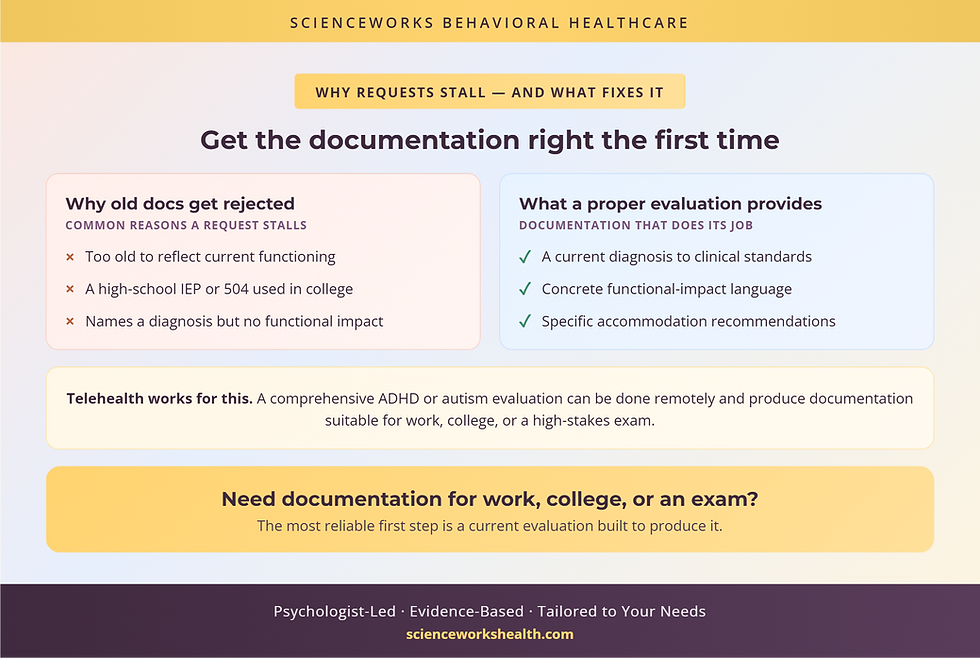
The recurring reasons a request stalls: documentation is too old to reflect current functioning (many colleges and testing agencies prefer evaluations within roughly the past few years, and some set explicit limits); a high-school IEP or 504 Plan is submitted but those operate under K–12 laws that no longer apply in college, so they may be deemed insufficient on their own [6]; or the letter states a diagnosis without describing functional impact or recommending specific accommodations. High-stakes testing bodies — the LSAT, MCAT, GRE, and similar — tend to be the strictest, which is why the exam-specific process deserves its own treatment in our guide to test accommodations for the SAT, LSAT, and MCAT.
⏳ Key takeaway: The top reasons accommodation requests fail are documentation that is too old, a K–12 IEP or 504 Plan used in a college setting, or a letter that names a diagnosis without describing functional impact.
What a proper evaluation provides for accommodations
A comprehensive ADHD or autism evaluation is built to produce exactly what accommodations require. Rather than a single questionnaire, it combines validated rating scales, structured clinical interviewing, and a developmental and functional history to document not only whether a condition is present, but how it affects you in real settings. A well-constructed report does the work that a vague note cannot: it establishes the diagnosis to current clinical standards [8], translates it into concrete functional limitations, and recommends accommodations tied to those limitations.
Because the standards for diagnosing ADHD and autism in adults call for a thorough, specialist-level assessment [9], an evaluation designed with accommodations in mind tends to clear documentation requirements that a brief note would not — and it gives you a single document you can bring to an employer, a disability-services office, or a testing agency. If you want the broader picture of what a thorough adult assessment looks like, our explainer on adult AuDHD evaluation walks through the components.
When you are choosing where to get evaluated, it helps to ask a provider a few direct questions:
Output: Will the report include functional-impact language and specific accommodation recommendations, or just a diagnosis?
Setting fit: Is the documentation appropriate for my specific need — workplace, college disability services, or a high-stakes exam — and does it meet that body's requirements?
Recency and scope: Is this a current, comprehensive evaluation that disability offices and testing agencies will accept?
Both conditions: If ADHD and autism are both possible, does the evaluation assess for both so I'm not back here later for a second letter?
Common accommodations for ADHD and autism (work and school)
Knowing what you can reasonably ask for helps you scope the request. Accommodations are always individualized — they depend on your specific limitations and the demands of the job or program — but common, well-established examples include the following.
At work: extended deadlines or flexible scheduling, written rather than verbal instructions, breaking large tasks into smaller steps, reduced-distraction workspaces or noise-canceling headphones, telework, and adjusted break schedules [4]. For autistic employees specifically, sensory and environmental adjustments and clear, structured communication are among the accommodations most consistently linked to better outcomes [5].
At college: extended time on exams, reduced-distraction testing environments, note-taking support or recorded lectures, priority registration, flexibility on attendance for disability-related reasons, and assignment-deadline flexibility [7]. The functional-impact section of your documentation is what justifies each of these — which is exactly why the quality of the evaluation matters.
🧩 Key takeaway: Accommodations are individualized, but common ones — extended time, written instructions, reduced-distraction settings, flexible scheduling — all trace back to documented functional impact. Build the documentation, and the request follows.
How telehealth evaluation and documentation works
You do not necessarily need to sit in a waiting room to get this done. A comprehensive ADHD or autism evaluation can be conducted via telehealth, using validated rating scales, structured interviews, and history-gathering — and the resulting report can serve as accommodation documentation for work or college. Telehealth has become a mainstream route to adult evaluation; nationally, about half of adults with ADHD have used telehealth for ADHD care [10]. The right fit depends on your setting's specific requirements and the complexity of your situation, which a qualified evaluator can confirm before you begin, so you are not surprised later.
A reasonable sequence is simple: confirm what your employer, college, or testing agency requires; complete a current, comprehensive evaluation with a qualified provider; and submit the resulting documentation through the appropriate channel — your HR or disability office, or the testing body's accommodation portal.
Next ste
Getting an accommodation letter does not have to be a maze. The throughline is straightforward: accommodations rest on current documentation from a qualified evaluator, and the best documentation connects your diagnosis to real functional impact and to the specific support you need. If you start with the right evaluation, the letter takes care of itself — and you arrive at HR or the disability office with a document that does its job the first time.
If you need documentation for work, college, or a high-stakes exam, the most reliable first step is a current evaluation built to produce it. We are glad to help you figure out exactly what your situation requires before you begin.
Wondering if ADHD explains the pattern?
A structured ADHD evaluation can tell you whether what you're noticing is ADHD, something else, or both — and what would actually help.
About ScienceWorks
ScienceWorks Behavioral Healthcare was founded by Dr. Kiesa Kelly, a licensed clinical psychologist with more than 20 years of experience in psychological assessment. Our team specializes in comprehensive ADHD and autism evaluations for adults and older teens — including evaluations designed to produce the documentation needed for workplace and college accommodations.
We are a telehealth-forward practice serving Tennessee. Our assessments combine validated instruments, structured clinical interviewing, and functional history to produce reports that establish a diagnosis and describe its real-world impact. Every article on this site is reviewed by a licensed clinician for accuracy before publication, and we believe readers make better decisions when they understand the process before they begin.
Frequently Asked Questions
What is an ADHD or autism accommodation letter, exactly?
It is documentation from a qualified evaluator that confirms a diagnosis and, importantly, describes how the condition functionally affects you in the relevant setting — at work or in school. A useful letter does more than state a diagnosis; it connects specific functional limitations to specific accommodations. Employers and disability-services offices use it to verify the need and decide which accommodations are reasonable.
Do I need a formal evaluation, or will a note from any doctor work?
For ADHD or autism accommodations, you generally need documentation from a professional qualified to diagnose and describe functional impact — typically a psychologist or physician familiar with the condition. A brief note may be enough for a simple workplace request, but colleges and high-stakes testing bodies usually require a comprehensive evaluation. An evaluation that documents your profile is the most reliable foundation for accommodations.
Will my high school IEP or 504 Plan work in college?
Often not on its own. IEPs and 504 Plans operate under K–12 laws that no longer apply once you enter college, so a college's disability-services office may find them insufficient. Colleges usually require current documentation that establishes the disability and its functional impact in a postsecondary setting. Information about what accommodations worked before is helpful, but a current evaluation is typically what's needed.
Why do accommodation requests get denied for old documentation?
Because accommodations are based on your current functional impact, and an evaluation from years ago may not reflect how the condition affects you now. Many colleges and testing agencies prefer documentation within roughly the past few years, and some specify limits. Old, vague, or diagnosis-only paperwork that doesn't connect limitations to specific accommodations is the most common reason a request stalls.
Can I get an accommodation evaluation and letter through telehealth?
Yes, in many cases. A comprehensive ADHD or autism evaluation can be conducted via telehealth using validated tools, structured interviews, and history-gathering, producing documentation suitable for work or college accommodations. The right approach depends on the setting's requirements and the complexity of your situation, which a qualified evaluator can confirm before you begin.
References
1. Reasonable Accommodations in the Workplace. ADA National Network. https://adata.org/factsheet/reasonable-accommodations-workplace
2. Postsecondary Institutions and Students With Disabilities. ADA National Network. https://adata.org/factsheet/postsecondary
3. Enforcement Guidance on Reasonable Accommodation and Undue Hardship under the ADA. U.S. Equal Employment Opportunity Commission. https://www.eeoc.gov/laws/guidance/enforcement-guidance-reasonable-accommodation-and-undue-hardship-under-ada
4. The Mental Health Provider's Role in a Client's Request for a Reasonable Accommodation at Work. U.S. Equal Employment Opportunity Commission. https://www.eeoc.gov/laws/guidance/mental-health-providers-role-clients-request-reasonable-accommodation-work
5. Workplace Accommodations and Employment Outcomes Among Employees With Autism: A Systematic Review. 2025. https://www.ncbi.nlm.nih.gov/pmc/articles/PMC12805453/
6. Auxiliary Aids and Services for Postsecondary Students with Disabilities. U.S. Department of Education. https://www.ed.gov/laws-and-policy/individuals-disabilities/auxiliary-aids-and-services-for-postsecondary-students-with-disabilities
7. A survey of knowledge and perceptions of ADHD and autism spectrum disorder in the workplace at a large corporation. Sci Rep. 2025. https://www.nature.com/articles/s41598-025-17470-8
8. American Psychiatric Association. Diagnostic and Statistical Manual of Mental Disorders, Fifth Edition, Text Revision (DSM-5-TR). 2022. https://www.psychiatry.org/psychiatrists/practice/dsm
9. National Institute for Health and Care Excellence. Attention deficit hyperactivity disorder: diagnosis and management (NG87). https://www.nice.org.uk/guidance/ng87
10. Attention-Deficit/Hyperactivity Disorder Diagnosis, Treatment, and Telehealth Use in Adults. MMWR Morb Mortal Wkly Rep. 2024. https://www.cdc.gov/mmwr/volumes/73/wr/mm7340a1.htm
Disclaimer
This article is for informational and educational purposes only. It is not legal advice, medical advice, or a substitute for professional evaluation, and reading it does not establish a clinician–patient relationship. Accommodation laws and documentation requirements vary by employer, institution, and testing agency, and final accommodation decisions are made by those entities, not by an evaluator. For guidance on your specific legal rights, consult a qualified attorney or your disability-services office. If you are struggling with your mental health, please reach out to a licensed clinician.