
Adult Autism Evaluation in Memphis, TN | ScienceWorks

Updated: Jul 6
Last reviewed: 05/21/2026
Reviewed by: Dr. Kiesa Kelly

If you are looking into an adult autism evaluation in Memphis, two things probably worry you most: the cost, and the wait. Both are hard to pin down. Prices are rarely posted, "evaluation" can mean very different things from one provider to the next, and local waitlists can stretch for months. It is easy to feel like you are being asked to spend real money on something you cannot see clearly.
This guide makes both the cost and the wait legible. You will learn exactly what a thorough adult autism evaluation includes, what your fee actually buys, how the Memphis landscape affects your wait, and how to get seen sooner without sacrificing quality.
In this article, you'll learn:
What an adult autism evaluation includes and what the fee actually buys
Why waits stretch in the Memphis area, and what shortens them
How statewide telehealth works for West Tennessee adults
How insurance and out-of-pocket cost typically work here
A faster, screener-first path to answers
Adult autism evaluation in Memphis: the short version
An adult autism evaluation is a structured clinical assessment, not a single test or an online quiz. A licensed clinician gathers your developmental and life history, uses validated tools, and weighs everything against established diagnostic criteria before reaching a conclusion. You can see the scope of this work on our psychological assessments page.
Here is the honest summary on cost and speed. The fee tracks clinician time and depth — a real evaluation is hours of skilled work, not a form. And the long part is almost always the wait to start, not the evaluation itself. The good news is that the wait is the part you have the most power to change.
The Memphis assessment landscape and why waits stretch
Demand for adult autism evaluations has grown much faster than the number of clinicians who do them well, and Memphis is no exception. Adult-focused autism specialists are relatively scarce, each evaluation takes meaningful time, and many practices prioritize children or have closed their waitlists. A Memphis adult calling around locally may be quoted a wait measured in seasons.
This is a national pattern, not a Memphis failing. A recent systematic review found that late diagnosis in autism is now widespread and still poorly handled by the systems meant to address it [5]. We unpack the statewide picture — and what your fee pays for — in our companion guide to adult autism evaluation in Tennessee: what you're paying for and why waitlists get so long, and the broader mechanics in our look at why these evaluations have such long waitlists and how to get answers sooner.
⏳ Key takeaway: In Memphis, the evaluation takes a matter of weeks once it begins — the waitlist is the real delay, and it is the part you can sidestep.

What an adult autism evaluation includes — and what the fee buys
This is the heart of "what you're paying for." A quality evaluation answers one question carefully: does your lifelong pattern of experiences fit the criteria for autism? Doing that responsibly takes more than a single appointment, which is why current guidance from the American Psychiatric Association and the UK's National Institute for Health and Care Excellence emphasizes developmental history and multiple sources of information [1][2].
Intake and history
The first part is a detailed conversation about your history — childhood, school, relationships, work, sensory experiences, and the strategies you have used to get by. Many adults are asked to reflect on patterns they have never put into words. If a brief screener like the AQ-10 autism screener flagged autistic traits for you, that result becomes a starting point here, not a verdict.
Testing
The core session combines structured interview questions with validated questionnaires designed to surface the lived patterns of autism — social communication style, sensory sensitivities, routines, and the cost of masking. This is the part that separates a thorough evaluation from a thin one, and it is a large share of what your fee covers: skilled clinician time, not paperwork.
Feedback and report
You should never be left to interpret your own results. A quality evaluation ends with a feedback session — overseen at our practice by clinical psychologist Dr. Kiesa Kelly — where the findings are explained in plain language, and a written report with specific recommendations. For most adults, that report is the single most valuable thing the fee buys.
💡 Key takeaway: Your fee pays for skilled clinician hours and a usable written report — not a questionnaire. If a quote does not include feedback and a report, you are not paying for a full evaluation.
Three things people get wrong about adult autism evaluation
Before the cost details, a few beliefs worth clearing up — especially the ones that make people overpay or underbuy.
"The cheapest evaluation is basically the same as an expensive one." Not necessarily. A bargain price often means a shorter process with no feedback session and a thin or generic report. Because the point of an evaluation is a usable, accurate result, the "cheap" option can cost you more if you end up needing a real one later.
"If I were autistic, it would have been caught in childhood." Many autistic adults were missed, especially those who learned to mask or whose presentation did not match the older stereotype. Researchers describe a "lost generation" of adults who reached adulthood without identification, and late diagnosis is now well-documented [3][6]. Being missed as a child is common, not disqualifying.
"I have a career and relationships, so I can't be autistic." Autism is not defined by visible struggle. Many autistic adults succeed at work and in relationships by working far harder behind the scenes to appear "fine" — a pattern called camouflaging or masking that can hide autistic traits while quietly draining the person doing it [7]. Functioning well in public does not rule autism out.
In-person vs. statewide telehealth for West Tennessee
Because so much of an adult autism evaluation is interview-based, it is well suited to secure video. We evaluate adults across Tennessee by telehealth, which means a Memphis or wider West Tennessee adult can usually start within weeks instead of joining a months-long local waitlist. You can meet the clinicians who do this work on our team page.
Telehealth is not automatically right for everyone, so here is a simple decision rule. If your main barriers are the local waitlist, travel, time off work, or the sensory load of an unfamiliar office, telehealth is very likely your fastest and most comfortable path. If you specifically need a component done in person, or you simply focus better in a physical room, an in-person option may suit you despite a longer wait. Either way, ask the provider which parts of their evaluation are done remotely.
🛰️ Key takeaway: For most West Tennessee adults, statewide telehealth removes the waitlist and travel barriers while keeping the evaluation — and the diagnosis — every bit as valid.
Cost and insurance logistics in Memphis
Let's be direct about money. An adult autism evaluation is priced by clinician time and complexity, which is why a thorough evaluation costs more than a quick screening — and is worth more. The main cost drivers are the number of validated instruments used, whether co-occurring conditions like ADHD or anxiety are also considered, the depth of the history-gathering, and how detailed the written report is.
Insurance coverage for adult autism evaluation varies widely by plan in Tennessee. Some plans cover part of the cost, some apply it to a deductible, and many adults pay out of pocket. We keep our pricing transparent, give you a clear quote before you commit, and can provide documentation like a superbill so you can pursue any reimbursement your plan allows. If you want a no-cost first step, our mental health screening overview is a good place to begin.
The one thing worth protecting against is paying for an evaluation too thin to use. A real evaluation always includes a feedback session and a written report with recommendations — if a quoted price does not, ask what you are actually getting.
💲 Key takeaway: Cost reflects depth and skilled time; the smartest comparison is not the lowest price but what is included — confirm feedback and a usable report before booking anywhere.
Does this sound familiar?
Two everyday patterns capture why adults in Memphis start looking into an evaluation in the first place.
You have spent your whole life feeling like socializing runs on a battery that drains faster than everyone else's. You can be warm and capable in a meeting or at a family dinner, but afterward you need hours alone to recover, and you have quietly built your life around limiting that drain. You script conversations in advance, dread small talk, and notice textures, sounds, or lighting that others seem not to register. From the outside you look fine; on the inside, "fine" takes constant effort.
Or: routines and systems are how you hold your life together, and disruptions cost you far more than they seem to cost others. A canceled plan, an unexpected change at work, or a noisy open office can derail your whole day. You have been called "intense," "particular," or "too sensitive," and you have wondered for years whether something deeper explains the pattern — without ever having a name for it.
Questions to ask before you book
Whether you choose us or another Memphis-area provider, these questions separate a thorough evaluation from a thin one:
Scope: Does the evaluation assess autism specifically, and will it consider co-occurring conditions like ADHD, anxiety, or depression if relevant?
Methodology: How does the evaluation account for masking and lifelong compensation in adults, not just how I present in one appointment?
Developmental history: What history do you gather, and what happens if I do not have childhood records or someone who knew me as a child?
Output: What exactly do I receive — a diagnosis, a written report, and specific recommendations I can use?
Cost transparency: Will I get a clear, all-in quote up front, and does it include the feedback session and report?
📋 Key takeaway: A provider who answers these five questions clearly — including the cost question — is far more likely to deliver an evaluation worth your money.
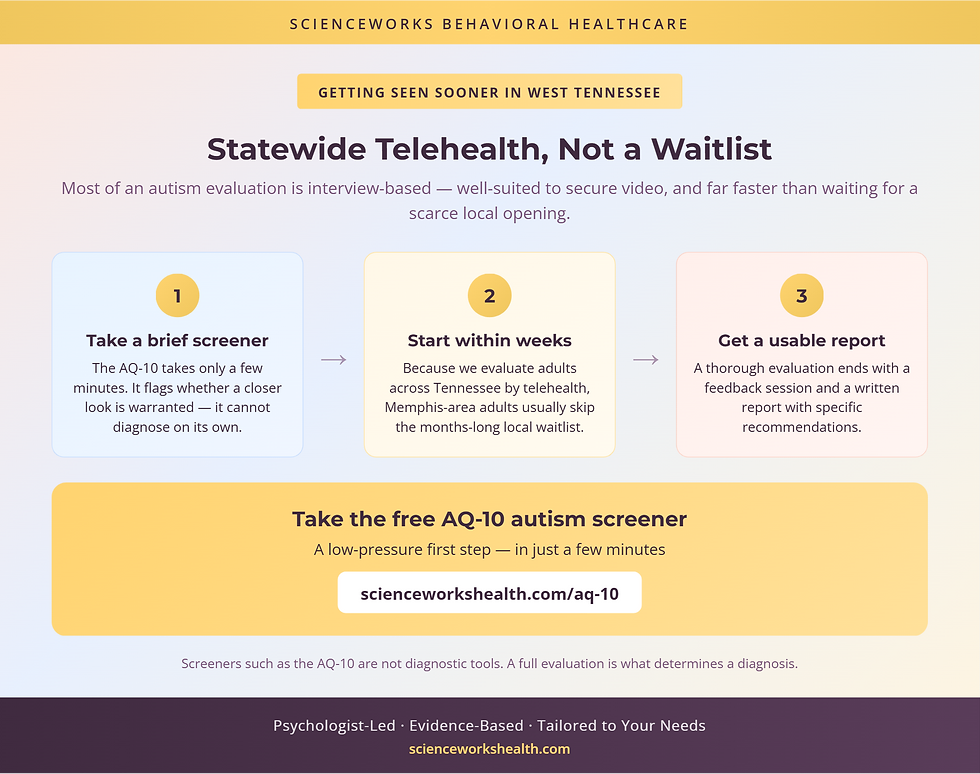
Getting seen sooner
The fastest path is rarely "wait for a local opening." It is to get scheduled with a provider who has near-term availability, which for West Tennessee usually means telehealth.
Start with a screener
A short, validated screener is a low-pressure first step. It will not diagnose you, but it tells you whether a full evaluation is warranted and gives a clinician a head start. The AQ-10 autism screener takes only a few minutes. If the result points toward a closer look, you will already have something useful in hand, and you can reach out to us to ask about current availability.
Consider an adult autism evaluation that accounts for masking and lifelong compensation — not just the older, narrower picture — so the results reflect how autism actually shows up for you. If the patterns in this guide feel familiar, a thorough evaluation is the most honest next step.
Frequently Asked Questions
Does insurance cover an adult autism evaluation in Tennessee?
It depends on your plan. Some Tennessee plans cover part of an adult autism evaluation, others apply it to a deductible, and many adults pay out of pocket. Coverage often hinges on medical necessity and your specific benefits. We can provide a superbill so you can seek any reimbursement your plan allows, and we will be clear about cost before you commit so there are no surprises.
How soon can I get an adult autism evaluation in Memphis?
Often within a few weeks, rather than the months a local in-person waitlist can take. Because we evaluate adults across Tennessee by telehealth, Memphis-area adults usually do not have to wait for a scarce local opening. Completing a short screener like the AQ-10 first can also make intake faster by giving the clinician a clear starting point.
Can an adult autism evaluation be done through telehealth in West Tennessee?
Yes. Most of an adult autism evaluation is interview-based and uses structured questionnaires, which work well over secure video. We serve the Memphis area and the rest of West Tennessee by telehealth, which usually means a shorter wait than in-person options. If any part of your specific evaluation is better done in person, we will tell you upfront.
Is a cheaper adult autism evaluation worth it?
Sometimes, but price alone is a poor guide. A very low fee can mean a thin evaluation with no feedback session and no usable written report, which leaves you paying again later. Focus on what is included rather than the sticker price: a thorough evaluation gathers real history, uses validated tools, and ends with a report and recommendations you can actually act on.
What do I actually get for the cost of an adult autism evaluation?
A thorough evaluation should give you more than a yes-or-no answer. You get a structured assessment of your history and current experiences, results from validated tools, a feedback session that explains what was found, and a written report with specific recommendations. For many adults, that report — usable for support, accommodations, or further care — is the most valuable part of the fee.
About ScienceWorks
ScienceWorks Behavioral Healthcare was founded by Dr. Kiesa Kelly, a licensed clinical psychologist with more than 20 years of experience in psychological assessment and evidence-based treatment. Our clinical team focuses on adult and adolescent evaluations for autism, ADHD, anxiety, OCD, trauma, and related concerns, with particular attention to adults whose neurodevelopmental differences were missed earlier in life.
We are a telehealth-forward practice serving Tennessee, including Memphis and the wider West Tennessee region, which lets us offer adult autism evaluation without the long in-person waitlists many adults encounter. Every article we publish is reviewed by a licensed clinician for accuracy before publication, and every evaluation ends with a clear explanation of what was found and what to do next.
References
1. American Psychiatric Association. Diagnostic and Statistical Manual of Mental Disorders, Fifth Edition, Text Revision (DSM-5-TR). https://www.psychiatry.org/psychiatrists/practice/dsm
2. National Institute for Health and Care Excellence. Autism spectrum disorder in adults: diagnosis and management (CG142). https://www.nice.org.uk/guidance/cg142
3. Lai MC, Baron-Cohen S. Identifying the lost generation of adults with autism spectrum conditions. Lancet Psychiatry. 2015;2(11):1013-1027. https://pubmed.ncbi.nlm.nih.gov/26544750/
4. Allison C, Auyeung B, Baron-Cohen S. Toward brief "red flags" for autism screening: the Short Autism Spectrum Quotient and the Short Quantitative Checklist (AQ-10) in 1,000 cases and 3,000 controls. J Am Acad Child Adolesc Psychiatry. 2012;51(2):202-212. https://pubmed.ncbi.nlm.nih.gov/22265366/
5. Russell G, et al. Who, when, where, and why: A systematic review of "late diagnosis" in autism. Autism Research. 2025. https://onlinelibrary.wiley.com/doi/10.1002/aur.3278
6. Huang Y, Arnold SR, Foley KR, Trollor JN. Diagnosis of autism in adulthood: A scoping review. Autism. 2020;24(6):1311-1327. https://pubmed.ncbi.nlm.nih.gov/32106698/
7. Hull L, Petrides KV, Allison C, et al. "Putting on My Best Normal": Social Camouflaging in Adults with Autism Spectrum Conditions. J Autism Dev Disord. 2017;47(8):2519-2534. https://pubmed.ncbi.nlm.nih.gov/28527095/
8. Cook J, Hull L, Mandy W. Improving Diagnostic Procedures in Autism for Girls and Women: A Narrative Review. Neuropsychiatr Dis Treat. 2024;20:505-514. https://pubmed.ncbi.nlm.nih.gov/38469208/
9. Dietz PM, Rose CE, McArthur D, Maenner M. National and State Estimates of Adults with Autism Spectrum Disorder. J Autism Dev Disord. 2020;50(12):4258-4266. https://pmc.ncbi.nlm.nih.gov/articles/PMC9128411/
10. Centers for Disease Control and Prevention. Autism Spectrum Disorder in Teenagers and Adults. https://www.cdc.gov/autism/about/asd-in-teenagers-adults.html
Disclaimer
This article is for informational and educational purposes only and is not a substitute for professional medical advice, diagnosis, or treatment. Reading it does not create a clinician–patient relationship. Screeners such as the AQ-10 are not diagnostic tools. If you have questions about autism, your mental health, or whether an evaluation is right for you, consult a qualified licensed professional.