
Adult Autism Evaluation: What a Full Assessment Clarifies

Updated: May 8
Last reviewed: 03/23/2026
Reviewed by: Dr. Kiesa Kelly
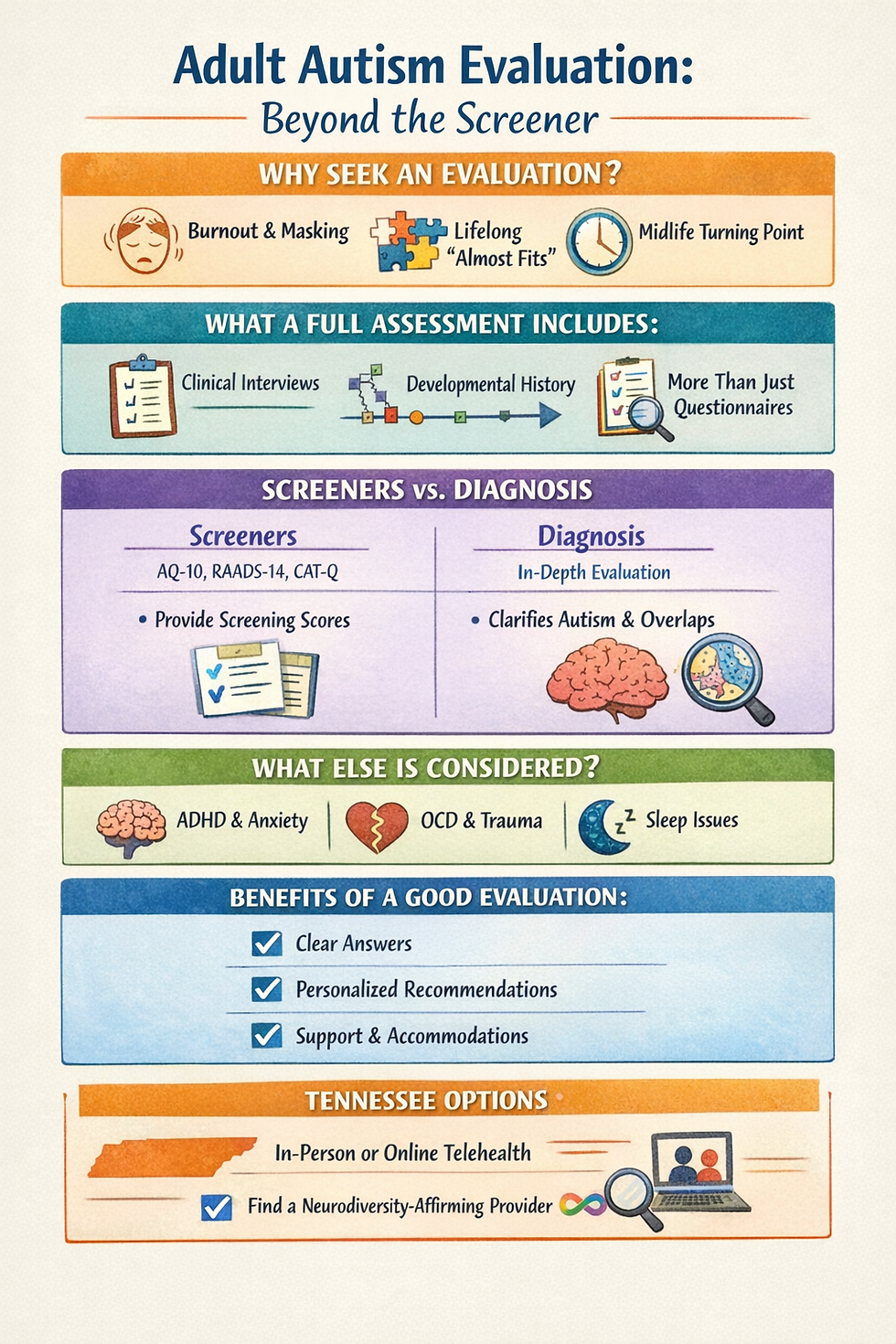
If you have been searching for an adult autism evaluation you can actually use, you may already know how quickly the conversation gets reduced to one number. A screener can be useful, but a full evaluation is meant to do something much more important: clarify whether your lifelong pattern fits autism, what may overlap with it, and what recommendations make sense for work, school, relationships, and daily life.[1-4]
In this article, you’ll learn:
why many adults start asking this question in midlife
what a real assessment usually includes beyond a quiz
what AQ-10, RAADS-14, and CAT-Q scores can and cannot tell you
why ADHD, anxiety, trauma, OCD, and sleep often matter in the differential picture
what a strong report should give you after the evaluation
what to ask about online options in Tennessee
🌱 Key takeaway: A screener can raise a flag. It cannot replace a clinician’s job of looking across history, context, overlap, and daily functioning.[2-4]
Why people seek an autism evaluation in adulthood
Burnout, masking, and lifelong “almost fits”
Many adults do not start with “I think I am autistic.” They start with exhaustion. Social interaction may take too much planning, sensory stress may linger too long, or your story keeps sounding like “almost ADHD,” “almost OCD,” or “almost just stress.”
That pattern makes sense. Autism is lifelong, but recognition often comes later, especially when someone has spent years masking or compensating.[1][4][7] Research links masking with burnout, anxiety, depression, and missed or delayed identification.[5][7]
🔎 Key takeaway: Looking fine from the outside does not tell you how much effort, recovery time, or distress is happening underneath.[4][7]
Why midlife is a common turning point
Midlife is a common turning point not because autism suddenly appears in your 30s, 40s, or 50s, but because work, parenting, caregiving, health changes, or reduced energy for masking can make an old coping style stop working.
Late diagnosed autism in women is especially relevant here. Research suggests autistic women are more likely to be missed or diagnosed later because traits may present less obviously and internalizing symptoms often get noticed first.[7][8] For some people, a child’s diagnosis is also the first time their own pattern clicks into place.
🧭 Key takeaway: Midlife evaluation is often less about “finding something new” and more about finally naming something old with better accuracy and less self-blame.[1][7][8]
What an adult autism evaluation usually includes
Interview, developmental history, and pattern review
A strong adult autism assessment is not just one questionnaire. Best-practice guidance emphasizes multiple methods and sources, including a clinical interview, developmental history, review of sensory and repetitive patterns, and attention to functioning across settings.[2][4]
Even when childhood records are limited, clinicians still look for early patterns through your own examples, family recollections when available, school history, and repeated long-term themes.[1][4]
In our psychological assessments process, we start with a free consultation and then build a custom package using interviews plus science-backed screening tools chosen for the actual question you need answered.[9]
Why it is more than one questionnaire
Questionnaires can help organize information, but they are not the diagnosis. Some tools screen for autistic traits. Some capture masking. Some help compare autism with ADHD, OCD, anxiety, depression, or trauma. A thoughtful evaluator may combine self-report measures, informant data when available, and clinician-led interviews or structured observations.[2][4]
That is why tools like the AQ-10 screener and other mental health screening tools are best treated as starting points rather than finish lines.[3][9]
🧩 Key takeaway: The point of an evaluation is not to collect as many tests as possible. It is to answer the right clinical question with enough context to trust the answer.[4][9]
What screeners can and cannot clarify
AQ-10, RAADS-14, and CAT-Q in context
The AQ-10 is recommended by NICE as a brief screening tool for adults with possible autism who do not have a moderate or severe learning disability, but NICE still treats it as a referral aid, not a diagnosis.[2][3] Their later surveillance review also noted concerns about AQ-10 validity and confirmed that clinical judgment still matters, including when autism is suspected despite a lower score.[3]
RAADS-14 was developed as a short screening measure for adult psychiatric settings, where autism can be missed because symptoms overlap with other conditions.[6] CAT-Q, by contrast, measures camouflaging. That can be useful when someone has learned to copy social behavior or suppress visible autistic traits, but it is not specific enough to stand alone because anxiety and other factors can also raise camouflaging scores.[4][5]
Why scores do not replace clinical judgment
A score is data. Diagnosis is reasoning. Clinicians still have to ask whether the pattern is lifelong, whether it shows up across settings, whether it fits DSM-based autism criteria, and whether another explanation fits better, worse, or alongside it.[1][4]
This is where many adults feel relief. Instead of staying stuck in “my score was high, now what?” or “my score was low, so maybe I imagined this,” you get a fuller explanation of what the data means in context.[3][4]
📝 Key takeaway: A useful report does not just list scores. It explains how the pieces do or do not fit together clinically.[4]
What else clinicians may consider
ADHD, anxiety, trauma, OCD, and sleep
Adults seeking autism assessment often also have questions about ADHD, anxiety, obsessive-compulsive symptoms, trauma, depression, or chronic sleep disruption. These can overlap with autism, coexist with it, or sometimes account for parts of the picture that first looked autistic.[4][8]
That is why differential diagnosis matters so much. Social fatigue can reflect masking, but it can also be amplified by panic, trauma, or insomnia. Repetitive thoughts may reflect autistic sameness needs, OCD, or both. If those overlap questions are active for you, it may help to also review resources related to OCD, trauma, or insomnia while you decide what kind of assessment you need.[8][9]
Why overlap does not cancel autism out
One common misconception is that overlap rules autism out. It does not. In fact, overlap is part of why adults seek assessment in the first place. Research on autistic adults shows that prior psychiatric diagnoses and perceived misdiagnoses are common, especially in women.[8]
⚖️ Key takeaway: “There is overlap” is not the end of the conversation. It is the reason a careful assessment can be so helpful.[4][8]
What you get from a good evaluation
Diagnostic clarity, recommendations, and accommodations
The most useful outcome is not just a label. It is a written explanation of how the conclusion was reached, what diagnoses were or were not supported, what supports make sense, and whether documentation may help with accommodations.[4][9]
That can matter in practical ways. A report may help you request workplace adjustments, understand sensory boundaries, plan therapy more accurately, or stop chasing the wrong explanation.[9]
Why language and framing matter
Language matters because an evaluation can feel either shaming or clarifying. A neurodiversity-affirming clinician should still be clinically rigorous, but the framing should help you understand your pattern rather than reduce you to deficits. It should also be honest about limits.
💬 Key takeaway: A good evaluation should leave you with more clarity and more self-understanding, not just more paperwork.[4][9]
Adult autism evaluation Tennessee: online options and what to ask before booking
What to ask before booking
If you are considering an online autism evaluation, ask practical questions first. Is the clinician licensed in Tennessee, or otherwise authorized to practice telepsychology where you are physically located? Tennessee licenses psychologists through the Board of Examiners of Psychology, and Tennessee also recognizes PSYPACT for psychologists with the appropriate telepsychology authorization.[10][11]
Then ask clinical questions. How do they gather developmental history? What do they use besides screeners? How do they address overlap with ADHD, anxiety, trauma, OCD, and sleep issues? What does the written report include? If you need documentation for accommodations, ask that before you book, not after.[2][4][9-11]
How to find a neurodiversity-affirming evaluator
Look for an evaluator who can explain both affirmation and differential diagnosis. You want someone who respects autistic adults and understands masking, especially in women and others whose presentation may be less stereotyped, while also being willing to say when a different explanation fits better.[4][7][8]
At ScienceWorks, our adult ADHD and autism assessments are offered by secure telehealth for clients physically located in Tennessee, and many adults find that being at home reduces sensory overload and logistical stress during the process.[10] When you are ready to compare options or talk through fit, you can schedule a free consultation or meet our team to see whether our approach matches what you need.[10][12]
The bottom line is simple: a screener score can point you toward the question. A full assessment is what helps clarify the answer, the overlap, and the next step that fits your real life.[1-4]
Frequently Asked Questions
What can a comprehensive autism evaluation tell me that a screener can't?
A screener like the AQ-10 or RAADS-R tells you whether your self-reported traits align with autistic profiles at a threshold level. A comprehensive evaluation goes further: it establishes whether those traits meet diagnostic criteria across multiple informant sources and developmental contexts, rules out or identifies conditions that produce similar presentations (ADHD, anxiety, trauma, sensory processing differences), and captures the specific profile of strengths and challenges that is unique to you. It also produces documentation — a formal report from a licensed psychologist — that carries weight for workplace accommodations, disability services, and insurance purposes. Screeners can't do any of that.
Can an autism evaluation also identify ADHD at the same time?
Yes, and this is one of the key advantages of a comprehensive psychological evaluation over a narrow screener or single-condition assessment. ADHD and autism co-occur frequently — estimates range from 30–80% depending on the sample and diagnostic criteria used — and they interact in ways that affect both diagnosis and treatment planning. An evaluator assessing for autism who also administers ADHD-sensitive instruments and conducts a thorough developmental history can establish whether both conditions are present, which symptoms belong to which diagnosis, and how the interaction between them shapes the clinical picture. If you're pursuing an autism evaluation and haven't been assessed for ADHD, it's worth asking whether the evaluation protocol includes ADHD screening.
How long does a comprehensive adult autism evaluation take?
A thorough adult autism evaluation typically takes 4 to 10 hours of direct assessment time, spread across one to three appointments. This includes the clinical interview (which alone can take 60–90 minutes for adults with complex histories), standardized instruments like the ADOS-2 adapted for adults or the ADI-R, self-report measures, and cognitive or neuropsychological testing when indicated. After the assessment appointments, the evaluator spends additional time scoring instruments, integrating findings, writing the report, and preparing for the feedback session. The total process from intake to written report is typically 3 to 6 weeks depending on the practice's schedule and report turnaround.
About the Author
Dr. Kiesa Kelly earned her PhD in Clinical Psychology, with a concentration in Neuropsychology, from Rosalind Franklin University of Medicine and Science. Her training included practica, internship, and an NIH-funded postdoctoral fellowship at the University of Chicago, the University of Wisconsin, the University of Florida, and Vanderbilt University.[13]
Her background includes more than 20 years of experience with psychological assessments, and her NIH postdoctoral fellowship focused on ADHD in both research and clinical settings.[13]
References
Centers for Disease Control and Prevention. Clinical testing and diagnosis for autism spectrum disorder. Updated May 8, 2025. Available from: https://www.cdc.gov/autism/hcp/diagnosis/index.html
National Institute for Health and Care Excellence. Autism spectrum disorder in adults: diagnosis and management (CG142). Last updated June 14, 2021. Available from: https://www.nice.org.uk/guidance/cg142
National Institute for Health and Care Excellence. 2021 surveillance of autism guidelines CG128, CG142 and CG170. June 14, 2021. Available from: https://www.nice.org.uk/guidance/cg142/resources/2021-surveillance-of-autism-nice-guidelines-cg128-cg142-and-cg170-9140525965/chapter/Surveillance-decision?tab=evidence
Pagán AF, Flint DD, Loveland KA. Diagnosing autism in adults: clinically focused recommendations. J Health Serv Psychol. 2024;50(2):103-111. Available from: https://doi.org/10.1007/s42843-024-00108-0
Hull L, Mandy W, Lai MC, Baron-Cohen S, Allison C, Smith P, et al. Development and validation of the Camouflaging Autistic Traits Questionnaire (CAT-Q). J Autism Dev Disord. 2019;49(3):819-833. Available from: https://doi.org/10.1007/s10803-018-3792-6
Eriksson JM, Andersen LMJ, Bejerot S. RAADS-14 Screen: validity of a screening tool for autism spectrum disorder in an adult psychiatric population. Mol Autism. 2013;4:49. Available from: https://doi.org/10.1186/2040-2392-4-49
Belcher HL, Morein-Zamir S, Stagg SD, Ford RM. Shining a light on a hidden population: social functioning and mental health in women reporting autistic traits but lacking diagnosis. J Autism Dev Disord. 2023;53(8):3118-3132. Available from: https://doi.org/10.1007/s10803-022-05583-2
Kentrou V, Livingston LA, Grove R, Hoekstra RA, Begeer S. Perceived misdiagnosis of psychiatric conditions in autistic adults. eClinicalMedicine. 2024;71:102586. Available from: https://doi.org/10.1016/j.eclinm.2024.102586
ScienceWorks Behavioral Healthcare. Psychological assessments. Available from: https://www.scienceworkshealth.com/psychological-assessments
ScienceWorks Behavioral Healthcare. ADHD and autism assessments for adults and older teens in Tennessee. Available from: https://www.scienceworkshealth.com/info/adhd-and-autism-assessments-for-adults-and-older-teens-in-tennessee
Tennessee Department of Health. Board of Examiners of Psychology. Available from: https://www.tn.gov/health/health/licensure/psy.html
Tennessee Department of Health. MultiState regulations: PSYPACT. Available from: https://www.tn.gov/health/health-program-areas/health-professional-boards/psychology-board/psych-board/multistate-regulations.html
ScienceWorks Behavioral Healthcare. Kiesa Kelly, PhD. Available from: https://www.scienceworkshealth.com/kiesakelly
Disclaimer
This article is for informational purposes only and is not a substitute for medical or mental health diagnosis, treatment, or individualized advice. Reading this article does not create a clinician-client relationship with ScienceWorks Behavioral Healthcare.