
Executive Function Coaching for College Students in Tennessee
- Ryan Burns

- 12 minutes ago
- 13 min read
Last reviewed: 06/15/2026
Reviewed by: Dr. Kiesa Kelly

A bright student who coasted through high school can hit college and quietly come apart. The reading gets done late or not at all, deadlines slip, the room is a mess, and the gap between how capable they are and how their semester is going keeps widening. Parents often describe it the same way: "She is so smart. I don't understand why she can't just do the work." That gap is rarely about intelligence or effort. It is usually about executive function — the brain's set of planning, starting, organizing, and follow-through skills — meeting a college environment that suddenly stops doing those things for the student.
Executive function coaching for college students is a practical, skills-based support that helps a student build the external systems college assumes they already have. This article explains what coaching is, how to tell when it would help, how a coaching engagement actually works, how coaching differs from tutoring and therapy, what the evidence says, where a formal evaluation fits, and what it costs. It is written for Tennessee families and students, including those who want to keep the same support after a move or across a study-abroad term.
In this article, you'll learn:
What executive function coaching is, in one paragraph
The signs a college student could benefit from it — and the "executive function cliff"
How a coaching engagement actually works, week to week
How coaching differs from tutoring and from therapy
What the research does and does not show about effectiveness
What coaching costs, and where a formal evaluation fits
What executive function coaching is — the short answer
Executive function coaching is a structured, action-oriented partnership that helps a student build and run the practical systems behind getting work done: planning a week, breaking big tasks into startable pieces, tracking deadlines, managing time, and following through when motivation runs out. A coach does not teach the course material and does not treat a mental health condition. A coach helps the student design a system that fits how their brain actually works, then holds steady accountability while the student practices using it. If you want the broader picture of what this looks like as an ongoing service, our executive function coaching page walks through the format.
The reason this matters in college specifically is that executive function is exactly the thing college stops scaffolding. In high school, a great deal of executive work happens off-stage — a parent checks the calendar, a teacher reminds the class about the test, the school day is blocked into fixed periods. College removes most of that structure at once and hands it to an eighteen-year-old whose executive skills are still developing. Coaching rebuilds that scaffold deliberately, on the student's side of the desk.
Signs a college student could benefit — and the "executive function cliff"
The clearest signal is a widening gap between ability and output. The student understands the material in class but cannot reliably convert that understanding into finished, turned-in work. This pattern shows up most sharply right after a transition, which is why clinicians often describe the move to college as an "executive function cliff" — the external supports drop away faster than the student's own systems can take over. We cover that transition in depth in our guide to starting college with ADHD or autism, and the pattern is worth naming early because it is so often misread as laziness.
Here is what the cliff can look like from inside a semester. A first-year student does fine in the first two weeks while the workload is light and the dorm is still novel. By week four, three reading-heavy courses have stacked up, there are no daily reminders, and nothing is due today — so nothing gets started. She knows exactly what she needs to read and writes it on a sticky note that joins five other sticky notes. The first paper is assigned three weeks out, which her brain files under "not now," and she does not think about it again until the night before, when she pulls an all-nighter, turns in something rushed, and privately concludes she is just bad at college.
Or: a capable sophomore can lock in and study brilliantly the night before an exam because the deadline finally feels real, but cannot start the slow, boring work of a research paper that has no looming consequence yet. He overfunctions in bursts and then crashes, and the inconsistency itself becomes the problem — professors see a student who aced the midterm and skipped three assignments, and they cannot tell that both came from the same underlying difficulty regulating activation.
A few misconceptions keep families stuck here, and they are worth correcting directly.
"If she were really struggling, she'd have struggled in high school too." Not necessarily. High school provides so much built-in structure that executive function gaps can stay hidden for years; the difficulty becomes visible only when the scaffolding is removed. A strong high school GPA does not rule out an executive function problem — it can simply mean the environment was carrying the load.
"He just needs to try harder." Effort is rarely the missing ingredient. Many of these students are trying intensely and exhaustingly, just not in a way that produces steady output, because the problem is regulating activation and attention, not a lack of caring. Telling someone to try harder at a skill they have not been taught to scaffold tends to add shame without adding follow-through.
"Coaching is just hand-holding that delays real independence." Good coaching is the opposite. The goal is to make the student less dependent over time by helping them internalize systems they can eventually run themselves — the same way a physical therapist builds toward you not needing the physical therapist.
📋 Key takeaway: The signature of an executive function problem in college is a gap between understanding and finishing — not a lack of intelligence, and not always a history of obvious struggle.
How a coaching engagement actually works
Coaching is regular, structured, and collaborative rather than open-ended advice. Most engagements run as weekly sessions, often by video, with brief check-ins between sessions to support follow-through. A typical arc looks like this: the coach and student start by clarifying goals and mapping where the breakdowns happen — is it starting tasks, planning the week, tracking deadlines, managing distraction, or recovering after falling behind? From there they build a concrete system together: a weekly planning routine, a way to break assignments into startable steps, calendar and reminder tools the student will actually use, and a realistic study structure.
Then the real work begins, which is practicing that system under real conditions and adjusting it when it breaks. A coach is not there to nag; they are there to help the student notice patterns, troubleshoot what is not working, and rebuild momentum after the inevitable bad week. Accountability in coaching is supportive, not punitive — the point is steady practice, not perfect compliance.
Several research-supported skills tend to anchor the work: time management, organization, planning and prioritization, and self-regulation strategies, including how to recover after a setback rather than spiral [1][2]. If you want a quick read on where a student's executive functioning is strongest and weakest before starting, a brief self-report screener like the ESQ-R executive functioning screener can give a useful starting map — though a screener is a starting point, not a diagnosis.
📋 Key takeaway: Coaching is a build-and-practice loop — design a system that fits the student, then practice running it and adjust it week to week.
How coaching differs from tutoring and from therapy
This is the distinction families most need clarified, because the three supports are easy to confuse and serve genuinely different jobs.
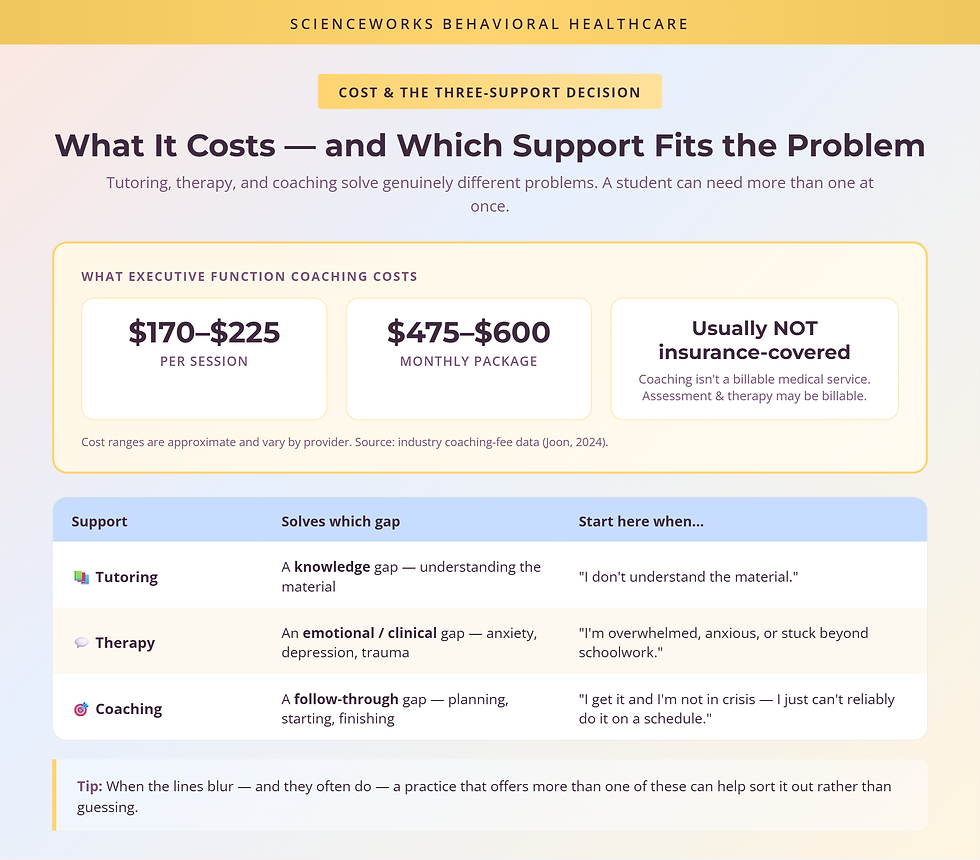
Tutoring teaches content. A tutor helps a student understand organic chemistry, write a stronger thesis, or work through a problem set. If the difficulty is "I don't understand the material," tutoring is the right tool.
Therapy treats mental health and emotional concerns. A therapist helps with anxiety, depression, trauma, or the emotional weight that often rides alongside chronic academic struggle, and it is a clinical service delivered by a licensed clinician. If the difficulty is "I'm overwhelmed, anxious, or stuck in a way that affects my life beyond schoolwork," therapy is the right tool, and our specialized therapy services describe what that looks like.
Coaching builds the systems that get understood material turned into finished work. If the difficulty is "I understand the material and I'm not in crisis — I just cannot reliably plan, start, and follow through," coaching is the right tool.
The mechanisms differ in a way that matters. Tutoring closes a knowledge gap. Therapy addresses an emotional or clinical gap. Coaching closes a follow-through gap — the distance between knowing what to do and actually doing it on a schedule. A student can need all three at once, and the supports are complementary rather than competing. A useful way to choose: if the breakdown is in understanding the work, start with tutoring; if it is in emotional regulation or mental health, start with therapy; if it is in planning, starting, and finishing work the student already understands, start with coaching. When the lines blur — which they often do — a clinical practice that offers more than one of these can help sort it out rather than guessing. (For a deeper comparison of where coaching ends and clinical care begins, see our piece on coaching versus ADHD therapy.)
📋 Key takeaway: Tutoring closes a knowledge gap, therapy closes an emotional or clinical gap, and coaching closes a follow-through gap — they are complementary, not interchangeable.
What the evidence does and does not show
ADHD and executive function affect a meaningful share of college students, and the academic cost is real. ADHD now affects an estimated 6.0% of U.S. adults — about 15.5 million people — and roughly half of those diagnosed received the diagnosis at age 18 or older, often precisely when college removed the scaffolding that had been masking the difficulty [3]. Systematic review evidence consistently links ADHD symptoms, especially inattention, with lower academic performance in college students [4]. So the underlying problem coaching targets is well documented.
On coaching itself, the honest summary is "promising, with realistic limits." A randomized controlled study of ADHD coaching for college students found statistically significant gains in learning and study strategies, self-regulation, and the "will" to follow through, measured with a validated instrument — but it did not find a significant short-term GPA difference between coached and comparison students [1]. An earlier study of a structured college coaching model reported improvements in self-regulation and, in that small sample, in grades [2]. A 2024 systematic review of executive function coaching for college students with disabilities concluded that coaching is a promising support associated with gains in GPA, time management, organization, study skills, self-esteem, behavioral regulation, and well-being across the studies reviewed [5]. A broader 2023 review of supports for university students with ADHD reached a similar conclusion: coaching helps with self-determination and goal-setting, and works best as part of a wider support picture that can include accommodations and clinical treatment [6].
What this means in plain terms: the strongest, most consistent evidence is for improvements in skills and self-regulation. Effects on GPA specifically are more mixed and depend on how long coaching lasts and what else is in place. Anyone promising a guaranteed grade jump from coaching alone is overstating the research. Coaching is one effective lever, not a cure, and the evidence base — while encouraging — is still growing, with many studies using small samples [5][6]. We think being straight about that is part of doing this well.
It is also worth saying what coaching is not: it is not a substitute for treatment when a student has untreated ADHD, anxiety, or depression driving the struggle. CHADD, the national ADHD nonprofit, frames coaching as a complement to — not a replacement for — appropriate clinical care [7]. That is exactly why having access to evaluation and therapy in the same place can matter.
🧩 Key takeaway: The research supports coaching for building study skills and self-regulation; GPA effects are real but mixed, and coaching works best alongside accommodations and any needed clinical care.
Where a formal evaluation fits — and what to ask
Sometimes the right first step is not coaching at all but clarity. If a student has never been formally evaluated and the pattern looks like long-standing attention or executive function difficulty, a structured evaluation can answer the question coaching cannot: what is actually going on? An evaluation can distinguish ADHD from anxiety, from a learning difference, or from a combination, and it produces documentation that a campus disability-services office needs to grant accommodations. A self-report screener such as the ASRS adult ADHD screener can hint at whether a full assessment is worth pursuing, but only a comprehensive evaluation can diagnose. Our psychological assessment services explain what a thorough adult evaluation involves.
The advantage of a practice that does both, rather than a stand-alone coaching vendor, is that the student does not have to be handed off. If coaching surfaces signs of an undiagnosed condition, evaluation is available without starting over somewhere new; if an evaluation points to a follow-through gap rather than a treatable disorder, coaching is right there. No page-one search result we are aware of bundles coaching with access to formal evaluation under one clinical roof, and for a struggling student that continuity is worth more than it sounds.
If you are deciding between a coach, an evaluation, or both, here are concrete questions worth asking any provider before you commit:
Scope: Will you assess for the full range of plausible causes — ADHD, learning differences, anxiety — or only the one I came in asking about?
Methodology: How do you account for a student who masked or compensated well in high school and only struggled once the structure was gone?
Documentation: If an evaluation is involved, will I receive documentation I can take to my campus disability-services office for accommodations — not just a label?
Continuity: If coaching reveals something that needs clinical attention, or an evaluation points back toward coaching, can the same practice handle the next step without a referral elsewhere?
🤝 Key takeaway: Coaching answers "how do I follow through"; an evaluation answers "what is going on" — and a practice that offers both can move between the two without making the student start over.

Next step — getting support
If a capable student in your life is sinking under a workload they clearly have the ability to handle, the gap is probably not effort and probably not intelligence — it is the executive scaffolding that college quietly stopped providing. Executive function coaching can rebuild that scaffolding, and where a clearer picture is needed first, a formal evaluation can provide it. Because we are a Tennessee-licensed clinical practice that works by telehealth, a student can keep the same support across breaks, internships, and even a move between states, and can move between coaching and clinical evaluation without being sent elsewhere.
Good ideas, hard to follow through?
Executive-function coaching builds the practical systems — time, task initiation, working memory — that make follow-through possible, without pathologizing how your brain works.
If you would rather talk it through with a person first, you can also reach out to our team to ask which starting point fits your student.
Frequently Asked Questions
How is executive function coaching different from therapy and tutoring?
Coaching builds the practical systems a student uses to plan, start, and finish work, while tutoring teaches course content and therapy treats mental health concerns. A tutor explains the chemistry; a therapist helps with the anxiety underneath the avoidance; a coach helps the student actually sit down, schedule the studying, and follow through. Many college students benefit from more than one of these at once, and the three are not interchangeable.
Does executive function coaching actually work for college students with ADHD?
Controlled and review-level studies report gains in study skills, self-regulation, time management, and organization for college students who receive ADHD or executive function coaching, with mixed results on GPA specifically. The strongest evidence supports skill and self-regulation improvement rather than guaranteed grade changes. Coaching is a promising support, not a cure, and works best alongside campus accommodations and any clinical treatment a student needs.
How much does executive function coaching cost, and is it covered by insurance?
Executive function and ADHD coaching commonly runs around $170 to $225 per session, with monthly packages often in the $475 to $600 range, and most plans do not cover it because coaching is not a billable medical service. Formal psychological assessment and therapy are clinical services that may be billable depending on your plan. We can explain what is clinical versus coaching so you know what to expect before you start.
Does executive function coaching work over telehealth?
Yes. Coaching is conversation-and-systems work, so it translates well to video, and reviews of college coaching include phone and virtual delivery among effective formats. Telehealth also lets a student keep the same coach across breaks, internships, or a move between states. Because we are a Tennessee-licensed clinical practice, we can hold coaching plus any clinical evaluation a student needs under one roof rather than sending them to separate vendors.
Should a struggling college student start with coaching or a formal ADHD evaluation?
It depends on whether the question is what is happening or what to do about it. If a student has never been evaluated and the pattern looks like long-standing attention or executive function difficulty, a formal ADHD or executive function evaluation can clarify the picture first. If the diagnosis is already known and the gap is follow-through, coaching is often the more direct next step. Because we offer both, we can help a family decide which door to start with.
About ScienceWorks
ScienceWorks Behavioral Healthcare was founded by Dr. Kiesa Kelly, a licensed clinical psychologist with more than 20 years of experience in psychological assessment and evidence-based treatment. Our work centers on neurodevelopmental conditions — ADHD, autism, and executive function — alongside anxiety, OCD, trauma, and related concerns, for adults and adolescents.
We are a telehealth-forward practice serving Tennessee, which lets students and families work with us flexibly and keep continuity of care across transitions. Because assessment, therapy, and executive function coaching live under one clinical roof, we can help a family figure out which kind of support fits the actual problem rather than guessing. Every article we publish is reviewed by a licensed clinician for accuracy before it goes live.
References
1. Field S, Parker DR, Sawilowsky S, Rolands L. Assessing the impact of ADHD coaching services on university students' learning skills, self-regulation, and well-being. Journal of Postsecondary Education and Disability. 2013;26(1):67-81. https://files.eric.ed.gov/fulltext/EJ1026813.pdf
2. Parker DR, Hoffman SF, Sawilowsky S, Rolands L. An examination of the effects of ADHD coaching on university students' executive functioning. Journal of Postsecondary Education and Disability. 2011;24(2):115-132. https://eric.ed.gov/?id=EJ960548
3. Staley BS, Robinson LR, Claussen AH, et al. Attention-deficit/hyperactivity disorder diagnosis, treatment, and telehealth use in adults — National Center for Health Statistics Rapid Surveys System, United States, October–November 2023. MMWR Morb Mortal Wkly Rep. 2024;73(40):890-895. https://www.cdc.gov/mmwr/volumes/73/wr/mm7340a1.htm
4. Pagespetit È, Pagerols M, Barrés N, et al. ADHD and academic performance in college students: a systematic review. Journal of Attention Disorders. 2025;29(4):281-297. https://doi.org/10.1177/10870547241306554
5. Anderson K, Marino MT. Executive function coaching for college students with disabilities: a systematic literature review. Journal of Postsecondary Education and Disability. 2024;37(2):131-142. https://files.eric.ed.gov/fulltext/EJ1445898.pdf
6. Lobato-Rincón LL, et al. A systematic review of actions aimed at university students with ADHD. Frontiers in Psychology. 2023;14:1216692. https://doi.org/10.3389/fpsyg.2023.1216692
7. CHADD (Children and Adults with Attention-Deficit/Hyperactivity Disorder). Coaching. https://chadd.org/about-adhd/coaching/
8. DuPaul GJ, Weyandt LL, O'Dell SM, Varejao M. College students with ADHD: current status and future directions. Journal of Attention Disorders. 2009;13(3):234-250. https://doi.org/10.1177/1087054709340650
9. Joon. How much does ADHD coaching cost? (Cost breakdown of per-session and monthly coaching fees.) https://www.joonapp.io/post/adhd-coaching-cost
Disclaimer
This article is for informational and educational purposes only and is not a substitute for professional medical or psychological advice, diagnosis, or treatment. Executive function coaching is a skills-based, non-clinical support and is not a form of psychotherapy or medical treatment. Reading this article does not create a provider–client relationship. If you are concerned about your mental health or that of a student, consult a qualified licensed clinician. If you are experiencing a mental health emergency, call or text 988 (the Suicide and Crisis Lifeline) or go to your nearest emergency room.