
EMDR for Anxiety and Phobias: Does It Work Beyond PTSD?

Updated: Sep 24
Last reviewed: 04/21/2026
Reviewed by: Dr. Kiesa Kelly

Most people first hear about EMDR as a treatment for PTSD — and the PTSD evidence base is where it has its strongest clinical practice guideline support [1][2]. But clinicians have been using EMDR for non-PTSD anxiety presentations for three decades, and a growing peer-reviewed literature supports its use for specific phobias, panic disorder, and certain presentations of generalized and social anxiety [3][4]. This article is for readers who do not have a formal PTSD diagnosis — or who are not sure — and are trying to figure out whether EMDR is worth considering for their anxiety or phobia.
In this article, you'll learn:
Why anxiety and traumatic memory are more overlapped than the diagnostic categories suggest
What the research actually shows on EMDR for anxiety, phobias, and panic
How an EMDR clinician finds the right "target" when the presenting problem is anxiety, not a single traumatic event
How EMDR compares to exposure-based CBT — and when each is the right first move
How to use the GAD-7 to benchmark your anxiety severity before and during treatment
Does EMDR work for anxiety when there's no PTSD?
Short answer: yes, for several anxiety presentations — though the evidence is strongest for specific phobias, moderate for panic disorder, and thinner for generalized and social anxiety as monotherapy [3]. Two peer-reviewed systematic reviews in the last three years have pulled the non-PTSD EMDR literature together and found consistent, if smaller, effect sizes for these conditions compared with PTSD [3][5]. What EMDR is not at this point is a first-line, stand-alone treatment for generalized or social anxiety the way cognitive-behavioral therapy is [6] — but it is a reasonable option when a clinician can identify specific memory-linked drivers underneath the anxiety picture, or when CBT has plateaued.
Misconception: EMDR is only for "real" trauma — big-T, single-incident events. In reality, the EMDR adaptive-information-processing model treats any emotionally distressing, inadequately processed memory as a potential target — including memories of embarrassment, chronic criticism, medical procedures, bullying, or sudden losses that would not meet DSM-5 Criterion A for PTSD [7]. This is why clinicians increasingly use EMDR for anxiety presentations where the anxiety is clearly tied to specific life events, even when those events are not "traumatic" in the formal diagnostic sense.
Key takeaway: 🎯 EMDR has the strongest evidence for PTSD and specific phobias, moderate evidence for panic disorder, and is best thought of as an option — not a default — for generalized or social anxiety without clear memory-linked drivers.
Why anxiety is often a "trauma-adjacent" condition
Where anxiety and traumatic memory overlap
Anxiety and trauma live on overlapping neural territory. Both involve hyperactive threat-detection circuitry, altered stress-response regulation, and memory networks that tag specific stimuli as dangerous in ways that outlast the original context [7][8]. When a person with a flying phobia walks onto a jetway, the same amygdala-hippocampal loop that fires in a PTSD flashback is firing for them — just anchored to a different set of cues. This is one reason EMDR, which was developed to reprocess distressing memory networks, can reach anxiety presentations it was not originally designed for.
The overlap also shows up epidemiologically. Anxiety disorders co-occur with PTSD at rates above 50 percent in most samples, and childhood adversity — which does not always produce a diagnosable PTSD picture — is a consistent risk factor across the anxiety disorders [9]. Readers whose anxiety feels "too big for how small the original event was" often have a memory network underneath that EMDR can directly work with.
When avoidance patterns lock anxiety in place
What keeps anxiety stuck, across almost every subtype, is avoidance. Someone with driving anxiety after a minor accident avoids the highway; the avoidance prevents the nervous system from learning that the highway is no longer dangerous; the anxiety narrows the person's life rather than resolving. Exposure-based CBT works directly on this loop — and so, by a different mechanism, does EMDR, by reprocessing the original memory so the avoidance response loses its fuel source [10].
Key takeaway: 🧠 Anxiety and trauma share a lot of neurobiology, which is why trauma-focused tools like EMDR can be useful even when the presenting diagnosis isn't PTSD — especially when avoidance is locking the picture in place.
What the research shows — EMDR for anxiety and phobias
Specific phobia outcomes
Specific phobias have the strongest non-PTSD EMDR evidence base. Randomized controlled trials and meta-analyses across the last decade have shown clinically meaningful reductions in fear ratings, behavioral avoidance, and subjective distress after relatively short EMDR protocols — often three to six sessions for single-stimulus phobias [3][11]. The effect sizes are smaller than what the in-vivo exposure literature shows for the same phobias, but EMDR has a lower dropout rate in some studies, which matters clinically for patients who cannot tolerate the graded-exposure pacing [4].
Generalized and social anxiety findings
For generalized anxiety disorder and social anxiety, the evidence is thinner. Small trials and case series suggest EMDR can reduce anxiety symptoms, but the literature does not yet support it as a first-line monotherapy [3][5]. Where EMDR appears most useful in these populations is as an adjunct — targeting specific memory-linked triggers (a humiliation event, a formative criticism, an early panic attack) underneath a broader CBT protocol.
Panic disorder evidence base
Panic disorder sits in between. Multiple trials have shown EMDR can reduce panic frequency and severity, with effect sizes moderate and comparable to some CBT-based panic protocols in some head-to-head studies — though sample sizes are often small [12]. Clinicians working with panic patients often combine EMDR with interoceptive exposure work and breathing retraining, rather than using it alone.
Key takeaway: 📊 The research supports EMDR most strongly for specific phobias, reasonably for panic disorder, and tentatively for GAD and social anxiety — generally as an adjunct rather than a first-line treatment.

How an EMDR clinician identifies the right "target" for an anxiety problem
The hardest part of doing EMDR for anxiety — and the place where skilled clinical work really matters — is identifying the right memory or memories to target when the presenting problem is not a single traumatic event.
Earliest memory or "touchstone" events
EMDR clinicians often start by asking: what is your earliest memory of feeling this kind of fear? Or: when do you first remember feeling this way in your body? The "touchstone event" framing invites the patient to locate an earlier, often childhood or adolescent, memory that carries the same emotional texture as the current anxiety [7]. This touchstone is often not the most distressing memory in absolute terms, but it is the one where the nervous-system pattern was first laid down.
Consider a recent client of mine — a 38-year-old physician with severe driving anxiety after a minor fender-bender eighteen months earlier. Standard CBT exposure work had reduced the anxiety partially, but he was plateauing. In the EMDR history-taking, he surfaced a much earlier memory: being in the back seat of his parents' car at age seven during a serious, non-injury highway accident. The fender-bender at 38 had reactivated a memory network that had been sitting quiet for three decades. Targeting the childhood memory first, then the recent one, moved him through his plateau in four reprocessing sessions.
Body-based triggers vs. cognitive triggers
Anxiety clients often describe their fear through the body — "my chest locks," "my stomach drops," "I can't get a full breath." Clinicians use those somatic signatures to identify target memories: asking the client to notice the sensation, and then asking when they first remember feeling that particular body pattern. Cognitive triggers — thoughts like "I'm going to be humiliated" or "something is wrong with me" — are similarly traced backward to early memories where the belief first attached.
Anticipation and future-template work
EMDR's eight-phase protocol includes a "future template" phase specifically for situations where anticipation of a feared event is itself fueling the anxiety — a flight next month, an upcoming wedding toast, a surgery [7]. The clinician guides the client through imagining the feared scenario with the target memory already reprocessed, using bilateral stimulation to reinforce a new, less-activating association with the anticipated event.
Key takeaway: 🔍 Good EMDR for anxiety depends on finding the right underlying memory — often an earlier, smaller event than the one the patient thinks is causing the problem. This is why intake and formulation matter so much.
EMDR vs. exposure-based CBT for anxiety
Exposure-based CBT — including prolonged exposure, systematic desensitization, and in-vivo exposure — is the most studied treatment for anxiety disorders, with large effect sizes across specific phobia, panic disorder, social anxiety, and GAD [6]. It is the default first-line psychotherapy recommended by most clinical guidelines for anxiety [13]. How does EMDR fit?
When each is first-line
CBT with exposure is typically the first-line choice when the anxiety picture is:
Driven primarily by current avoidance patterns rather than memory-linked triggers
Responsive to graded-exposure pacing (the patient can tolerate systematic desensitization)
Relatively recent in onset without a clear "touchstone" earlier event
Not complicated by significant trauma history, dissociation, or emotion-regulation issues
EMDR is more likely to be first-line — or tied for first-line — when:
The anxiety has clear memory-linked drivers the patient can identify
Graded in-vivo exposure is intolerable or impractical (specific phobia of a rarely encountered stimulus, medical procedures, aviation)
The patient has plateaued on CBT despite a good-faith course
There is a trauma history alongside the anxiety, even if formal PTSD criteria are not met
When combining makes sense
Increasingly, anxiety clinicians who are trained in both modalities combine them. A common sequence is: CBT to build coping skills and establish a graded-exposure hierarchy; EMDR to reprocess the memory networks that surface as "stuck points" in the exposure work; back to CBT to consolidate the gains in vivo. This is how I most commonly use EMDR in my own anxiety practice — not as a replacement for CBT, but as a targeted intervention for the memory layer underneath it.
Misconception: EMDR and CBT are competing modalities you have to choose between. In reality, most clinicians trained in both use them together for complex anxiety presentations. The "which one first" question is usually less important than the "which problem is each one solving" question — CBT for current-behavior-and-cognition, EMDR for past-memory-network, both contributing to the same overall outcome.
Key takeaway: ⚖️ CBT with exposure is the default first-line for most anxiety; EMDR earns a first-line or co-first-line role when there's a clear memory layer, when exposure is intolerable, or when CBT has plateaued.
Specific phobia examples and how EMDR approaches them
Flying, driving, dental
These three are the specific-phobia presentations I see most often for EMDR referral. For flying, the target memory is usually either a specific turbulence or near-miss event, or a vicarious experience (a crash in the news that landed at a formative age). For driving, a real or witnessed accident is often the touchstone, but not always: in one study of adults with a fear of driving, 15% named an accident as the main reason the fear began, while 53% named panic attacks [15]. For dental phobia, the target is typically a childhood dental experience where pain, restraint, or disrespect was involved. In all three cases, a short protocol — usually three to six sessions — produces meaningful reduction in anticipatory anxiety and in-situation distress for most patients [11].
Emetophobia and claustrophobia
Emetophobia (fear of vomiting) and claustrophobia (fear of enclosed spaces) are harder. Both tend to involve diffuse networks of memories rather than a single touchstone, and both often co-occur with other anxiety or OCD features. EMDR can be useful as part of a broader protocol for these — particularly when a formative memory (a childhood stomach-flu episode, a time stuck in an elevator or MRI machine) is identifiable — but progress tends to be slower and more stop-and-start than with flying or driving phobias.
Consider a second client — a 29-year-old preschool teacher with lifelong emetophobia that had intensified after giving birth. She had done CBT with moderate gains; her emetophobia-specific work had stalled around three discrete memories of early-childhood illness episodes. We did EMDR on those three memories across five sessions, interleaved with ongoing exposure-based work her primary CBT therapist was running in parallel. The combination — not EMDR alone — moved her functioning from avoiding restaurants and grocery stores to a manageable baseline six months later.
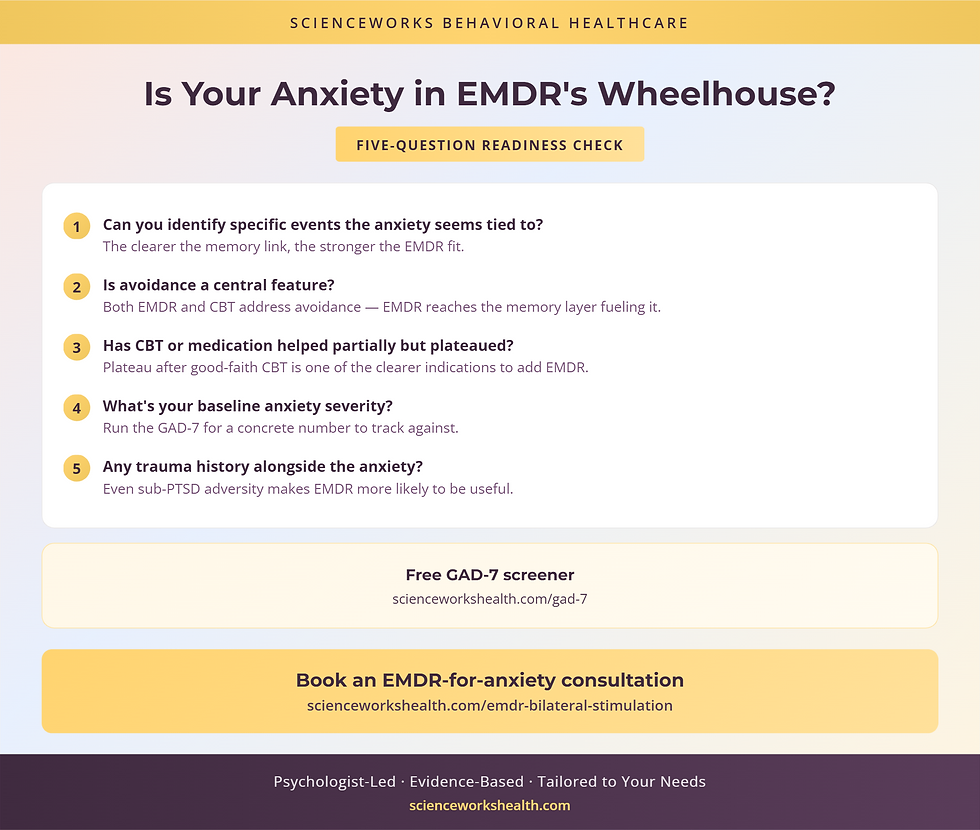
How to tell if your anxiety is in EMDR's wheelhouse
A simple readiness check most EMDR-trained clinicians use:
Can you identify a specific event — or a small number of events — that the anxiety seems tied to? The clearer the memory link, the stronger the EMDR fit.
Is avoidance a central feature? Both EMDR and CBT address avoidance, but EMDR can reach the memory layer that keeps the avoidance loop fueled.
Has CBT or medication helped partially but plateaued? Plateau after good-faith CBT is one of the clearer indications for adding EMDR.
What's your baseline anxiety severity right now? The GAD-7 is a well-validated seven-item self-report measure [14] that takes under two minutes to complete and gives you — and your clinician — a concrete number to track against over the course of treatment. A baseline score in the moderate or severe range does not disqualify you from any treatment modality, but it does inform the pacing and sequencing decisions.
Is there any trauma history alongside the anxiety? Even non-PTSD-level adversity — chronic childhood criticism, a significant loss, a medical crisis — makes EMDR more likely to be useful. The trauma services page covers the broader picture.
Misconception: You need a "clean" anxiety diagnosis before you can start EMDR. In reality, most anxiety presentations in real clinical practice are mixed — anxiety plus depression, anxiety plus subthreshold trauma features, anxiety plus OCD or ADHD overlap. EMDR clinicians are used to mixed presentations and do not require a diagnostic purity that clinical reality rarely supplies.
Key takeaway: 📝 Bring a symptom log, a GAD-7 score, and a short narrative of what the anxiety is tied to. Those three inputs let a clinician match you to the right modality — or the right combination — quickly.
Frequently asked questions
Can I do EMDR for anxiety without a trauma history?
Yes — though the clinician will be looking for memory-linked drivers during intake, even if they are not "traumatic" in the formal DSM-5 Criterion A sense [7]. If the anxiety truly has no memory-linked anchors and is driven purely by current avoidance and cognition patterns, CBT is likely to be a more efficient first move.
How many sessions for a specific phobia?
For single-stimulus specific phobias, three to six reprocessing sessions plus one to two preparation sessions is typical in the literature [11]. Complex or long-standing phobias can take longer, and most clinicians will give you a rough estimate at intake that they refine as they get to know your case.
Will EMDR replace medication for anxiety?
EMDR is a psychotherapy, not a replacement for medication. Many anxiety patients do both. Decisions about medication belong with your prescribing clinician; EMDR can be running in parallel, and most EMDR therapists work collaboratively with psychiatry.
What about social-media-fueled anxiety spirals?
For anxiety that is primarily driven by current information-environment patterns — doom-scrolling, comparison spirals, news-cycle activation — the primary intervention is behavioral (reducing the input), alongside CBT approaches to cognitive and attentional retraining. EMDR can have a role where the social-media triggers are re-activating earlier memory networks, but it is not a first move for this presentation.
Scheduling an EMDR-for-anxiety consult at ScienceWorks
If you are considering EMDR for anxiety or a specific phobia, our EMDR service page covers the full eight-phase protocol and ScienceWorks' telehealth-forward delivery. If you are not sure whether EMDR or a more traditional CBT approach is right for you, our specialized therapy page lays out our broader anxiety-treatment options, and our contact page is where intake begins. Initial consultations are thirty minutes and structured around the same readiness questions in the checklist above — not around pushing you toward any particular modality.
Key takeaway: 📅 A thirty-minute intake is the fastest way to find out whether your anxiety picture is a good EMDR fit or whether a different starting point would serve you better.
About the Author
Dr. Kiesa Kelly is a licensed clinical psychologist and the founder of ScienceWorks Behavioral Healthcare. Her clinical training includes coursework and supervised practice at the University of Chicago, Vanderbilt University, and the University of Wisconsin, with more than 20 years of experience in psychological assessment and evidence-based treatment for trauma, anxiety, OCD, and neurodevelopmental conditions. Her anxiety and phobia practice spans specific phobia, panic disorder, generalized anxiety, social anxiety, and complex anxiety presentations co-occurring with trauma, OCD, or neurodevelopmental conditions.
Dr. Kelly oversees clinical quality across ScienceWorks, including the practice's trauma, anxiety, and EMDR programs. She maintains ongoing consultation and continuing education in EMDR, exposure-based CBT, and adjacent modalities. Every article on the ScienceWorks blog is reviewed by a licensed clinician for clinical accuracy before publication.
References
1. National Institute for Health and Care Excellence. Post-traumatic stress disorder (NG116). 2018. https://www.nice.org.uk/guidance/ng116
2. American Psychological Association. Clinical practice guideline for the treatment of posttraumatic stress disorder in adults. 2017. https://www.apa.org/ptsd-guideline
3. Scelles C, Bulnes LC. EMDR as treatment option for conditions other than PTSD: a systematic review. Frontiers in Psychology. 2023. https://doi.org/10.3389/fpsyg.2021.644369
4. De Jongh A, et al. The impact of eye movements and tones on disturbing memories involving PTSD and other mental disorders. Journal of Behavior Therapy and Experimental Psychiatry. 2019. https://doi.org/10.1016/j.jbtep.2018.11.002
5. Wright SL, et al. The effectiveness of EMDR for adult posttraumatic stress disorder: an updated meta-analysis of randomized controlled trials. European Journal of Psychotraumatology. 2024. https://doi.org/10.1080/20008066.2024.2313741
6. Hofmann SG, et al. The efficacy of cognitive behavioral therapy: a review of meta-analyses. Cognitive Therapy and Research. 2012. https://doi.org/10.1007/s10608-012-9476-1
7. Shapiro F. Eye Movement Desensitization and Reprocessing (EMDR) therapy: basic principles, protocols, and procedures. 3rd ed. Guilford Press. 2018. https://pubmed.ncbi.nlm.nih.gov/29300065/
8. Landin-Romero R, et al. How does eye movement desensitization and reprocessing therapy work? A systematic review on suggested mechanisms of action. Frontiers in Psychology. 2018. https://doi.org/10.3389/fpsyg.2018.01395
9. Kessler RC, et al. Posttraumatic stress disorder in the National Comorbidity Survey. Archives of General Psychiatry. 1995 (with subsequent replication literature). https://doi.org/10.1001/archpsyc.1995.03950240066012
10. Craske MG, et al. Maximizing exposure therapy: an inhibitory learning approach. Behaviour Research and Therapy. 2014. https://doi.org/10.1016/j.brat.2014.04.006
11. Doering S, et al. Efficacy of a specific trauma-focused EMDR protocol for specific phobia. Journal of Clinical Psychology. 2013. https://doi.org/10.1002/jclp.21934
12. Horst F, et al. Cognitive behavioral therapy vs. eye movement desensitization and reprocessing for treating panic disorder: a randomized controlled trial. Frontiers in Psychology. 2017. https://doi.org/10.3389/fpsyg.2017.01409
13. National Institute for Health and Care Excellence. Generalised anxiety disorder and panic disorder in adults: management (CG113). 2011 (with subsequent updates). https://www.nice.org.uk/guidance/cg113
14. Spitzer RL, et al. A brief measure for assessing generalized anxiety disorder: the GAD-7. Archives of Internal Medicine. 2006. https://doi.org/10.1001/archinte.166.10.1092
15. Ehlers A, Hofmann SG, Herda CA, Roth WT. Clinical characteristics of driving phobia. J Anxiety Disord. 1994;8(4):323-339. https://doi.org/10.1016/0887-6185(94)00021-2
Disclaimer
This article is for informational purposes only and is not a substitute for individualized medical, psychological, or psychiatric advice, diagnosis, or treatment. Reading this article does not create a clinician-client relationship. If you are experiencing a mental health emergency, call or text 988 (the Suicide and Crisis Lifeline in the United States) or go to your nearest emergency department.