
Late-Diagnosed Autism & ADHD in Men | ScienceWorks

Updated: Jul 6
Last reviewed: 06/03/2026
Reviewed by: Dr. Kiesa Kelly
Much of the recent conversation about missed neurodivergence has centered on women — and for good reason. But there is a quieter version of the same story that gets far less attention: the man who reaches his thirties, forties, or fifties sensing that something has always been different, who was never the "classic" autistic or hyperactive boy, and who was therefore never assessed. Autism and ADHD are missed in men too. They are simply missed for different reasons than the stereotype suggests.
If you are a man who has spent years feeling like you were running a slightly different operating system — capable, often successful, but quietly exhausted by things that seem easy for everyone else — this article is for you. The goal is not to label you from a blog post. It is to help you understand why these traits get overlooked in men, what late-diagnosed autism and ADHD actually look like, and how a careful adult evaluation can give you a clearer answer than self-doubt ever will.
In this article, you'll learn:
Why the "classic male autism" image actually hides many autistic men
What late-diagnosed autism and ADHD look like in adult men, with everyday examples
How men's presentations differ from — and overlap with — the women's-midlife pattern
The real cost of decades undiagnosed, and why it often shows up as anxiety or burnout
What an adult evaluation involves and how to decide whether to pursue one
Short answer: autism and ADHD are missed in men too, just for different reasons than the stereotype suggests
The popular image of autism is a young boy who avoids eye contact, lines up his toys, and does not speak much. The popular image of ADHD is a boy who cannot sit still. Both pictures are real for some people — and both leave out enormous numbers of men whose traits are subtler, more internalized, or masked by intelligence and effort. When a man does not match the cartoon, the assessment often never happens.
This matters because the conditions do not disappear when they go unnamed. An estimated 6.0% of U.S. adults have a current ADHD diagnosis, and roughly half of them were diagnosed in adulthood [1]. Adult autism recognition is following a similar arc as clinicians get better at seeing presentations that earlier generations missed. If you have always sensed a difference, you are not imagining it, and you are not alone in coming to this question later in life. The first step many men take is a low-pressure one — a brief, validated screener like the AQ-10 for autistic traits or the ASRS for adult ADHD — not as a diagnosis, but as a structured way to decide whether a full adult ADHD and autism evaluation is worth pursuing.
Why the "classic male autism" image actually hides many autistic men
Here is the irony. Autism is diagnosed more often in males than females — high-quality studies put the ratio at roughly three to one rather than the older four-to-one estimate [2]. Yet that statistic describes the stereotyped presentation, the one that gets recognized. It does not mean every autistic man is easy to spot. Many men sit far outside the cartoon, and the very fact that "autism is a male thing" can make clinicians less likely to look closely when a man does not act like the textbook.
Let's correct a few of the misconceptions that keep men undiagnosed, because these beliefs are often what stops a man from ever asking the question.
"If he can hold a conversation and make eye contact, it isn't autism." In reality, many autistic adults learn social scripts the way other people learn a second language — consciously, effortfully, and well enough to pass. Forced eye contact and a rehearsed conversational style can look fluent on the surface while costing real energy underneath.
"He's too successful to be autistic or ADHD." Achievement is not the same as ease. Plenty of men build careers on a narrow, intense strength while privately struggling with everything around it — the admin, the transitions, the social maintenance. Compensation is not the absence of a condition; it is often the evidence of one.
"ADHD means you can't focus. He hyperfocuses for hours." ADHD is a difficulty regulating attention, not a simple lack of it. The same man who cannot start a boring report can disappear into a project for six hours and forget to eat. That inconsistency is the pattern, not a contradiction of it.
Masking and the internalized presentation
Masking — consciously managing your face, voice, and behavior to appear "normal" — is most often discussed in autistic women, and the research does link camouflaging more strongly to women than men [3]. But "more often in women" is not "only in women." Many men mask heavily; they are simply missed more often because their masking gets read as personality. The man who has trained himself to nod at the right moments, to script small talk before a meeting, to mimic the warmth he sees in others — he is masking, even if no one ever names it.
🎭 Key takeaway: Masking does not mean a man isn't autistic or ADHD. It often means the traits were demanding enough that he built a lifetime of workarounds to hide them.
A recognizable example: You are good at your job, but you rehearse conversations in advance and replay them for hours afterward, scanning for the moment you said the wrong thing. Social events leave you flattened in a way that puzzles you, because nothing "bad" happened — you just spent the whole time monitoring yourself. You have a few deep interests you could talk about endlessly and a wide territory of small talk that feels like reading lines in a play. From the outside you look fine. From the inside, "fine" takes everything you have.
When ADHD and autism mask each other
A particular trap for men is that autism and ADHD frequently co-occur, and they can cover for each other. ADHD's impulsivity and sociability can soften autism's social rigidity, so the man looks more flexible than he feels. Autism's love of routine can rein in ADHD's chaos, so he looks more organized than his inner experience. The result is a blended profile that fits neither stereotype cleanly — which, under a system built around stereotypes, means he often gets neither diagnosis. People who have both conditions also face the highest rates of co-occurring anxiety and depression, which is part of why the underlying neurodevelopmental picture so often goes unexamined while the anxiety gets all the attention.

What late-diagnosed autism looks like in adult men
Late-identified autism in men rarely looks like the diagnostic checklist. It looks like a life shaped quietly around sensory and social limits that the man learned to hide.
Consider a man who has always needed a great deal of time alone to recover from being around people, and who structures his life — jobs, relationships, weekends — to protect that recovery time without quite knowing why. He has strong, durable interests that have anchored him for decades. He is honest to a fault and baffled when that honesty lands as rude. Bright lights, certain fabrics, background noise, and unexpected changes to plans cost him more than he lets on; he has simply organized his world to minimize them. People describe him as reserved, intense, or "his own person." He has often described himself as a loner, not because he dislikes people, but because people are work.
Or: a man who is deeply loyal and reliable but has been told, across multiple relationships, that he seems emotionally distant or hard to read. He cares enormously; the expression of it just does not come through the expected channels. He misses subtext, takes things literally, and feels most himself in clear, rule-based situations — at work, in a hobby with explicit standards, in a role with a defined script. The unstructured, implied, read-the-room demands of social life are where he feels most lost.
🧩 Key takeaway: In men, autism often hides inside traits we call personality — reserved, blunt, rigid, a loner — rather than presenting as an obvious clinical picture.
What late-diagnosed ADHD looks like in adult men (and how it shifts with age)
Adult ADHD in men is frequently missed because the visible hyperactivity of childhood quiets down, while the harder-to-see executive-function struggles persist or worsen as life's demands grow [4]. The hyperactivity does not vanish so much as move inward — into restlessness, a racing mind, an inability to relax.
A recognizable example: You do well in fast, high-stimulation situations because the pressure keeps you engaged, but you drown in the slow, self-directed parts of adult life. You pay bills late despite having the money, miss appointments you genuinely cared about, and lose hours to your phone when you meant to start a task you have been dreading for a week. Your home has three half-finished projects, and you know exactly what each one needs — you just cannot make yourself begin. People call you capable but scattered, and you have learned to overfunction in urgent bursts to make up for long stretches of paralysis.
Or: You changed jobs, hobbies, and plans often when you were younger and were called restless or commitment-shy. Now, with a mortgage and people depending on you, the same wiring shows up as chronic overwhelm, irritability, and a sense that you are always one step behind on the logistics of life. You may have leaned on alcohol, intense exercise, or work to quiet the restlessness without ever connecting it to attention regulation.
⏱️ Key takeaway: Adult ADHD in men is often a time-and-task problem — starting, finishing, remembering, and following through — long after the visible hyperactivity of boyhood has faded.
The cost of decades undiagnosed — anxiety, depression, burnout, relationships, work
When a neurodevelopmental difference goes unnamed for thirty or forty years, the man rarely concludes "my brain works differently." He concludes "something is wrong with me." That story — internalized over decades — is expensive.
The clearest cost is mental health. Autistic adults experience anxiety and depression at strikingly higher rates than the general population; a large review found that roughly a quarter of autistic adults meet criteria for an anxiety disorder and a similar share for depression at any given time [5]. Untreated adult ADHD carries parallel risks. For many men, the anxiety and the low mood are not separate problems — they are the accumulated cost of years spent compensating, masking, and falling short of standards that were never built for their wiring. If you have cycled through treatment for anxiety or depression that helped only partly, it is reasonable to ask whether an underlying profile was driving it all along.
There is a sharper edge worth naming honestly: chronic masking and a late diagnosis have been identified as risk markers for poorer mental health and for suicidality in autistic adults [6]. This is not said to frighten anyone. It is said because understanding yourself accurately, and getting support that fits, is protective — and because too many men carry this load silently, assuming it is just who they are.
The costs also show up in relationships and work — the partner who feels shut out by a man who genuinely does not know how to show what he feels; the burnout of a career built on one fierce strength surrounded by tasks that quietly drain him. None of this means a man is broken. It means he has been solving the wrong problem for a long time.
🌡️ Key takeaway: In many men, the anxiety, depression, or burnout that finally brings them to a clinician is the visible cost of an undiagnosed neurodevelopmental difference underneath.
How men's presentation differs from the women's-midlife pattern (and where they overlap)
It would be a mistake to draw a hard line between "male" and "female" presentations, because the overlap is large and the differences are tendencies, not rules. Still, the patterns are worth naming.
The women's-midlife story — explored in our companion piece on late-diagnosed autism in women — often centers on heavy social camouflaging, a lifetime of intense effort to fit in, and a diagnostic system whose criteria were built around boys and therefore missed girls entirely. The research supports this: much of the documented sex difference in diagnosis reflects under-recognition rather than true absence, and the assessment tools themselves were standardized largely on male samples [7].
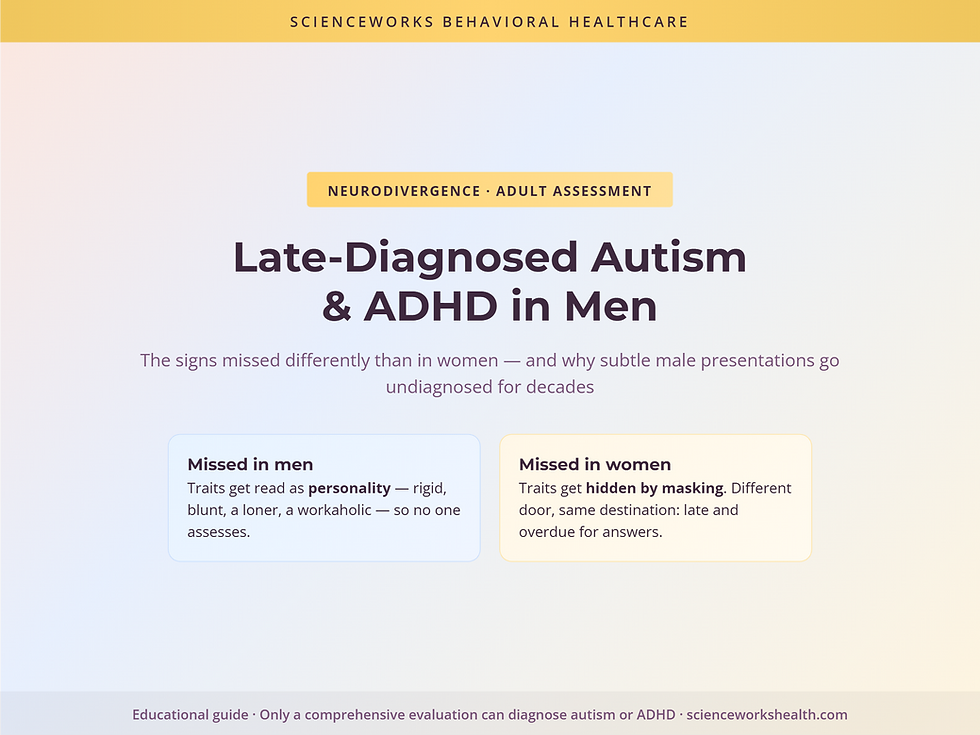
Men get missed through a different door. Their traits are more often read as fixed personality — the rigid one, the blunt one, the workaholic, the loner — so no one thinks to assess them. Where many women are missed because they hide their traits so well, many men are missed because their traits are visible but reframed as character. Both groups end up in the same place: undiagnosed, self-blaming, and arriving at this question late.
Where they overlap is the inner experience — the exhaustion of compensation, the relief and grief that come with finally having a name, and the way an accurate understanding changes everything downstream. This is also why a modern evaluation looks at autism and ADHD together rather than forcing a man into one box or the other.
🔍 Key takeaway: Women are often missed because they hide their traits; men are often missed because their traits are visible but mislabeled as personality. The destination — late, self-doubting, and overdue for answers — is the same.
What an adult evaluation actually involves
A good adult evaluation is not a checklist or a single questionnaire. It is a structured process that looks at how your mind has worked across your whole life, using validated tools alongside clinical interviewing. Brief screeners such as the AQ-10 and ASRS are starting points, not diagnoses; their job is to flag whether a fuller assessment is warranted, and they should always be interpreted by a clinician rather than read off a website [8][9]. It helps to know what a real adult assessment looks like before you begin, so the process feels less opaque. A comprehensive psychological and neurodevelopmental assessment then combines structured rating scales, a developmental and life history, and a careful account of how traits show up in your current relationships, work, and daily functioning — an approach consistent with current clinical guidelines for diagnosing ADHD and autism in adults and with established diagnostic criteria [10][11][12]. Where masking is part of the picture — as it so often is for adults — a skilled evaluator is specifically trained to look beneath the surface presentation, which is why a high-masking adult assessment is built differently from a child evaluation.
If you are deciding whether and where to be evaluated, here are concrete questions you can ask a provider:
Scope: Does the evaluation assess both autism and ADHD if both are plausible, rather than only the one I called about?
Masking: How does your process account for adult masking and lifelong compensation, so a "high-functioning" presentation doesn't lead to a missed diagnosis?
Developmental history: What history do you gather if I don't have childhood records, and how do you reconstruct a lifespan picture?
Co-occurring conditions: How do you tell whether my anxiety or depression is separate, or the downstream cost of an underlying ADHD or autism profile?
Output: What will I actually leave with — a clear formulation and specific, usable recommendations, or just a label?
A man who walks in with those five questions is already doing the assessment justice.

Next step
If the patterns in this article felt less like reading about a stranger and more like reading about yourself, that recognition is worth taking seriously — not as a verdict, but as a reason to get a real answer. You do not have to keep explaining yourself to yourself. A careful evaluation can replace decades of "what is wrong with me" with a clearer, kinder, more accurate understanding of how your mind actually works, and a plan that finally fits it.
Ready for an AuDHD-specialized evaluation?
If the patterns above feel familiar, an evaluation that looks at autism and ADHD together — not one or the other in isolation — can help name what's actually driving the overload.
Frequently Asked Questions
Can autism or ADHD really be diagnosed for the first time in an adult man?
Yes. About half of U.S. adults with an ADHD diagnosis received it in adulthood, and adult autism diagnoses are rising as clinicians recognize subtler presentations. A man can reach midlife with real, lifelong traits that were never named because he compensated, masked, or was read as 'shy,' 'difficult,' or 'a daydreamer.' An adult evaluation is built for exactly this — assessing traits across the lifespan, not just in childhood.
Why would autism be missed in a man if autism is diagnosed more often in males?
Higher diagnosis rates in males reflect the stereotyped, visible presentation — not every presentation. A man with strong verbal skills, average or high intelligence, intense focused interests, and learned social scripts can fall far outside the 'classic' picture. When masking and co-occurring anxiety hide the underlying traits, clinicians may treat the anxiety or depression and never assess for autism itself.
What is the difference between how autism shows up in men versus women?
The differences are real but overlap heavily, so the line is not clean. Research links masking and camouflaging more strongly to women, which is part of why women are diagnosed later. Many men mask too, but are more often missed because their traits get read as personality — rigid, blunt, a loner, a workaholic. The honest takeaway is that both presentations get overlooked, just through different doors.
Could my anxiety or depression actually be undiagnosed autism or ADHD?
Sometimes the anxiety or depression is the visible cost of an undiagnosed neurodevelopmental difference. Autistic adults experience anxiety and depression at much higher rates than the general population, and untreated adult ADHD carries similar risks. If treatment for anxiety or depression keeps falling short, it is reasonable to ask whether an underlying ADHD or autism profile is part of the picture.
Do I need childhood records to be evaluated for autism or ADHD as an adult man?
Helpful, but not required. A good adult evaluation gathers developmental history through structured interviews, your own recollections, and sometimes input from family — not only old school or medical records. If records are missing, a skilled evaluator works with what is available to reconstruct a lifespan picture rather than turning you away.
About the Author
This article was reviewed by Dr. Kiesa Kelly, a licensed clinical psychologist and the founder of ScienceWorks Behavioral Healthcare, with more than 20 years of experience in psychological assessment. Her work centers on neurodevelopmental evaluation for adults and older teens — including autism and ADHD assessment — with particular attention to the high-masking, late-identified presentations that earlier generations of clinicians often overlooked.
Dr. Kelly built ScienceWorks as a telehealth-forward practice serving Tennessee, with a focus on rigorous, affirming evaluation and evidence-based care. She and the ScienceWorks clinical team specialize in adult ADHD and autism assessment, OCD and anxiety, and trauma, and every article on this site is reviewed by a licensed clinician for accuracy before publication.
References
1. Staley BS, Maenner MJ, et al. Attention-Deficit/Hyperactivity Disorder Diagnosis, Treatment, and Telehealth Use in Adults — National Center for Health Statistics Rapid Surveys System, United States, October–November 2023. MMWR Morb Mortal Wkly Rep. 2024. https://www.cdc.gov/mmwr/volumes/73/wr/mm7340a1.htm
2. Loomes R, Hull L, Mandy WPL. What Is the Male-to-Female Ratio in Autism Spectrum Disorder? A Systematic Review and Meta-Analysis. J Am Acad Child Adolesc Psychiatry. 2017. https://pubmed.ncbi.nlm.nih.gov/28545751/
3. Hull L, Lai MC, Baron-Cohen S, et al. Gender differences in self-reported camouflaging in autistic and non-autistic adults. Autism. 2020. https://journals.sagepub.com/doi/abs/10.1177/1362361319864804
4. Faraone SV, Banaschewski T, Coghill D, et al. The World Federation of ADHD International Consensus Statement: 208 Evidence-based conclusions about the disorder. Neurosci Biobehav Rev. 2021;128:789–818. https://www.sciencedirect.com/science/article/pii/S014976342100049X
5. Hollocks MJ, Lerh JW, Magiati I, Meiser-Stedman R, Brugha TS. Anxiety and depression in adults with autism spectrum disorder: a systematic review and meta-analysis. Psychol Med. 2019. https://pubmed.ncbi.nlm.nih.gov/30178724/
6. Cassidy S, Bradley L, et al. Is camouflaging autistic traits associated with defeat, entrapment, and lifetime suicidal thoughts? Suicide Life Threat Behav. 2023. https://onlinelibrary.wiley.com/doi/full/10.1111/sltb.12965
7. Hinshaw SP, et al. Why are females less likely to be diagnosed with ADHD in childhood than males? Lancet Psychiatry. 2024. https://www.thelancet.com/journals/lanpsy/article/PIIS2215-0366(24)00010-5/fulltext
8. Allison C, Auyeung B, Baron-Cohen S. Toward brief "red flags" for autism screening: the Short Autism Spectrum Quotient and the Short Quantitative Checklist. 2012. https://pubmed.ncbi.nlm.nih.gov/22265366/
9. Validity and accuracy of the Adult ADHD Self-Report Scale (ASRS) in discriminating between adults with and without ADHD. PMC. https://www.ncbi.nlm.nih.gov/pmc/articles/PMC7303368/
10. National Institute for Health and Care Excellence. Attention deficit hyperactivity disorder: diagnosis and management (NG87). https://www.nice.org.uk/guidance/ng87
11. National Institute for Health and Care Excellence. Autism spectrum disorder in adults: diagnosis and management (CG142). https://www.nice.org.uk/guidance/cg142
12. American Psychiatric Association. Diagnostic and Statistical Manual of Mental Disorders, Fifth Edition, Text Revision (DSM-5-TR). 2022. https://www.psychiatry.org/psychiatrists/practice/dsm
Disclaimer
This article is for informational and educational purposes only and is not a substitute for professional diagnosis, evaluation, or treatment. Reading it does not establish a clinician–patient relationship, and it cannot diagnose autism, ADHD, or any other condition in you or anyone else. If the patterns described here resonate, a qualified clinician can help you understand what is actually going on and what support fits. If you are in crisis or having thoughts of harming yourself, call or text 988 (Suicide and Crisis Lifeline) or 911, or go to your nearest emergency department.