
Online EMDR Therapy: How Virtual Bilateral Stimulation Works

Updated: 2 days ago
Last reviewed: 04/21/2026
Reviewed by: Dr. Kiesa Kelly

If you have spent any time researching trauma therapy, you have probably asked the same quiet question most adults ask us: "Can this actually work over a screen?" It is a fair thing to wonder. EMDR — Eye Movement Desensitization and Reprocessing — was built around a therapist sitting across from a client, moving two fingers side to side while the client tracked them with their eyes. Moving that into a laptop camera feels, at first, like a shortcut. Our answer, based on how we practice and what the research has shown over the last decade, is less tidy than a yes or a no. For many people, online EMDR therapy works as well as the in-office version. For a smaller group of people, in-person is still the right starting point. Knowing which one you are is the hard part, and that is what this article is for.
In this article, you'll learn:
Whether virtual EMDR is supported by research and how those outcomes compare to in-office care
How bilateral stimulation is actually delivered over video — eye movement, tactile, and auditory options
When telehealth EMDR is usually a strong fit, and the smaller set of situations where it is not
What you need on your end — privacy, hardware, and safety planning — for a remote session to work well
Practical answers to common questions about insurance, state lines, recording, and group formats
Our practice is telehealth-first, and a meaningful percentage of the EMDR we deliver happens over video. We have had the chance to watch who this format serves well and who it does not, and the patterns are consistent enough to give you honest guidance.
Does EMDR work over telehealth?
Short answer: yes, for most presentations. A growing body of research — including controlled trials conducted during and after the pandemic — has compared remote EMDR to in-person EMDR and found broadly similar outcomes on the symptom measures that matter most in trauma care, particularly PTSD checklists and measures of distress tied to a target memory [1][2][3]. The PCL-5, a widely used self-report PTSD measure, is one of the instruments these trials have tracked — if you are weighing whether to start, running your current symptom picture through a validated screener can help frame the conversation. Meta-analyses of trauma-focused psychotherapy delivered by video conferencing — EMDR and related modalities — have reached the same general conclusion: the format changes, the core mechanism does not appear to [4][12]. Clinical practice guidelines from the World Health Organization and NICE continue to list EMDR among the first-line treatments for PTSD, and both bodies have adapted guidance to accommodate remote delivery where appropriate [5][6].
A few important caveats before we go further. The strongest evidence is for adult PTSD and single-incident trauma. Evidence for complex, developmental, or dissociative trauma is promising but thinner, and the research base on group telehealth EMDR is still early [7]. Where the evidence is incomplete, we'll say so — that is part of how we try to write about this responsibly.
Key takeaway: 📊 The research base for remote EMDR is large enough that most adults with single-incident PTSD can reasonably expect outcomes similar to in-office care. Evidence for complex trauma is growing but less settled.
How virtual EMDR sessions are actually run
One of the most common misconceptions we hear — sometimes from clients, sometimes from other clinicians — is worth naming directly.
Misconception: EMDR only works with real eye movements, so it cannot be delivered over video. In reality, the bilateral stimulation in EMDR can be visual, tactile, or auditory. What matters is the rhythmic, alternating left-right input during reprocessing, not the specific sense organ receiving it. The Shapiro protocol has always included tactile and auditory options, and clinical studies have compared these modalities and generally found them comparable for most presentations [8].
Eye movement via on-screen cue
The most common remote setup is still visual. Your therapist shares a screen or uses an EMDR software tool — several reputable platforms exist — that displays a moving dot, light bar, or target traveling side to side at an adjustable speed. You track the target with your eyes the same way you would track a therapist's fingers in person. The rhythm, duration, and set length are directed by your therapist, the same as in office.
Tactile bilateral stimulation (self-tapping, butterfly hug)
For clients who find it easier to close their eyes during reprocessing, or who have visual sensitivities, we often use self-tapping. You cross your arms over your chest and tap alternating shoulders at the pace your therapist directs — often called the butterfly hug — or tap the tops of your thighs. Some clients use handheld tappers at home that pulse left-right; these are inexpensive and can be shipped before the first reprocessing session.
Audio-based bilateral stimulation (alternating tones through headphones)
Audio bilateral stimulation uses stereo headphones to deliver alternating tones in your left and right ear. You do not need special software — several free tools produce clinically appropriate tones — and you do not have to choose between modalities. We commonly combine visual and auditory, or tactile and auditory, depending on what helps a given client stay within their window of tolerance during reprocessing.
What the research shows on remote EMDR outcomes
Symptom reduction compared to in-person EMDR
Randomized trials and pre-post studies conducted since 2020 have generally found that the effect sizes for remote EMDR sit in the same range as in-office EMDR for adult PTSD, with comparable drops in PTSD checklist scores and distress ratings after a standard course of treatment [1][2][9]. There are exceptions in the literature — some smaller studies find somewhat attenuated effects remotely, especially for severe or highly complex presentations — but the overall direction is consistent.
Therapeutic alliance findings
One of the most common worries — "I won't feel as connected to my therapist over video" — has also been directly studied. Most research on working alliance in teletherapy, including in trauma-focused modalities, finds that alliance ratings are comparable between in-person and remote, and in some samples are slightly higher remotely [10]. Our working theory, after several years of delivering this format, is that being in your own space, in your own chair, with your own water glass, actually lowers the bar to vulnerability for many clients — not all, but many.
Access benefits for rural and disabled clients
The population for whom remote EMDR matters most is the population that could not realistically access it otherwise. Rural Tennessee residents, clients with mobility limitations, clients whose symptom picture includes agoraphobia or severe social anxiety, caregivers who cannot sit in a waiting room for an hour — these are readers for whom remote delivery is not a convenience feature but a precondition for getting evidence-based trauma care at all [11]. That access dimension is rarely represented in the narrow "is it as effective" framing, and we think it deserves more weight than it usually gets.
Key takeaway: 🤝 Therapeutic alliance over video is generally comparable to in-person — and for many clients, being in their own space lowers the threshold to doing deep trauma work.
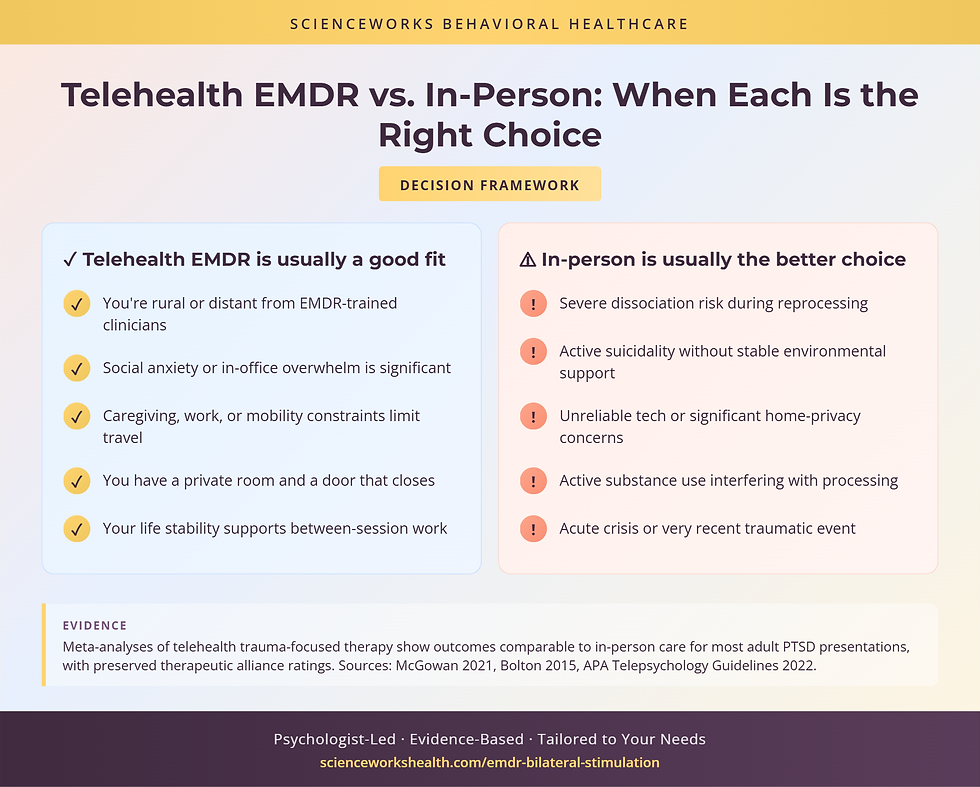
When telehealth EMDR is usually a good fit
The clients for whom virtual EMDR tends to work well share a few common features.
Geographic access limits
You live in a part of Tennessee where the nearest EMDR-trained clinician is an hour or more away. The drive alone is enough friction to derail the weekly cadence trauma-focused treatment benefits from. Consider a middle-aged small-business owner in rural West Tennessee who had a single-incident workplace trauma several years ago and has been reading about EMDR for months. Every in-person clinician she has looked up is either in Nashville or Memphis, both of which require her to close her shop for half a day. She has tried twice to book and pulled the plug each time because of the logistics. Telehealth collapses the logistics to a fifty-minute block and makes the cadence possible — which is itself the most important predictor of a good outcome.
Social anxiety, agoraphobia, or in-office overwhelm
Paradoxically, some of the clients who benefit most from remote EMDR are clients whose symptoms make the office itself a challenge. For a client whose trauma-related avoidance includes crowded waiting rooms, or whose sensory sensitivities make a clinical office feel dysregulating before the appointment even begins, doing the session in a familiar private space can reduce the environmental load enough that the actual therapeutic work becomes possible.
Scheduling flexibility and caregiving constraints
Consider a working parent of two young children who has been carrying a decade-old trauma and has never been able to find ninety minutes — the appointment plus the drive — in a week. The only window that reliably opens is a fifty-minute block after school drop-off, before the 9 a.m. meeting. Telehealth makes that window usable; in-person does not.
When in-person EMDR is the better choice
This is the shorter list, but it is the list that matters most. Not every client is a good telehealth candidate, and we would rather steer a reader toward a safer starting point than generate an intake that was not right to begin with.
Severe dissociation risk
If you have a history of severe dissociation during therapy or outside it — time lost, finding yourself in unfamiliar places without memory, prolonged depersonalization — remote EMDR is not our first choice. The therapist's ability to read subtle nonverbal cues is narrower over video, and grounding mid-session is harder to scaffold remotely.
Active suicidality without a stable support system
EMDR reprocessing can temporarily increase emotional activation between sessions. For a client who is actively suicidal and does not have a stable environmental support system to hold that activation, the margin for error is thinner remotely. We will still offer trauma-focused services in that situation, but usually stabilization work — not reprocessing — and often a hybrid format that starts in person.
Unreliable tech or privacy concerns at home
The format assumes you have a private space, a door that closes, and a reliable enough internet connection to hold a video call without dropouts during reprocessing. If either is missing, the delivery mechanism itself can become a safety issue, and we'll either adjust the plan or recommend in-person care.
Misconception: If I cannot do EMDR over telehealth, I cannot do it at all. In reality, not being a telehealth candidate tells us something useful about your clinical picture — usually that stabilization or skills-building comes first, or that in-person is the safer starting format. It is a routing question, not a disqualification.
Key takeaway: 🚨 Severe dissociation risk, active suicidality without environmental support, and an unreliable private setup are the situations where in-person EMDR is the better starting format.
What you need on your end for a remote session to work well
This is the part of the conversation that often gets underweighted. The format places some real responsibilities on the client, and sessions go better when these are set up deliberately.
Privacy and a door that closes
The room does not need to be fancy. It needs to be one where you will not be interrupted for fifty minutes, where the audio of the session will not be overheard by someone you do not want it overheard by, and where you will not be trying to keep your voice down. Clients often underestimate how much the reprocessing itself depends on being able to cry, laugh, or sit quietly without managing the impression you are making on someone else in the next room.
Hardware checklist
A laptop, desktop, or tablet with a working camera is usually enough. A phone is acceptable for stabilization and resourcing work but is less comfortable for the eye-movement protocols because the screen is small and held in the hand. Stereo headphones are highly recommended if you will be using auditory bilateral stimulation, and strongly helpful for privacy even when you will not. Most clients do not need handheld tappers, but if tactile BLS will be part of your protocol, we will let you know before the first reprocessing session.
Safety planning before you start
Before the first reprocessing session — not the intake, but the first session where a target memory is worked — your therapist should have walked you through a safety plan that is specific to your environment. Who is reachable in the first few hours after a session? What grounding tools do you have on hand? What do you do if the call drops mid-set? These are not dramatic questions; they are logistics, and they are part of making the format safe.
Misconception: Safety planning for EMDR is a formality. In reality, the margin between a hard session and a destabilizing session often sits in the planning you did before the session. The actual reprocessing phase is not where contingencies should be invented.
Key takeaway: 🏡 A private room, a working camera, and a specific safety plan are the three non-negotiables. Everything else in the hardware list is preference.

A simple way to decide: is virtual EMDR likely the right start for you?
Here is the rule of thumb we use internally with new clients:
If your primary barriers to in-person care are geographic, scheduling, social-anxiety, or mobility related, and you have a private space and stable environmental support, then virtual EMDR is usually the right starting format.
If you have severe unmanaged dissociation, active suicidality without support, or cannot reliably create a private session space, then in-person — or a hybrid starting in person — is a safer opening move.
If you are in the middle — motivated, stable-ish, some dissociative experiences but not severe, a private space that mostly works — start with a telehealth consultation. We can often get a read in the consult itself on whether the format will serve the clinical goal.
That heuristic is deliberately not a substitute for a clinical conversation — but it is close enough to help you decide whether to book a consult in the first place. If you are on the fence, a thirty-minute consult with a licensed clinician is often more informative than another month of reading.
Key takeaway: ⏱️ If geography, scheduling, or social anxiety are your main barriers and your home setup is workable, virtual EMDR is usually the right first move. If severe dissociation or active crisis are in the picture, start in person.
Frequently asked questions
Will insurance cover remote EMDR?
Most major insurers in Tennessee have continued to cover telehealth psychotherapy, including EMDR, at parity with in-person sessions through 2026. Coverage details vary by plan and employer, so we always recommend a benefits check before the first session. For self-pay clients, remote and in-person sessions are priced the same in our practice.
Can I do telehealth EMDR if I live in Tennessee but travel out of state?
Mental health licensure is regulated by the state the client is physically in at the time of the session, not where they live. If you will be traveling, let us know in advance — we can confirm whether your session dates fall in states where your clinician is licensed to deliver care.
Is recording the session legal or advisable?
In most cases we do not recommend recording reprocessing sessions. The therapeutic space is most useful when it is ephemeral, and a recording creates retention and privacy questions that can complicate the work. If there is a clinical reason you want to revisit a session, your therapist can provide a written summary.
Can group EMDR happen virtually?
Yes, and it is an active area of development — particularly group EMDR protocols designed for shared-incident trauma. The research base on virtual group EMDR is smaller than on individual EMDR, so we treat it as a complement to individual care rather than a replacement.
Starting telehealth EMDR at ScienceWorks
If you have read this far and the geography-scheduling-privacy triangle lines up, the next step is a consult. Our intake is a thirty-minute video conversation — no reprocessing, no pressure — focused on whether EMDR is the right modality for what you are dealing with and whether the virtual format fits your picture. You can reach our team through the contact page or book directly from the EMDR service page. We serve clients across Tennessee, and the consult itself is free.
Key takeaway: 🖥️ The consultation is the right place to decide whether virtual EMDR is a fit — not the intake paperwork and not the first reprocessing session. Protect that step; it is where the format question gets resolved.
Frequently Asked Questions
Can EMDR be done via telehealth?
Yes. EMDR can be delivered via telehealth using video sessions and digital tools for bilateral stimulation (visual targets on the client's screen, auditory tones, or self-tapping). Research and clinical guidelines from the EMDR International Association support virtual delivery as a valid format when conducted by a trained clinician with appropriate setup. Telehealth EMDR works for many adults but isn't optimal for everyone: clients with severe dissociation, complex trauma, or unstable home environments may need in-person care for safety and containment. The decision is individualized based on client factors and clinician judgment.
Does online EMDR actually work?
Studies and clinical practice during and after the pandemic suggest online EMDR produces comparable outcomes to in-person EMDR for many trauma presentations, particularly single-incident PTSD and adult clients with stable functioning. The structured 8-phase EMDR protocol translates well to video format. Outcomes depend less on virtual-vs-in-person and more on therapist training, client stability, treatment adherence, and severity of presentation. Online EMDR isn't a watered-down version: it's a different delivery mode of the same evidence-based treatment, with comparable mechanisms and effects in appropriately selected clients.
Can you do EMDR by video call?
Yes. Video-call EMDR uses a video conferencing platform (Zoom, Doxy.me, SimplePractice, or similar HIPAA-compliant tool) for the therapeutic relationship and either screen-based bilateral stimulation (a moving dot the client tracks visually), auditory tones via headphones, or self-administered tapping. The 8-phase protocol stays the same. The therapist watches the client's face and reactions for signs of distress or dissociation just as in person. Setup matters: a stable internet connection, private quiet space, and grounding tools accessible to the client are essential.
About ScienceWorks
ScienceWorks Behavioral Healthcare was founded by Dr. Kiesa Kelly, a licensed clinical psychologist with more than 20 years of experience in psychological assessment and evidence-based treatment for trauma, anxiety, OCD, and neurodevelopmental conditions. Our clinical team delivers trauma-focused care — including EMDR and adjacent modalities — across Tennessee, primarily via a telehealth-first model designed to reduce the logistical barriers that keep many clients out of specialty care.
Every article on our site is reviewed by a licensed clinician for clinical accuracy before publication. Our EMDR services are coordinated by therapists with EMDRIA-consistent training, and we maintain the same protocol fidelity and safety standards across remote and in-person sessions.
References
1. McGowan IW, et al. An assessment of the efficacy of EMDR therapy delivered remotely via telehealth during the COVID-19 pandemic: a systematic review. Frontiers in Psychology. 2021. https://doi.org/10.3389/fpsyg.2021.748527
2. Lenferink LIM, et al. Online therapy for adults with PTSD: a systematic review of randomized controlled trials. European Journal of Psychotraumatology. 2020. https://doi.org/10.1080/20008198.2020.1832784
3. Spence J, et al. Feasibility and outcomes of a randomized controlled trial of online trauma-focused therapy. Journal of Telemedicine and Telecare. 2013. https://doi.org/10.1177/1357633X13495916
4. Bolton AJ, Dorstyn DS. Telepsychology for posttraumatic stress disorder: a systematic review. Journal of Telemedicine and Telecare. 2015. https://pubmed.ncbi.nlm.nih.gov/25712110/
5. World Health Organization. Guidelines for the management of conditions specifically related to stress. 2013 (with subsequent updates). https://www.who.int/publications/i/item/9789241505406
6. National Institute for Health and Care Excellence. Post-traumatic stress disorder (NG116). 2018. https://www.nice.org.uk/guidance/ng116
7. Shapiro F. Eye Movement Desensitization and Reprocessing (EMDR) therapy: basic principles, protocols, and procedures. 3rd ed. Guilford Press. 2018. https://pubmed.ncbi.nlm.nih.gov/29300065/
8. Servan-Schreiber D, et al. Eye movement desensitization and reprocessing (EMDR) and dual attention: which modalities work? Journal of Clinical Psychology. 2006. https://doi.org/10.1002/jclp.20289
9. Perri RL, et al. Remote EMDR therapy during the COVID-19 pandemic: a pre-post clinical study. Clinical Neuropsychiatry. 2021. https://pubmed.ncbi.nlm.nih.gov/34909030/
10. Simpson S, Reid C. Therapeutic alliance in videoconferencing psychotherapy: a review. Australian Journal of Rural Health. 2014. https://doi.org/10.1111/ajr.12070
11. American Psychological Association. Telepsychology: a primer for practice (with continued guidance post-pandemic). 2020–2024. https://www.apa.org/practice/guidelines/telepsychology
12. Maxfield L, Hyer L. The relationship between efficacy and methodology in studies investigating EMDR treatment of PTSD. Journal of Clinical Psychology. 2002 (and subsequent EMDRIA position updates on telehealth delivery). https://doi.org/10.1002/jclp.1129
Disclaimer
This article is for informational purposes only and is not a substitute for individualized medical, psychological, or psychiatric advice, diagnosis, or treatment. Reading this article does not create a clinician-client relationship. If you are experiencing a mental health emergency, call or text 988 (the Suicide and Crisis Lifeline in the United States) or go to your nearest emergency department.