
Panic Attack vs. Anxiety Attack

Updated: Jul 30
Last reviewed: 07/30/2026
Reviewed by: Dr. Kiesa Kelly

It came out of nowhere. One minute you were standing in line at the store, and the next your heart was hammering, the room felt unreal, you could not get a full breath, and you were certain something was terribly wrong. By the time you reached the car it was fading, but it left you shaken — and now part of you is bracing for the next one. If that sounds familiar, what you experienced has a name, a mechanism, and an effective treatment.
People use "panic attack" and "anxiety attack" interchangeably, but only one is a clinical term, and the difference matters for understanding what is happening and what helps. This guide walks through panic attacks versus anxiety attacks, how panic disorder and agoraphobia develop, why avoidance quietly makes everything worse, and what actually treats the pattern.
In this article, you'll learn:
The real difference between a panic attack and an "anxiety attack"
When recurring panic attacks become panic disorder
How agoraphobia develops — and why it's about escape, not open spaces
Why avoidance escalates the cycle
What actually treats panic and agoraphobia, and what to do in the moment
Short answer — "panic attack" is a clinical event; "anxiety attack" is an everyday term, and the difference matters
A panic attack is a specific, defined event: an abrupt surge of intense fear or discomfort that peaks within minutes, accompanied by a cluster of physical symptoms [1]. An anxiety attack is not a clinical diagnosis at all — it is the everyday phrase people reach for to describe feeling overwhelmed by worry. The distinction is not pedantic. Panic tends to hit suddenly and feel physically catastrophic; anxiety tends to build more slowly in response to a stressor and lingers. Knowing which one you are having points you toward the right evidence-based therapy.
⚡ Key takeaway: Panic attacks spike fast and feel like a physical emergency. "Anxiety attacks" build slowly and aren't a formal diagnosis. Onset and intensity are the tells.

Panic attack vs. anxiety attack — onset, intensity, duration, triggers
Here is the practical contrast. A panic attack arrives abruptly, often with no obvious trigger, and reaches peak intensity within about ten minutes before subsiding. The DSM-5 describes it as a sudden surge of fear or discomfort with at least four of thirteen symptoms — pounding heart, sweating, trembling, shortness of breath, chest pain, nausea, dizziness, chills or heat, numbness, feelings of unreality, fear of losing control, and fear of dying [1]. The physical intensity is what makes panic so frightening: the body is in a full fight-or-flight response, and people frequently believe they are having a heart attack or stroke.
An "anxiety attack," by contrast, usually describes a slower swell of dread tied to something specific — a looming deadline, a hard conversation, a stressful week. It builds, it sits with you, and it can last hours, but it rarely has the sudden, ten-minute, physically explosive quality of panic.
Consider two recognizable scenes. In the first, you are loading groceries onto the belt when, with no warning, your chest tightens, your vision goes swimmy, your hands tingle, and a wave of certainty hits that you are about to collapse or die. It peaks within a few minutes, and you abandon the cart and rush out. That is a panic attack. In the second, you have a presentation tomorrow, and all afternoon your stomach churns, your thoughts race, and you cannot settle — a steady, building anxiety tied to a clear stressor. That is what people usually mean by an anxiety attack.
The distinguishing pattern: panic is sudden, peaks fast, and feels like a bodily emergency; everyday anxiety builds gradually and ties to an identifiable worry.
A note on the heart-attack fear, because it traps so many people: panic attacks are intensely uncomfortable but not physically dangerous. A first episode is worth a medical check to rule out other causes — but once your heart is cleared, repeated episodes that fit the pattern above point toward panic, not cardiac disease.
When panic attacks become panic disorder
A single panic attack is common — a large share of the general population has had at least one [3]. It becomes panic disorder when the attacks recur unexpectedly and you develop persistent worry about having more, or change your behavior significantly to avoid them, for a month or longer [1][2]. Lifetime panic disorder affects roughly 3 to 5 percent of adults, while isolated panic attacks are far more common [3].
Panic attack vs. panic disorder — one is an event, the other is a diagnosis
This is the distinction that trips people up most often after the panic-versus-anxiety one, and it is worth stating plainly: a panic attack is an event; panic disorder is a diagnosis. They are not two names for the same thing, and one does not automatically add up to the other.
A panic attack is the discrete episode described above — an abrupt surge of intense fear or discomfort that peaks within minutes, with a cluster of physical symptoms alongside it [1]. It arrives, it crests, it passes. Panic disorder is the ongoing pattern that can form around those episodes. Three things have to be true for the event to become the diagnosis: the attacks recur and arrive unexpectedly, you develop persistent worry about having more of them or you change your behavior significantly to avoid them, and the pattern lasts a month or longer [1][2].
The numbers make the gap concrete. A large share of the general population has had at least one panic attack, while lifetime panic disorder affects roughly 3 to 5 percent of adults [3]. Isolated attacks are far more common than the disorder — so a single frightening episode is a long way from a diagnosis.
Why the distinction matters in practice: one bad episode during a punishing stretch of weeks is a panic attack, and it does not need a diagnosis attached to it. What treatment targets is the pattern — the recurrence, the worry, the avoidance. So the more useful question after an attack is not “was that a panic attack?” but “has this started to repeat, and have I begun arranging my life around preventing the next one?” — and that is a question worth bringing to a clinician rather than settling on your own. (A first episode is also worth a medical check to rule out other causes.)
The fear-of-the-fear loop
What turns scattered attacks into a disorder is a shift in what you are afraid of. At first you fear the situation; soon you fear the attack itself. You begin scanning your body for the first flicker of a racing heart, avoiding caffeine, sitting near exits, and rehearsing escape routes. This hypervigilance makes normal sensations more noticeable and more alarming, which makes an attack more likely — a self-fulfilling loop. It is the same mechanism that drives other anxiety patterns, including how reassurance and monitoring backfire in relationship-focused anxiety: the more you try to prevent the feared thing, the more power it gains.
🔁 Key takeaway: Panic disorder is fueled by fear of fear. Once you start dreading the next attack, vigilance makes attacks more likely.
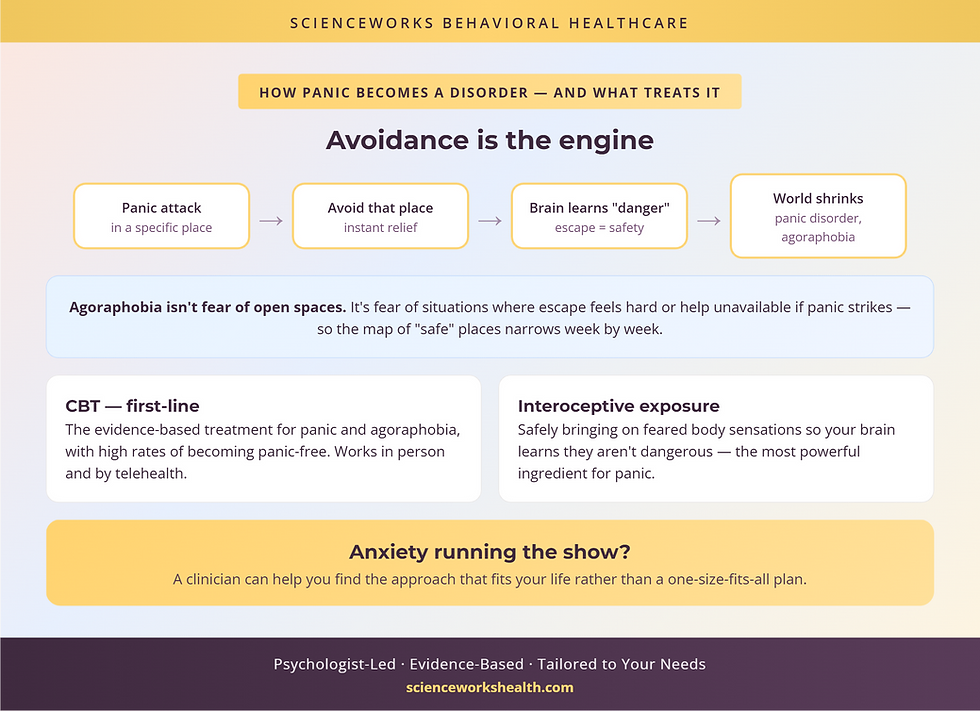
How agoraphobia develops (and why it's about escape, not just open spaces)
Agoraphobia is widely misunderstood as a fear of open spaces or simply of leaving the house. Clinically, it is a marked fear of two or more situations where escape might be difficult or help unavailable if panic strikes — using public transportation, being in open or enclosed spaces, standing in line or in a crowd, or being outside the home alone [1][4]. The common thread is not the place; it is the fear of being trapped or helpless during an attack.
That is why agoraphobia so often grows out of panic. After a frightening attack in a specific setting, you avoid that setting. Relief follows, so you avoid the next risky-feeling place too — the highway, the theater, the distance from home. The map of "safe" territory shrinks week by week until, for some, it contracts to the house itself. In DSM-5, agoraphobia and panic disorder are now diagnosed separately, recognizing that agoraphobic avoidance can take on a life of its own [2]. It also carries substantial impairment and high rates of co-occurring anxiety and depression [3].
🚪 Key takeaway: Agoraphobia is fear of being trapped or helpless during panic — not fear of the outdoors. The places change; the underlying fear of no escape is the constant.
Why avoidance makes it worse over time
Avoidance is the engine. It is also completely understandable — when something feels life-threatening, leaving brings instant relief. But that relief is precisely the problem. Every time you escape or avoid, your brain logs two false lessons: that the situation was genuinely dangerous, and that escaping is what kept you safe. So the fear never gets a chance to disconfirm itself, the "danger" list grows, and your world narrows. This is the well-documented avoidance-anxiety cycle: short-term relief, long-term escalation.
🌀 Key takeaway: Avoidance trades a moment of relief for a larger fear later. Breaking the cycle means letting your nervous system learn the feared situation is survivable.
What actually treats panic and agoraphobia — CBT, interoceptive exposure, and when EMDR fits
Panic and agoraphobia are highly treatable, and the evidence base is strong and consistent. Cognitive behavioral therapy (CBT) is the first-line psychological treatment, supported by clinical practice guidelines and large meta-analyses, with many people becoming panic-free [5][6]. A recent network meta-analysis of CBT for anxiety-related disorders confirms robust effects across the anxiety conditions [10].
The most distinctive and powerful ingredient for panic is interoceptive exposure — deliberately and safely bringing on the feared bodily sensations (through exercise that raises your heart rate, controlled breathing changes, or spinning to provoke dizziness) so your brain learns those sensations are not dangerous [8]. Component analyses find that interoceptive exposure, delivered face to face, drives the strongest results, while passive relaxation techniques add little [6]. For agoraphobic avoidance, in-person, graded exposure — practicing the avoided situations step by step, with the support of a clinician — is what rebuilds your range, and therapist-guided exposure in real-world settings improves outcomes [9]. These exposure principles are the same ones we use across the obsessive-compulsive and anxiety spectrum.
Because CBT for panic works well remotely, telehealth therapy is a strong option, and digital and video-delivered CBT for panic and agoraphobia have been validated in recent trials [7]. EMDR — primarily a trauma therapy — is sometimes applied to phobic avoidance or trauma-linked panic when a specific frightening event is driving the fear; its evidence base for panic is smaller than CBT's, so it is best considered a complement when trauma is part of the picture rather than a first-line replacement.
🫁 Key takeaway: CBT with interoceptive exposure is first-line for panic; graded real-world exposure rebuilds range in agoraphobia. Both work in person and by telehealth.
What to do in the moment vs. what changes the pattern
It helps to separate two different jobs. In the moment, grounding and slow breathing can help you ride out an attack — reminding yourself that it will peak and pass, that the sensations are a false alarm, and that you are not in danger. These coping tools make an attack more bearable. But riding out attacks is not the same as recovering. Changing the pattern requires the opposite of avoidance: gradually facing the sensations and situations you have been steering around, so your nervous system updates its threat estimate for good. If panic has started to shape your choices — the places you will and will not go — that is the signal to get support, and a brief mental-health screening can be a low-pressure first step.
A simple decision heuristic: If episodes hit suddenly, peak within minutes, and feel like a physical emergency, you are describing panic attacks. If you have started avoiding places or activities to prevent them, that is the agoraphobic turn — and the point at which evidence-based treatment makes the biggest difference.
🧭 Key takeaway: Coping skills help you survive an attack; exposure-based therapy changes the pattern. When panic starts shrinking your life, that's the time to reach out.
Anxiety running the show?
Evidence-based therapy can turn the volume down on anxiety — a clinician can help you find the approach that fits your life rather than a one-size-fits-all plan.
Frequently Asked Questions
what is the difference between a panic attack and an anxiety attack?
A panic attack is a defined clinical event: a sudden surge of intense fear that peaks within about ten minutes, with physical symptoms like a racing heart, shortness of breath, and a feeling of doom. "Anxiety attack" is an everyday term, not a clinical diagnosis, usually describing a slower build of worry tied to a stressor. The key contrasts are onset and intensity—panic spikes fast and feels catastrophic; anxiety builds and lingers.
are panic attacks dangerous to your heart?
Panic attacks are intensely uncomfortable but not physically dangerous in themselves. They trigger a real fight-or-flight response—racing heart, chest tightness, breathlessness—that can mimic a heart problem, which is why a first episode is worth a medical check. Once a cardiac cause is ruled out, recurring attacks point toward panic, and the danger your body is signaling is a false alarm, not a real threat.
what is agoraphobia, really?
Agoraphobia is not simply a fear of open spaces or leaving the house. It is a marked fear of situations where escape might be hard or help unavailable if panic strikes—public transit, crowds, lines, enclosed spaces, or being far from home. The core is fear of being trapped or helpless during an attack, which is why people start avoiding those situations and their world gradually narrows.
can panic disorder and agoraphobia be treated?
Yes. Cognitive behavioral therapy is the first-line, evidence-based treatment for both, with high rates of becoming panic-free. The most powerful ingredient is exposure—interoceptive exposure to feared body sensations and gradual in-person practice in avoided situations. These approaches work in person and by telehealth, and many people see meaningful change without relying on medication alone.
why does avoiding situations make panic worse over time?
Avoidance works in the moment—leaving or staying home brings instant relief—but that relief teaches your brain the situation was genuinely dangerous and that escape saved you. So the fear grows and the list of "unsafe" places expands. Avoidance is the engine that turns occasional panic into panic disorder and agoraphobia, which is why facing situations gradually, with support, is what breaks the cycle.
About the Author
Dr. Kiesa Kelly is a licensed clinical psychologist and the founder of ScienceWorks Behavioral Healthcare, with more than 20 years of experience in psychological assessment and the evidence-based treatment of anxiety disorders, including panic disorder and agoraphobia. Her clinical work emphasizes cognitive behavioral therapy and exposure-based methods — including interoceptive and in-vivo exposure — that target the avoidance cycle at the heart of panic.
Dr. Kelly leads a telehealth-forward practice serving Tennessee, where clinicians help people understand the difference between everyday anxiety and clinical panic, and rebuild the range that agoraphobic avoidance takes away — at a pace that feels manageable.
References
1. Panic Attacks and Panic Disorder. Merck Manual Professional Edition. https://www.merckmanuals.com/professional/psychiatric-disorders/anxiety-and-stressor-related-disorders/panic-attacks-and-panic-disorder
2. Highlights of Changes from DSM-IV-TR to DSM-5. American Psychiatric Association. https://www.psychiatry.org/File%20Library/Psychiatrists/Practice/DSM/APA_DSM_Changes_from_DSM-IV-TR_-to_DSM-5.pdf
3. Kessler RC, Chiu WT, Jin R, et al. The epidemiology of panic attacks, panic disorder, and agoraphobia in the National Comorbidity Survey Replication. Archives of General Psychiatry. https://pmc.ncbi.nlm.nih.gov/articles/PMC1958997/
4. Agoraphobia. StatPearls. NCBI Bookshelf. https://www.ncbi.nlm.nih.gov/books/NBK554387/
5. Clinical Practice Guidelines for Cognitive-Behavioral Therapies in Anxiety Disorders and Obsessive-Compulsive and Related Disorders. 2020. https://pmc.ncbi.nlm.nih.gov/articles/PMC7001348/
6. CBT treatment delivery formats for panic disorder: a systematic review and network meta-analysis of randomised controlled trials. Psychological Medicine. 2023. https://www.ncbi.nlm.nih.gov/pmc/articles/PMC9975966/
7. Digital Cognitive Behavioral Therapy for Panic Disorder and Agoraphobia: A Meta-Analytic Review of Clinical Components to Maximize Efficacy. Journal of Clinical Medicine. 2025. https://www.mdpi.com/2077-0383/14/5/1771
8. Interoceptive hypersensitivity and interoceptive exposure in patients with panic disorder: specificity and effectiveness. https://www.ncbi.nlm.nih.gov/pmc/articles/PMC1559685/
9. Gloster AT, Wittchen HU, Einsle F, et al. Psychological treatment for panic disorder with agoraphobia: a randomized controlled trial to examine the role of therapist-guided exposure in situ in CBT. 2011. https://pubmed.ncbi.nlm.nih.gov/21534651/
10. Bandelow B, et al. Efficacy of Cognitive Behavioral Therapy for Anxiety-Related Disorders: A Meta-Analysis of Recent Literature. Current Psychiatry Reports. 2023. https://pubmed.ncbi.nlm.nih.gov/36534317/
Disclaimer
This article is for informational and educational purposes only and is not a substitute for professional medical or mental health advice, diagnosis, or treatment. It is not intended to help you diagnose yourself or anyone else. Symptoms such as chest pain, shortness of breath, or a racing heart can have medical causes and should be evaluated by a medical provider, especially the first time they occur. If you are in crisis or thinking about harming yourself, call or text 988 (Suicide and Crisis Lifeline) or 911.