
PDA vs ODD: What's Similar, What's Different, and Why It Matters

Updated: 2 days ago
Last reviewed: 10/13/2026
Reviewed by: Dr. Kiesa Kelly
If you’ve been searching for pda vs odd, this page is for sorting out PDA-style demand avoidance versus ODD-like presentations. From the outside, both can look like refusal, arguing, or “won’t comply.” But the difference matters because support approaches are not the same, and this is not about labeling a child as “bad” or a parent as “too soft.”

PDA vs ODD: What can look similar from the outside
A child refuses schoolwork, argues about getting dressed, or melts down when asked to turn off a screen. On the surface, it can all look like defiance.
That is why so many families compare demand avoidance with oppositional behavior. The behavior you can see is only the top layer. Underneath it, one person may feel trapped and panicked, while another may show a broader pattern of anger, arguing, and resistance that clinicians assess over time. If you want a plain-language overview of what clinicians usually mean by PDA-style demand avoidance, that background can help frame the comparison. [1]
Common misconceptions to drop:
If consequences do not work, that does not automatically mean PDA. It can also mean the demand is too hard, the person is overloaded, or the real issue has not been identified yet.
ODD does not mean a child is choosing to be “bad.” It describes a behavior pattern, not a character judgment. [3]
PDA-style support does not mean zero expectations. It usually means expectations have to be realistic, collaborative, and delivered in a way that does not trigger threat. [1]
Why these patterns get mixed up
They get mixed up because both can involve saying no, escalating around requests, and struggling with authority. Adults often see the same outward pattern before they see the function underneath it.
“ODD” and “PDA” also work differently in clinical language. ODD is a formal diagnosis clinicians assess. PDA is a term many families and clinicians use for a demand-avoidant profile, often discussed in relation to autism and anxiety, but it is not a standalone diagnosis in the DSM or ICD. There is still debate about how best to define it and when the label is clinically useful. [1] In current U.S. practice, ODD is assessed against specific DSM-5-TR criteria — a pattern of angry or irritable mood and argumentative or defiant behavior lasting at least six months and showing up in more than one setting — whereas PDA stays a descriptive profile rather than a manual diagnosis.
Why does PDA get misdiagnosed as ODD?
Both PDA (pathological demand avoidance) and ODD (oppositional defiant disorder) involve a child or adult appearing to resist or refuse demands, which leads to surface-level overlap. The key difference is the mechanism: ODD is characterized by a pattern of angry, argumentative, and vindictive behavior directed at authority figures; PDA involves anxiety-driven avoidance of demands across all contexts — including demands from people the child likes and activities they want to do. Clinicians unfamiliar with PDA, or working in settings where it isn’t part of the diagnostic vocabulary, often apply ODD as the best available fit, even when the anxiety-driven mechanism points elsewhere.
What tends to be different
In PDA-style demand avoidance, the “no” often looks less like “I do not want to” and more like “I cannot do this under pressure.” Everyday demands can register as threat, leading to panic, shutdown, explosive behavior, or fast shifts into negotiation, humor, distraction, or role-play to regain control. Research describing PDA features highlights intense resistance to everyday demands, anxiety, and socially strategic avoidance. [2]
In ODD-like presentations, clinicians look for a more sustained pattern of angry or irritable mood and argumentative or defiant behavior that persists over time and causes impairment. The picture is usually broader than demand-triggered panic alone. [3,5]
A practical way to compare them:
When the request lands: PDA-style patterns often spike when the person feels pressured, cornered, or controlled. ODD-like patterns may show up as more ongoing friction with rules, limits, or authority figures.
How the escalation feels: PDA-style escalation often looks rapid and closely tied to demand load. ODD-like patterns may be less specifically linked to demand threat and more tied to persistent conflict over time. [2,3]
What happens afterward: In demand-avoidant profiles, there may be confusion, shame, or remorse after the blow-up. In more oppositional patterns, the conflict may continue without that same clear “I got flooded” quality.
What usually escalates each pattern
When the driver is threat, overwhelm, or autonomy protection, repeated prompting, direct commands, public correction, cornering someone into compliance, or stacking consequences onto visible distress can make things worse. [1,2]
When the pattern is more oppositional, escalation often grows through long lectures, inconsistent boundaries, high-conflict back-and-forth, adults matching the child’s intensity, and rules that change depending on the day. In that situation, the problem may be less “the request itself feels dangerous” and more “the interaction around limits has become chronically adversarial.” [5]
Two quick examples:
Morning routine blow-ups: If “Put your shoes on” predictably triggers panic, stalling, bargaining, or meltdown, pressure may be functioning as threat.
Chronic rule arguments: If nearly every limit becomes a prolonged fight, even when demand load is low, clinicians may look harder at a broader oppositional pattern and at the interaction cycles keeping it going.
What parents and clinicians should look at before jumping to conclusions
Before settling on odd vs pda, slow down and look at context.
Start with questions like:
Which demands trigger the biggest reaction, and which do not?
Does the behavior show up mainly when the person feels controlled, overloaded, rushed, or publicly pressured?
Is the pattern broad and persistent across time, or tightly linked to certain demands and settings?
What happens before, during, and after the conflict?
Clinicians also need to look for other drivers that can mimic or intensify oppositional behavior: anxiety, learning difficulties, sensory overload, poor sleep, trauma history, OCD, depression, and ADHD-related problems with task initiation, frustration tolerance, and emotional regulation. ODD commonly co-occurs with ADHD, which is one reason differential assessment matters. [4]
If you are trying to sort out the driver instead of guessing from day-to-day blowups, a comprehensive psychological assessment can help map patterns, triggers, and co-occurring factors. And if you are unsure whether you need clarity first or support first, this decision guide on assessment versus therapy can help you think through the next step.
What happens when pressure drops
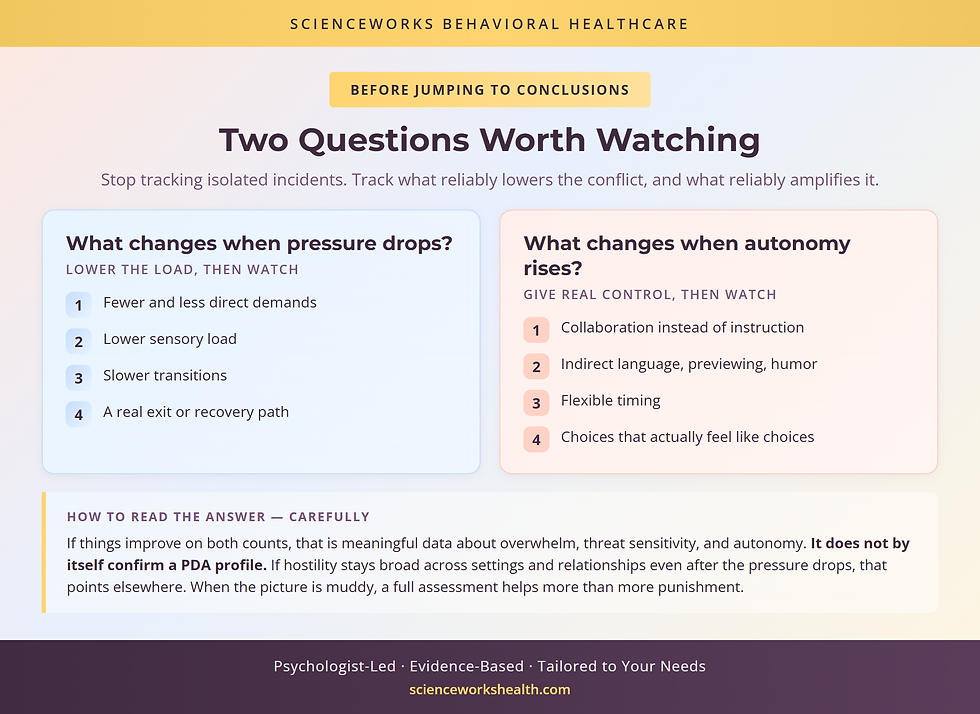
One of the most useful questions is what changes when pressure changes. If the situation improves when demands are reduced, language becomes less direct, sensory load is lowered, transitions slow down, and the child is given a real exit or recovery path, that is meaningful data. It does not automatically confirm a PDA profile, but it suggests that overwhelm, threat sensitivity, and autonomy are important parts of the picture.
What happens when autonomy increases
It also helps to ask what changes when autonomy increases. Does the child do better with collaboration, indirect language, previewing, humor, flexible timing, and choices that actually feel like choices? Or does the hostility stay broad across settings and relationships, even after the pressure drops? In practice, odd vs pda becomes clearer when you stop focusing on isolated incidents and start tracking what reliably lowers versus amplifies the conflict. When the picture is muddy, a full assessment is often more helpful than more punishment.
What support looks like when the driver matters
When the driver is threat, overwhelm, or autonomy protection, support usually works better when it lowers pressure without giving up structure. That can mean offering limited choices, using indirect or collaborative language, reducing repeated prompts, previewing transitions, and helping the person regain regulation before returning to the task. [1,2]
When the pattern is broader oppositional behavior, support usually works better when limits are clear, predictable, and calm. That may include brief house rules, fewer lectures, consistent follow-through, coordinated school supports, and skill-building around emotion regulation and problem solving. Evidence-based ODD treatment frameworks often emphasize parent-focused behavior strategies rather than shame or harsh punishment. [5]
Either way, blame rarely helps. Most families do better when they shift from “Who is winning this?” to “What would help this person succeed without a power struggle?”
Next steps
If you are trying to sort out what is driving the pattern, assessment can help clarify it. And if you need a next step that feels practical, you can reach out for a free consultation so we can help you think through whether assessment, therapy, or another support path makes the most sense.
Frequently Asked Questions
What is the difference between PDA and ODD?
PDA, or pathological demand avoidance, is best described as an anxiety-driven, often autism-related profile of demand avoidance. ODD, oppositional defiant disorder, is a behavioral pattern of anger, defiance, and deliberate provocation that's not specifically tied to autism or anxiety. Both can look like a child saying no, but the drivers and the right responses are very different. PDA is typically about felt control and overwhelm; ODD is more about persistent oppositional behavior across contexts.
How are PDA and ODD assessed and diagnosed?
ODD is a DSM-5-TR diagnosis with specific criteria: a pattern of angry mood, argumentative behavior, and vindictiveness across at least 6 months and across more than one setting. PDA is not a stand-alone DSM-5-TR diagnosis; clinicians evaluate it as a profile within autism using interview, parent or partner report, and validated scales. Comprehensive assessment looks at history, anxiety, autism, ADHD, trauma, and current supports before settling on which framework fits.
Can a child or adult have both PDA and ODD?
It's possible to meet criteria for ODD while also showing a strong PDA profile, but doing so is uncommon and requires careful assessment. Clinicians look for whether avoidance and oppositional behavior are mostly driven by anxiety, sensory overload, and felt loss of control, more typical of PDA, or by chronic, broad oppositional patterns across many settings, more typical of ODD. The same surface behavior can have very different drivers across settings.
Why does it matter whether a child has PDA or ODD?
It matters because the recommended responses are very different. ODD treatment leans on consistent limits, parent management training, and addressing irritability or co-occurring conditions. PDA-informed support emphasizes flexibility, indirect language, lowered demand pressure, validation, and predictable autonomy. Mismatching support can backfire: rigid behavior plans tend to escalate PDA-driven distress, and overly permissive plans can leave ODD patterns unaddressed and reinforce conflict.
How is treatment different for PDA versus ODD?
ODD treatment usually centers on parent management training, predictable consequences, addressing co-occurring ADHD, mood, or trauma, and individual or family CBT. PDA-informed treatment focuses on lowering felt demand, increasing sense of control, supporting communication and sensory regulation, and treating co-occurring anxiety. Clinicians often build a hybrid plan when both patterns appear, but understanding which is the dominant driver shapes which strategies are emphasized at home, school, and in therapy.
About the Author
Dr. Kiesa Kelly is a clinical psychologist and neuropsychologist by training with 20+ years of experience in psychological assessments. Her NIH post-doctoral fellowship focused on ADHD in both research and clinical settings.
At ScienceWorks Behavioral Healthcare, Dr. Kelly provides assessment and therapy with a neurodiversity-affirming lens, helping clients connect patterns, context, and practical next steps.
References
National Autistic Society. Demand avoidance [Internet]. autism.org.uk. Available from: https://www.autism.org.uk/advice-and-guidance/topics/behaviour/demand-avoidance
O'Nions E, Gould J, Christie P, Gillberg C, Viding E, Happé F. Identifying features of 'pathological demand avoidance' using the Diagnostic Interview for Social and Communication Disorders (DISCO). Eur Child Adolesc Psychiatry. 2016 Apr;25(4):407-419. Available from: https://doi.org/10.1007/s00787-015-0740-2
Riley M, Ahmed S, Locke A. Common questions about oppositional defiant disorder. Am Fam Physician [Internet]. 2016 Apr 1. Available from: https://www.aafp.org/pubs/afp/issues/2016/0401/p586.html
Centers for Disease Control and Prevention. Other concerns and conditions with ADHD [Internet]. Available from: https://www.cdc.gov/adhd/about/other-concerns-and-conditions.html
Cleveland Clinic. Oppositional defiant disorder (ODD): Symptoms & treatment [Internet]. Available from: https://my.clevelandclinic.org/health/diseases/9905-oppositional-defiant-disorder
Disclaimer
This article is for informational purposes only and is not a substitute for professional diagnosis, treatment, or medical advice. If you have concerns about safety or urgent mental health needs, seek immediate help from local emergency services.