
The 8 Phases of EMDR Therapy: A Step-by-Step Walkthrough

Updated: 6 days ago
Last reviewed: 04/21/2026
Reviewed by: Dr. Kiesa Kelly
If you are thinking about starting EMDR, the part that tends to feel most uncertain is not whether the approach works — the evidence base is strong — but what actually happens once you are in the chair. EMDR looks different from most talk therapy, and it is often described in vague, dramatic terms online. That gap between "clinically structured protocol" and "eye movements that erase trauma" is where a lot of reasonable hesitation lives.
The real answer is more reassuring and more ordinary. EMDR is a structured, eight-phase protocol developed by Francine Shapiro and formally recognized by the World Health Organization, the American Psychiatric Association, and the U.S. Department of Veterans Affairs as an evidence-based treatment for PTSD [1][2][3]. Each of the eight phases has a specific job. You do not jump straight into reprocessing a memory. Your therapist does not guess their way through the session. The 8 phases of EMDR are essentially a clinical roadmap — one that is paced around your readiness, your nervous system, and the specific target you are working on.
In this article, you'll learn:
What each of the 8 phases of EMDR actually involves, in plain language
Why phase 2 (preparation) often takes longer than people expect — and why that's a good sign
What bilateral stimulation is, and what it does during phase 4
How long the full protocol typically takes, and what a first session feels like
Answers to common questions about telehealth EMDR, getting "stuck," and combining phases
If you already know you want to start, our EMDR and bilateral stimulation service page describes how we structure it in our practice. If you are still researching, this article is designed to give you a full picture of the process before you commit.
What are the 8 phases of EMDR?
EMDR (Eye Movement Desensitization and Reprocessing) is a phased psychotherapy protocol designed to help the brain reprocess distressing memories so they no longer drive current symptoms [4]. The core hypothesis behind the model — Adaptive Information Processing — is that disturbing experiences can get stored in a "stuck" form, with the original emotions, body sensations, and beliefs still active, as if the event were happening now. The 8 phases guide the brain through a structured reprocessing sequence while dual attention (focusing on the memory while tracking bilateral stimulation) is engaged [4][5].
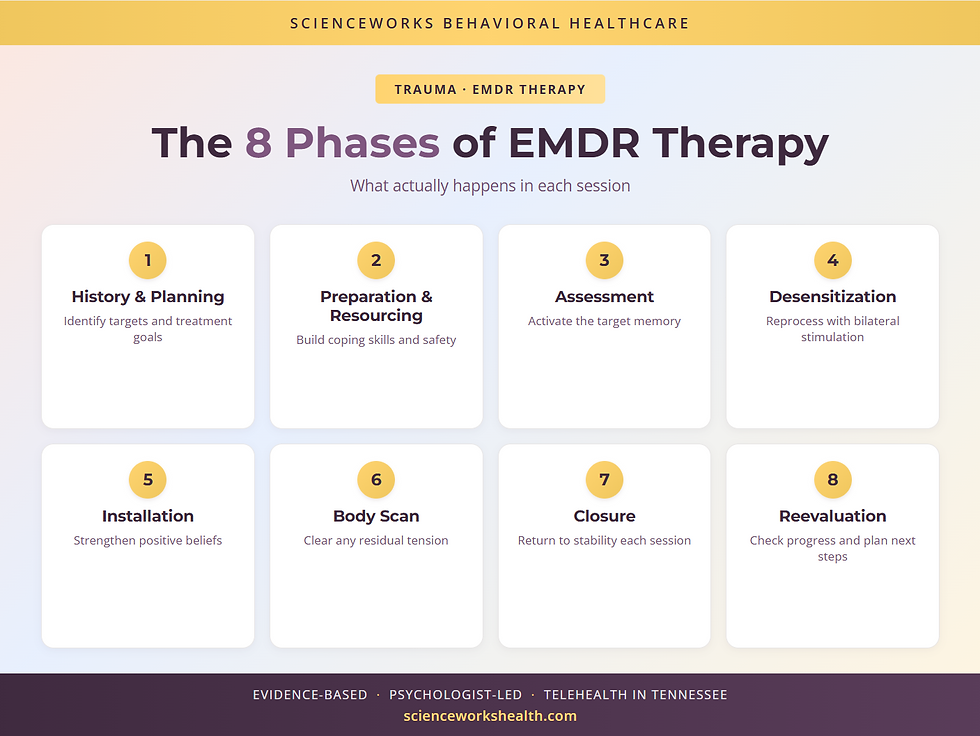
The 8 phases of EMDR, in order, are:
History taking and treatment planning
Preparation and resourcing
Assessment (selecting and measuring the target memory)
Desensitization (the bilateral stimulation phase)
Installation (strengthening a positive belief)
Body scan (clearing residual physical tension)
Closure (bringing the session to a safe stop)
Reevaluation (reviewing progress at the start of the next session)
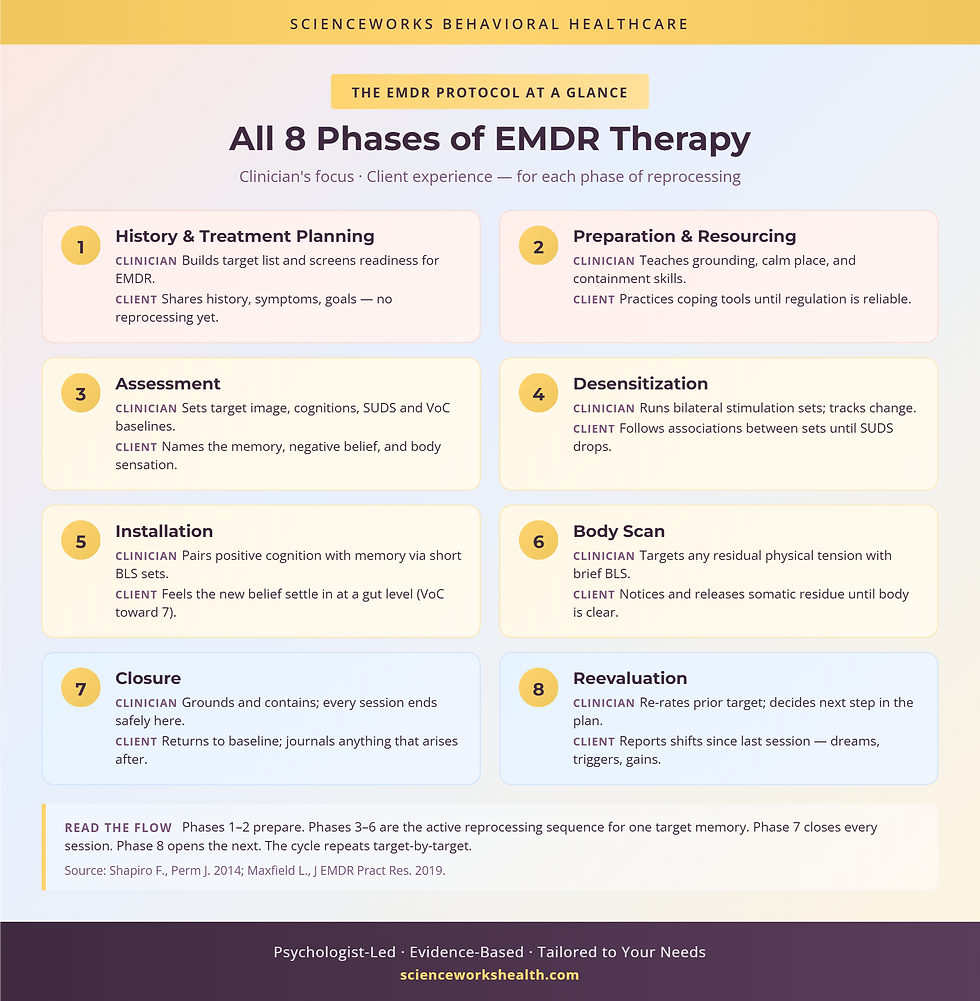
Phases 1 and 2 are preparation. Phases 3 through 6 are the active reprocessing sequence for a single target memory. Phase 7 ends every session safely. Phase 8 is the bridge between sessions. A full course of EMDR cycles through phases 3 through 8 many times, across many targets [4][5].
Key takeaway: The 8 phases are not eight separate sessions. They are a repeatable protocol that your therapist applies target-by-target. Some phases may take multiple sessions; others take only a few minutes.
A quick note on scope. Trauma treatment is a specialized area of therapy, and EMDR is one evidence-based option among several. This article walks through the protocol itself so you know what to expect; it does not attempt to decide whether EMDR is the right fit for your specific history. That conversation belongs with a clinician.
Phase 1 — History taking and treatment planning
Phase 1 is a thorough clinical intake. Your therapist is gathering the information they need to decide whether EMDR is appropriate, what you want to work on, and in what order. This typically includes your symptom history, current functioning, support system, medical and medication history, substance use, dissociation screening, and any previous therapy experiences.
They are also building what EMDR clinicians call a "target list" — a map of the memories, beliefs, triggers, and future situations that may need reprocessing. Not every memory on that list will become a direct target. A skilled EMDR therapist looks for touchstone memories: the earliest or most emotionally charged events that seem to be driving current symptoms. Reprocessing those often reduces the charge on later, related memories without having to work each one individually.
Phase 1 usually takes one to three sessions, though complex trauma histories or dissociative presentations may require longer. If you have never talked about a specific event before, that is okay — phase 1 is not the place where you reprocess it. You are just orienting your therapist to the terrain.
Phase 2 — Preparation and resourcing
Phase 2 is where EMDR noticeably diverges from a lot of other therapies. Before any reprocessing begins, your therapist is making sure you have the internal skills to tolerate it. This means teaching grounding techniques, building a "calm place" or "safe space" you can mentally return to, practicing bilateral stimulation in a low-stakes way, and confirming you can shift out of a distressed state before the session ends.
You will also get a plain-language explanation of the EMDR model — why reprocessing works, what bilateral stimulation is thought to do, and what the session structure will look like. Informed consent in EMDR is not a signature on a form; it is a working understanding of the protocol so you can participate actively in it.
Why this phase is often longer than clients expect
Many people arrive ready to "get to the trauma work," and then feel impatient when the first few sessions are focused on skills rather than memories. This is deliberate. EMDR reprocessing temporarily raises emotional activation on purpose — that is part of what allows the brain to update the memory. If you do not already have reliable ways to come back down from that activation, the session can end in a worse state than it started. Phase 2 is what prevents that.
For simple, single-incident trauma in an otherwise well-regulated adult, phase 2 may take one or two sessions. For complex PTSD, developmental trauma, dissociative symptoms, or limited existing coping skills, it can take several weeks or more. A therapist who spends real time on phase 2 is not stalling — they are doing the part of the work that makes phase 4 safe.
Grounding skills and the "calm place"
The core resources you will practice in phase 2 usually include:
A calm or safe place: a real or imagined setting you can mentally step into, paired with bilateral stimulation to strengthen the association.
Containment: a mental "container" for material that comes up between sessions, so unfinished reprocessing does not follow you home.
Grounding techniques: sensory anchors (5-4-3-2-1, breath, orienting to the room) to stay present.
Resource installation: deliberately strengthening felt memories of competence, safety, or support using short sets of bilateral stimulation.
These are not filler. They are the tools you will actually use during phases 4 and 7, so they need to be well-rehearsed before reprocessing begins.
Key takeaway: Phase 2 is not a warm-up — it is load-bearing. If you cannot reliably bring yourself back to baseline, you are not ready for desensitization yet. That is a clinical judgment, not a setback.

Phase 3 — Assessment
Phase 3 is the short, structured setup that happens at the start of reprocessing a specific target memory. It is usually completed in the same session as phase 4, but the two phases have distinct jobs. In phase 3, you and your therapist are identifying and measuring the target; in phase 4, you are actually reprocessing it.
Target memory selection
Your therapist will guide you to select one specific memory to work on — not "my childhood" in general, but a single recalled moment. You will be asked to bring up the image that represents the worst part of that memory. You do not have to narrate the entire story in detail; you only need to hold the image in mind.
Negative and positive cognitions, SUDS, VoC
Phase 3 then collects four anchor measurements:
Negative cognition: the self-referential belief the memory currently generates ("I am powerless," "It was my fault," "I am not safe").
Positive cognition: the belief you would rather hold about yourself in relation to that memory ("I did what I could," "I am safe now").
Validity of Cognition (VoC): how true the positive cognition feels on a 1–7 scale, gut-level, not intellectually.
Subjective Units of Disturbance (SUDS): how disturbing the memory feels right now on a 0–10 scale.
You will also notice where the disturbance shows up in your body. These four data points — negative cognition, positive cognition, VoC, and SUDS — are the before measurements. At the end of reprocessing, your therapist will take them again to see what shifted. If you have seen references to the "EMDR SUDS scale" or "EMDR positive cognition," this is the phase they belong to.
Phase 4 — Desensitization (the bilateral stimulation phase)
Phase 4 is where the reprocessing actually happens. Your therapist asks you to hold the target image, the negative cognition, and the body sensation in mind, then starts a set of bilateral stimulation — typically guided eye movements, but sometimes alternating tactile taps or auditory tones. A set usually lasts 20 to 40 seconds.
At the end of each set, your therapist will ask a short question — usually some version of "What are you noticing now?" You briefly report whatever came up (an image, a thought, an emotion, a body sensation, sometimes nothing), and then another set begins. This repeats, with your therapist tracking the direction of change, until the SUDS rating reaches 0 or a minimally disturbing level.
What many people do not expect about phase 4 is that you do not have to describe the memory in narrative detail. You do not have to relive it. You are following whatever your mind and body bring up between sets, which is often surprisingly associative — a memory, a color, an unrelated event, a sentence someone once said. The bilateral stimulation is the engine; your internal associations are the material.
Common misconceptions about phase 4 are worth addressing directly. Misconception: "EMDR makes you forget the event." In reality, the memory does not disappear. What changes is its emotional and somatic charge. You still know what happened; it just no longer feels like it is happening now [4][5]. Misconception: "If I cry or feel activated, the therapy is going wrong." In reality, moderate emotional activation is expected and is part of how reprocessing works. Your therapist is trained to stay with you through it and to pause if activation exceeds your window of tolerance. Misconception: "Bilateral stimulation has to be eye movements." In reality, auditory and tactile bilateral stimulation have comparable effects in many clinical contexts, which matters for telehealth delivery [6].
Phase 4 does not always finish in one session. If SUDS is still above 0 when time is running out, your therapist moves to phase 7 (closure) and resumes reprocessing in the next session.
Phase 5 — Installation
Once the target memory has desensitized to SUDS 0 or close to it, phase 5 strengthens the positive cognition chosen back in phase 3. Your therapist asks you to hold the original memory along with the positive belief ("I am safe now," "I did the best I could"), and runs additional short sets of bilateral stimulation.
The goal is to raise the Validity of Cognition (VoC) rating to 7 — the point where the new belief feels fully true at a gut level, not just intellectually. This phase is usually short compared to phase 4; if the desensitization was thorough, the positive cognition often installs quickly. If it stalls, that is useful clinical information — usually a sign that a related memory or blocking belief still needs attention.
If you have heard the term "EMDR installation phase," this is what it refers to. It is the corrective emotional side of reprocessing: the memory is no longer disturbing, and the updated self-belief now has somatic weight.
Phase 6 — Body scan
In phase 6, your therapist asks you to hold the memory and the positive cognition in mind at the same time and notice any remaining physical tension or sensation. The body often carries residue after a memory has cognitively and emotionally cleared — a tight chest, a held breath, a knot in the stomach. If anything remains, additional short sets of bilateral stimulation are used to target those specific sensations until the body scan is clean.
This step reflects one of the core principles of trauma-focused treatment: traumatic memory is stored somatically as well as cognitively. A memory is not fully reprocessed until the body agrees [7]. The body scan is how EMDR checks that agreement.
Phase 7 — Closure
Phase 7 ends every session — whether or not reprocessing is complete for that target — and returns you to a stable, grounded state before you leave. If the target reached SUDS 0, VoC 7, and a clean body scan, closure is brief: your therapist reviews what happened, reminds you that material may continue to surface over the next few days, and reinforces the resources you learned in phase 2.
If reprocessing was incomplete when time ran out (an "incomplete session"), phase 7 is more deliberate. Your therapist uses containment and grounding techniques to help you set aside unfinished material, reduce activation, and return to baseline before you walk out the door — or log off, in the case of telehealth. You are asked to notice and keep track of anything that comes up between sessions: dreams, memories, intrusive thoughts, body sensations, emotional shifts. This journal becomes input for phase 8.
Key takeaway: Phase 7 is not optional. Every session ends with closure, even — especially — when reprocessing is not finished. You should not leave an EMDR session in an emotionally activated or dissociated state.
Phase 8 — Reevaluation
Phase 8 happens at the start of the next session, before any new reprocessing begins. Your therapist asks you to bring the previous target memory back to mind and re-rate the SUDS and VoC. They also ask what came up between sessions — dreams, memory fragments, new triggers, changes in how you felt in specific situations.
Based on that check-in, your therapist decides what happens next. If the previous target is still at SUDS 0 and VoC 7 and has stayed that way, you move on to the next target on the list. If something has shifted back, that target gets more reprocessing. If a new memory surfaced that is clearly related, that becomes the next target. Over time, as touchstone memories are reprocessed, the broader symptom pattern usually lifts — and phase 8 is how your therapist tracks that arc.
How long does the full 8-phase protocol take?
There is no single answer, and honest timelines matter. Research on single-incident PTSD in adults suggests significant symptom reduction in roughly 3–6 active reprocessing sessions, on top of phase 1 and phase 2 preparation [8]. For complex PTSD, developmental trauma, or multiple target memories, treatment often runs longer — sometimes several months to a year — because there are simply more targets and more preparation to build along the way.
A typical EMDR session is 60 to 90 minutes. A 50-minute session can work, but many therapists prefer 90 minutes because it gives phase 4 room to reach a natural pause point without interrupting reprocessing mid-stream. If you have seen the question "how long is an EMDR session," this is why the answer varies.
In our practice, we scope EMDR after the initial intake, with an honest estimate of how many sessions it will likely take and what factors could extend that. We would rather be upfront about a longer timeline than promise a short one we cannot honor.
What a first appointment actually feels like
Your first EMDR appointment is almost always a phase 1 session. You should not expect eye movements, target memories, or SUDS ratings on day one. The first session usually feels closer to a thorough intake: your therapist asks about current symptoms, relevant history, what brought you in, what you have tried before, and what you want out of treatment. If you have specific memories or events in mind, you can mention them — but you will not be asked to reprocess them.
Many people feel a mix of relief and anticlimax after the first session. Relief because the tone is calm and the therapist is not pushing you into anything. Anticlimax because the EMDR they have read about online (bilateral stimulation, reprocessing, shifts in how a memory feels) has not happened yet. Both reactions are normal. The first session is doing its job if you leave with a clearer sense of what the course of treatment will look like and a working relationship with your therapist.
Key takeaway: Your first EMDR appointment is a conversation, not a reprocessing session. If a provider offers to jump straight into bilateral stimulation on day one, that is a reason to ask questions about their protocol.
Frequently asked questions
Is every session a bilateral stimulation session?
No. Phases 1, 2, 7, and 8 involve little or no bilateral stimulation. Phase 2 uses short, gentle sets to install resources (like the calm place), but these are very different from reprocessing sets. Bilateral stimulation as most people picture it — fast, sustained, focused on a distressing memory — is specifically a phase 4 activity, with shorter sets continuing into phase 5 and sometimes phase 6.
What if I get stuck in the middle of the protocol?
Getting "stuck" during phase 4 is common and expected. Your therapist has a range of interventions for it — cognitive interweaves, shifting the bilateral stimulation modality, returning to the target image, or switching to a related memory that is blocking progress. Being stuck is a clinical moment, not a failure. What matters is that the session still ends safely at phase 7, with you grounded and resourced, even if the target did not fully desensitize that day.
Can phases be combined in one session?
Often, yes. Phases 3 through 6 are frequently completed in a single session when a target reprocesses cleanly. Phases 7 and 8 are structurally bracketed — closure always ends the current session, and reevaluation always opens the next one. What you should not see is phase 2 skipped or rushed so that phase 4 can happen faster. That is a protocol shortcut that changes the safety profile of the treatment.
Is telehealth EMDR the same protocol?
The protocol is the same; the delivery adapts. Telehealth EMDR typically uses therapist-guided eye movements via a shared visual (a moving dot or ball on screen), auditory bilateral stimulation through stereo headphones, or self-tapping (butterfly hug, knee taps) coordinated with the therapist. Research on telehealth-delivered EMDR indicates outcomes comparable to in-person delivery for many presentations, particularly when the therapist is experienced with remote protocol adaptations [6]. A strong telehealth setup — stable connection, headphones, a private room, and a therapist who knows how to manage closure remotely — is what makes the equivalence hold in practice.
What are the 8 phases of EMDR therapy in order?
The eight phases are: (1) history taking and treatment planning, where the therapist gathers developmental and trauma history and identifies targets for reprocessing; (2) preparation and resourcing, building stabilization skills and explaining the process; (3) assessment, activating the specific target memory with its image, cognition, emotion, and body sensation; (4) desensitization, the active reprocessing phase using bilateral stimulation while the client holds the target; (5) installation, strengthening the positive cognition that replaces the negative belief; (6) body scan, checking for any remaining physical tension or disturbance; (7) closure, returning the client to equilibrium if reprocessing is incomplete; and (8) reevaluation, reviewing progress at the start of subsequent sessions.
Why does EMDR phase 2 sometimes take longer than expected?
Phase 2 — preparation and resourcing — builds the internal skills needed to tolerate reprocessing. This includes window of tolerance work, containment techniques, and resourcing exercises that provide an anchor during difficult material. For clients with complex trauma, dissociation, fragile emotion regulation, or limited internal resources, phase 2 cannot be rushed without increasing the risk that reprocessing will destabilize rather than help. Some clients need weeks or months in phase 2 before the trauma history can safely be approached. Clinicians trained in EMDR understand this as appropriate pacing rather than treatment stalling.
Does EMDR therapy make you forget your trauma?
No. EMDR does not erase the memory. What changes is its emotional and physical charge — the vividness, distress, and body activation that make the memory feel present rather than past. After successful reprocessing, clients can access the same event but experience it as something that happened in the past rather than something happening now. The factual content remains; the nervous system's alarm response to the memory diminishes. This is different from forgetting, which EMDR does not produce and does not aim to.
Is telehealth EMDR the same as in-person EMDR?
The protocol is the same; the delivery adapts. Telehealth EMDR typically uses therapist-guided eye movements via screen tracking, audio bilateral stimulation through headphones, or tactile self-tapping techniques the client performs on their own body. Research on remotely delivered EMDR has shown comparable outcomes to in-person delivery for most presentations. The preparation phase may be extended slightly to ensure adequate stabilization in a home environment, and the therapist pays close attention to the client's ability to signal distress and feel contained across a digital connection. Most clinicians who do both report that telehealth EMDR is a genuine and effective format, not a compromise.
Next step: starting your own 8-phase process
If you have read this far, you probably have a clearer picture of what EMDR actually asks of you. The protocol is structured, paced, and designed around your readiness at each phase — not a dramatic single-session intervention. Most of the anxiety people bring to EMDR is really anxiety about the unknown shape of the process. Knowing the shape helps.
A reasonable next step is a consultation with an EMDR-trained clinician who can tell you, based on your history, what phase 1 and phase 2 would likely look like for you and roughly how many reprocessing sessions to expect. You can contact us here if you would like to start that conversation with our team, or read more about how we deliver trauma-focused treatment in our practice. You do not have to commit to the full protocol to ask the question.
About the Author
Dr. Kelly's background includes more than 20 years of experience in psychological assessment and evidence-based treatment, with specialized clinical interest in trauma, anxiety, and neurodevelopmental presentations in adults and adolescents. Her clinical training includes graduate and postgraduate work at the University of Chicago, Vanderbilt University, and the University of Wisconsin, including NIH-funded research training relevant to her ongoing work in trauma and mental health assessment.
At ScienceWorks Behavioral Healthcare, Dr. Kelly founded and leads a telehealth-forward practice in Tennessee that emphasizes evidence-based protocols — including EMDR and other trauma-focused therapies — alongside comprehensive psychological assessment. Every article on this site is reviewed by a licensed clinician before publication.
References
1. World Health Organization. Guidelines for the management of conditions specifically related to stress. Geneva: WHO; 2013. https://www.who.int/publications/i/item/9789241505406
2. American Psychiatric Association. Practice guideline for the treatment of patients with acute stress disorder and posttraumatic stress disorder. https://psychiatryonline.org/pb/assets/raw/sitewide/practice_guidelines/guidelines/acutestressdisorderptsd.pdf
3. U.S. Department of Veterans Affairs / Department of Defense. VA/DoD Clinical Practice Guideline for the Management of Posttraumatic Stress Disorder and Acute Stress Disorder. 2023. https://www.healthquality.va.gov/guidelines/MH/ptsd/
4. Shapiro F. The role of eye movement desensitization and reprocessing (EMDR) therapy in medicine: addressing the psychological and physical symptoms stemming from adverse life experiences. Perm J. 2014;18(1):71–77. https://doi.org/10.7812/TPP/13-098
5. Maxfield L. A clinician's guide to the efficacy of EMDR therapy. J EMDR Pract Res. 2019;13(4):239–246. https://doi.org/10.1891/1933-3196.13.4.239
6. Lenferink LIM, Meyerbröker K, Boelen PA. PTSD treatment in times of COVID-19: a systematic review of the effects of online EMDR. Psychiatry Res. 2020;293:113438. https://doi.org/10.1016/j.psychres.2020.113438
7. van der Kolk BA. The body keeps the score: memory and the evolving psychobiology of posttraumatic stress. Harv Rev Psychiatry. 1994;1(5):253–265. https://doi.org/10.3109/10673229409017088
8. Chen YR, Hung KW, Tsai JC, Chu H, Chung MH, Chen SR, et al. Efficacy of eye-movement desensitization and reprocessing for patients with posttraumatic-stress disorder: a meta-analysis of randomized controlled trials. PLoS One. 2014;9(8):e103676. https://doi.org/10.1371/journal.pone.0103676
9. Cuijpers P, van Veen SC, Sijbrandij M, Yoder W, Cristea IA. Eye movement desensitization and reprocessing for mental health problems: a systematic review and meta-analysis. Cogn Behav Ther. 2020;49(3):165–180. https://doi.org/10.1080/16506073.2019.1703801
10. National Institute for Health and Care Excellence (NICE). Post-traumatic stress disorder. NICE guideline NG116. 2018. https://www.nice.org.uk/guidance/ng116
Disclaimer
This article is for informational purposes only and is not a substitute for professional diagnosis, treatment, or advice. Reading it does not create a clinician-patient relationship. If you are experiencing distressing symptoms, considering trauma treatment, or unsure whether EMDR is appropriate for your situation, please consult a licensed mental health professional. If you are in crisis, contact the 988 Suicide and Crisis Lifeline (call or text 988 in the United States) or your final emergency services.