
Working Memory Strategies for Adults: External Scaffolds That Actually Stick

Updated: Sep 15
Last reviewed: 07/12/2026
Reviewed by: Dr. Kiesa Kelly

You walk into the kitchen and forget why. Someone gives you three instructions and you hold on to the first and the last. You lose the thread of a conversation the moment your phone buzzes. These are not character flaws, and they are not signs that you have stopped trying. They are working memory in action — or, more precisely, working memory reaching its limit. Most working memory strategies for adults miss the point because they promise to make that limit bigger. The more honest and more useful goal is to make the limit matter less.
This article is about the difference between those two goals. You cannot expand working-memory capacity the way you build a muscle, and the evidence for popular brain-training programs is far weaker than the marketing suggests. What you can do is build external scaffolds — systems outside your head that hold information so your mind is free to think and follow through. That shift, from remembering harder to remembering less, is where real change happens.
In this article, you'll learn:
What working memory actually is, in plain terms
How a weak working memory quietly shows up in everyday life
Why you can't "train" capacity but can scaffold around it — and what the research really says
Concrete external strategies for capture, chunking, visualization, and environment
When working-memory struggles are worth a professional conversation
What working memory actually is
Working memory is the mental workspace where you hold and use a small amount of information for a few seconds — a phone number before you dial it, the three steps of a recipe, the point you want to make once the other person stops talking. In the most widely used model, developed by Alan Baddeley and Graham Hitch, working memory is not a single store but a set of parts: a verbal loop for words and sounds, a visual-spatial sketchpad for images and layouts, and a central executive that directs attention and juggles the pieces [1]. It is the "keeping in mind" that sits underneath planning, reasoning, and getting things done.
The single most important fact about working memory is that it is small. Decades of research suggest most adults can hold only about three to five meaningful "chunks" at once, not the "seven" often repeated in popular culture [2]. That capacity is also fragile: stress, fatigue, interruptions, and doing two things at once all shrink the space further. If you have ever lost a good idea because someone asked you a question mid-thought, you have felt how little it takes to overwhelm the workspace.
The takeaway is freeing. If the workspace is small for everyone, then struggling to hold a lot in your head is not a sign something is broken. It is a sign you are asking a small system to do a big job — and the fix is usually structural, not personal.
Common myths that keep adults stuck
Before the strategies, it helps to clear away three beliefs that quietly sabotage people.
"If I just concentrated harder, I would remember." In reality, working memory is a capacity limit, not a motivation problem. You can care deeply about a task and still lose the details, because effort does not enlarge the workspace — it only helps you notice sooner that it is full. Blaming willpower keeps you trying the one thing that does not work while ignoring the things that do.
"Using reminders and notes is a crutch that makes my memory worse." Relying on external tools is not cheating or weakness. Cognitive scientists call this "cognitive offloading," and it is how capable people manage complex lives — pilots use checklists and skilled professionals write things down so their limited workspace is free for judgment [7]. The goal is not to hold it all in your head; it is to get things done reliably.
"Brain-training apps will fix this if I stick with them." This is the most expensive myth. As we'll see below, the science shows people improve at the specific game they practice, but those gains rarely transfer to real life [5]. Time spent drilling a memory app is usually better spent building systems you will still use next year.
Key takeaway: 🧠 Working memory is a small, shared workspace — not a measure of how hard you are trying. Treat the limit as a design problem, not a personal failing.
How weak working memory shows up day to day
Working-memory difficulty rarely announces itself. It hides inside ordinary moments and gets misread as carelessness. Seeing the pattern clearly is the first step toward building around it.
Picture a normal Tuesday. Your manager stops by your desk and rattles off four things she needs before Friday. You nod, you genuinely intend to do all four, and by the time you sit back down you can reconstruct maybe two. You do not want to look scattered, so you do not ask her to repeat it — and now two tasks are gone, not because you did not care, but because they never made it out of the workspace before it filled. Over months, this looks to other people like unreliability. To you, it feels like a small betrayal by your own brain.
Or: you are in a meeting and you have a genuinely good point to make. You wait for a pause, someone else talks for ninety seconds, and when your turn comes the point has evaporated. You spend the rest of the meeting quietly frustrated, not because you lacked the idea, but because you had nowhere to park it while you waited.
If those scenes feel familiar, notice what they share. The problem is almost never the thinking itself. It is the holding — keeping information intact across a gap of time, distraction, or competing demand. That is the specific weak spot external scaffolds are built to cover.
Key takeaway: ⏱️ Working-memory costs are "holding" costs — following instructions, tracking steps mid-task, and keeping a thought alive until you can use it. Name the pattern and it stops feeling like a character flaw.

Can you train working memory, or only work around it?
This is the question the whole topic turns on, and getting the answer wrong wastes months.
For years, commercial "brain-training" programs promised that practicing memory drills would expand your underlying capacity and spill over into sharper attention, better grades, and clearer thinking. The research has not been kind to that promise. A large, careful meta-analysis found that working-memory training reliably improves performance on the trained tasks and closely related ones, but shows no convincing transfer to broader outcomes like reasoning, attention, or academic achievement [5]. In plain terms: you get better at the game, not at life. Studies of one of the best-known programs, Cogmed, echo this, and researchers have noted that even carrying out the intensive training as designed is genuinely difficult for adults, especially adults with ADHD — the very group most likely to try it [6].
This is a redirection, not a dead end. The evidence points away from trying to grow the workspace and toward reducing what the workspace has to carry — which is what compensatory, external strategies do, and the half of the story most "boost your memory" lists underweight. The approach is well established clinically: memory-strategy training that teaches people to lean on external aids and structured routines is a standard, evidence-supported part of cognitive rehabilitation for adults with everyday memory difficulties [10]. If you notice these struggles most at work, our companion guide to external systems for staying on top of work with ADHD applies the same logic to the office; this one stays zoomed in on working memory itself, across all of daily life.
Key takeaway: 🔧 You can't train the capacity, but you can engineer the load. Every strategy below works by moving information out of your head and into something more reliable.
Working memory strategies that actually stick
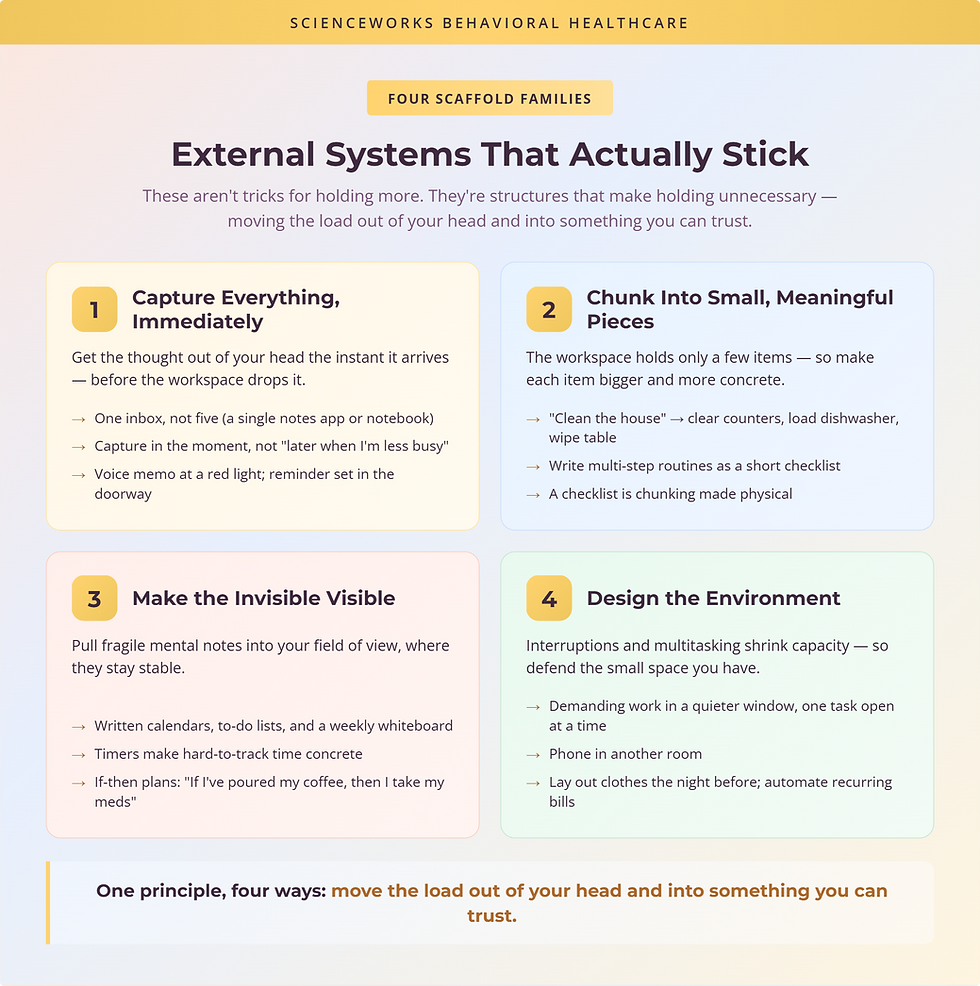
The strategies that endure share one feature: they do the remembering for you. They are not tricks for holding more; they are structures that make holding unnecessary. Four families cover most of daily life.
1. Capture everything, immediately
The single highest-value habit is to get information out of your head and into a trusted place the instant it arrives — before the workspace can drop it. This is cognitive offloading in its most practical form, and the research is clear that shifting information to an external store frees up mental resources for the task in front of you [7].
The rules that make capture work are simple. Keep it to one inbox, not five — a single notes app, notebook, or reminder system. Capture in the moment the thought appears, not later when you are "less busy," because later is when it is already gone. And make capture friction-free: a voice memo at a red light, a phone reminder set while you are still in the doorway, a sticky note on the mug you'll pick up in the morning. Among external aids, smartphone-based reminders are some of the best studied and, for many people, the most effective for everyday follow-through, partly because the phone is already with you [11].
One caution worth naming: research on offloading finds that when you hand information to a device, you tend to remember it less well yourself, and performance can dip if the aid is suddenly gone [7]. That is not a reason to avoid capture — it is a reason to make your systems dependable and backed up, so you can trust them the way you would trust a colleague.
2. Chunk big things into small, meaningful pieces
Because the workspace holds only a few items, the trick is to make each item bigger and more meaningful. Chunking groups small bits of information into a single unit — the way a phone number is easier as three chunks than ten loose digits. Studies show that when people group information into meaningful chunks, they recall more and report lower mental effort [9].
In daily life, chunking is mostly about tasks, not trivia. "Clean the house" is a single overwhelming blob that your workspace cannot hold or start. Broken into "clear the counters, load the dishwasher, wipe the table," it becomes three concrete actions you can see and check off. The same move works for a multi-step work process, a recipe, or a morning routine: write the steps down as a short checklist so you are reading the sequence instead of holding it. A checklist is chunking made physical.
3. Make the invisible visible
Working memory is where things go to disappear, so pull as much as possible out of it and into your field of view. Visualization and visual cues turn a fragile mental note into a stable external one.
A visible calendar beats a mental one; a written to-do list beats an intended one; a whiteboard of the week's moving parts beats reconstructing them each morning. Timers make the passage of time — which working memory tracks poorly — visible and concrete. Even placement is a cue: the pills next to the coffee maker, the gym bag by the door, the bill on the keyboard. You are not trusting yourself to remember at the right moment; you are arranging the world so the reminder finds you.
A specific, well-tested version of this is the "if-then" plan: decide in advance exactly when and where you will act — "if it is 8 a.m. and I have poured my coffee, then I take my medication." Linking an action to a concrete cue takes the remembering off your shoulders and hands it to the situation, and a large body of research shows this simple format meaningfully improves follow-through compared with just intending to do something [8].
4. Design the environment to protect the workspace
Finally, defend the small workspace you have. Because interruptions and multitasking shrink capacity, the environment around a task is not a luxury — it is part of the strategy.
Do the demanding, hold-a-lot-in-mind work in a quieter window, with the phone in another room and one thing open at a time. Reduce the decisions competing for the same space: lay out clothes the night before, keep a standing grocery list, automate recurring bills. Every open loop you close in advance is space returned for the thing that actually needs it. None of this is about discipline; it is about not asking a small system to fight a noisy room.
Key takeaway: 📋 Capture, chunk, make-visible, and protect are not four tricks — they are one principle applied four ways: move the load out of your head and into something you can trust.
A simple way to decide where to start
You do not need all four families at once. Use this rule of thumb: start where your failures cluster. If things slip because you never write them down, build the capture habit first. If tasks feel too big to begin, practice chunking and checklists. If you forget at the moment of action — the pills, the appointment, the follow-up — lean on visible cues and if-then plans. If you hold things fine until the room gets loud, environmental design is your highest-leverage move. Pick the one that matches your most common Tuesday failure, make it boringly consistent for two weeks, then add the next.
When it's worth a professional conversation
For most adults, better systems are enough, and the strategies above will carry you a long way. Sometimes, though, working-memory struggles are steady, severe, and spread across work, home, and relationships in a way no reminder app seems to touch. When that is the case, it can be worth looking at what is underneath.
Persistent working-memory difficulty is one common feature of ADHD in adults; meta-analytic research confirms that measurable working-memory differences continue into adulthood for many people with the condition [3][4]. But it is not proof of ADHD. The same difficulty can come from anxiety, depression, chronic poor sleep, high stress, or ordinary aging — which is why a real answer requires more than a symptom checklist. Clinical guidelines are explicit that ADHD should be diagnosed through a comprehensive assessment of symptoms, developmental history, and real-world impairment — never from a single questionnaire [12].
A reasonable first step is a validated screener. If ADHD is on your mind, the ASRS self-report screener or an executive-functioning screener like the ESQ-R can help you see whether your pattern is worth a closer look; both are starting points, not diagnoses. If the picture is broader than attention, a full psychological assessment can sort out what is actually driving the difficulty. And if the goal is simply to function better regardless of any label, specialized therapy and skills-based coaching can help you build and stick with the systems this article describes. When you are ready to talk it through with a person rather than a page, you can reach our team directly.
Here are a few questions worth asking any provider you consider: Does your evaluation look at whether something other than ADHD — like anxiety, sleep, or mood — could explain the memory difficulty? How do you account for the ways adults compensate and mask? What developmental history do you gather if I don't have childhood records? And what will I actually walk away with — concrete recommendations I can use, not just a label? Good answers to those questions are a strong sign you are in the right place.
Key takeaway: 🩺 Weak working memory is common and rarely dangerous, but when it's constant and costly across your whole life, a proper evaluation — not a memory app — is the honest next step.
Getting started
You do not have to overhaul your life this week. Working memory is a small workspace, and the whole point is to stop asking it to carry more than it can. Choose one scaffold — one capture habit, one checklist, one visible cue, one quieter hour — and make it reliable before adding another. The compounding comes not from remembering harder, but from steadily needing to.
Good ideas, hard to follow through?
Executive-function coaching builds the practical systems — time, task initiation, working memory — that make follow-through possible, without pathologizing how your brain works.
Frequently Asked Questions
How do you fix poor working memory in adults?
You generally can't 'fix' working-memory capacity itself, but you can reduce how much it has to hold. The most reliable approach is compensatory: capture information the moment it arrives, break tasks into small chunks, and set up external cues so remembering doesn't depend on your mind alone. Brain-training drills tend to improve the practiced task without changing everyday life.
Can working memory be improved, or only worked around?
The honest answer is mostly worked around. Controlled studies show that working-memory training improves the specific drill you practice but does not reliably transfer to unrelated skills like attention or academic performance. External scaffolds — notes, reminders, chunking, and steady routines — have a stronger track record for changing day-to-day function, which is why we emphasize them.
What are examples of external memory aids?
External memory aids are anything that holds information so your brain doesn't have to. Common examples include phone reminders and alarms, one capture app or notebook, shared calendars, checklists, labeled bins, sticky notes placed where you'll act, and visual timers. In cognitive rehabilitation research, smartphone-based reminders are among the better-studied and more effective aids for everyday tasks.
Is weak working memory a sign of ADHD?
It can be, but weak working memory is not specific to ADHD. Working-memory difficulty is a common feature of ADHD in adults, yet it also appears with anxiety, depression, poor sleep, chronic stress, and normal aging. A screener such as the ASRS can help you decide whether a full evaluation makes sense, but only a clinical assessment can determine whether ADHD is the cause.
Do brain-training apps improve working memory?
Mostly no, at least not in a way that carries over to daily life. Research finds that people get better at the specific game or task they practice, but those gains rarely generalize to real-world attention, work, or memory. If you enjoy the apps there's little harm, but they are not a substitute for external systems and, for some adults, professional support.
About ScienceWorks
ScienceWorks Behavioral Healthcare was founded by Dr. Kiesa Kelly, a licensed clinical psychologist with more than 20 years of experience in psychological assessment and evidence-based treatment. Our clinical team focuses on the areas where executive function, attention, and daily follow-through intersect — including ADHD and autism evaluations, executive-function coaching, and skills-based therapy for adults and adolescents.
We are a telehealth-forward practice serving Tennessee, now with an in-person option in Nashville. Every article we publish is reviewed by a licensed clinician for accuracy before it goes live, because on health topics, getting the details right matters more than getting them fast.
References
1. Baddeley A. Working memory and language: an overview. J Commun Disord. 2003. https://pubmed.ncbi.nlm.nih.gov/12742667/
2. Cowan N. The Magical Mystery Four: How Is Working Memory Capacity Limited, and Why? Curr Dir Psychol Sci. 2010. https://pmc.ncbi.nlm.nih.gov/articles/PMC2864034/
3. CHADD. ADHD and Working Memory. https://chadd.org/attention-article/adhd-and-working-memory/
4. Alderson RM, Kasper LJ, Hudec KL, Patros CHG. Attention-deficit/hyperactivity disorder (ADHD) and working memory in adults: a meta-analytic review. Neuropsychology. 2013. https://pubmed.ncbi.nlm.nih.gov/23688211/
5. Melby-Lervåg M, Redick TS, Hulme C. Working Memory Training Does Not Improve Performance on Measures of Intelligence or Other Measures of "Far Transfer": Evidence From a Meta-Analytic Review. Perspect Psychol Sci. 2016. https://pmc.ncbi.nlm.nih.gov/articles/PMC4968033/
6. Weicker J, et al. Cogmed Working Memory Training Presents Unique Implementation Challenges in Adults With ADHD. Front Psychiatry. 2018. https://www.ncbi.nlm.nih.gov/pmc/articles/PMC6121173/
7. Risko EF, Gilbert SJ. Cognitive Offloading. Trends Cogn Sci. 2016. https://www.sciencedirect.com/science/article/abs/pii/S1364661316300985
8. Gollwitzer PM, Sheeran P. Implementation Intentions and Goal Achievement: A Meta-Analysis of Effects and Processes. Adv Exp Soc Psychol. 2006. https://cancercontrol.cancer.gov/sites/default/files/2020-06/goal_intent_attain.pdf
9. Ramkumar P, et al. Chunking improves symbolic sequence processing and relies on working memory gating mechanisms. Learn Mem. 2016. https://pmc.ncbi.nlm.nih.gov/articles/PMC4755266/
10. A systematic review and meta-analysis on prospective memory rehabilitation in adults with non-progressive acquired brain injury. 2025. https://pmc.ncbi.nlm.nih.gov/articles/PMC12808730/
11. Kochi K, et al. Smartphone-Based Compensatory Support for Acquired Memory Impairment: A Scoping Review of Interventions and Implementation Challenges. Health Soc Care Community. 2026. https://onlinelibrary.wiley.com/doi/10.1155/hsc/2056034
12. National Institute for Health and Care Excellence (NICE). Attention deficit hyperactivity disorder: diagnosis and management (NG87). https://www.nice.org.uk/guidance/ng87
Disclaimer
This article is for informational and educational purposes only. It is not a substitute for professional medical or psychological advice, diagnosis, or treatment. Reading it does not create a clinician-patient relationship. Working-memory difficulties can have many causes, and only a qualified professional can evaluate your individual situation. If you are concerned about your memory, attention, or mental health, please consult a licensed clinician. If you are in crisis or may be in danger, call or text 988 (the Suicide and Crisis Lifeline) or dial 911.