
CBT, ACT, or Exposure Therapy for Anxiety: How the Three Approaches Actually Differ

Last reviewed: 09/01/2026
Reviewed by: Dr. Kiesa Kelly
You have probably already found the listicles. They rank CBT, ACT, and exposure therapy in some order, hand you a paragraph on each, and leave you with three acronyms and the worry that picking wrong will cost you months.
Here is the part almost nobody says plainly. When these approaches are compared head-to-head for anxiety, the studies mostly do not find a winner. That sounds like bad news. It is actually what makes the decision manageable, because it moves the question off "which is strongest" and onto something you can answer yourself: which of these is doing the job my anxiety actually needs done. Where you are starting matters too, and a validated measure like the GAD-7 tells you more about that than any of these labels [12].
In this article, you'll learn:
What the head-to-head evidence really shows, and where it is genuinely equivocal
The mechanism each approach targets, and how that feels different in a session
Why exposure is not a separate escalation from CBT
What "I'm not getting anything out of therapy" usually means, and the three problems behind it
An if/then decision guide you can apply before you book anything
The honest headline: there is no head-to-head winner
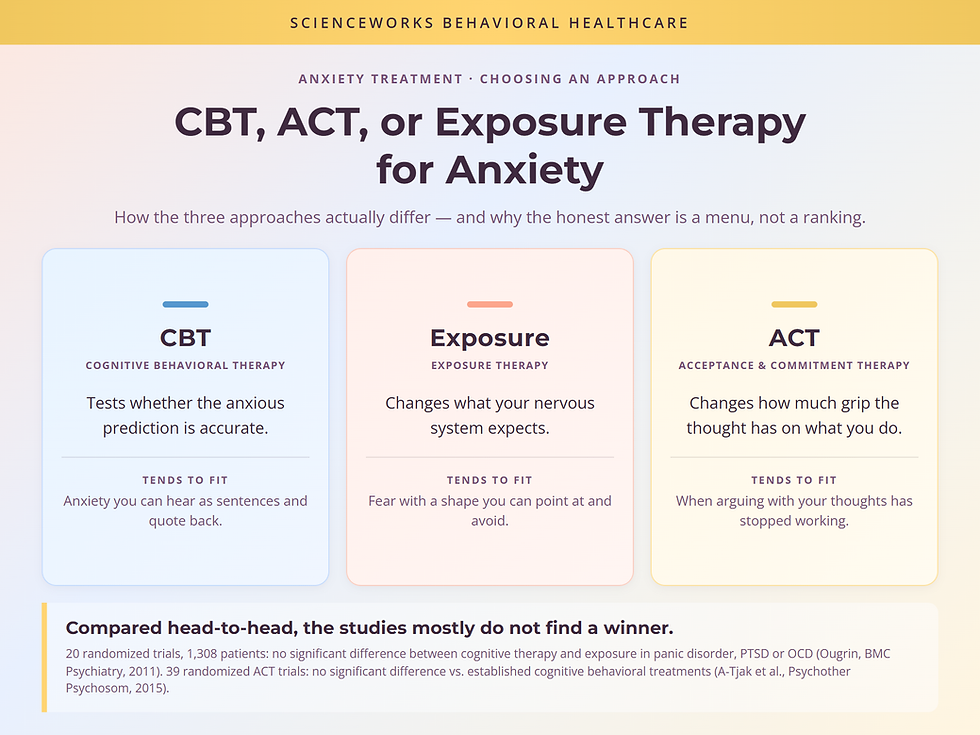
Start with the study that gets quoted least and matters most. A meta-analysis of 20 randomized controlled trials, covering 1,308 patients, compared cognitive therapy directly against exposure in panic disorder, PTSD, and OCD, and found no significant difference in any of the three [1]. A separate meta-analysis of 39 randomized ACT trials found no significant difference between ACT and established cognitive behavioral treatments [2]. And a 2025 review of 49 randomized CBT trials found a moderate average advantage over control conditions that has not grown in three decades [3].
Three research groups, one answer: these are not competing claims about what anxiety is, but different entry points into the same problem. Three beliefs get in the way, and are worth clearing first.
"One of these must be the strongest, and a good clinician will know which." The direct comparisons say otherwise, and a clinician who claims certainty is claiming more than the evidence supports. What they can tell you is which is the better opening move for your pattern. We walk the same decision through for a different condition in our guide to choosing between depression therapies.
"Exposure therapy is the aggressive option you escalate to when talking hasn't worked." Exposure is not an escalation. It is a standard component of ordinary CBT for anxiety disorders, and for several of them it does most of the work. Treating it as a last resort is how it ends up under-delivered.
"ACT is the gentle one, where you just accept the anxiety." ACT also asks you to move toward what you have been avoiding, just for a different reason, and it measures success differently. Nobody in these three lanes will tell you to keep avoiding.
🧭 Key takeaway: The evidence supports a menu, not a ranking. Choosing well means matching mechanism to pattern, not finding a winner.
Three approaches, three different mechanisms
The clearest way to tell them apart is by what each is trying to change. Read them with your own week in mind.
CBT: testing whether the anxious prediction is accurate
Cognitive behavioral therapy treats anxiety as a loop between prediction, feeling, and behavior. The work is structured: catch the specific prediction ("I will freeze and everyone will notice"), examine what it is actually based on, then design a real-world test that would show whether it holds. It runs as weekly sessions with practice between them, and that part is not optional.
This is the lane with the deepest guideline support. NICE lists CBT as a high-intensity psychological option for generalized anxiety disorder and panic disorder [4], and recommends individual CBT built specifically for social anxiety as first-line for that condition [5]. The Society of Clinical Psychology rates cognitive and behavioral therapies for generalized anxiety disorder as having strong research support [6]. Our overview of mental health screening covers what structured measurement can and cannot tell you.
It tends to fit when you have a running commentary you can quote back verbatim: I'm going to say something stupid, they'll think I'm incompetent, this presentation is going to expose me. You can hear the sentences, you half-know they are inflated, and you want a way to work on them rather than being told to relax.
Or: your worry is diffuse rather than pointed. There is no single feared situation, just a rolling audit of everything that could go wrong, and you have started to believe the worrying is what keeps disaster away. That belief is itself something CBT works on.
The distinguishing pattern: CBT's costs are prediction costs. The work targets the accuracy of what your anxiety forecasts, and success looks like a forecast that no longer holds up.
Exposure: changing what your nervous system expects
Exposure therapy works further upstream, on learning rather than reasoning. Avoidance keeps a fear intact, because avoiding a situation means never getting the information that would update it. Exposure is the structured, paced practice of entering that situation and staying long enough to learn something new. The Society of Clinical Psychology rates exposure therapies for specific phobias as having strong research support [7].
It tends to fit when the anxiety has a shape you can point at. You know exactly what you avoid: the highway, the elevator, the phone call, the sensations that feel like a panic attack starting. Your life has quietly reorganized itself around not encountering that thing, and the reorganizing has cost more than the fear itself.
Or: you already know the feared outcome is unlikely and can argue the case perfectly well. It changes nothing, because the knowledge lives in one system and the fear in another. Format matters less here than people expect, and our piece on whether exposure therapy works online covers where it does and does not.
The distinguishing pattern: exposure's costs are avoidance costs. They are measured in the size of the life you have stopped living, and success looks like territory returning.
ACT: changing the grip of the thought rather than its content
Acceptance and commitment therapy declines the argument. Rather than testing whether an anxious thought is accurate, it works on how much authority that thought has over what you do next, while rebuilding action around what you care about. The Society of Clinical Psychology lists ACT for mixed anxiety disorders with modest research support under the older criteria, and as pending re-evaluation under the newer ones [8]. That is a real evidence base, and a smaller one than CBT's.
It tends to fit when arguing with your own thoughts has become its own exhausting occupation. You have done the thought records and can generate the balanced alternative on demand. The anxiety is unimpressed, and now you are anxious about being bad at the technique.
Or: the anxiety is not organized around a prediction at all. It is a general contraction. You have stopped applying, stopped driving certain routes, stopped saying yes, and if asked what you want your week to look like you would struggle to answer it. Our explainer on ACT for anxiety walks through what a course of it involves.
The distinguishing pattern: ACT's costs are direction costs. They are measured in how much of your life anxiety is quietly setting the agenda for, and success looks like acting on what matters while the anxiety is still present.
🔍 Key takeaway: CBT works on the accuracy of the prediction. Exposure works on the expectation underneath it. ACT works on how much the thought gets to decide.

Where the three overlap, and why that matters
The comparison most people are trying to make is partly a false one.
Exposure is not an alternative to CBT. It is a component of it. Standard CBT for panic, social anxiety, and phobias contains exposure by design, and the meta-analysis that found no difference between "cognitive therapy" and "exposure" was comparing two ingredients tested in isolation, not two competing packages [1]. Two of the conditions in that analysis, PTSD and OCD, are also no longer classified as anxiety disorders under current diagnostic criteria [14] — one more reason to read the result as "these mechanisms perform comparably" rather than as a verdict on anxiety treatment as a whole.
ACT sits closer to CBT than its branding suggests, too. It grew out of the same behavioral tradition, and it also moves you toward avoided situations. What changes is why: not to disconfirm a prediction, but to act on something you value while the discomfort is present.
That overlap has a practical consequence. If you are also carrying low mood, the choice between these three matters less than getting the depression on the table at all. A PHQ-9 alongside an anxiety measure gives a clinician a better picture than either alone [13].
"I'm not getting anything out of therapy" is the most useful thing you can say
A stalled course is data, not a verdict. It usually points to one of three problems, each with a different fix.
The wrong mechanism. Careful cognitive work has never landed, because your anxiety is not running on a prediction you can test. This is the clearest real-world indication for ACT: not that CBT failed, but that you thoroughly tried the mechanism that changes thought content and nothing moved. Changing the target beats doing the same work harder.
The right mechanism, under-dosed. A 2024 systematic review found exposure therapy is frequently underused in ordinary clinical practice, often because clinicians hold negative beliefs about how clients will cope with it [9]. Therapy that has stalled at "we talk about the anxiety" is not evidence that exposure does not work for you. It may be evidence you have not had much of it.
A fit problem. If you cannot be honest in the room, no model performs at its best, and the fix is a conversation or a different clinician, not a different acronym. Reading about the clinicians on our team is a reasonable place to start.
🔄 Key takeaway: Before concluding that therapy does not work for you, work out which of the three you have. They look identical from the inside and have different solutions.
What the evidence distinguishes, and what it does not
There is one place the head-to-head data leans, and honesty requires reporting it precisely.
In the same 20-trial meta-analysis, cognitive therapy outperformed exposure alone in social phobia at both short- and long-term follow-up [1]. The author's own cautions come with it: three studies, from two research groups who may be unusually skilled at delivering cognitive therapy, with exposure mostly delivered individually rather than in groups. It is a disorder-specific result about two isolated ingredients. It does not mean CBT beats exposure generally, and says nothing about ACT. Everywhere else the differences were not significant, and the analysis could not estimate an effect for generalized anxiety disorder at all, for want of direct comparisons.
Newer evidence has the same shape. A 2025 network meta-analysis in children and adolescents ranked ACT first, but its credible interval crossed zero and the authors called the evidence low quality [10] — a headline outrunning its own numbers, in a different population from an adult reading this page. A 2025 trial of ACT versus CBT in 314 older adults found the emotion-regulation processes ACT is meant to work through did not actually mediate its effect [11]. The approaches work. Why is still being written.
⚖️ Key takeaway: Where the evidence distinguishes, it does so narrowly and for specific disorders. Treat any broad "X beats Y for anxiety" claim as one the literature does not currently make.

The decision guide: five if/then rules you can use today
Sort by your loudest feature.
If your anxiety has a nameable trigger you organize your week around avoiding — a place, a situation, a bodily sensation — an exposure-forward plan is the highest-yield opening. Name the trigger at intake and ask how soon the approach work starts.
If your anxiety is social and driven by what you believe others are seeing in you, ask specifically for CBT developed for social anxiety. This is the one place guidelines and head-to-head data point the same direction [1][5].
If it is diffuse worry with no single trigger, and the worrying itself feels protective, CBT for generalized anxiety is the guideline lane [4][6]. Expect cognitive work plus structured practice, not relaxation alone.
If you have already had competent CBT and the thought-challenging never clicked, ACT is the most defensible next move, because it changes the target rather than repeating it louder. Bring what you tried, not just the conclusion that it failed.
If two of these describe you, or none cleanly do, say exactly that at intake. Sorting the entry point is the clinician's job, and "I genuinely can't tell" beats a guess.
Most people have more than one loud feature. The second and third do not get ignored; they shape the plan. If you are weighing local options more broadly, our survey of anxiety therapy options in Nashville covers the wider landscape.
What to ask before you book
Ask five concrete questions, and listen to how specific the answers are.
Which of these three would you lead with for the anxiety I just described, and why that one?
How much of this involves approaching the things I currently avoid, and when does that begin?
If I have already tried testing my thoughts and it did not land, what would you do differently rather than more of?
What measure will tell us whether this is working, and at what week do we look at it?
If nothing has moved by then, would you change the approach, the intensity, or refer me on?
Vague answers are informative. Someone working from a structured model can describe the shape of the course, the rough number of sessions, and the between-session work. Our therapy services include CBT, exposure-based work, and ACT for anxiety, by telehealth across Tennessee and in person at our Nashville office.
🗺️ Key takeaway: You are choosing where to start, not what you commit to for a year. Naming your expectations out loud at session one is what makes the review point work.
The decision is smaller than the internet makes it look. Three approaches, comparable evidence, different mechanisms. Describe your anxiety accurately, say what you have tried, name a preference if you have one, and let the clinician bring the model.
Anxiety running the show?
Evidence-based therapy can turn the volume down on anxiety — a clinician can help you find the approach that fits your life rather than a one-size-fits-all plan.
Frequently Asked Questions
Is ACT better than CBT for anxiety?
No, and the research does not support ranking them. A 2015 meta-analysis of 39 randomized ACT trials found no significant difference between ACT and established cognitive behavioral treatments. What differs is the mechanism: CBT tests whether an anxious prediction is accurate, while ACT changes how much grip the thought has on what you do. The useful question is which of those two jobs matches your anxiety.
What is the most effective treatment for anxiety?
There is no single most effective treatment for anxiety, and it is worth being careful with any page that names one. Cognitive behavioral therapy has the largest evidence base and appears on clinical guidelines for generalized anxiety, panic, and social anxiety, with exposure as a core ingredient. ACT has a smaller but real evidence base. In head-to-head trials the differences are mostly not significant, so fit and follow-through decide more than the label does.
What type of therapist is best for anxiety?
Look for someone who names a specific model and actually delivers its behavioral parts. A 2024 systematic review found that exposure therapy is often underused in ordinary practice, frequently because clinicians hold negative beliefs about how clients will cope with it. Ask directly how much of the work involves approaching what you avoid, and when that starts. Anyone trained in CBT, exposure, or ACT should be able to describe the shape of the work in plain language.
I'm not getting anything out of therapy. What should I do?
Say it out loud in the next session, and say it specifically. Name what has not changed, what you have actually practiced between sessions, and how much of the work has involved approaching the things you avoid. That detail is what lets a clinician tell three different problems apart: the wrong mechanism, the right mechanism at too low a dose, and a fit problem between the two of you. Stalling is information about the plan, not a verdict on you.
Do I have to do exposure therapy to treat anxiety?
Not necessarily, but it helps to know what you would be declining. Exposure is a core component of standard CBT for most anxiety disorders, and it is the part that most directly works on avoidance. ACT also asks you to approach avoided situations, though for a different reason: acting on what matters to you rather than testing a prediction. If exposure feels impossible right now, say so at intake so the pacing gets planned rather than quietly dropped.
About ScienceWorks
ScienceWorks Behavioral Healthcare was founded by Dr. Kiesa Kelly, a licensed clinical psychologist with more than 20 years of experience in psychological assessment and evidence-based treatment. Our clinical team provides structured, evidence-based therapy for anxiety and related conditions, including cognitive behavioral therapy, exposure-based approaches, and acceptance and commitment therapy, alongside evaluations for ADHD, autism, OCD, trauma, and insomnia in adults and adolescents.
We work telehealth-first across Tennessee, with an in-person option at our Nashville office. Every article we publish is reviewed by a licensed clinician for accuracy before it goes live, and the aim of a piece like this one is to help you arrive at a first appointment with sharper questions rather than a decision you felt pressured into making alone.
References
1. Ougrin D. Efficacy of exposure versus cognitive therapy in anxiety disorders: systematic review and meta-analysis. BMC Psychiatry. 2011;11:200. https://bmcpsychiatry.biomedcentral.com/articles/10.1186/1471-244X-11-200
2. A-Tjak JGL, Davis ML, Morina N, Powers MB, Smits JAJ, Emmelkamp PMG. A meta-analysis of the efficacy of acceptance and commitment therapy for clinically relevant mental and physical health problems. Psychother Psychosom. 2015;84(1):30-36. https://doi.org/10.1159/000365764
3. Hofmann SG, Kasch C, Reis A. Effect sizes of randomized-controlled studies of cognitive behavioral therapy for anxiety disorders over the past 30 years. Clin Psychol Rev. 2025;117:102553. https://doi.org/10.1016/j.cpr.2025.102553
4. National Institute for Health and Care Excellence. Generalised anxiety disorder and panic disorder in adults: management. NICE clinical guideline CG113. https://www.nice.org.uk/guidance/cg113
5. National Institute for Health and Care Excellence. Social anxiety disorder: recognition, assessment and treatment. NICE clinical guideline CG159. https://www.nice.org.uk/guidance/cg159
6. Society of Clinical Psychology (APA Division 12). Cognitive and Behavioral Therapies for Generalized Anxiety Disorder. Strength of research support: Strong. https://div12.org/treatment/cognitive-and-behavioral-therapies-for-generalized-anxiety-disorder/
7. Society of Clinical Psychology (APA Division 12). Exposure Therapies for Specific Phobias. Strength of research support: Strong. https://div12.org/treatment/exposure-therapies-for-specific-phobias/
8. Society of Clinical Psychology (APA Division 12). Acceptance and Commitment Therapy for Mixed Anxiety Disorders. Strength of research support: Modest (1998 criteria); pending re-evaluation under 2015 criteria. https://div12.org/treatment/acceptance-and-commitment-therapy-for-mixed-anxiety-disorders/
9. Racz JI, Bialocerkowski A, Calteaux I, Farrell LJ. Determinants of exposure therapy implementation in clinical practice for the treatment of anxiety, OCD, and PTSD: a systematic review. Clin Child Fam Psychol Rev. 2024;27(2):317-341. https://doi.org/10.1007/s10567-024-00478-3
10. Li L, Li Q, Wang J, Fu Q, Chi M. Effects of different interventions on anxiety disorders in children and adolescents: a systematic review and bayesian network meta-analysis. BMC Psychiatry. 2025;25(1):809. https://doi.org/10.1186/s12888-025-07227-y
11. Spinhoven P, Kraaij V, Garnefski N, Bohlmeijer E, Witlox M. Which emotion regulation strategies are mediating the outcome of acceptance and commitment therapy compared to cognitive-behaviour therapy in the treatment of anxiety symptoms? Psychother Res. 2025;1-13. https://doi.org/10.1080/10503307.2025.2556836
12. Spitzer RL, Kroenke K, Williams JBW, Löwe B. A brief measure for assessing generalized anxiety disorder: the GAD-7. Arch Intern Med. 2006;166(10):1092-1097. https://pubmed.ncbi.nlm.nih.gov/16717171/
13. Kroenke K, Spitzer RL, Williams JBW. The PHQ-9: validity of a brief depression severity measure. J Gen Intern Med. 2001;16(9):606-613. https://doi.org/10.1046/j.1525-1497.2001.016009606.x
14. National Institute of Mental Health. Anxiety Disorders. https://www.nimh.nih.gov/health/topics/anxiety-disorders
Disclaimer
This article is for informational purposes only and is not a substitute for professional diagnosis or treatment. It cannot tell you which therapy approach is right for you; only a conversation with a qualified clinician can do that. If you are struggling with anxiety or having thoughts of harming yourself, please reach out for support. If you are in crisis, call or text 988 to reach the Suicide & Crisis Lifeline.