
Staying Well After Depression: Relapse Prevention and What Maintenance Looks Like

Updated: Jul 9
Last reviewed: 07/08/2026
Reviewed by: Dr. Kiesa Kelly
Coming through a depressive episode is a real achievement. The fog lifted, and you started to feel like yourself again. Then a quieter question arrives: how do I keep this? Feeling better can carry a low hum of worry that the darkness might return, and that worry is understandable, because depression can. The good news is that staying well is not luck. It is a skill set you can build deliberately.
This is where relapse prevention comes in. Most advice online stops at a generic list of warning signs. That is a start, but not a plan. What protects your recovery is a personal, written strategy: knowing your early signals, having concrete steps ready before you need them, and knowing when to reconnect with care. That is the tension here: you do not want to live on high alert scanning for symptoms, but you also do not want to miss the early window when acting is easiest.
In this article, you'll learn:
The precise difference between relapse and recurrence, and why it changes your plan
How common relapse actually is, based on the real research
How to build a personal early-warning-signs inventory you can use
What maintenance treatment looks like, including therapy and general medication considerations
A simple spot-act-return decision plan you can apply before you leave this page
One honest note: relapse prevention is well studied, but it is not about a guarantee. It is about tilting the odds meaningfully in your favor and shortening any dip that occurs. Let's start with the language.
What relapse and recurrence actually mean
These two terms get used interchangeably, and they should not be. The distinction comes from a consensus effort by depression researchers in the early 1990s that still guides clinical practice today [1].
Relapse is a return of full depression symptoms before you have fully recovered from an episode. Picture the months just after you start feeling better: your symptoms have eased, but the episode is not yet firmly behind you. If depression comes roaring back in this vulnerable window, that is a relapse, treated clinically as the same episode reasserting itself, not a new one.
Recurrence is different: a brand-new episode that begins after you have stayed well for a sustained stretch, well past the point where the last episode counts as resolved. Recurrence means depression came back after a genuine period of recovery, not a partial one [2].
Why does this matter to you? The two point to different tasks. Preventing relapse is about protecting a fragile early recovery, which is why clinicians often recommend continuing treatment for a stretch after you feel well. Preventing recurrence is about longer-term maintenance and staying alert to your patterns over years. If you are still within the first several months of feeling better, you are in relapse-prevention territory, and that is when a plan earns its keep. A structured, individualized therapy approach can help you map where you are and what protection fits that stage.
Let's clear up three misconceptions early, because they are often what keeps people from building a plan at all.
Misconception 1: "If I feel better, I'm cured and can stop everything." Feeling better is remission, not the finish line. Symptoms easing is good news, but the underlying vulnerability can persist for a while, and stopping all support the moment you feel well is one of the most common paths back into an episode. Recovery is a phase you protect, not a switch that flips.
Misconception 2: "Relapse means I failed." Relapse is not a character flaw or a sign you did recovery wrong. Depression is a recurrent condition for many people, driven by biology, history, and life stress. A returning episode is information, not a verdict, and it responds to the same treatments that worked before.
Misconception 3: "There's nothing I can do; it either comes back or it doesn't." Common, and wrong. Relapse risk is not fixed. Continuing treatment, learning specific skills, and catching early signals all measurably lower the odds. Passivity is the real risk, not fate.
Key takeaway: 🧭 Relapse is old depression returning before recovery is complete; recurrence is a new episode after real recovery. Knowing which you are guarding against tells you how long to keep your supports in place.

How common is relapse, really
The honest numbers explain why maintenance is worth the effort without tipping into alarm. Depression is common to begin with; globally, an estimated 5.7% of adults live with it [3]. For people who have had one episode, the risk of another is real: research finds recurrence rates exceed 85% within a decade of an index episode, and average roughly 50% or more within six months of apparent remission when treatment is stopped early [4].
The phrase when treatment is stopped early is doing a lot of work here. Those higher figures largely describe what happens without continued support. Staying on treatment changes the picture substantially: a landmark review found continuing antidepressant medication cut the odds of relapse by roughly half to two-thirds [5], and psychological treatments show comparable protective effects [6].
So both things are true: relapse is common enough to take seriously, and it is meaningfully preventable. That is the whole reason a maintenance plan exists.
Key takeaway: 📊 Relapse and recurrence are common after depression, but continuing treatment can cut relapse risk by roughly half. The risk is real and it is modifiable.

Early warning signs: building your personal inventory
Here is the single most useful thing you can do, and few generic articles walk you through it: build your own early-warning-signs inventory while you are well. Depression rarely arrives all at once. For most people it follows a familiar sequence, a personal fingerprint in a recognizable order. Learn yours now, so later you notice it in week one rather than week four.
Consider a recognizable pattern. Maybe the first thing that slips is sleep: you start waking at 4 a.m. and cannot get back down, and within a week or two you are canceling plans you would normally keep, telling yourself you are just tired. Then small tasks, the dishes, the unanswered texts, pile up because starting them feels heavier than it should. If you had written down "early sign: 4 a.m. waking, then withdrawal, then task avoidance," you would catch this sequence in week one instead of week four.
Or a different fingerprint. For you, the first signal is not sleep but tone. You catch yourself getting sharp with people you love over things that would not normally bother you, and a quiet "what's the point" starts running behind your day. You still function, but the internal weather has shifted, and the things that usually recharge you have stopped feeling worth the effort. That flattening of interest and rising irritability is your early warning, and naming it in advance lets you act on it.
To build it, sit down on a good day and write out what happened before your last episode, in order: changes in sleep, appetite, energy, social contact, motivation, irritability, and the thoughts that return. The PHQ-9 depression screener helps you put a number on where you are and track shifts over time, and since anxiety often rises alongside a depressive dip, the GAD-7 anxiety screener rounds out the picture. These are self-report tools, not diagnoses, but they make a vague sense of "off" concrete enough to act on. Keep it somewhere you will see it, and consider sharing it with one trusted person who can point out what you might miss.
Key takeaway: 📝 Your early warning signs are personal and tend to appear in a familiar order. Writing them down while you are well is what makes them useful when you are not.
Why relapse happens: the main risk factors
Understanding what drives relapse tells you where to put your energy. A large systematic review identified a handful of the strongest, consistent predictors, and most are addressable [7].
The first is residual symptoms, the leftover pieces of depression that linger even after you technically meet criteria for remission. Low-level sleep trouble, mild loss of interest, or persistent fatigue are among the strongest signals that risk stays elevated, which is why clinicians care about getting you not just to "better" but to genuinely well.
The second is the number of previous episodes. Each episode you have had tends to raise the likelihood of another, which is why someone on their third or fourth episode is usually offered longer maintenance than someone recovering from their first [8].
The third, and one of the most preventable, is stopping treatment too early. Coming off medication or ending therapy the moment you feel better, especially abruptly, is strongly associated with symptoms returning. Other contributors include unresolved chronic stress, childhood adversity, ongoing anxiety, and rumination, the spin cycle of replaying the same negative thoughts [7].
Notice that residual symptoms, premature discontinuation, and rumination are all things you and your clinician can work on. Your history is fixed, but your response to it is not.
Key takeaway: ⚠️ The strongest relapse drivers are leftover symptoms, several past episodes, and stopping treatment too soon. Most of these are workable, not fixed.
What maintenance actually looks like
"Maintenance" sounds vague, so let's make it concrete. It has three components: maintenance therapy, decisions about continuing medication, and the everyday lifestyle foundation. You will not necessarily use all three; the mix is a conversation with your clinician.
Maintenance therapy
Some therapies are designed to keep you well rather than to treat an active episode. The best-studied is mindfulness-based cognitive therapy (MBCT), an eight-week group program that teaches you to notice the early return of depressive thinking and relate to it differently, so a passing low mood does not snowball. A large analysis pooling individual data from nine trials and more than 1,200 patients found MBCT reduced relapse risk versus usual care and other active treatments, with the clearest benefit for people who still carried residual symptoms [9]. Recent reviews continue to support MBCT and continuation cognitive behavioral therapy (CBT) as effective relapse-prevention approaches [6]. The point is not that one therapy is magic, but that structured, ongoing psychological work has a real protective effect, and the right therapeutic approach can be matched to your history.
Medication continuation decisions
Many people who recover with antidepressant medication face a decision about how long to stay on it. I want to be clear about my role: I am a licensed clinical psychologist, not a physician, so I do not prescribe medication or advise on doses. What I can offer is the general landscape, and a strong recommendation that any medication decision be made with the prescriber who manages it.
In general, guidelines note that continuing an antidepressant after remission, at the dose that helped you get well, lowers relapse risk for people at higher risk, and that stopping should be gradual rather than sudden [8]. Continued treatment substantially reduces relapse compared with stopping [5]. What "long enough" means varies by person and history, which is why it is a shared decision with your prescriber, not something to decide alone. If you are weighing this, a formal look at your full picture through psychological assessment can help clarify your risk level and inform that conversation.
The lifestyle foundation
The basics are not a substitute for treatment, but they are the floor everything else stands on. Protecting sleep, keeping some regular movement, staying connected rather than isolating, and limiting alcohol all support mood regulation and appear in general self-care guidance for depression [3]. Think of them as maintenance for the system treatment repaired.
Key takeaway: 🔧 Maintenance blends ongoing therapy, careful medication decisions made with your prescriber, and steady lifestyle habits. You rarely need all three at once; the mix is personal.
Building your relapse-prevention action plan
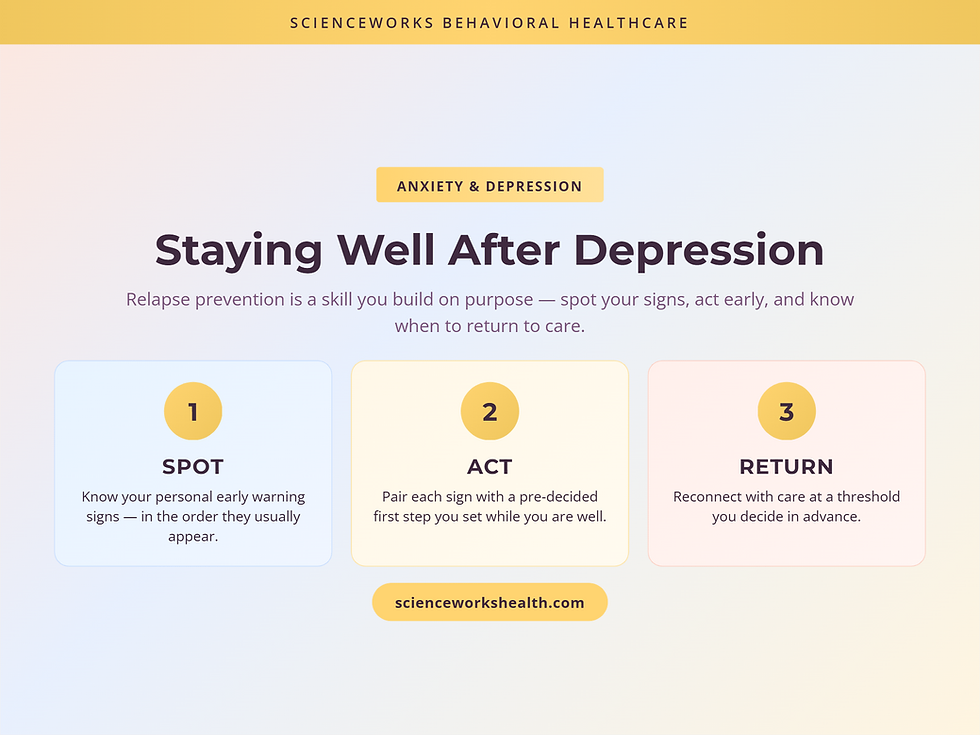
Now let's turn this into something usable: a three-part plan built on spot, act, return. The goal is to decide your response in advance, while you are calm and clear, so a low period does not also require you to figure out what to do from scratch.
Spot. This is your early-warning inventory. Keep it written and visible. You are watching for your personal signals in their usual order, not scanning yourself anxiously every hour.
Act. For each early sign, decide now what your first move is. If your first sign is disrupted sleep, restart the sleep routine that steadied you before and cut evening screens. If it is withdrawal, schedule one small social contact you will not cancel. Write these pairings down, so spotting a sign automatically triggers a pre-decided action rather than a debate.
Return. Decide in advance what threshold sends you back to care, and honor it. Here is an if/then heuristic you can adopt directly:
If one or two early warning signs appear and lift within a few days after your act steps, then keep monitoring and carry on.
If warning signs persist for about two weeks, or start affecting your work, sleep, or relationships, then contact your clinician to check in, rather than waiting to see if it worsens.
If thoughts of self-harm or being better off dead show up at all, then reach out for support the same day; do not wait for a threshold. In the U.S., you can call or text 988 at any time.
Consider how this plays out. You notice the 4 a.m. waking and a pull to cancel weekend plans, two known early signs, so you trigger your act steps: sleep routine back on, coffee date kept. A few days later things settle, and you move on. That is the plan working. But if a week later the fog has thickened and small tasks feel impossible, your "return" threshold is met, and you reach out. Reconnecting is not a sign the plan failed. Reconnecting is the plan.
Key takeaway: 🗺️ A relapse-prevention plan pre-decides your response: spot your signs, act with a pre-chosen step, and return to care at a threshold you set in advance.
When to return to care
So many people wait too long, so let's be plain: you do not have to be in a full episode to reach back out to a clinician. The most protective moment to reconnect is early, when you first notice your pattern beginning, because that is when the smallest intervention does the most.
Reach out promptly if your warning signs stick around for roughly two weeks, begin interfering with daily life, pull you away from the people and activities that anchor you, or if hopeless or self-critical thinking is gaining volume. Reach out the same day if you have any thoughts of harming yourself. If you are in the U.S. and in crisis, the 988 Suicide and Crisis Lifeline is available by call or text around the clock.
Returning to care after a period of wellness can feel like a step backward, but it is the opposite. Catching a dip early often means a brief adjustment rather than starting over. The people who stay well long term are usually not the ones who never dip; they are the ones who respond to dips quickly. If you would like a partner in that, you can always reach out to us to talk through where you are.
Key takeaway: 🌱 Reconnecting with care early, at the first sign of your pattern, is a strength, not a setback. Early action usually means a smaller intervention.
Bringing it together
Staying well after depression is an active practice, not a hopeful wait. You now have the core of it: know whether you are guarding against relapse or recurrence, learn your personal early warning signs while you are well, keep the maintenance supports that fit your history, and hold a clear spot-act-return plan with a threshold for when to reconnect. None of this demands perfection or constant vigilance. It asks for a little preparation now so that future-you has a map.
If any of this raised a sense that you might already be noticing your early signals, take that seriously and gently, not as alarm but as useful information.
Feeling weighed down lately?
Depression is treatable, and the right support makes a difference — a clinician can help you understand what's going on and what would help you feel like yourself again.
About the Author
Dr. Kiesa Kelly is a licensed clinical psychologist and the founder of ScienceWorks Behavioral Healthcare, a telehealth practice serving Tennessee. She earned her PhD in Clinical Psychology, with a concentration in Neuropsychology, from Rosalind Franklin University of Medicine and Science, and completed an NIH-funded postdoctoral fellowship. Her clinical training spanned the University of Chicago, the University of Wisconsin, the University of Florida, and Vanderbilt University, and included direct work with adults experiencing major depression and related mood and anxiety conditions.
With more than 20 years of experience in psychological assessment and evidence-based treatment, Dr. Kelly's practice centers on careful, individualized care, including differential diagnosis and treatment planning for people navigating mood, anxiety, and neurodivergent profiles. She is a member of professional bodies including the American Psychological Association and the Anxiety and Depression Association of America, and every ScienceWorks article is reviewed by a licensed clinician for accuracy before publication.
Frequently Asked Questions
What is the difference between depression relapse and recurrence?
Relapse and recurrence describe different points in recovery. Relapse means symptoms return before you have fully recovered from an episode, so it is treated as the same episode coming back. Recurrence means a brand-new episode starts after you have stayed well for a sustained period. The distinction matters because it shapes how long treatment should continue and how closely you and your clinician watch for warning signs.
What are the early warning signs of depression relapse?
Early warning signs are the specific, personal shifts that showed up before your last episode. Common ones include sleep changes, pulling back from people, losing interest in things you enjoy, rising irritability, and returning negative thought patterns. The most useful warning signs are your own, written down while you are well, because relapse tends to follow a familiar sequence for each person rather than a universal checklist.
How long should maintenance treatment for depression last?
There is no single answer, and the right length depends on your history. Guidelines suggest that people at higher risk of relapse, such as those with several past episodes or lingering symptoms, often benefit from continuing treatment well beyond feeling better. Continuation of antidepressant medication or therapy after remission lowers relapse risk. Any decision to stop, especially with medication, should be made gradually with the prescriber who manages it.
Does mindfulness-based cognitive therapy prevent depression relapse?
Yes, mindfulness-based cognitive therapy (MBCT) has good evidence for reducing relapse risk in people with recurrent depression. A large analysis of individual patient data found MBCT lowered the risk of relapse compared with usual care and other active treatments, with the strongest benefit for people who still had residual symptoms. It is designed as a maintenance approach for people who are currently well, not as a treatment for an active episode.
When should I return to care after recovering from depression?
Return to care when warning signs persist for about two weeks, when symptoms start affecting your work, sleep, or relationships, or any time thoughts of self-harm appear. You do not need to wait until you are in a full episode to reconnect with a clinician. Reaching out early, when you notice the pattern beginning, is often what keeps a dip from becoming a full relapse. If you are in crisis, call or text 988.
References
1. Frank E, Prien RF, Jarrett RB, et al. Conceptualization and rationale for consensus definitions of terms in major depressive disorder. Remission, recovery, relapse, and recurrence. Arch Gen Psychiatry. 1991;48(9):851-855. https://pubmed.ncbi.nlm.nih.gov/1929776/
2. Beshai S, Dobson KS, Bockting CLH, et al. Empirical evidence for definitions of episode, remission, recovery, relapse and recurrence in depression: a systematic review. Epidemiol Psychiatr Sci. 2019;28(5):544-562. https://www.cambridge.org/core/journals/epidemiology-and-psychiatric-sciences/article/empirical-evidence-for-definitions-of-episode-remission-recovery-relapse-and-recurrence-in-depression-a-systematic-review/7FC54F95B5FC63FAD8D6709E873C1058
3. World Health Organization. Depressive disorder (depression). Fact sheet, 2025. https://www.who.int/news-room/fact-sheets/detail/depression
4. Sim K, Lau WK, Sim J, Sum MY, Baldessarini RJ. Prevention of Relapse and Recurrence in Adults with Major Depressive Disorder: Systematic Review and Meta-Analyses of Controlled Trials. Int J Neuropsychopharmacol. 2016;19(2):pyv076. https://academic.oup.com/ijnp/article/19/2/pyv076/2910032
5. Geddes JR, Carney SM, Davies C, et al. Relapse prevention with antidepressant drug treatment in depressive disorders: a systematic review. Lancet. 2003;361(9358):653-661. https://www.thelancet.com/journals/lancet/article/PIIS0140-6736(03)13709-9/fulltext
6. Breedvelt JJF, Warren FC, Segal Z, Kuyken W, Bockting CL. Psychological interventions for the prevention of depression relapse: systematic review and network meta-analysis. Transl Psychiatry. 2023;13:190. https://www.nature.com/articles/s41398-023-02604-1
7. Buckman JEJ, Underwood A, Clarke K, et al. Risk factors for relapse and recurrence of depression in adults and how they operate: A four-phase systematic review and meta-synthesis. Clin Psychol Rev. 2018;64:13-38. https://pubmed.ncbi.nlm.nih.gov/30075313/
8. National Institute for Health and Care Excellence. Depression in adults: treatment and management (NICE guideline NG222). Recommendations. 2022 (updated). https://www.nice.org.uk/guidance/ng222/chapter/recommendations
9. Kuyken W, Warren FC, Taylor RS, et al. Efficacy of Mindfulness-Based Cognitive Therapy in Prevention of Depressive Relapse: An Individual Patient Data Meta-analysis From Randomized Trials. JAMA Psychiatry. 2016;73(6):565-574. https://jamanetwork.com/journals/jamapsychiatry/fullarticle/2517515
10. Breedvelt JJF, Karyotaki E, Warren FC, et al. An individual participant data meta-analysis of psychological interventions for preventing depression relapse. Nat Ment Health. 2023;1:667-678. https://www.nature.com/articles/s44220-023-00178-x
11. Kroenke K, Spitzer RL, Williams JB. The PHQ-9: validity of a brief depression severity measure. J Gen Intern Med. 2001;16(9):606-613. https://onlinelibrary.wiley.com/doi/full/10.1046/j.1525-1497.2001.016009606.x
12. Wynants L, Breedvelt JJF, Bockting CLH, et al. Psychological interventions for preventing relapse in individuals with partial remission of depression: a systematic review and individual participant data meta-analysis. Psychol Med. 2025. https://www.cambridge.org/core/journals/psychological-medicine/article/psychological-interventions-for-preventing-relapse-in-individuals-with-partial-remission-of-depression-a-systematic-review-and-individual-participant-data-metaanalysis/DAD429F541BFC9A12A392A6BF6F462F7
Disclaimer
This article is for informational and educational purposes only and is not a substitute for individualized medical or mental-health advice, diagnosis, or treatment. Reading it does not create a clinician-patient relationship. Decisions about therapy, medication, and when to stop or continue treatment should be made with a qualified professional who knows your history. If you are struggling with your mental health, please reach out to a licensed clinician. If you are in crisis or thinking about harming yourself, call or text the 988 Suicide and Crisis Lifeline (in the U.S.) at any time, or contact your local emergency services.