
Hoarding Disorder vs. OCD vs. Clutter: How to Tell

Updated: Jul 15
Last reviewed: 06/02/2026
Reviewed by: Dr. Kiesa Kelly
If your home has filled up in a way that is starting to affect your daily life, you may be wondering whether you have a real problem or are just messier than most. You may also have heard hoarding described as "a type of OCD" and felt unsure whether that fits. The truth is that hoarding disorder, obsessive-compulsive disorder (OCD), and ordinary clutter are three different things, and the difference matters because it points to three different next steps.
This confusion is understandable. All three can leave a kitchen counter buried or a spare room unusable. But what is driving the piles is not the same in each case, and that "why" is what a clinician is actually assessing. Getting it right changes everything about what helps.
In this article, you'll learn:
What hoarding disorder actually is, as a standalone diagnosis
How emotional attachment and the "I might need it" pull keep items in place
When hoarding is part of OCD, and when it is its own condition
How ordinary clutter and ADHD "doom piles" overlap with — but differ from — hoarding
Why the distinction changes which treatment is likely to help
What progress in therapy realistically looks like
Short answer — hoarding disorder, OCD, and ordinary clutter are not the same thing
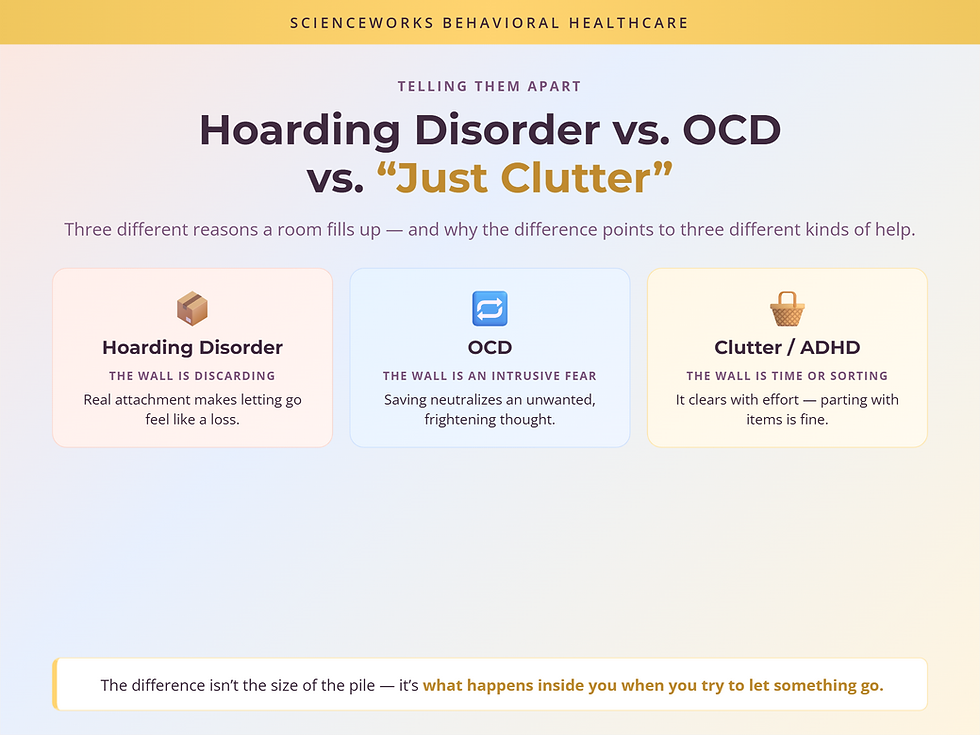
Here is the quick version before we go deeper. Hoarding disorder is a distinct mental health diagnosis defined by persistent difficulty parting with possessions, driven by a real need to save them and distress at the thought of discarding [1]. OCD is a separate disorder defined by unwanted intrusive thoughts (obsessions) and repetitive behaviors (compulsions) done to reduce the anxiety those thoughts cause [2]. Ordinary clutter is what happens to most homes when life gets busy — it is not a disorder, and it clears when you have the time and motivation to deal with it.
The line that separates them is not how the room looks. It is what happens inside you when you try to let something go. If your free time and a few weekends would fix it, that is clutter. If the thought of discarding triggers real grief, panic, or a sense that you are losing part of yourself, that points toward hoarding disorder. And if the saving is tied to a specific intrusive fear you are trying to neutralize — "if I throw this away, something terrible will happen" — that points toward OCD.
That distinction is the whole reason a proper psychological assessment exists for these concerns. The rest of this article walks through how each one actually feels from the inside, so you can hold it up against your own experience.
🧩 Key takeaway: The difference between clutter, hoarding disorder, and OCD is not the size of the pile — it is what drives the saving and what happens emotionally when you try to discard.

What hoarding disorder actually is
Hoarding disorder became its own diagnosis in 2013, when it was added to the DSM-5 and placed in the Obsessive-Compulsive and Related Disorders chapter — near OCD, but as a separate condition. That placement is the source of a lot of the "hoarding is just OCD" confusion. The DSM-5-TR keeps it there and defines it by a few core features: a persistent difficulty discarding possessions regardless of their actual value, a perceived need to save them, distress associated with letting them go, and an accumulation that congests living spaces and gets in the way of their intended use [1][3].
It is also more common than many people realize. Population studies estimate that significant hoarding affects somewhere in the range of 2 to 6 percent of adults, and the difficulties often worsen with age [4]. So if you are dealing with this, you are far from alone, and you are not simply "bad at cleaning."
A few misconceptions keep people stuck, so let's name them directly.
"Hoarding is just being lazy or messy." In reality, hoarding disorder involves real impairment in decision-making, categorizing, and attention, not a character flaw [4][5]. Many people with hoarding work hard at their homes and still feel unable to make progress, which is one of the most painful parts of the condition.
"Hoarding is a type of OCD." Hoarding sits in the same DSM-5-TR chapter as OCD, but it is a distinct diagnosis with a different driver. Older research lumped them together; current classification separates them precisely because they respond to different treatment [1][6].
"If you really wanted to, you could just throw it out." For someone with hoarding disorder, discarding is not a simple act of will. It can trigger genuine grief, anxiety, or a feeling of betraying a future self who might need the item. Telling someone to "just toss it" misunderstands the mechanism entirely.
Emotional attachment and the "I might need it" pull
The heart of hoarding disorder is a relationship with objects that runs deeper than convenience. Consider a common scenario. You keep a stack of newspapers and printouts because each one contains something you might need someday — an article, a coupon, an idea you meant to follow up on. You know, logically, that you will probably never read most of them. But when you pick one up to recycle it, a quiet alarm goes off: what if this is the one you need next month? So you set it back down, and the stack grows. The decision is not "keep or toss" — it is "risk a future loss or avoid that feeling right now," and avoiding the feeling almost always wins.
Or consider attachment that runs through memory and identity. A worn t-shirt is not just fabric — it is the concert you went to, the version of yourself who wore it, the person who gave it to you. Letting it go can feel like erasing part of your history. This is why well-meaning relatives who swoop in to "clean out" a home often make things worse: from the inside, it does not feel like decluttering, it feels like having pieces of your life thrown away without consent.
These attachments are part of why a co-occurring depression screener or anxiety screener can be useful early on. Hoarding disorder frequently travels with depression and anxiety, and untreated mood symptoms can deepen the inertia around sorting and discarding [4][7].
🔋 Key takeaway: In hoarding disorder, the cost is emotional and decision-based — each discard asks you to tolerate loss, future-risk, or a threat to identity, and that cost is what makes letting go feel impossible.

The insight gap — why it's hard to see from the inside
One feature that sets hoarding disorder apart is how variable insight can be. Insight is the clinical word for how clearly a person recognizes that their behavior is a problem. Many people with hoarding have good insight and are distressed by their homes. But a meaningful number have what clinicians call poor or absent insight — they may genuinely believe their saving is reasonable and that everyone else is overreacting [1][8].
This is different from OCD, where people usually recognize their obsessions and compulsions as excessive even while feeling unable to stop. Picture two people in cluttered homes. The first knows the clutter is a problem, feels ashamed of it, and avoids having anyone over — that distress is itself a clue. The second insists there is no problem at all and reacts with frustration when family raises concerns, even as walkways narrow and rooms close off. Both can have hoarding disorder; the second person's reduced insight simply makes reaching out harder and is part of why the condition often goes untreated for years.
If you are reading this and recognizing yourself, that awareness is actually a good sign. It means insight is on your side, and insight is one of the things that makes treatment more workable.
📋 Key takeaway: Insight varies widely in hoarding disorder — some people are acutely distressed, others see no problem at all — which is why outside concern and a structured evaluation both matter.
When hoarding is part of OCD (and when it isn't)
Here is where the OCD overlap becomes important, because hoarding-like behavior can show up in two very different ways.
In hoarding disorder, saving is the primary problem and there is usually no specific intrusive thought behind it. The person saves because the items feel needed, valuable, or meaningful, and discarding feels like a loss. There is no underlying "if I throw this away, my mother will get sick" fear driving the behavior.
In OCD, by contrast, saving can be a compulsion in service of an obsession. Someone with OCD might be unable to throw away mail because of an intrusive fear of contamination, or a fear that they will accidentally discard something important and be responsible for a catastrophe, or a magical-thinking fear that discarding will cause harm to someone they love [2][6]. The saving is not about valuing the object — it is about neutralizing an unwanted thought. If the obsession were resolved, the saving would stop. OCD often shows up in forms that do not match the stereotype at all, and recognizing those less-obvious presentations of OCD is part of telling it apart from hoarding.
The distinction is not academic. A worked example helps. Imagine someone who cannot throw out empty containers. If you ask why and the answer is "they might be useful, and it would be wasteful to toss them" — with a quiet attachment to having them on hand — that pattern points toward hoarding disorder. Now imagine the same behavior, but the answer is "if I throw them out, I'll have an intrusive image of my family being harmed, and I have to keep them to make that thought go away." That is OCD wearing a hoarding costume. Same pile, completely different mechanism. The saving here works like any other compulsion — a short-lived relief that quietly teaches the brain the fear was real, which is the same trap that keeps reassurance-seeking in OCD going.
This is also why co-occurrence has to be taken seriously. Research has historically found hoarding symptoms in roughly 1 in 5 people diagnosed with OCD, and a person can genuinely meet criteria for both disorders at once [6][9]. When that happens, the OCD symptom screener and a careful interview help a clinician map which behaviors belong to which condition, because the treatment plan has to address both drivers, not just one.
The distinguishing pattern: OCD-driven saving is thought-based and fear-based — the items are kept to neutralize an intrusive obsession. Hoarding-disorder saving is value-based and attachment-based — the items are kept because they genuinely feel needed, useful, or meaningful in themselves.
Clutter, ADHD "doom piles," and hoarding — sorting the overlap
Not every full room is a disorder. Ordinary clutter is the natural result of a busy life: mail accumulates, laundry piles up, the garage becomes a holding zone. The defining feature of ordinary clutter is that it responds to time and effort. When you finally get a free weekend, you can sort it, and parting with things does not cause real distress. There is no perceived need to save, and the mess does not reflect a deeper relationship with the objects.
ADHD adds a different wrinkle that is worth naming, because it is widely misread as hoarding. People with ADHD often create what the internet affectionately calls "doom piles" — Didn't Organize, Only Moved — stacks of stuff that get shifted from surface to surface without ever being processed. The mechanism here is executive function: trouble with task initiation, sustaining attention through a boring sort, and the working memory needed to decide where each item belongs [10]. Out of sight quickly becomes out of mind, so things accumulate not because they feel precious but because the act of sorting and putting away is genuinely hard to start and finish.
The mechanism-level difference matters. In ADHD, the items themselves carry no special emotional weight — the person could often discard them easily if someone simply sat with them and helped them get through the task. The barrier is doing the sorting, not parting with the objects. In hoarding disorder, the barrier is parting with the objects — even with help and time, discarding triggers distress because the attachment is real. A person can have both, and the two can amplify each other, which is one reason an evaluation looks at attention and executive function alongside the saving behavior. If executive function is the sticking point, executive function coaching may be part of the picture rather than hoarding-focused therapy alone.
So a quick decision heuristic you can apply right now: If a free weekend and some motivation would clear the space and discarding does not bother you, it is most likely ordinary clutter. If the sorting task itself is the wall — starting, sustaining, deciding where things go — but you could let items go once you got to them, look toward attention and executive function. If the act of discarding itself triggers real distress, grief, or a sense of loss, look toward hoarding disorder. And if saving is tied to a specific intrusive fear you are trying to neutralize, look toward OCD.
⏱️ Key takeaway: Clutter clears with time, ADHD piles stall on the sorting task, and hoarding stalls on the discarding itself — three different walls that call for three different kinds of help.
Why the distinction changes treatment
If all three were the same, treatment could be one-size-fits-all. They are not, and the treatment paths genuinely diverge.
For OCD, the front-line psychological treatment is exposure and response prevention (ERP), a form of cognitive behavioral therapy in which a person gradually faces the trigger for an obsession while resisting the compulsion, so the brain learns the feared outcome does not occur [2][11]. Certain SSRIs, often at higher doses than are used for depression, also have strong evidence in OCD [11]. ERP works because it targets the obsession-compulsion cycle directly.
For hoarding disorder, that same approach does not map cleanly, because the saving is not powered by an obsession to extinguish. Hoarding is treated with a specialized cognitive behavioral therapy developed specifically for it, which targets acquiring, sorting, discarding, decision-making, and the beliefs about possessions that keep the cycle going [5][12]. The evidence base for medication in hoarding is thinner and less consistent than it is for OCD, so therapy tends to carry more of the load [4][12]. Using an ERP-only or medication-only plan designed for OCD on someone whose real condition is hoarding disorder is a common reason people feel like treatment "didn't work."
This is also why screening for the conditions that travel alongside hoarding matters. Depression, anxiety, ADHD, and trauma histories are all more common in people with hoarding, and any of them can quietly stall progress if they go unaddressed [4][7]. A thoughtful plan looks at the whole picture rather than treating the piles in isolation. Our specialized therapy approach is built around matching the method to what is actually driving the behavior.
🤝 Key takeaway: OCD responds to ERP and SSRIs aimed at the obsession-compulsion cycle; hoarding disorder needs a CBT designed specifically for saving and discarding, and responds less reliably to medication alone.
How therapy helps (and what progress realistically looks like)
It helps to know what good treatment actually involves, and what a realistic timeline looks like, because the popular image of a single dramatic cleanout is misleading and often counterproductive.
Specialized CBT for hoarding usually moves slowly and on purpose. Early sessions focus less on the piles and more on understanding your particular relationship with your possessions — the beliefs, the attachments, and the decision-making patterns underneath the saving. From there, work typically includes practicing decision-making on real items in graded steps, building sorting and organizing skills, reducing new acquiring, and gently challenging the thoughts that make discarding feel intolerable [5][12]. The aim is not an empty, magazine-perfect home. It is a home you can use safely and a set of skills you can keep applying after therapy ends.
Progress is real but rarely linear. People often describe it as two steps forward and one step back, and a return of some clutter after a stressful stretch is normal rather than a sign of failure. Because hoarding tends to be chronic if untreated, the more honest frame is meaningful, durable improvement and relapse-prevention skills, not a one-time fix [4][12]. Outside help that respects your pace — rather than family members clearing the home in a weekend, which research suggests tends to backfire — is part of what makes the gains stick.
If you are choosing a provider, a few questions worth asking can tell you a lot about fit:
Does your evaluation distinguish hoarding disorder from OCD, ADHD, and ordinary clutter, or do you treat them as the same thing?
How do you account for variable insight — what happens if I am not always sure my saving is a problem?
What history do you gather about how and when the saving started, including any losses or life transitions?
Can you assess and treat co-occurring conditions like depression, anxiety, or ADHD, or would that require a separate referral?
What will I actually come away with — concrete skills and a plan I can keep using, or just a diagnosis?
🌡️ Key takeaway: Effective hoarding treatment is gradual and skills-based, aimed at durable improvement and relapse prevention rather than a single dramatic cleanout — and setbacks are part of the normal path, not proof that it isn't working.
The whole point of telling these conditions apart is that the right name points to the right help. Clutter clears with time. ADHD piles ease when the sorting task gets supported. OCD responds to ERP and the right medication. Hoarding disorder responds to a therapy built specifically for it. If you have been blaming yourself for not being able to "just clean up," the most useful next step is usually not another weekend of trying harder — it is finding out what is actually driving the difficulty, so the plan can match the cause.
Think it might be OCD?
OCD responds well to the right approach — a clinician trained in ERP and I-CBT can help you tell OCD apart from anxiety and build a plan that fits.
Frequently Asked Questions
Is hoarding disorder the same as OCD?
No. Hoarding disorder is its own diagnosis in the DSM-5-TR, listed alongside OCD in the Obsessive-Compulsive and Related Disorders chapter but distinct from it. In OCD, saving is usually driven by unwanted intrusive thoughts a person wants to neutralize. In hoarding disorder, saving is driven by genuine attachment to items and distress at the thought of discarding them, with no underlying obsession most of the time.
Why can't I throw things away even when I want to?
For many people with hoarding disorder, the trouble is not laziness or disorganization but a real emotional and decision-making barrier. Items can feel like part of your identity, a safeguard against future need, or a link to a memory, so letting go feels like a loss. Difficulty with attention, categorizing, and decision-making often makes sorting feel overwhelming. This pattern is treatable with the right support.
How is hoarding disorder different from collecting?
Collecting is usually organized, intentional, and a source of pride, and it does not crowd out the use of living spaces. Hoarding disorder involves acquiring and keeping items to the point that rooms can no longer be used as intended, paired with significant distress or impairment. A collector can typically display, catalog, and part with duplicates; hoarding makes discarding feel intolerable.
Does hoarding disorder respond to the same treatment as OCD?
Not exactly. OCD responds well to exposure and response prevention (ERP) and certain SSRIs. Hoarding disorder is treated with a specialized form of cognitive behavioral therapy that targets acquiring, discarding, organizing, and the beliefs behind saving, and it tends to respond less reliably to medication alone. Matching the treatment to the actual diagnosis is why an accurate assessment matters.
Can someone have both OCD and hoarding disorder?
Yes. A person can meet criteria for both, and hoarding-like behavior can also occur as part of OCD rather than as a separate disorder. Because the right treatment depends on what is actually driving the saving, a careful clinical assessment is used to sort out whether you are dealing with hoarding disorder, OCD, both, or another condition such as ADHD or depression.
About the Author
Dr. Kiesa Kelly is a licensed clinical psychologist with more than 20 years of experience in psychological assessment and evidence-based treatment. Her background includes clinical training and academic appointments focused on the assessment of anxiety, obsessive-compulsive and related disorders, and the careful differential diagnosis that distinguishes conditions which can look alike on the surface. She founded ScienceWorks Behavioral Healthcare to make that kind of thorough, individualized assessment accessible to adults and adolescents across Tennessee.
In her clinical work, Dr. Kelly emphasizes matching the treatment to the mechanism — understanding what is actually driving a behavior before recommending a path forward. For obsessive-compulsive and related concerns, that means distinguishing hoarding disorder, OCD, attention and executive-function difficulties, and ordinary life stress, so the plan that follows is built on an accurate picture rather than an assumption.
References
1. American Psychiatric Association. Diagnostic and Statistical Manual of Mental Disorders, Fifth Edition, Text Revision (DSM-5-TR): Hoarding Disorder. 2022. https://doi.org/10.1176/appi.books.9780890425787
2. National Institute of Mental Health. Obsessive-Compulsive Disorder (OCD). 2024. https://www.nimh.nih.gov/health/topics/obsessive-compulsive-disorder-ocd
3. Mataix-Cols D, Frost RO, Pertusa A, et al. Hoarding disorder: a new diagnosis for DSM-V? Depression and Anxiety. 2010;27(6):556-572. https://doi.org/10.1002/da.20693
4. Postlethwaite A, Kellett S, Mataix-Cols D. Prevalence of hoarding disorder: A systematic review and meta-analysis. Journal of Affective Disorders. 2019;256:309-316. https://doi.org/10.1016/j.jad.2019.06.004
5. Tolin DF, Frost RO, Steketee G, Muroff J. Cognitive behavioral therapy for hoarding disorder: A meta-analysis. Depression and Anxiety. 2015;32(3):158-166. https://doi.org/10.1002/da.22327
6. Pertusa A, Frost RO, Fullana MA, et al. Refining the diagnostic boundaries of compulsive hoarding: A critical review. Clinical Psychology Review. 2010;30(4):371-386. https://doi.org/10.1016/j.cpr.2010.01.007
7. Frost RO, Steketee G, Tolin DF. Comorbidity in hoarding disorder. Depression and Anxiety. 2011;28(10):876-884. https://doi.org/10.1002/da.20861
8. Mataix-Cols D, Pertusa A. Annual research review: Hoarding disorder: potential benefits and pitfalls of a new mental disorder. Journal of Child Psychology and Psychiatry. 2012;53(5):608-618. https://doi.org/10.1111/j.1469-7610.2011.02464.x
9. Samuels JF, Bienvenu OJ, Grados MA, et al. Prevalence and correlates of hoarding behavior in a community-based sample. Behaviour Research and Therapy. 2008;46(7):836-844. https://doi.org/10.1016/j.brat.2008.04.004
10. National Institute of Mental Health. Attention-Deficit/Hyperactivity Disorder (ADHD). 2024. https://www.nimh.nih.gov/health/topics/attention-deficit-hyperactivity-disorder-adhd
11. National Institute for Health and Care Excellence (NICE). Obsessive-compulsive disorder and body dysmorphic disorder: treatment (CG31). 2005, updated 2024. https://www.nice.org.uk/guidance/cg31
12. Thompson C, Fernández de la Cruz L, Mataix-Cols D, Onwumere J. A systematic review and quality assessment of psychological, pharmacological, and family-based interventions for hoarding disorder. Asian Journal of Psychiatry. 2017;27:53-66. https://doi.org/10.1016/j.ajp.2017.02.020
Disclaimer
This article is for informational and educational purposes only and is not a substitute for professional medical or psychological advice, diagnosis, or treatment. Reading this content does not create a clinician-patient relationship. Hoarding disorder, OCD, and related conditions can only be diagnosed through an individual clinical evaluation. If you are concerned about hoarding, difficulty discarding possessions, or related symptoms, please consult a qualified licensed clinician. If you are experiencing a mental health emergency, call or text 988 (the Suicide and Crisis Lifeline) in the United States, or contact your local emergency services.