
Hormones and Mental Health: A Woman's Guide | ScienceWorks

Updated: Jul 6
Last reviewed: 06/06/2026
Reviewed by: Dr. Kiesa Kelly
If your mood seems to shift with the calendar — heavy and irritable the week before your period, foggy and tearful in the months after a baby, or suddenly anxious in your forties for no clear reason — you are not imagining it. Hormones and mental health are genuinely linked, and the connection runs deeper than "PMS." Understanding how your reproductive hormones shape mood can help you tell an ordinary rough patch from something worth addressing, and it can point you toward help that actually fits the pattern.
This guide is a starting map for women trying to connect mood changes to a hormonal life stage. It is not a diagnosis, and it is not a reason to wave off real symptoms as "just hormones." If anything, the science gives you permission to take these patterns seriously.
In this article, you'll learn:
Why hormones affect mood at the level of brain chemistry, not willpower
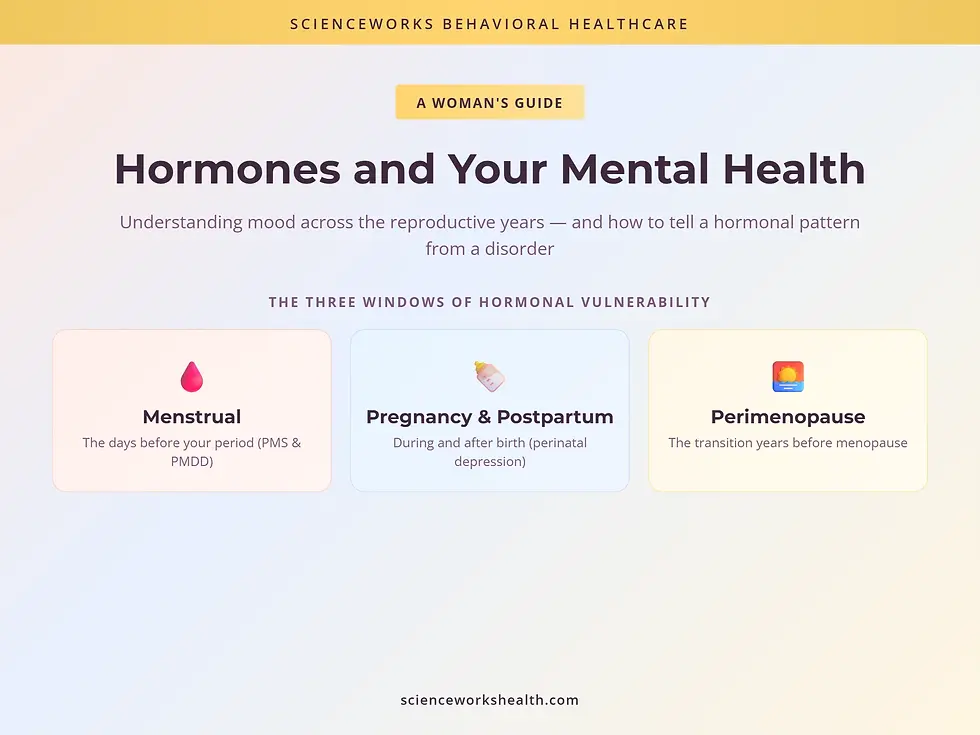
The three life stages when women are most vulnerable to hormonal mood changes
How to tell a hormonal pattern from a standalone mood or anxiety disorder
What actually helps — therapy, medical care, and evaluation — across the lifespan
Where to start if you are not sure who to see first
If you want a structured way to check where your mood sits right now, a brief mental health screening is a low-stakes place to begin while you read on.
Why hormones and mood are genuinely linked
The link between hormones and mood is not vague or mystical. Reproductive hormones act directly on the same brain systems that govern emotion, sleep, motivation, and stress. When those hormones rise, fall, or swing, the brain's mood circuitry feels it.
This matters because women carry more of this load. Women are about twice as likely as men to experience depression over their lifetime, and much of that added risk clusters around reproductive events — the menstrual cycle, pregnancy and the postpartum period, and the menopause transition [5][11]. That is not a coincidence. It reflects how closely mood and reproductive biology are wired together.
The brain systems hormones touch (serotonin, dopamine, GABA)
Estrogen is a good place to start. Beyond its role in the reproductive system, estrogen helps regulate serotonin — the neurotransmitter most associated with mood. It increases serotonin availability and influences serotonin receptors, which is part of why mood can dip when estrogen drops or swings [6]. Estrogen also interacts with dopamine, the chemistry behind motivation and reward, so energy and drive can move with it too.
Progesterone works through a different door. Your body converts progesterone into a compound called allopregnanolone, which acts on GABA-A receptors — the brain's main "calming" system, the same target as anti-anxiety medications [7]. In most people this is steadying. But in some women, the brain's response to these normal shifts is dysregulated, and the result is irritability, anxiety, and low mood rather than calm [7]. This is why progesterone and anxiety are so often mentioned together — and why an anxiety screener like the GAD-7 can be a useful gauge when edginess is your main premenstrual symptom.
The takeaway is simple: hormones are not acting on some separate "hormonal" part of you. They are acting on your mood, sleep, and stress circuits directly.
Key takeaway: 🧠 Reproductive hormones shape mood by acting on the brain's serotonin, dopamine, and GABA systems — the same circuits involved in depression and anxiety.

Sensitivity vs levels — why "normal labs" does not mean "not real"
Here is one of the most common and most damaging misconceptions: if your hormone levels are normal, your symptoms can't really be hormonal. In reality, the leading scientific view is that hormone-related mood disorders are usually driven by the brain's sensitivity to normal hormone changes, not by abnormal hormone levels [7][9]. Two women can have identical bloodwork and completely different mood responses. This is also why a blood test rarely settles the question.
A second misconception follows close behind: severe premenstrual mood symptoms are just PMS, something every woman pushes through. Most women do have some premenstrual symptoms [2], but a smaller group experiences symptoms severe enough to disrupt work, relationships, and daily functioning. That is a recognized condition with its own diagnosis, not a personal failing [1][3]. Naming it correctly is the first step toward the right help, which is part of why diagnosis here relies on your pattern over time rather than a one-time lab — the same principle behind thorough psychological assessments.
A third misconception is that hormonal mood changes and "real" mental health conditions are separate categories — one biological, one psychological. They overlap constantly. Hormonal shifts can trigger, worsen, or unmask depression and anxiety, and a standalone disorder can sit underneath a hormonal pattern. The honest framing is both, often, not either, or.
Key takeaway: 🔬 Hormone-related mood symptoms reflect brain sensitivity to normal hormone shifts — so "normal labs" does not mean the symptoms are imagined.

The three windows of hormonal vulnerability
Across the reproductive lifespan, three stages stand out as higher-risk for mood changes. Each involves significant hormonal movement, and each has its own recognizable pattern.
The menstrual cycle and PMDD
Take a week you know well: the seven or so days before your period. Your fuse is short, small frustrations feel enormous, and you cry at things that wouldn't touch you at other times. You may feel hopeless or on edge, struggle to concentrate, and want to cancel plans — and then, within a day or two of your period starting, the fog lifts and you feel like yourself again. If that pattern repeats most months and disrupts your work or relationships, it may be premenstrual dysphoric disorder (PMDD), a recognized condition rather than ordinary PMS [1][3].
PMDD affects roughly 2 to 5 percent of women of reproductive age [1]. The defining feature is timing: symptoms appear in the luteal phase (after ovulation, before menstruation) and clear shortly after bleeding begins. That cyclical on-off pattern is what separates PMDD from a mood disorder that runs all month. If this sounds familiar, our deeper guide to why PMDD is not just bad PMS walks through it in detail.
Pregnancy and postpartum
Or picture the months after a baby arrives. Everyone told you to expect a few weepy days, and at first that's what it was. But weeks later the sadness hasn't lifted — you feel anxious, drained in a way sleep doesn't fix, guilty that you're not enjoying this, and sometimes disconnected from the baby. You can still function on the outside, which is part of why no one notices. This may be perinatal depression — depression during pregnancy or after birth — which is common, treatable, and not a reflection of how much you love your child [4].
The "baby blues" are mild and lift within about two weeks of birth. Mood symptoms that are severe or last longer than two weeks deserve attention, because perinatal depression generally does not resolve on its own without support [4]. The hormonal plunge after delivery, layered on top of exhaustion and a wholly new set of demands, is a genuine biological and emotional stressor — not a character flaw.
Key takeaway: 🍼 Postpartum sadness that is severe or lasts more than two weeks is not the "baby blues" — it is treatable perinatal depression and worth raising with a provider.
Perimenopause and the menopause transition
Or consider your early forties. Your cycles are becoming unpredictable, your sleep is broken, and a new, low-grade anxiety has crept in that you can't trace to any one stressor. You feel irritable and flat by turns, and you wonder, quietly, whether something is wrong with you. For many women this is perimenopause — the years of fluctuating hormones leading up to the final period — and it carries one of the highest risks for depressive symptoms across the entire reproductive lifespan [8][9].
What makes perimenopause distinctive is the fluctuation. It is not simply that estrogen is lower; it is that estrogen swings unpredictably, and for sensitive women those swings can increase vulnerability to depressed mood and to stress [9]. Mood symptoms here often arrive alongside hot flashes, sleep disruption, and brain fog, which can make the emotional piece easy to overlook. Our guide to perimenopause, depression, and anxiety covers this stage more fully.
How to tell a hormonal pattern from a standalone disorder
This is the question most women actually want answered: is this hormones, or is this depression or anxiety on its own? You usually cannot tell from a single bad week. You can tell from the pattern over time.
Tracking — the single most useful first step
If you do one thing before booking an appointment, track your symptoms daily for about two months. Each day, note your mood, sleep, energy, and anxiety, alongside where you are in your cycle (or, postpartum, how many weeks out you are). Two full menstrual cycles is not an arbitrary number — it is the standard clinicians use to diagnose PMDD, precisely because the diagnosis depends on seeing symptoms rise and fall with the cycle rather than relying on memory [3].
Tracking does two things. It gives you data that no blood test can provide, and it gives whoever you see a head start. A clear two-month record often shortens the path to the right answer dramatically.
Key takeaway: 📅 Two months of daily symptom tracking is the most useful first step — it reveals the timing pattern that bloodwork cannot.
When the timing points to hormones, and when it does not
A simple rule of thumb: if your symptoms reliably rise and fall with a hormonal phase and genuinely ease in between, start with the hormonal pattern. If your low mood, anxiety, or loss of interest stays fairly constant week to week — present on good cycle days and bad ones alike — treat it as a possible standalone mood or anxiety disorder and have it assessed on its own terms.
And if both seem true — a steady baseline of low mood with a premenstrual spike layered on top — that combination is common, and you do not have to choose between explanations. Bring both to a clinician [11]. When the picture is genuinely mixed, comparing two overlapping patterns can be its own challenge; our breakdown of PMDD versus perimenopause is a useful example of how clinicians sort similar-looking timelines apart.
What helps across the lifespan
The encouraging part: hormone-related mood changes respond to treatment, and many of the most effective approaches carry across every stage.
Therapy approaches that translate across stages
Therapy is not a consolation prize for "mild" cases — it is a first-line, evidence-based treatment. Cognitive behavioral therapy (CBT) and interpersonal therapy (IPT) both have research support for perinatal depression [4], and clinical guidelines recommend CBT for low mood tied to the menopause transition [10]. The skills these therapies build — managing the thoughts and stress responses that amplify mood symptoms — apply just as well to premenstrual and perimenopausal mood changes.
What this means practically is that you can start working on symptoms now, without waiting to settle the hormonal question first. If you are weighing where therapy fits, our overview of specialized therapy options lays out the approaches we use most.
When medication or hormonal treatment enters the picture
For some women, therapy alone is enough; for others, medication or hormonal treatment is the right addition. For PMDD, selective serotonin reuptake inhibitors (SSRIs) are an established option and can be used in different dosing patterns [1]. For menopause-related low mood, guidelines point to CBT and, where appropriate, hormone replacement therapy — and they note that antidepressants are not automatically first-line for menopausal mood unless a depressive disorder is actually diagnosed [10].
Postpartum care has expanded too. Alongside standard antidepressants, newer medications that act on the same GABA system discussed earlier — brexanolone and the oral option zuranolone — are now approved specifically for postpartum depression [4]. The right choice depends on your symptoms, your stage of life, and your preferences, and it is a conversation worth having rather than a decision to make alone.
Key takeaway: 💬 Therapy is a first-line treatment across every stage; medication and hormonal options can be added based on severity, life stage, and your goals.
The role of evaluation when the picture is mixed
Sometimes the pattern does not resolve neatly, even with tracking. Mood symptoms may overlap with attention problems, trauma history, sleep disorders, or anxiety that predates any hormonal shift. When several explanations are plausible at once, a structured evaluation can clarify what is driving what — and prevent you from treating the wrong target. A careful assessment looks at your history and your current pattern together, rather than reaching for a single label.
Where to start
You do not need to have it all figured out before you reach out. You just need a first step that matches where you are.
Screeners as a first read
A validated screener is a quick, structured way to take your own temperature before an appointment. If low mood is your main concern, a depression screener like the PHQ-9 gives you a snapshot you can bring to a provider. If anxiety is more prominent, the GAD-7 does the same for anxiety symptoms. Screeners do not diagnose anything on their own, but a high score is a meaningful signal that an evaluation may be worthwhile — and pairing a screener with your two-month symptom log gives a clinician a remarkably clear starting point.
When to bring it to a clinician
Bring it to a clinician when symptoms disrupt your work, relationships, or daily functioning; when they last beyond the expected window; or when they simply feel like more than you should have to manage alone. You do not have to wait for a crisis, and you do not have to be certain it is "really" hormonal first. If you would like help sorting out where to begin, you can reach out to our team and we will help you find the right starting point.
A final note on urgency: if you ever have thoughts of harming yourself or your baby, treat that as an emergency and seek help immediately by calling or texting 988 (the Suicide and Crisis Lifeline) or 911. That is not a "wait and track" situation — it is a reach-out-now one.
Navigating a women's-health or hormonal change?
Hannah Pollok works at the intersection of physical and mental health — hormones, reproductive changes, and the mood and cognitive shifts that come with them.
Frequently Asked Questions
Are my mood changes hormonal or psychological?
Often it is both, and the most reliable way to tell is timing. If low mood, irritability, or anxiety reliably track a hormonal phase — the days before your period, the months after birth, or the perimenopausal years — and genuinely ease at other times, a hormonal pattern is likely. Symptoms that stay steady regardless of your cycle point more toward a standalone mood or anxiety disorder. Tracking daily for two months is the clearest first step.
Can a blood test tell me if my mood is hormonal?
No — a blood test usually cannot confirm whether your mood symptoms are hormonal. Conditions like PMDD and perimenopausal depression are driven by your brain's sensitivity to normal hormone shifts, not by abnormal hormone levels, so standard labs often look normal even when symptoms are severe. Diagnosis relies on your symptom pattern over time rather than a single hormone reading. Daily symptom tracking is far more informative than bloodwork.
Should I see a therapist or my OB-GYN first?
Either is a reasonable starting point, and many women benefit from both. If your main concern is mood, anxiety, or how symptoms affect daily life, a mental health clinician can assess the pattern and begin therapy. If you also have physical symptoms — irregular cycles, hot flashes, or disrupted sleep — your OB-GYN can address the hormonal side. We often coordinate care between the two so nothing falls through the cracks.
Can therapy actually help mood that is driven by hormones?
Yes — therapy is an effective, evidence-based option for hormone-related mood changes, not just a fallback. Cognitive behavioral therapy and interpersonal therapy have research support for premenstrual, perinatal, and perimenopausal mood symptoms, and clinical guidelines recommend CBT for menopause-related low mood. Therapy can be used on its own or alongside medical or hormonal treatment, depending on severity and your preferences.
How long should I track symptoms before seeing someone?
Two full menstrual cycles — about two months — is the standard for spotting a hormonal pattern, and it is also what clinicians use to diagnose PMDD. Note your mood, sleep, and energy each day along with where you are in your cycle. You do not have to wait two months to seek help, though: if symptoms feel severe, unsafe, or unmanageable, reach out now and track as you go.
About the Author
Dr. Kiesa Kelly is a licensed clinical psychologist and the founder of ScienceWorks Behavioral Healthcare. Her background includes more than 20 years of experience in psychological assessment and evidence-based treatment, with particular attention to how mental health presents differently across women's life stages and how overlapping conditions can be told apart.
Dr. Kelly's clinical work centers on careful, individualized evaluation — distinguishing similar-looking patterns and tailoring care to the whole person rather than a single diagnostic label. As a PhD clinical psychologist, she focuses on assessment, therapy, and clinical oversight, and she reviews each ScienceWorks article for accuracy before publication.
References
1. American College of Obstetricians and Gynecologists. Management of Premenstrual Disorders (Clinical Practice Guideline No. 7). 2023. https://www.acog.org/clinical/clinical-guidance/clinical-practice-guideline/articles/2023/12/management-of-premenstrual-disorders
2. American College of Obstetricians and Gynecologists. Premenstrual Syndrome (PMS) — Frequently Asked Questions. https://www.acog.org/womens-health/faqs/premenstrual-syndrome
3. Diagnostic validity of premenstrual dysphoric disorder: revisited. Frontiers in Global Women's Health. 2023. https://www.frontiersin.org/journals/global-womens-health/articles/10.3389/fgwh.2023.1181583/full
4. National Institute of Mental Health. Perinatal Depression. 2023. https://www.nimh.nih.gov/health/publications/perinatal-depression
5. National Institute of Mental Health. Depression in Women: 4 Things to Know. https://www.nimh.nih.gov/health/publications/depression-in-women
6. The impact of estradiol on serotonin, glutamate, and dopamine systems. 2024. https://pmc.ncbi.nlm.nih.gov/articles/PMC10998471/
7. Role of allopregnanolone-mediated γ-aminobutyric acid A receptor sensitivity in the pathogenesis of premenstrual dysphoric disorder. Frontiers in Psychiatry. 2023. https://www.frontiersin.org/journals/psychiatry/articles/10.3389/fpsyt.2023.1140796/full
8. The risk of depression in the menopausal stages: A systematic review and meta-analysis. Journal of Affective Disorders. 2024. https://www.sciencedirect.com/science/article/pii/S0165032724006438
9. Gordon JL, Sander B. The role of estradiol fluctuation in the pathophysiology of perimenopausal depression: A hypothesis paper. Psychoneuroendocrinology. 2021. https://pubmed.ncbi.nlm.nih.gov/34607269/
10. National Institute for Health and Care Excellence. Menopause: identification and management (NICE guideline NG23). https://www.nice.org.uk/guidance/ng23
11. Steroid Hormone Sensitivity in Reproductive Mood Disorders: On the Role of the GABA-A Receptor Complex and Stress During Hormonal Transitions. Frontiers in Medicine. 2021. https://www.ncbi.nlm.nih.gov/pmc/articles/PMC7873927/
Disclaimer
This article is for informational and educational purposes only and is not a substitute for professional medical or mental health advice, diagnosis, or treatment. Reading it does not create a clinician-patient relationship. Always consult a qualified health provider with questions about your health or a medical or mental health condition. If you are experiencing a mental health emergency or having thoughts of harming yourself or others, call or text 988 (the Suicide and Crisis Lifeline) or call 911 immediately.