
Late-Identified Autism in Adults: What Screening Scores Mean

Updated: Sep 14
Last reviewed: 09/02/2026
Reviewed by: Dr. Kiesa Kelly
Autism screening adults tools can feel like a turning point: you answer a few questions, get a number, and suddenly the past makes more sense. If you’re exploring late diagnosed autism, this guide will help you interpret common screeners and use results as a map toward support rather than a verdict.
In this article, you’ll learn:
Why autism is often identified later in adulthood
What AQ-10, RAADS-14, and CAT-Q screeners actually measure
How to interpret scores without over-trusting one number
A gentle, non-diagnostic reflection checklist you can use today
When a formal evaluation can help with accommodations and treatment fit
Key takeaway: 🧭 Screeners are best used as a conversation starter about lifelong patterns, not a self-diagnosis.
Why Many Adults Consider Autism Later in Life
Masking, high achievement, and invisible effort
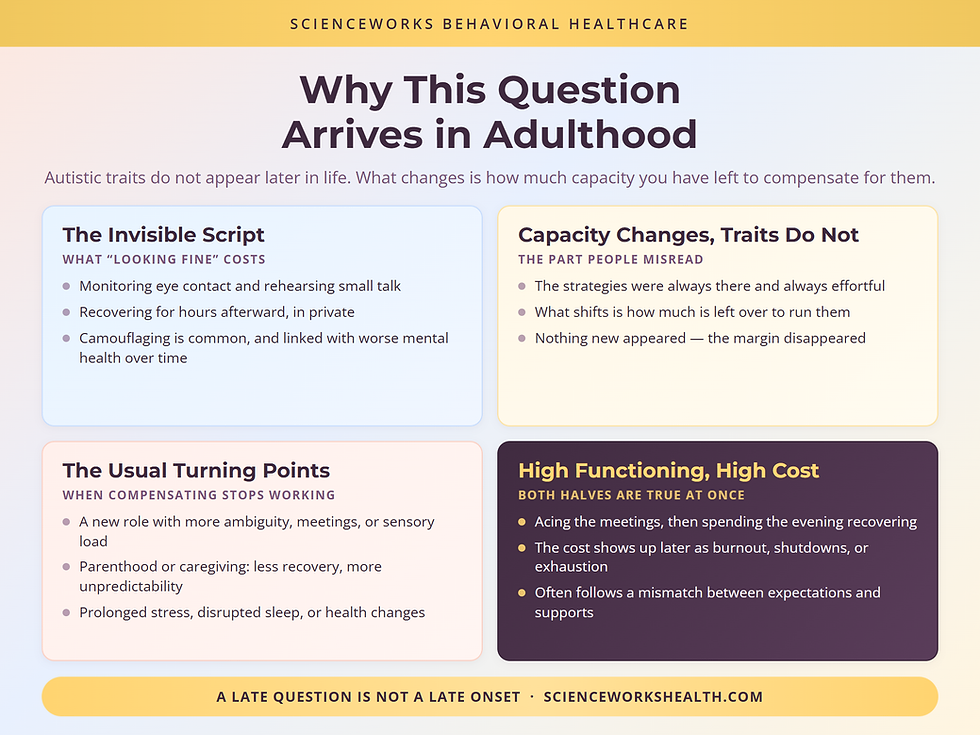
Many adults with high masking autism look “fine” to others while running an exhausting internal script: monitoring eye contact, rehearsing small talk, and recovering for hours afterward. Research on camouflaging shows these strategies are common and can be linked with worse mental health outcomes over time. [4,5]
Practical example: a high-performing professional can ace meetings, then spend evenings in recovery mode, needing quiet and routine to feel human again.
Key takeaway: 🧠 “High functioning” can mean “high cost,” and the cost may show up as burnout, shutdowns, or chronic exhaustion. [6]
Life changes that reduce coping capacity
Autistic traits don’t suddenly appear in adulthood, but your ability to compensate can change. Turning points often include:
A new role with more ambiguity, meetings, or sensory load
Parenthood or caregiving (less recovery time, more unpredictability)
Prolonged stress, sleep disruption, or health changes
Autistic burnout has been described as long-term exhaustion and reduced functioning that can follow chronic stress and a mismatch between expectations and supports. [6]
Practical example: someone who has always managed by tightly controlling routines may hit a wall after a move or a new baby, when days become more unpredictable and recovery time disappears.
What Autism Screening Adults Can Do for You
Give language for patterns
A good autism self assessment adults tool can help you name patterns you’ve lived with for years, such as sensory overload, a strong need for predictability, or “social math” that takes effort. Having words for adult autism traits can reduce shame and support clearer self-advocacy.
Help you decide whether to pursue evaluation or support
Screeners can be a low-pressure first step. They can help you decide if it’s worth exploring:
A formal autism assessment (especially for high masking presentations)
Therapy or coaching that fits your brain and sensory needs
Work or school accommodations
Key takeaway: 🧩 The next step can be “clarity + support,” not “prove it.”
What the AQ-10, RAADS-14, and CAT-Q Each Measure
The three screeners linked in this guide are not interchangeable, and knowing what each is built to do makes the results far easier to read. The AQ-10 is a very brief, ten-item tool designed as a first-pass referral aid — it asks whether there's enough signal to consider a full assessment, and clinical guidance treats it that way rather than as a diagnosis.[1,2] The RAADS-14 is a short version of a longer scale, validated in adult psychiatric samples, which makes it useful for adults already navigating mental health services — though in those same samples, elevated scores from anxiety or other conditions were common, so a high number is a prompt, not a conclusion.[3]
The CAT-Q is different in kind: it doesn't screen for autism at all, but measures *camouflaging* — the compensating, masking, and assimilation strategies a person uses to appear more neurotypical.[4] That's why it's offered "if masking is part of your story." A high CAT-Q can help explain why someone who has always "passed" socially still feels exhausted and out of step. Read together, the three answer different questions: is there signal (AQ-10), is there signal in a clinical context (RAADS-14), and how much effort is going into masking (CAT-Q).
Why Camouflaging Can Blur a Screening Score
Camouflaging is one of the main reasons screening scores can be hard to interpret, especially for adults who have spent decades learning to blend in. Someone who has rehearsed eye contact, scripted small talk, and studied social rules may answer screening items based on the polished performance they've built rather than the effort underneath it — which can pull a score down even when autistic patterns are clearly present. This is part of why brief screeners are designed to cast a wide net and defer to fuller assessment rather than stand alone.[1]
Masking also carries a cost that's worth naming. Research on camouflaging in autistic adults links higher masking with higher rates of anxiety and depression, likely reflecting the sustained strain of monitoring and suppressing oneself in social settings.[4,5] If you recognize yourself in that description — competent on the outside, depleted on the inside — the CAT-Q may resonate more than a general screener, and that gap between how you appear and how you feel is exactly the kind of pattern worth bringing to an evaluation.
How to Interpret Results Without Over-Trusting Them
Think “patterns over time,” not “one number”
Most screeners are designed to answer: “Is there enough signal here to consider a full evaluation?” They are not designed to confirm or rule out autism on their own. NICE guidance supports using brief tools like the AQ-10 as part of referral decisions, alongside clinical judgment and comprehensive assessment. [1]
A quick interpretation guide:
AQ-10 score meaning: The AQ-10 is a 10-item screener. In NICE guidance, a score of 6 or above is one reason to offer a comprehensive autism assessment (when autism is suspected). [1,2]
RAADS-14 score meaning: The RAADS-14 Screen is scored from 0–42. In validation research, a cut-off of 14 or above had high sensitivity but lower specificity in psychiatric samples, so false positives are possible. [3]
CAT-Q score meaning: The CAT-Q measures camouflaging strategies (masking, compensation, assimilation). It does not diagnose autism. Higher scores suggest more camouflaging, which may be exhausting and has been linked with greater anxiety and depression risk in autistic adults. [4,5]
Common misconceptions to let go of:
“A high score means I’m definitely autistic.” Screeners can’t diagnose on their own.
“If I can make eye contact, I can’t be autistic.” Many people learn compensatory strategies.
“If I wasn’t flagged as a kid, it can’t be autism.” High masking and uneven support needs are often missed.
“Masking means I’m being fake.” Masking is usually a survival strategy, not dishonesty.
Key takeaway: 🔎 A “positive” screen is a reason to look closer, and a “negative” screen doesn’t erase lived experience.
Consider context: burnout, anxiety, trauma, ADHD overlap
Scores can be influenced by what else is going on. Burnout, chronic stress, anxiety, and trauma can amplify sensory sensitivity and shutdowns. [6] ADHD overlap is also common, and can blur the picture (attention, organization, emotion regulation). [7]
A helpful reframe is: “What patterns have been present since childhood, across settings, even when life was going well?” [1]
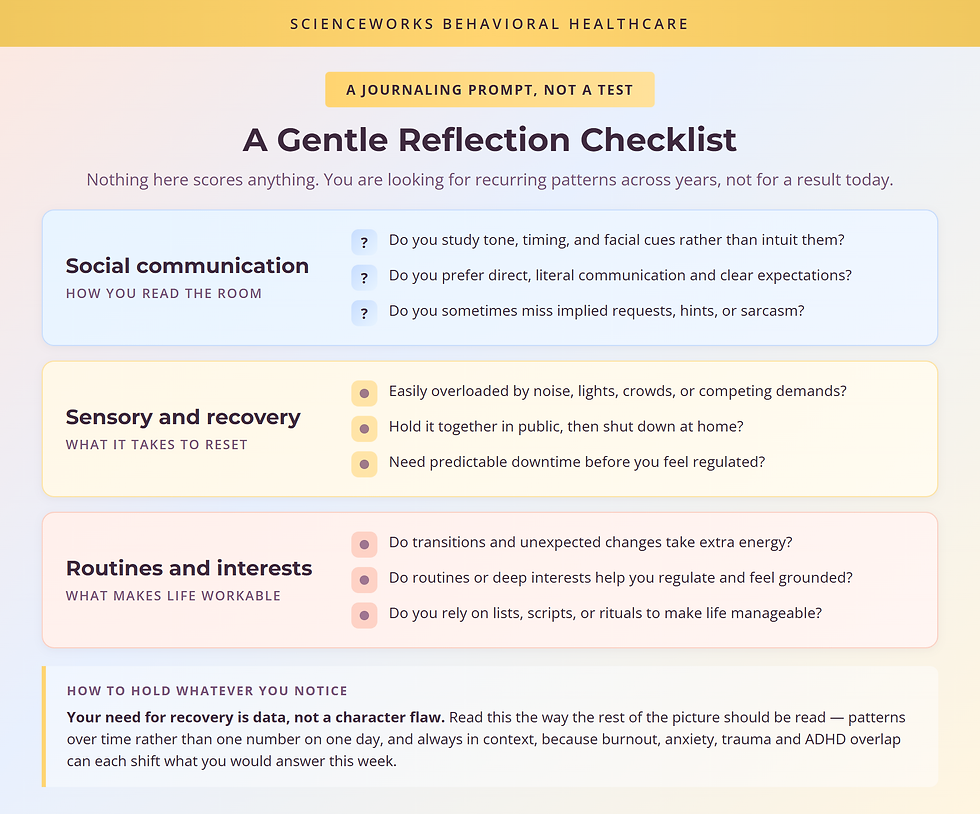
A Gentle Reflection Checklist (Non-Diagnostic)
Use this as a journaling prompt, not a test. You’re looking for recurring patterns across time.
Social communication differences
Do you often “study” people (tone, timing, facial cues) rather than intuit it?
Do you prefer direct, literal communication and clear expectations?
Do you sometimes miss implied requests, hints, or sarcasm?
Sensory profile and recovery needs
Are you easily overloaded by noise, lights, crowds, or competing demands?
Do you “hold it together” in public but melt down or shut down at home?
Do you need predictable downtime to feel regulated?
Key takeaway: 🌿 Your need for recovery is data, not a character flaw.
Routines, transitions, special interests, predictability
Do transitions and unexpected changes take extra energy?
Do routines or deep interests help you regulate and feel grounded?
Do you rely on systems (lists, scripts, rituals) to make life manageable?
What a Full Autism Evaluation Actually Involves
A screener takes minutes; a proper evaluation takes a fuller look, and understanding the difference lowers the pressure on any single score. Comprehensive assessment in adults draws on a developmental history — patterns present since childhood and across different settings — alongside current functioning and clinical judgment, not a single questionnaire.[1] The guiding question is less "what's my number today" and more "which patterns have been there over time, even when life was going well."
That broader lens is what lets an evaluation do things a screener can't: distinguish long-standing neurodevelopmental patterns from the effects of stress, burnout, or another condition, and translate a profile into practical supports and, where relevant, documentation for accommodations.[1] For many adults the value isn't only the label but the map — an accurate account of how their brain works and what actually helps. If a screener has raised real questions for you, a formal evaluation is the step designed to answer them thoughtfully rather than quickly.
When ADHD Is Part of the Picture
Autism and ADHD co-occur often, and that overlap is one of the most common reasons a screening picture looks muddy.[7] Several traits the screeners touch — difficulty with routines and transitions, feeling socially out of sync, emotional intensity, and sensory sensitivity — can arise from either profile, or both at once, so an elevated autism screen doesn't rule ADHD in or out. When both are present, each can mask or amplify the other, which is hard to untangle from a questionnaire alone.
This is a strength of a comprehensive evaluation rather than a problem with the screeners: a clinician can weigh which patterns fit where and how they interact, so support is matched to the whole profile instead of half of it. If you've tried supports aimed at one piece and they haven't quite fit, an overlapping ADHD picture is one reason why — and a good reason to seek an assessment that considers the full neurodevelopmental context rather than a single lane.[7]
When a Formal Evaluation Can Help
Work or school accommodations
If you’re requesting accommodations, documentation often matters. A clinician can translate your profile into practical recommendations (for example, reduced sensory load, written instructions, or predictable communication).
Treatment fit (supports that match your brain)
If you’ve tried treatment and it hasn’t “fit,” an accurate neurodevelopmental picture can clarify why. Anxiety supports, for example, may need to account for sensory overload and executive function differences, not just thoughts and feelings. [1,5]
Self-understanding and reducing shame
Many adults describe diagnosis as a shift from moral explanations (“lazy,” “too sensitive”) to accurate explanations (“my brain needs different supports”). Reviews note that adulthood diagnosis can be a meaningful milestone toward effective and affirming support, even as definitions of “late diagnosis” vary across studies. [8]
Key takeaway: 🧾 A good evaluation doesn’t just label, it translates patterns into actionable supports.
Next Steps and Support Options
Neurodiversity-affirming therapy or coaching goals
Consider goals that reduce daily load and increase self-trust:
Building sensory supports (earplugs, lighting changes, movement breaks)
Reducing masking where it’s safe, and increasing recovery time
Creating routines and executive function supports that work for you
Community resources and identity-safe supports
Many people find relief in autistic-led communities, peer support, and resources by autistic authors. If you’re searching for an online autism evaluation Tennessee option or an autism assessment Tennessee telehealth provider, look for clinicians experienced with adult and high-masking presentations, and confirm services are offered for people physically located in your state.
Take the Screeners + Explore Next Steps
Take the AQ-10 screener
Start here: AQ-10 autism screener
Take the RAADS-14 screener
Explore next: RAADS-14 autism screener
Take the CAT-Q screener
If masking is part of your story: CAT-Q camouflaging questionnaire
Explore broader mental health screeners
If you want to map the full picture: Mental health screening hub
If your screening results raised new questions, you don’t have to figure them out alone. You can explore formal evaluation options through ScienceWorks psychological assessments or reach out via our contact page. A supportive next step is one that improves self-understanding and reduces daily friction, without rushing you into any identity.
Frequently Asked Questions
Can perimenopause unmask autism in women who were never diagnosed?
Yes. Autistic traits do not appear during perimenopause, but the ability to compensate for them can change significantly when hormonal shifts affect sleep, stress tolerance, and energy. Many autistic women have masked their traits for decades through intense internal effort — monitoring social cues, rehearsing interactions, and recovering from sensory overload in private. When perimenopause reduces the cognitive and emotional resources available for masking, traits that were always present may become much more visible — to the person themselves and sometimes to others. This is one reason late autism identification in women often occurs in midlife, and why a formal evaluation can be valuable if patterns resonate.
Why do so many autistic women get diagnosed with autism late in life?
Late diagnosis is common in autistic women because autism research and diagnostic criteria were historically developed primarily from studies of autistic boys and men. Autistic girls and women often show different presentations: more social camouflaging, stronger verbal and emotional skills on the surface, and internalizing patterns rather than externalizing behavior. These differences made them easier to miss in childhood and adolescence. Masking strategies — rehearsing conversation, studying social cues, suppressing sensory responses — can maintain the appearance of neurotypical functioning until burnout, life transitions, or perimenopause reduce the capacity to sustain that effort.
Can an autism screener like the AQ-10 or RAADS-14 give a false positive?
Yes. Autism screeners like the AQ-10 and RAADS-14 are designed to cast a wide net — they identify people who may benefit from a fuller evaluation, not confirm or rule out a diagnosis. That means false positives are possible. Anxiety, trauma, ADHD, burnout, and other experiences can produce elevated scores because some traits they measure — social exhaustion, sensory sensitivity, need for routine — can be driven by multiple causes. A high screener score is a useful prompt to pursue a professional evaluation, not a diagnosis in itself. The RAADS-14 in particular was validated in psychiatric samples where false positives were relatively common.
About the Author
Dr. Kiesa Kelly earned a PhD in Clinical Psychology with a concentration in Neuropsychology and has 20+ years of experience with psychological assessment and evidence-based care.
Her work at ScienceWorks emphasizes neurodiversity-affirming evaluation and practical support planning, including for previously undiagnosed adults and high-masking presentations.
References
National Institute for Health and Care Excellence (NICE). Autism spectrum disorder in adults: diagnosis and management (CG142). Updated 14 June 2021. https://www.nice.org.uk/guidance/cg142/chapter/recommendations
Booth T, Murray AL, McKenzie K, Kuenssberg R, O'Donnell M, Burnett H. Brief report: An evaluation of the AQ-10 as a brief screening instrument for ASD in adults. J Autism Dev Disord. 2013;43(12):2997-3000. https://doi.org/10.1007/s10803-013-1844-5
Eriksson JM, Andersen LM, Bejerot S. RAADS-14 Screen: validity of a screening tool for autism spectrum disorder in an adult psychiatric population. Mol Autism. 2013;4:49. https://doi.org/10.1186/2040-2392-4-49
Hull L, Mandy W, Lai MC, et al. Development and validation of the Camouflaging Autistic Traits Questionnaire (CAT-Q). J Autism Dev Disord. 2019;49(3):819-833. https://doi.org/10.1007/s10803-018-3792-6
Hull L, Levy L, Lai MC, et al. Is social camouflaging associated with anxiety and depression in autistic adults? Mol Autism. 2021;12:13. https://doi.org/10.1186/s13229-021-00421-1
Raymaker DM, Teo AR, Steckler NA, et al. "Having All of Your Internal Resources Exhausted Beyond Measure and Being Left with No Clean-Up Crew": Defining autistic burnout. Autism Adulthood. 2020;2(2):132-143. https://doi.org/10.1089/aut.2019.0079
Hours C, Recasens C, Baleyte JM. ASD and ADHD comorbidity: what are we talking about? Front Psychiatry. 2022;13:837424. https://doi.org/10.3389/fpsyt.2022.837424
Russell AS, McFayden TC, McAllister M, et al. Who, when, where, and why: A systematic review of "late diagnosis" in autism. Autism Res. 2025;18(1):22-36. https://doi.org/10.1002/aur.3278
Disclaimer
This article is for informational purposes only and is not a substitute for professional diagnosis, treatment, or medical advice. If you are in crisis or considering self-harm, call 988 (U.S.) or your local emergency number.