
Psychoeducational Evaluation Cost | ScienceWorks

Updated: Jul 6
Last reviewed: 06/06/2026
Reviewed by: Dr. Kiesa Kelly
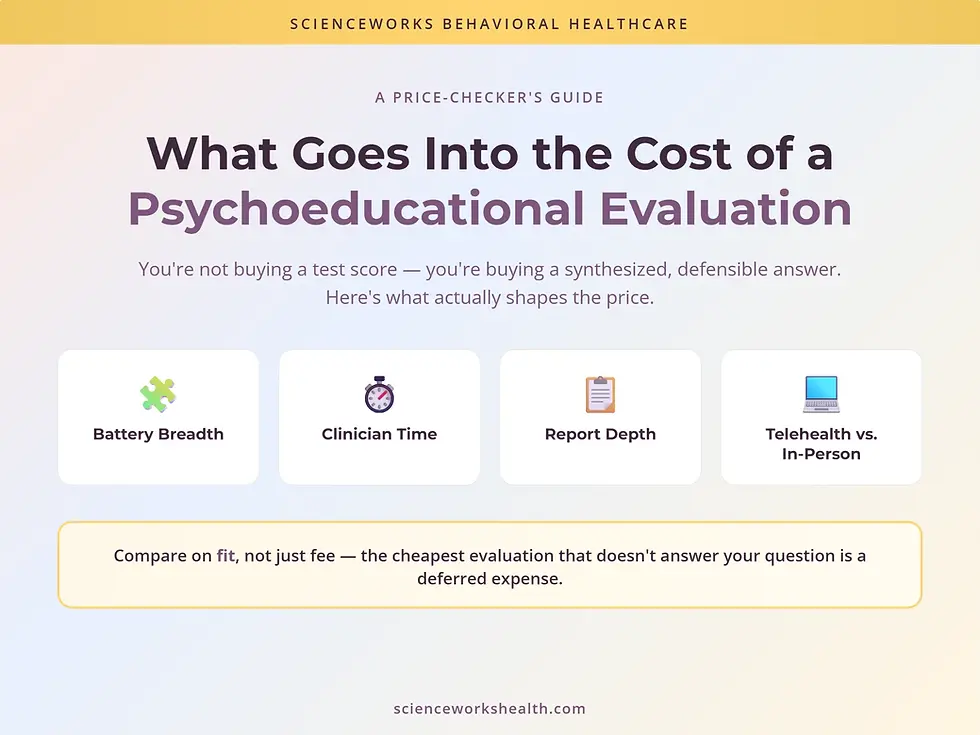
If you are weighing a psychoeducational or learning evaluation, the first question is usually the hardest to get a straight answer to: what will this cost, and what am I actually getting for it? The price can feel like a black box, especially when one provider quotes a short screening and another describes a multi-day process. The real tension is not just the number — it is knowing whether the evaluation will actually answer your question and hold up where you need it to, like a school accommodation request or a workplace conversation.
This guide walks through what the cost of a psychoeducational evaluation reflects, why prices vary so much, and how to compare providers without simply chasing the lowest quote.
In this article, you'll learn:
What you are really paying for in a psychoeducational evaluation
The specific factors that drive the cost up or down
How insurance treats educational versus medical testing
What the process and timeline typically look like
Concrete questions to ask a provider before you book
What you're really paying for
It helps to reframe the purchase. A psychoeducational evaluation is not a test you buy; it is a clinical service that produces a usable answer. Psychologists use tests and other tools to observe and measure how a person learns and performs, then synthesize that data into a diagnosis and a plan — much the way a physician uses lab work to reach a conclusion [1]. The cost reflects the whole arc of that work, not the minutes spent answering questions.
That distinction matters because it explains why two evaluations with similar-sounding names can cost very differently. The price tracks the depth of the questions being answered and the work required to answer them well. If you are still at the stage of deciding whether a full evaluation is even the right step, starting with our psychological assessment services page can help you see what a comprehensive evaluation includes before you commit.
Why a thorough evaluation is more than a test
A common misconception is that a learning evaluation is essentially a single test with a score at the end. In reality, a sound evaluation pulls from several sources. For a specific learning disorder, the diagnosis is made through a clinical review of developmental, medical, educational, and family history, alongside test scores and observations — psychometric data alone are not enough [2]. The same principle shows up in education law: federal special-education rules require drawing on a variety of assessments and information sources, and prohibit relying on any single procedure to identify a learning disability [3].
So when you pay for a quality evaluation, you are paying for that triangulation: the testing, yes, but also the history-gathering, the cross-checking, and the clinical judgment that turns numbers into meaning. If you want a low-cost first step before any of this, a free mental health screening can help you decide whether a deeper evaluation is worth pursuing.
The report as the deliverable that does the work
The written report is the product you actually keep. Long after the testing sessions are over, the report is what a school, a college disability office, or an employer reads. A thin report with scores and little interpretation is cheap to produce but often falls short exactly when you need it — when someone asks why a particular accommodation is justified.
A strong report explains what the scores mean together, names the specific difficulties and strengths, and translates them into concrete recommendations. That interpretive work is skilled labor, and it is a large part of what your fee covers. A free tool like the ESQ-R executive-function screener can give you an early read on areas like organization and follow-through, but it is a screener, not a report — it points toward questions rather than answering them.
Key takeaway: 📋 You are not buying a test score. You are buying a synthesized, defensible answer in a report that has to stand on its own months later.
What drives the cost
Once you see the evaluation as a service, the cost drivers become easy to read. Four factors do most of the work.
Breadth of the battery (cognitive, academic, additional measures)
The "battery" is the set of tests administered. A focused evaluation might pair a cognitive measure with academic-achievement testing to answer a learning question. A broader one adds measures of attention, memory, emotional functioning, or behavior when the picture is more complex.
More measures mean more administration time, more scoring, and more interpretation — so breadth is one of the clearest cost levers. It is also where matching the battery to your actual question matters. If attention is part of the picture, for example, a clinician may add an adult ADHD screener like the ASRS or formal attention testing, because difficulties that look like a learning problem sometimes trace back to something else entirely.
Clinician time — testing, scoring, interpretation, and feedback
Direct testing is only one slice of the clinician's time. Behind each evaluation sits scoring, comparison of results against history, integration into a coherent picture, report writing, and a feedback session to walk you through the findings. For most evaluations, the hours spent away from the testing table outnumber the hours in it.
This is why turnaround and depth tend to move together with price. A provider who spends real time interpreting and explaining results is doing more work than one who hands over a scores sheet, and the fee reflects that.
Key takeaway: ⏱️ Most of what you pay for happens after the testing session — in scoring, interpretation, and the write-up.
Report depth and the documentation it supports
Reports are not one-size-fits-all. A report meant only to confirm a diagnosis can be shorter than one written to support a formal accommodation under a school plan, a college disability application, or a workplace request. Documentation that has to satisfy an outside reviewer needs more detail, clearer linkage between findings and recommendations, and language that holds up to scrutiny.
If the recommendations point toward ongoing support — say, strategies for planning and follow-through — that is also where a report earns its keep. Recommendations might connect to services like executive function coaching, and a well-written report makes those next steps actionable instead of vague.
Telehealth vs in-person
Format affects cost and logistics too. Many components of an evaluation can be administered remotely, and the research base supporting tele-assessment has grown, with reviews finding that remote administration can be valid for many measures when conditions are appropriate [8][9]. Telehealth can reduce travel and scheduling friction, which matters for families balancing school and work.
That said, the evidence is still developing, and some tasks are better suited to in-person administration. The right format is a clinical decision, not a discount lever — in our process we choose the mix based on the questions being answered and what gives the most reliable results.

How insurance fits (and often doesn't)
Here is the misconception that surprises the most people: because it is a psychological evaluation, insurance will cover it. Often, it will not. Understanding why saves a lot of frustration.
Why educational testing is frequently private-pay
Many health plans treat learning and educational testing as not medically necessary and exclude it [6]. Part of the logic is that public schools are legally required to evaluate children for educational eligibility at no cost to families [3][5], so insurers often relegate "school problems" to the school system [6]. Private evaluations, by contrast, are generally not free, and they can be a meaningful expense [7].
This is not a quirk of one company; it is a common pattern across plans. Knowing it upfront lets you plan rather than be caught off guard at the billing window.
Questions to ask your insurer
A short, specific phone call clears up most of the uncertainty. When you call the number on the back of your insurance card, ask:
Is psychological testing (or neuropsychological testing) a covered benefit under my plan?
Does coverage depend on the diagnosis or reason for testing?
Do I need preauthorization, and is the provider in-network or out-of-network?
If testing is not covered, can I submit a superbill for possible reimbursement?
Be specific about the reason for testing when you call, since that is often what determines the answer [6]. If you would like help thinking through coverage or want a superbill for your records, you can reach our team to ask before you schedule.
When a medical/diagnostic framing changes coverage
Coverage often turns on whether the testing is framed around a medical or diagnostic question rather than a purely educational one. When an evaluation is requested to assess or rule out a condition like ADHD or another diagnosis — and a referring clinician documents the medical rationale — some plans are more likely to provide at least partial coverage [6]. You always have the right to appeal a denial, and a denial is not necessarily the final word [6].
A note on honesty here: this is about accurately describing a genuine medical question, not about gaming a code. The goal is a referral that truthfully reflects why the testing is needed.
Key takeaway: 💳 Educational testing is frequently private-pay; a medical or diagnostic question is what most often opens the door to coverage.
What the process and timeline look like
Cost questions and timeline questions are linked, because the timeline reflects the same work that drives the price. Here is the usual shape.
Intake to feedback session, step by step
Most evaluations move through a recognizable sequence. First comes an intake, where you and the clinician clarify the questions to answer and gather history. Next is the testing itself, often one or several sessions depending on the battery. Then the clinician scores and interprets the results, integrating them with your history. Finally, a feedback session walks you through the findings and recommendations, and you receive the written report.
Picture a parent comparing two quotes for a child struggling with reading. One quote covers a brief screening and a short summary; the other covers a full battery, an integrated report, and a feedback meeting. The second costs more, but it is the one that answers whether a specific learning disorder is present and what to do about it — and it is the one a school is more likely to act on.
How long until you get the report
The interval from testing to finished report varies, but it commonly runs from a couple of weeks to several, because careful scoring, interpretation, and writing take time. If you are working against a deadline — a school accommodation window, a college disability application, or testing accommodations for an exam — tell the provider early. Ask for their typical turnaround so the timeline fits your real-world dates rather than surprising you.
Key takeaway: 🗓️ The timeline mirrors the cost: most of it is the interpretation and report work that happens after testing ends.

How to compare providers without just chasing the lowest price
The lowest quote is not automatically the best value, and the highest is not automatically the most thorough. The goal is matching the evaluation to your question.
What a cheap evaluation may leave out
A misconception worth naming directly: the cheapest evaluation is the best deal. Sometimes it is — if your question is narrow and a focused evaluation answers it. But a bargain evaluation can cost more in the long run if it uses too thin a battery to answer your actual question, produces a report too sparse to support an accommodation, or skips the feedback session that helps you act on the findings. When that happens, families often end up paying again for a second, more complete evaluation.
A cheap evaluation that does not answer your question is not cheap; it is a deferred expense. The better filter is fit: does this evaluation's scope match what you need to walk away with?
Questions to ask before you book
Before you schedule, ask any provider these questions directly. Their answers tell you what you are really buying:
Scope: What specific questions will this evaluation answer, and which tests are included to answer them?
Methodology: How do you gather developmental and educational history, and how do you account for it alongside the test scores?
What's included: Does the fee cover scoring, interpretation, a written report, and a feedback session — or are any of those billed separately?
Output / report: What will the final report actually contain, and will it include specific, usable recommendations rather than only a diagnosis?
Insurance / superbill: Is any of this covered by insurance, and if not, will you provide an itemized superbill I can submit for possible reimbursement?
It is also fair to ask who will conduct the evaluation and interpret the results. You can review who would be involved in your care on our meet the team page, and read more about our founding psychologist on Dr. Kiesa Kelly's bio. The person behind the report matters as much as the tests inside it.
Key takeaway: 🔍 Compare on fit, not just fee — the right question is whether the evaluation's scope matches what you need to walk away with.
Here is a simple way to decide. If your question is narrow and well-defined, a focused, lower-cost evaluation may be exactly right. If you need documentation that will be reviewed by a school, college, or employer — or if the picture is complex and more than one explanation is possible — invest in a comprehensive evaluation and a detailed report. And if you are unsure which you need, that uncertainty is itself a reason to start with a conversation rather than the cheapest booking link.
Next step
A psychoeducational or learning evaluation is an investment, and the cost reflects real work: the breadth of the testing, the clinician's time, the depth of the report, and the questions you need answered. The clearest way to spend wisely is to match the evaluation to your goal and to ask providers what their fee actually includes before you book.
If you are ready to understand what a thorough evaluation would look like for your situation, our psychological assessment services page lays out what is included and how to take the next step. There is no pressure to decide today — only to get a clear answer so your next choice is an informed one.
Frequently Asked Questions
Does insurance cover psychoeducational or learning disability testing?
Often it does not. Many plans treat learning and educational testing as not medically necessary and exclude it, because public schools are legally required to evaluate for educational eligibility. Coverage is more likely when testing is framed around a medical or diagnostic question, such as ADHD. Call your plan, ask about psychological testing, and ask us for a superbill you can submit for possible reimbursement.
How long does a psychoeducational evaluation take from start to finish?
From the first intake to the feedback session, the full process often runs a few weeks, though it varies by case and scheduling. Direct testing is usually one to several hours, but most of the time goes into scoring, interpreting results against history, and writing the report. Ask any provider for their typical turnaround so you can plan around school deadlines or accommodation requests.
Can a psychoeducational evaluation be done over telehealth?
Many parts of an evaluation can be administered over telehealth when conditions are right, and a growing research base supports the validity of tele-assessment for many measures. Some tasks still work best in person, and the right mix depends on the questions being answered and the person being tested. We decide the format case by case rather than forcing everything online or in person.
What is the cost difference between a psychoeducational and a neuropsychological evaluation?
A neuropsychological evaluation is usually broader and deeper than a psychoeducational one, so it often takes more clinician time and costs more. Psychoeducational evaluations focus on cognitive ability and academic skills to answer learning questions. Neuropsychological evaluations add detailed testing of brain-behavior domains like memory and attention. The right choice depends on the referral question, not the price tag.
What makes one psychoeducational evaluation cost more than another?
The biggest drivers are how broad the test battery is, how much clinician time goes into testing, scoring, interpretation, and feedback, and how detailed the final report is. Logistics like telehealth versus in-person also play a role. A short screening costs less than a comprehensive evaluation, but it also answers fewer questions and may not support formal accommodations.
About ScienceWorks
ScienceWorks Behavioral Healthcare was founded by Dr. Kiesa Kelly, a licensed clinical psychologist with more than 20 years of experience in psychological assessment and evidence-based treatment. Our work centers on careful, thorough evaluation — psychoeducational and learning assessments for children and adults, along with assessments for ADHD, autism, and related concerns — and our clinical team brings specialized training in neurodevelopmental and learning evaluation.
We are a telehealth-forward practice serving Tennessee, which lets us offer flexible scheduling and remote testing where it is clinically appropriate. Every article we publish is reviewed by a licensed clinician for accuracy before it goes live, so the guidance you read here reflects current clinical standards rather than marketing copy.
References
1. American Psychological Association. Understanding psychological testing and assessment. https://www.apa.org/topics/testing-assessment-measurement/understanding
2. American Psychiatric Association. Specific Learning Disorder (DSM-5 fact sheet). https://www.psychiatry.org/File%20Library/Psychiatrists/Practice/DSM/APA_DSM-5-Specific-Learning-Disorder.pdf
3. U.S. Department of Education. Individuals with Disabilities Education Act (IDEA), Sec. 300.309 Determining the existence of a specific learning disability. https://sites.ed.gov/idea/regs/b/d/300.309
4. American Speech-Language-Hearing Association. IDEA Part B: Identification of Specific Learning Disabilities. https://www.asha.org/advocacy/idea/idea-part-b-issue-brief-identification-of-specific-learning-disabilities/
5. Learning Disabilities Association of America. Eligibility: Determining Whether a Child Is Eligible for Special Education Services. https://ldaamerica.org/info/eligibility-determining-whether-a-child-is-eligible-for-special-education-services/
6. Braaten E. Playing the Insurance Game: When Is Testing Covered? MGH Clay Center for Young Healthy Minds, Massachusetts General Hospital. https://www.mghclaycenter.org/parenting-concerns/playing-the-insurance-game-when-is-testing-covered/
7. Morin A. How to get a free or low-cost private evaluation. Understood.org. https://www.understood.org/en/articles/how-to-get-free-low-cost-evaluation-for-child
8. Tele-neuropsychological Assessment of Children and Young People: A Systematic Review. 2023. PubMed Central PMC10231293. https://www.ncbi.nlm.nih.gov/pmc/articles/PMC10231293/
9. Diagnostic Assessment via Live Telehealth (Phone or Video) Versus Face-to-Face for the Diagnoses of Psychiatric Conditions: A Systematic Review. 2024. PubMed PMID 39315948. https://pubmed.ncbi.nlm.nih.gov/39315948/
Disclaimer
This article is for informational and educational purposes only and is not a substitute for professional medical or psychological advice, diagnosis, or treatment. Reading it does not create a clinician-patient relationship. Coverage, costs, timelines, and evaluation components vary by individual circumstances, provider, and insurance plan. Always consult a qualified health provider with questions about your situation, and contact your insurer directly to confirm your specific benefits.