
While You Wait for an ERP Therapist: What Helps and What Makes It Worse

Last reviewed: 09/24/2026
Reviewed by: Dr. Kiesa Kelly

You finally did the hard part. You admitted that the checking, the mental reviewing or the late-night searching had gone too far. You found a therapist who offers exposure and response prevention (ERP), and you booked. Now there is a gap: a few weeks until the first session, or a spot on another provider's list with no date attached.
That gap is a common part of getting specialized OCD care. One advocate writing for the International OCD Foundation described waitlists of months or longer, and noted that therapists qualified to provide ERP are a small share of therapists overall [1]. If you are still deciding whether what you are dealing with is OCD, our page on OCD treatment describes common obsessions and compulsions and how the OCD cycle works. This article is about the waiting time itself: what tends to help, what tends to backfire, and when not to wait at all.
In this article, you'll learn:
Why the goal of the wait is preparation, not do-it-yourself treatment
How OCD can quietly take up more room while you wait
Four things that help, including a gentle place to start with family
Three habits that tend to make the wait harder
When waiting is not safe, and what to do instead
The short answer: use the wait to prepare, not to self-treat the hardest parts
ERP has two parts. Exposure means practicing contact with the thoughts, objects and situations that trigger obsessions. Response prevention means choosing not to do the compulsion once the anxiety has been triggered. According to the International OCD Foundation (IOCDF), this is done "under the guidance of a therapist at the beginning," and people gradually learn to run their own exercises [2].
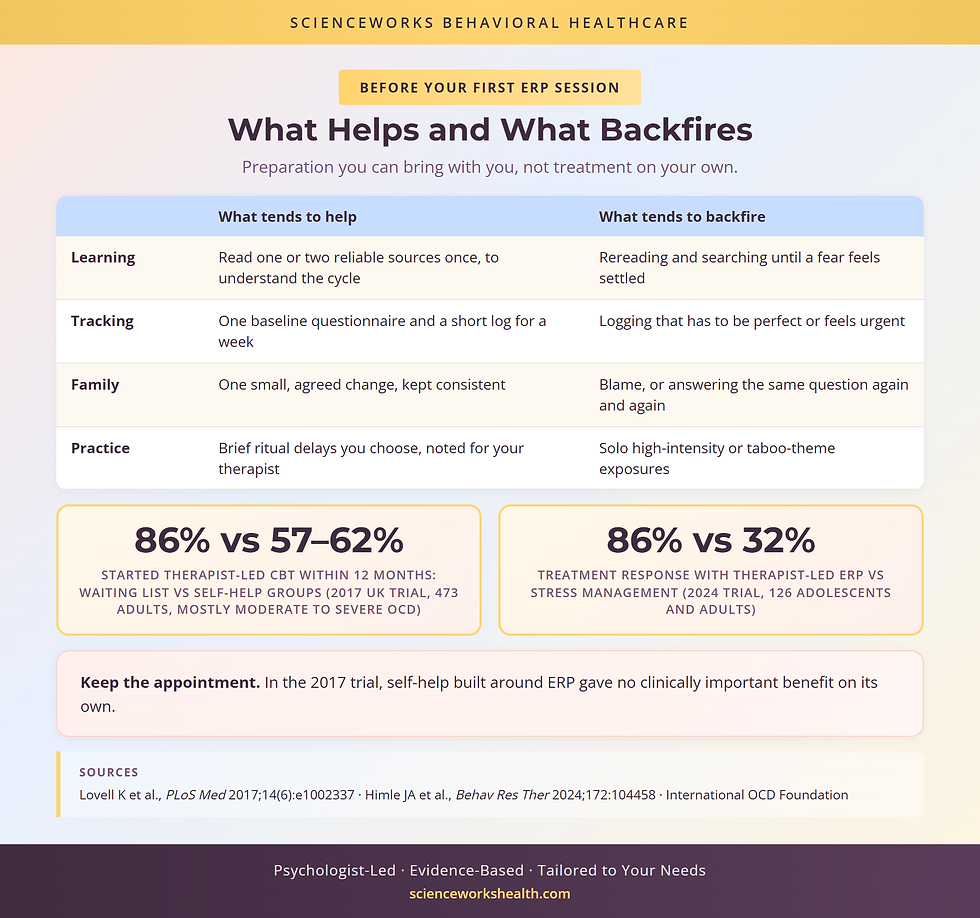
The specific method matters too. In a 2024 randomized trial of 126 adolescents and adults with OCD, 12 weekly therapist-led sessions of ERP led to significantly greater improvement than a stress-management therapy of the same length, delivered the same way. In that trial, 86% of the ERP group met the study's definition of treatment response, compared with 32% of the comparison group, and 39% reached remission, compared with 7% [3].
So the waiting period is not a race to finish treatment early. It is a chance to arrive at your first session understanding the OCD cycle, with a clearer picture of your own patterns, and with fewer extra habits propping OCD up. If you have not yet been assessed, our article on what happens before ERP starts walks through that first step.
🧭 Key takeaway: Use the wait to learn, observe and practice small steps. Keep the harder work for when a trained therapist can plan it with you.
Why the waiting period matters
How research and reassurance quietly become compulsions
Waiting leaves time to read, and some reading helps. But reading can shift into a search for certainty: "Is this thought normal?" "Does this mean something about me?" Each answer brings brief relief, and then the question comes back. Our article on googling and online reassurance seeking explains how searching can become a compulsion of its own.
How OCD can take up more room while you wait
A compulsion brings quick relief, which is why it is so hard to resist. The IOCDF explains that each compulsion also reinforces the brain's idea that you must be in danger [2]. For some people, that can show up over the weeks as more avoidance, longer rituals, or new situations that suddenly need checking.
Family and partners get pulled in too. Helping with rituals, answering the same question again, or changing routines to avoid a trigger is called family accommodation. The IOCDF counts providing excessive reassurance among these behaviors [4]. A 2024 review of 108 studies found that higher family accommodation went along with more severe OCD symptoms [5]. That is a correlation, so it does not show which causes which.
Here is how it often begins. Maya books her first ERP session for three weeks away. Most mornings she checks the stove several times before she can leave. In week one, her partner starts checking it for her "so you can get to work on time." By week three, he checks twice every morning, and Maya has stopped cooking breakfast so there is less to check. Neither of them did anything wrong. Accommodation often starts as kindness.
What actually helps while you wait
Learn the OCD cycle from a few reliable sources
Pick one or two trustworthy sources, such as the IOCDF's pages on OCD and ERP [2], and read them once, with the goal of understanding the cycle of obsession, anxiety, compulsion and relief. Reading the same material again and again, or hunting for a source that will finally settle a specific fear, is where learning turns into reassurance.
Support groups are another option. The IOCDF advocate who described long waitlists also recommended peer support groups while waiting, and was clear that such resources "are not meant to substitute therapy" [1].
Take one baseline, then track briefly
A standardized questionnaire gives you and your future therapist a shared starting point. The DOCS (Dimensional Obsessive-Compulsive Scale) is a 20-item measure covering four common symptom areas, and it has been shown to be sensitive to change during treatment [6]. Take it once, save the result, and bring it with you. It is not a diagnosis.
Then keep a short log for a week: the situation, the urge, what you did, and roughly how long it took. A few lines a day is enough. For some people, logging can turn into another form of checking or reviewing. If writing it down starts to feel urgent, or it has to be perfect, stop and bring what you already have.
Start trimming family accommodation, gently
The IOCDF offers practical direction for families: blaming is unproductive, and the aim is to "gently withdraw and hold the line," consistently, with everyone in the household agreeing on the same plan [4]. Expect your ERP therapist to ask about this too. UK guidance recommends including relevant family members in assessment and treatment plans where appropriate, including how involved they are in supporting or carrying out OCD-related behaviors [7].
A good start is small. Choose one accommodation, talk about it at a calm moment, and agree on what the family member will say instead, such as: "I know this is hard. I'm not going to check it for you, and I'm right here." Research has not tested whether cutting back before therapy starts changes how well treatment works, so keep changes small and let your therapist guide the rest. Family accommodation tends to fall during cognitive behavioral therapy for OCD [5], so your therapist can help with the harder parts. Our article on why reassurance stops working explains what families can say instead.
Small ritual delays, as practice for your first session
Response prevention means encouraging the person to "resist or at least delay" a compulsion [4], and a small delay is the easiest part of it to try on your own. When an urge comes, choose to wait a few minutes before acting on it, and notice what happens to the urge while you wait. This is practice and observation, not a head start on treatment: in the OCTET trial described below, structured self-help built around ERP did not produce clinically important improvement on its own [8]. You are gathering information to bring to your first session.
Jordan washes his hands every time he touches his mail. For one week, he tries waiting two minutes before washing, once a day, and writes down what the urge felt like at the start and at the end. Some days he washes anyway, and that is fine. At his first ERP appointment, his notes give the therapist a real starting point.
Keep these delays brief and self-chosen. If distress climbs very high, or the delay itself becomes a ritual that has to be done exactly right, stop and leave it for your therapist. Our guide to myths about ERP and gentle ways to start describes how therapists pace this work.
🌱 Key takeaway: Small, self-chosen steps you can write down and bring with you are the right size for the wait.
What makes it worse
Endless research and reassurance
"If I read enough, I will finally be sure" is one of OCD's most convincing promises. Certainty rarely arrives, and each search can strengthen the habit of looking for it. If you notice that you are rereading the same pages, searching the same question in new words, or asking the people around you for the same answer, that is a sign to step back.
Solo high-intensity or taboo-theme exposures
It can be tempting to "get a head start" by forcing yourself into your hardest fears. At the start of ERP, a trained clinician works with you to build an exposure plan and coaches you through it [2]. Without that structure, a very difficult exposure can end in a compulsion at peak distress, or leave you feeling that ERP is impossible before you have even started.
This applies especially to intrusive thoughts on taboo themes, such as unwanted violent, sexual or religious thoughts. Having those thoughts says nothing about your character. The reason to wait is that exposure on these themes works best with a clear plan and careful framing, which is exactly what a trained ERP therapist provides.
Letting self-help replace the appointment
The most direct trial evidence about self-help during the wait comes from a UK trial called OCTET. It included 473 adults with moderate to severe OCD who were already waiting for therapist-led cognitive behavioral therapy (CBT) [8][9]. People were randomly assigned to keep waiting, to use computerized CBT with support, or to use a guided self-help book with support. Both self-help options focused on exposure and response prevention [9].
Guided self-help produced a small improvement at three months that was statistically significant but not large enough to be clinically important, and computerized CBT showed no significant benefit [8]. By 12 months, neither self-help group was meaningfully better off than the waiting-list group, most of whom had started therapist-led CBT by then [8][9]. And people offered the self-help options were less likely to go on to therapist-led CBT: 86% of the waiting group started it by 12 months, compared with 62% in the computerized group and 57% in the guided self-help group [8].
An NIHR summary of the trial noted that it is not clear why uptake dropped [9], and the lower uptake did not seem to harm outcomes at 12 months [8]. The same summary notes that results might differ for milder OCD, which the trial did not focus on [9]. Waits in the trial were also shorter than expected, which the study summary notes may have favored the waiting-list group [9]. Even so, the practical lesson is clear enough: whatever you read or try while you wait, keep the appointment.
The same goes for replacing ERP with general talk therapy for OCD. If you already see a therapist for depression or anxiety, keep going and let them know you have ERP booked. The IOCDF notes that there is no research evidence that traditional talk therapy is effective for OCD [2], and the 2024 trial authors warned that nonspecific treatments are "still all-too-commonly provided" [3].
⚖️ Key takeaway: Self-help can support the wait. It is not a replacement for the specialized appointment you booked.

When waiting isn't safe
It is common for people with OCD to also have a mood or anxiety disorder [10]. Waiting is the wrong plan if things are escalating quickly.
If you are having thoughts of suicide or self-harm, or are in severe distress, call or text the 988 Suicide & Crisis Lifeline at 988, or chat at 988lifeline.org. It is free, confidential, and available 24/7 [10][11].
If anyone's life is in danger, call 911 or go to the nearest emergency room [1][10].
If symptoms are getting worse fast, for example you cannot eat, sleep, work or leave home because of rituals, or your mood is sinking, contact the provider you booked with, or your doctor, and ask whether you can be seen sooner or should get other care in the meantime.
If you are unsure whether what you are experiencing is OCD, or you suspect something else is also going on, a psychological assessment can help sort out the picture before treatment begins.
Questions to ask the provider you booked with
Is there anything you would like me to read, track or avoid before we start?
Should my family or partner be involved, and when?
If an earlier appointment opens up, can I be contacted?
What should I do if my symptoms get worse before my first session?
Should I talk to a doctor or psychiatrist about medication while I wait? The IOCDF names ERP and medication as the treatments to try first for OCD [2].
Next step - getting support
Waiting for ERP is not wasted time if you use it to understand the cycle, notice your patterns and ease a little of the pressure at home. The goal is to walk into your first session a bit more prepared, not to have treated yourself already. If you are still looking for the right fit, our specialized therapy page describes the evidence-based approaches our clinicians use, and you can reach our team with questions about OCD care.
Think it might be OCD?
OCD responds well to the right approach — a clinician trained in ERP and I-CBT can help you tell OCD apart from anxiety and build a plan that fits.
Frequently Asked Questions
Could trying OCD self-help while I wait make me less likely to start therapy?
In one large UK trial of adults with moderate to severe OCD who were already waiting for therapist-led CBT, those offered supported self-help while they waited were less likely to start that therapy within a year than those who simply waited. Why this happened is not clear, and 12-month outcomes did not seem to suffer. The practical lesson is to keep your appointment, whatever you read or try in the meantime.
Should my family stop giving reassurance before my ERP therapy starts?
Families can start, gently, and a therapist can guide the rest. Answering the same question again, checking on someone's behalf or changing routines around rituals is called family accommodation, and it tends to go along with more severe symptoms. It can help to pick one habit, agree on a calm response together, and keep it consistent. Research has not tested cutting back before therapy starts, so keep changes small. Your therapist can help with the harder parts once treatment begins.
Is it okay to practice small ritual delays before my first ERP session?
A small delay you choose yourself can be a way to gather information for your therapist: wait a few minutes before a compulsion and notice what the urge does. Keep it brief, write down what happened and bring it to your first session. Leave harder or frightening exposures, including anything involving taboo intrusive thoughts, for when a trained therapist can plan them with you.
About ScienceWorks
ScienceWorks Behavioral Healthcare was founded by Dr. Kiesa Kelly, a licensed clinical psychologist with more than 20 years of experience in psychological assessment and evidence-based treatment. Our clinical team works with adults and adolescents across OCD, anxiety, depression, trauma, ADHD and autism, and insomnia, including the overlap between OCD and the conditions it is often mistaken for.
We are a telehealth-forward practice serving Tennessee, with an in-person option at our Nashville office. Every patient-facing article on this site is reviewed by a licensed clinician for accuracy before it is published.
References
1. Rose J. Kick-starting OCD treatment when you or a loved one can't see a therapist. International OCD Foundation blog. Published September 5, 2024. https://iocdf.org/blog/2024/09/05/kick-starting-ocd-treatment-when-you-or-a-loved-one-cant-see-a-therapist/
2. International OCD Foundation. Exposure and response prevention (ERP). https://iocdf.org/about-ocd/treatment/erp/
3. Himle JA, Grogan-Kaylor A, Hiller MA, Mannella KA, Norman LJ, Abelson JL, Prout A, Shunnarah AA, Becker HC, Russman Block SR, Taylor SF, Fitzgerald KD. Exposure and response prevention versus stress management training for adults and adolescents with obsessive compulsive disorder: a randomized clinical trial. Behav Res Ther. 2024;172:104458 (published online December 12, 2023). https://doi.org/10.1016/j.brat.2023.104458
4. Van Noppen B, Pato M. Families: "What can I do to help?" International OCD Foundation, Expert Opinion (undated). https://iocdf.org/expert-opinions/expert-opinion-families-what-you-can-do-to-help/
5. Hermida-Barros L, Primé-Tous M, García-Delgar B, Forcadell E, Lera-Miguel S, Fernández de la Cruz L, Vieta E, Radua J, Lázaro L, Fullana MA. Family accommodation in obsessive-compulsive disorder: an updated systematic review and meta-analysis. Neurosci Biobehav Rev. 2024;161:105678. https://doi.org/10.1016/j.neubiorev.2024.105678
6. Abramowitz JS, Deacon BJ, Olatunji BO, Wheaton MG, Berman NC, Losardo D, Timpano KR, McGrath PB, Riemann BC, Adams T, Björgvinsson T, Storch EA, Hale LR. Assessment of obsessive-compulsive symptom dimensions: development and evaluation of the Dimensional Obsessive-Compulsive Scale. Psychol Assess. 2010;22(1):180-198. https://doi.org/10.1037/a0018260
7. National Institute for Health and Care Excellence. Obsessive-compulsive disorder and body dysmorphic disorder: treatment (CG31). Published November 29, 2005. https://www.nice.org.uk/guidance/cg31/chapter/Recommendations
8. Lovell K, Bower P, Gellatly J, Byford S, Bee P, McMillan D, et al. Low-intensity cognitive-behaviour therapy interventions for obsessive-compulsive disorder compared to waiting list for therapist-led cognitive-behaviour therapy: 3-arm randomised controlled trial of clinical effectiveness. PLoS Med. 2017;14(6):e1002337. https://doi.org/10.1371/journal.pmed.1002337
9. National Institute for Health and Care Research. Guided self-help therapy for people with obsessive-compulsive disorder (OCD) did not improve symptoms. NIHR Evidence. Published September 19, 2017. https://doi.org/10.3310/signal-000478
10. National Institute of Mental Health. Obsessive-compulsive disorder (OCD). Last reviewed December 2024. https://www.nimh.nih.gov/health/topics/obsessive-compulsive-disorder-ocd
11. 988 Suicide & Crisis Lifeline. https://988lifeline.org/
Disclaimer
This article is for informational purposes only and is not a substitute for professional medical or mental health advice, diagnosis, or treatment. If you are in crisis, call or text 988, or call 911 in an emergency.