
Exhausted but Can’t Sleep: Why It Happens and How CBT-I Helps

Updated: 4 days ago
Last reviewed: 08/26/2026
Reviewed by: Dr. Kiesa Kelly
If you’re exhausted but can’t sleep, it can feel like your body and brain are arguing: you’re drained, but your mind won’t slow down. This “tired and wired” experience is common in anxiety, stress, and burnout.
In this article, you’ll learn:
Why fatigue doesn’t guarantee sleep
How nervous system arousal blocks sleep
How insomnia becomes a learned pattern
Habits that accidentally reinforce insomnia
How CBT-I rebuilds sleep, including options in Tennessee
Key takeaway: 😴 Feeling tired but awake at night usually reflects arousal (your brain’s threat system staying on) rather than a “broken” ability to sleep. [4]
The Exhaustion–Insomnia Paradox: Exhausted but Can’t Sleep
Why fatigue doesn’t guarantee sleep
Sleep isn’t something you can force, even when you’re wiped out. Your body needs enough sleep pressure (the drive that builds the longer you’re awake) and the right conditions for your brain to shift into sleep. When people ask, “why am i tired but can’t sleep,” the sleep drive may be there, but the brain is still on problem-solving duty.
A common misconception is that exhaustion should guarantee sleep. But the brain treats sleep as a vulnerable state. If it senses threat or unfinished business, it may stay alert “just in case.” [5]
The role of nervous system arousal
Insomnia is often explained through “hyperarousal”: the sleep system and the arousal system are both active at the same time. Hyperarousal can show up as:
Physical activation (tense body, racing heart, restlessness)
Cognitive activation (worry, rumination, clock-watching)
Emotional activation (dread, frustration, fear of bedtime) [4]
Key takeaway: 🔥 “Wired but tired” insomnia often includes real cognitive and physiological arousal, not just “bad habits.” [4]
Stress and sleep disruption
Short-term insomnia can happen during a stressful week. The trouble starts when bedtime becomes high-stakes and you begin monitoring, bracing, and compensating.
That’s the insomnia anxiety cycle: worry increases arousal, arousal disrupts sleep, and poor sleep makes the next day feel harder, which increases worry again. [2]
Practical example: if you start doing “sleep math” at 1:00 a.m. (“If I fall asleep now, I’ll get 5 hours…”), your brain learns that nighttime is for vigilance. [5]
How the Brain Learns Insomnia
Conditioning the bed with wakefulness
One of the strongest drivers of chronic insomnia is conditioned arousal: the bed and bedtime start to cue wakefulness instead of sleep. Bed becomes linked with scrolling, planning, clock-checking, or frustration. [8]
This is why staying in bed while awake can backfire. The goal is to rebuild “bed = sleep” as a clean association. [7]
Key takeaway: 🛏️ When your bed becomes linked with wakefulness, stimulus control helps retrain the bed-sleep connection. [7]
The frustration response
After a few bad nights, many people feel angry at their bodies and scared of tomorrow. That emotional surge increases arousal and makes it harder for sleep to arrive. [5] This doesn’t mean you’re “too sensitive” or “doing it wrong.” It means your nervous system is responding to perceived threat.
Sleep performance anxiety
Sleep performance anxiety is when sleep starts to feel like a test: you track it, judge it, and brace for another “bad night.” In cognitive models of insomnia, worry about sleep can trigger monitoring, safety behaviors, and more distress, which keeps the loop going. [5]
Misconception check:
“If I don’t get 8 hours, tomorrow is ruined.” Sleep needs vary, and one short night is rarely catastrophic.
“If I can’t sleep, I should stay in bed and rest.” Rest is helpful, but long stretches awake in bed train wakefulness.
“If I perfect my sleep hygiene, insomnia will disappear.” Sleep hygiene helps, but chronic insomnia usually needs retraining, not just tips. [1]

Common Habits That Make Insomnia Worse
Staying in bed while awake
Lying in bed awake for long stretches gives your brain repeated practice being alert in your sleep space. Stimulus control does the opposite: keep the bed reserved for sleep (and sex), and get out of bed when you’re awake too long. [7]
Practical application: a gentle stimulus-control loop
If you can’t fall asleep (or fall back asleep) after about 15–30 minutes, get up.
Keep lights low and do something quiet and boring.
Return to bed only when you feel sleepy. [7]
Irregular sleep schedules
Sleeping in, going to bed much earlier, and frequent long naps can reduce sleep pressure. That can make the next night harder, which reinforces the urge to compensate again.
Sleep restriction therapy (also called sleep scheduling) uses a consistent “sleep window” to strengthen sleep pressure and rebuild consolidated sleep over time. [6]
Key takeaway: 🧭 More time in bed does not always mean more sleep; it can dilute sleep pressure and keep insomnia going. [6]
Trying harder to sleep
“Trying harder” can keep sleep feeling effortful: forcing relaxation, chasing the perfect routine, switching tools nightly, or monitoring your body for signs of sleep. CBT-I replaces effort with a plan that retrains your system. [5]
How CBT-I Rebuilds Healthy Sleep
Resetting sleep pressure
CBT-I (Cognitive Behavioral Therapy for Insomnia) is recommended as a first-line treatment for chronic insomnia. [2] In the AASM guideline, components like sleep restriction and stimulus control have supportive evidence. [1]
In practice, “resetting sleep pressure” means using a sleep diary to build a realistic schedule, then adjusting it gradually based on how your sleep consolidates. [6]
Practical example: what a sleep window might look like
If you’re in bed for 9 hours but sleeping about 6, a CBT-I plan might temporarily set a 6.5-hour sleep window (for example, 12:30 a.m. to 7:00 a.m.). As sleep becomes steadier, time in bed is increased in small steps. [6]
Stimulus control
Stimulus control is the retraining piece: it strengthens “bed = sleep” and weakens “bed = awake.” [7] Over time, this can reduce sleep anxiety because the bed stops feeling like a battleground.
Gradual schedule adjustments
CBT-I is not about harsh rules. It’s about a few high-impact steps done consistently, typically including:
Sleep scheduling (sleep restriction therapy)
Stimulus control
Cognitive strategies for worry and catastrophizing
Targeted sleep hygiene and relaxation as support [1]
Key takeaway: 🧠 CBT-I works because it changes both the sleep schedule and the thoughts/behaviors that train your brain to stay alert at night. [3]
If you’re considering online insomnia therapy, research supports structured internet-delivered CBT-I for many adults with insomnia. [9]
Why You Can Feel Tired All Day and Still Not Sleep at Night
Fatigue and sleepiness are not the same thing
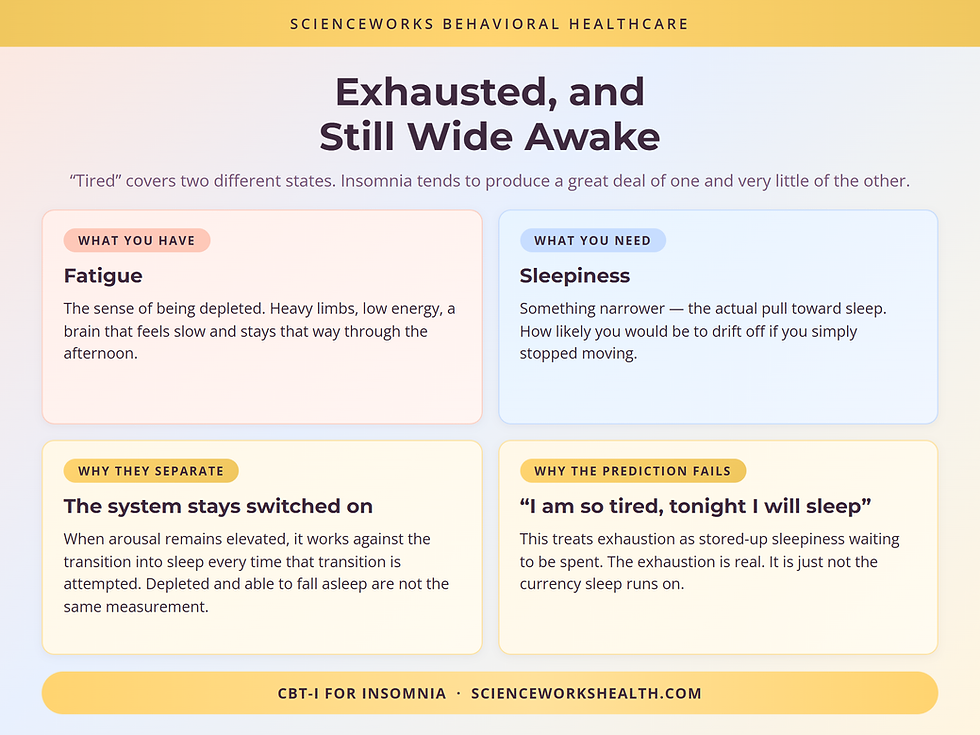
In everyday language, "tired" covers two different states. Fatigue is the sense of being depleted — heavy limbs, low energy, a brain that feels slow. Sleepiness is narrower: the actual pull toward sleep, the likelihood you would drift off if you stopped moving.
In insomnia these two routinely come apart. People describe profound fatigue all day, yet if they lie down for a nap, sleep does not arrive. That combination is confusing, because most of us assume the two travel together.
The hyperarousal model offers a way to make sense of it: if the arousal system stays elevated, it works against the transition into sleep whenever that transition is attempted. [4] Feeling depleted and being able to fall asleep are simply not the same measurement. [8]
Key takeaway: 🔋 Fatigue is about depletion. Sleepiness is about the drive to fall asleep. Insomnia often produces plenty of the first and very little of the second.
Why "always tired but can't sleep" is a round-the-clock pattern
Many people notice the "tired and wired" feeling only at bedtime, and assume the rest of the day is unaffected. Often it is not. When arousal stays raised across the whole day, the daytime picture is fatigue without sleepiness — drained, foggy, and still unable to doze. [4]
This is also why one of the most intuitive predictions keeps failing. "I'm exhausted, so tonight I'll sleep" treats exhaustion as if it were stored-up sleepiness waiting to be spent. Under sustained arousal, the exhaustion is real, but it is not the currency sleep runs on. [8]
Why chasing daytime rest can backfire
Once the days feel this heavy, the natural response is to recover the lost sleep — sleeping in, going to bed early, or napping when there is a gap. Each of those reduces the sleep pressure you would otherwise carry into the night, which tends to make the next night harder rather than easier. [6]
It is worth separating rest from sleep here. A short, quiet break to take the edge off a demanding day is not the same thing as a long nap, and it does not carry the same cost to your sleep pressure.
Key takeaway: ⚖️ Daytime fatigue is a signal worth taking seriously, but treating it with extra sleep opportunity is usually what keeps the cycle turning. [6]
When daytime fatigue deserves its own look
Sometimes daytime tiredness is not only the downstream effect of a difficult night. If your sleep is long enough and reasonably consolidated but you still wake unrefreshed, or if the fatigue is out of proportion to how you are actually sleeping, that pattern is worth raising with a clinician directly rather than folding it into the insomnia picture. [2]
A CBT-I assessment will normally ask about your days as well as your nights — energy, concentration, and mood are part of how progress gets measured, not an afterthought. [1]
When to Seek Help for Chronic Insomnia
Signs insomnia is becoming persistent
Consider reaching out if you notice:
Trouble falling asleep, staying asleep, or waking too early at least 3 nights per week
Symptoms lasting 3 months or longer
Daytime impairment (fatigue, mood changes, concentration problems)
Growing sleep anxiety or dread at bedtime [2]
Also consider a medical evaluation if you have loud snoring, breathing pauses, restless legs sensations, or significant medication changes.
Key takeaway: 📅 If insomnia is frequent, lasts months, and affects daytime life, evidence-based treatment is worth exploring. [2]
How CBT-I works through telehealth
CBT-I can be delivered through telehealth for many people. Research suggests telehealth delivery can be effective and may be comparable to in-person CBT-I for some patients. [10] This can make it easier to get support without adding more demands to an already tired week.
Finding insomnia treatment in Tennessee
If you’re looking for CBT-I therapy in Tennessee, look for a clinician or program that explicitly offers CBT-I (not just “sleep hygiene”), and ask how the treatment is structured (sleep diary, schedule plan, stimulus control, cognitive work).
At ScienceWorks, our clinicians offer CBT-I and related support. You can read about our approach on our insomnia services page, explore specialized therapy options, or meet the ScienceWorks team.
If anxiety or mood symptoms are part of the picture, our mental health screening resources can help you organize what you’re noticing, and you can learn more about treatment for OCD and related concerns.
If you want to talk through next steps, you can contact ScienceWorks to schedule a free consultation.
Frequently Asked Questions
Why am I exhausted but can't sleep?
The exhaustion-insomnia paradox happens because your body needs sleep pressure AND the right conditions for your brain to shift into sleep. When the arousal system is active — from stress, anxiety, burnout, or chronic worry about sleep itself — your brain stays alert even when you're physically drained. Exhaustion builds sleep pressure (the drive to sleep), but hyperarousal keeps the brain from acting on it. The result is feeling tired but wired: depleted and unable to switch off simultaneously.
Can burnout cause insomnia even when you're physically exhausted?
Yes. Burnout is associated with high cortisol and sustained nervous system activation, both of which increase the arousal component of the sleep-wake system. Even when you are physically depleted, a burnout-activated nervous system may maintain hyperarousal at bedtime — producing exactly the 'tired but can't sleep' pattern. If burnout is driving insomnia, addressing sleep behaviors alone (hygiene tips) is usually insufficient; the arousal system needs to be targeted, which is what CBT-I's behavioral and cognitive components do.
How does CBT-I help when you're exhausted but can't fall asleep?
CBT-I targets the behavioral and cognitive patterns maintaining the insomnia cycle: it uses stimulus control to rebuild the bed-sleep association (rather than bed-wakefulness-anxiety), sleep restriction to consolidate fragmented sleep and increase sleep pressure, and cognitive techniques to reduce sleep-performance anxiety. Together, these retrain the brain to treat bedtime as a signal for sleep rather than a signal for vigilance. CBT-I typically produces durable improvements across 6–8 sessions and is recommended as the first-line treatment for chronic insomnia.
Why does staying in bed when you can't sleep make insomnia worse?
When you stay in bed while awake — scrolling, watching the clock, feeling frustrated — the bed becomes paired with wakefulness and anxiety rather than sleep. This is conditioned arousal: your brain learns that bed is the place where you lie awake worrying, not the place where sleep happens automatically. Stimulus control, a core CBT-I technique, works by getting out of bed when you're awake and returning only when sleepy, gradually rebuilding 'bed = sleep' as a conditioned association.
About ScienceWorks
Dr. Kiesa Kelly is a psychologist and owner of ScienceWorks Behavioral Healthcare. She earned a PhD in Clinical Psychology with a concentration in Neuropsychology from Rosalind Franklin University of Medicine and Science, and has over 20 years of experience with psychological assessments.
Dr. Kelly provides specialized, evidence-based therapy for insomnia (CBT-I), OCD, trauma, and related concerns, and is available via telehealth in Tennessee and many other states.
References
Edinger JD, Arnedt JT, Bertisch SM, et al. Behavioral and psychological treatments for chronic insomnia disorder in adults: an American Academy of Sleep Medicine clinical practice guideline. J Clin Sleep Med. 2021;17(2):255-262. https://pubmed.ncbi.nlm.nih.gov/33164742/
Qaseem A, Kansagara D, Forciea MA, Cooke M, Denberg TD; Clinical Guidelines Committee of the American College of Physicians. Management of chronic insomnia disorder in adults: a clinical practice guideline from the American College of Physicians. Ann Intern Med. 2016;165(2):125-133. https://pubmed.ncbi.nlm.nih.gov/27136449/
Trauer JM, Qian MY, Doyle JS, Rajaratnam SMW, Cunnington D. Cognitive behavioral therapy for chronic insomnia: a systematic review and meta-analysis. Ann Intern Med. 2015;163(3):191-204. https://pubmed.ncbi.nlm.nih.gov/26054060/
Riemann D, Spiegelhalder K, Feige B, et al. The hyperarousal model of insomnia: a review of the concept and its evidence. Sleep Med Rev. 2010;14(1):19-31. https://pubmed.ncbi.nlm.nih.gov/19481481/
Harvey AG. A cognitive model of insomnia. Behav Res Ther. 2002;40(8):869-893. https://pubmed.ncbi.nlm.nih.gov/12186352/
Spielman AJ, Saskin P, Thorpy MJ. Treatment of chronic insomnia by restriction of time in bed. Sleep. 1987;10(1):45-56. https://pubmed.ncbi.nlm.nih.gov/3563247/
Bootzin RR. Stimulus control treatment for insomnia. Proceedings of the 80th Annual Convention of the American Psychological Association. 1972. https://www.med.upenn.edu/cbti/assets/user-content/documents/Bootzin%201972.pdf
Levenson JC, Kay DB, Buysse DJ. The pathophysiology of insomnia. Chest. 2015;147(4):1179-1192. https://pmc.ncbi.nlm.nih.gov/articles/PMC4388122/
Seyffert M, Lagisetty P, Landgraf J, et al. Internet-delivered cognitive behavioral therapy to treat insomnia: a systematic review and meta-analysis. PLoS One. 2016;11(2):e0149139. https://pubmed.ncbi.nlm.nih.gov/26867139/
Gehrman P, Shah MT, Miles A, et al. Randomized noninferiority trial of telehealth delivery of cognitive behavioral therapy for insomnia compared with in-person therapy. J Clin Psychiatry. 2021;82(6):21m14075. https://pubmed.ncbi.nlm.nih.gov/34428360/
Disclaimer
This article is for informational purposes only and is not a substitute for medical advice, diagnosis, or treatment. If you have urgent safety concerns, call 911 or go to the nearest emergency room.