
Acceptance and Commitment Therapy for Depression: Living Meaningfully When Mood Is Low

Updated: Sep 16
Last reviewed: 07/10/2026
Reviewed by: Dr. Kiesa Kelly
If you have tried to think your way out of depression and it has not worked, you are not doing it wrong. Some of the most exhausting parts of low mood are the hours spent arguing with your own thoughts—trying to talk yourself out of feeling numb, hopeless, or worthless, and feeling more stuck each time. Acceptance and commitment therapy takes a different route. Instead of fighting the thoughts, it helps you change your relationship to them and reconnect with a life that feels worth living, even before your mood fully lifts.
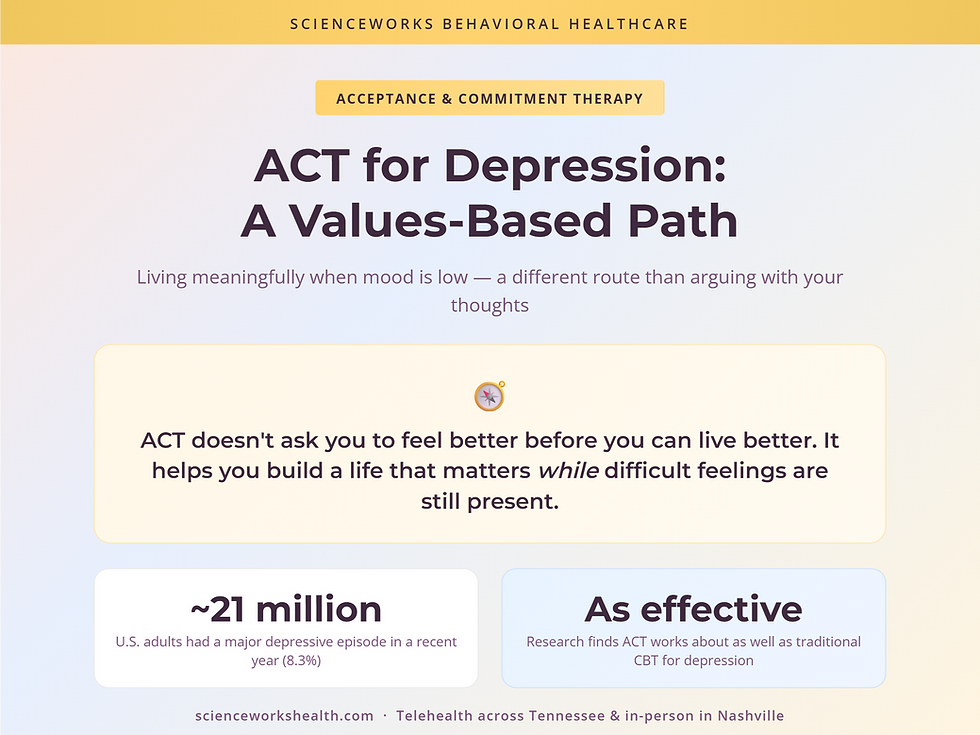
This article explains what ACT is, how it works for depression, and how it differs from the cognitive behavioral therapy you may already know. Depression is common and treatable—an estimated 8.3% of U.S. adults, about 21 million people, had at least one major depressive episode in a recent year [1]. There is no single "best" therapy for everyone, and the honest answer to "which one?" is usually "it depends." Our aim here is to help you decide whether an acceptance-and-values approach fits you.
In this article, you'll learn:
What ACT is and the six processes it uses
Why depression shrinks life to avoidance—and how ACT reopens it
How ACT and CBT differ, and how a clinician helps you choose
What ACT for depression looks like in practice, including online in Tennessee
When ACT is a strong fit, and when another approach may serve you better
When to reach out for help, and where to turn in a crisis
The short answer: ACT changes your relationship to low mood, not just your thoughts
Acceptance and commitment therapy—said as the word "act," not the letters—is an evidence-based, third-wave form of CBT. Rather than trying to eliminate or dispute every negative thought, ACT for depression teaches you to notice difficult thoughts and feelings, loosen their grip, and keep moving toward what matters to you anyway.
The core idea is a skill called psychological flexibility: the ability to stay present with hard internal experiences while still acting in line with your values [2]. Depression tends to do the opposite. It pulls you into rumination and withdrawal, narrows your world, and makes "wait until I feel better" the rule for everything. ACT gently reverses that order. You take small, meaningful steps first, and a fuller life often follows.
Key takeaway: 🧭 ACT does not ask you to feel better before you can live better. It helps you build a life that matters while difficult feelings are still present.

What ACT is: six processes, in plain language
ACT works through six overlapping processes, sometimes drawn as a hexagon [2]. In practice they blend together, but it helps to see them named:
Acceptance — making room for painful feelings instead of struggling to push them away.
Cognitive defusion — unhooking from thoughts so you can see them as thoughts, not commands or facts.
Present-moment contact — noticing what is actually happening now, rather than living inside rumination about the past or worry about the future.
Self-as-context — sensing that you are the observer of your experiences, larger than any single mood or story about yourself.
Values — getting clear on what genuinely matters to you: connection, creativity, parenting, honesty, health.
Committed action — taking small, values-guided steps, and returning to them when you drift.
Together these build psychological flexibility. Depression, by contrast, is marked by psychological inflexibility—getting fused with harsh thoughts ("I'm a failure"), avoiding anything that stirs discomfort, and losing contact with values under the weight of low mood [2]. ACT targets that pattern directly. If you want to understand where depression sits alongside other concerns, it can help to start with depression-focused therapy and a simple check-in on your symptoms.
Why depression shrinks life to avoidance—and how ACT reopens it
Depression rarely announces itself as one big decision to give up. It arrives as a slow narrowing. Consider a worked example. You used to see friends on the weekend, but lately the effort of showering, driving, and making conversation feels like too much, so you cancel. Cancelling brings a flicker of relief, which teaches your nervous system that avoiding is safer. The next invitation feels even harder. Within a couple of months your world has shrunk to your bed, your phone, and the low hum of self-criticism—and the isolation feeds the very mood you were trying to escape.
Or take mornings. You wake with a heaviness that makes getting up feel pointless, so you scroll instead. An hour passes, then two, and now there is real evidence for the thought "I've wasted the day," which lowers your mood further and makes the afternoon feel not worth starting either. Each small avoidance makes sense in the moment. Stacked together, they build the cage.
Clinicians call this experiential avoidance—the effort to avoid or suppress unwanted inner experiences, even at the cost of the things you care about. ACT treats it as a central engine of depression. The way out is not to force yourself to feel motivated first. It is to reconnect with a value ("I want to be a present parent," "I want to make things") and take one small action toward it while the low mood is still in the room. This is ACT's values-driven cousin of behavioral activation: movement first, mood often following.
Key takeaway: 🌱 Avoidance shrinks your life quietly, one reasonable cancellation at a time. Values-guided action is how ACT helps you widen it again.

Three common misconceptions about ACT for depression
"ACT means accepting that I'll be depressed forever." Not at all. In ACT, acceptance refers to making room for painful feelings in the moment so they stop running the show—not resigning yourself to depression. The point of dropping the struggle is to free up energy for change. People in ACT still get meaningfully better; acceptance is the doorway, not the destination [3].
"If I just think more positively, the depression will lift." Positive thinking is not what ACT—or good therapy generally—asks of you. Trying to force cheerful thoughts often backfires, because the mind notices the effort and pushes back. ACT sidesteps the argument entirely: you learn to hold a thought like "nothing will get better" lightly, without either believing it or fighting it, and act on your values anyway.
"ACT is just meditation with a new name." Mindfulness is one ingredient, but ACT is a full, structured therapy with a strong evidence base. Meditation alone will not clarify your values or plan committed action. Meta-analyses and randomized trials show ACT produces real reductions in depressive symptoms, working through changes in psychological flexibility rather than through relaxation alone [4][5][10][11].
ACT vs. CBT for depression: two evidence-based paths, honestly compared
Traditional cognitive behavioral therapy and ACT are both well-supported treatments, and they are more alike than different—ACT grew out of the cognitive behavioral tradition. The clearest way to see the difference is to look at what each one changes.
Classic CBT works largely on the content of thoughts. When a thought like "I'm worthless" shows up, CBT helps you examine the evidence, test the thought against reality, and build a more balanced, accurate alternative. For many people this is powerful and freeing.
ACT works on your relationship to the thought instead. It does not ask whether "I'm worthless" is true or false. It helps you notice it as a passing mental event—"I'm having the thought that I'm worthless"—so it carries less weight, and then it turns your attention to a values-based action you can take regardless. This mechanism-level difference matters: where CBT loosens depression by changing what you conclude, ACT loosens it by changing how tightly you hold any conclusion at all.
Which works better? For depression, the honest answer from the research is: about the same. A randomized trial comparing ACT and CBT for major depressive disorder found large symptom reductions in both, with remission rates of roughly 75% for ACT and 80% for CBT and no meaningful difference between them [6]. A review of dozens of trials reached a similar conclusion—ACT outperforms no treatment and works comparably to standard CBT [4]. Neither is a magic bullet, and neither is "the best" for everyone.
So how do you choose? A useful heuristic: if you respond well to structure, logic, and actively re-examining your thoughts, classic CBT may be a natural fit. If you feel exhausted from fighting your thoughts and want a values-and-meaning focus, ACT may be the better opening move. If you are not sure, that is normal—many clinicians, including ours, are trained in both and will help you match the approach to how your mind actually works. It can also help to look at the broader menu; professional guidelines list several effective psychotherapies for adult depression, which is exactly why fit matters more than picking a single "winner" [7].
Key takeaway: ⚖️ ACT and CBT work about equally well for depression. The right choice is the one that fits how you relate to your own thoughts—not a ranking.
What ACT for depression looks like at ScienceWorks
ACT is usually a structured, collaborative, and relatively focused therapy rather than open-ended talk. In early sessions, we get clear on what matters to you and where depression has pulled you away from it. From there, sessions weave together defusion exercises (practical ways to unhook from sticky thoughts), acceptance and mindfulness practices you can use between sessions, and committed-action planning—small, specific steps toward a value you have named.
Care is delivered by clinicians trained in acceptance and commitment therapy and experienced with depression, and our clinical work is overseen by Dr. Kiesa Kelly, a licensed clinical psychologist. We see people two ways: by secure telehealth across Tennessee, and in person at our Nashville office. Many clients choose video sessions to protect a steady weekly rhythm—which matters, because ACT is a skills-based therapy that builds over time.
Because depression and anxiety so often travel together, we also pay attention to what else is in the picture. If worry and physical tension are prominent alongside low mood, a brief measure such as the GAD-7 can help us see the fuller pattern and adapt the plan, rather than treating depression in isolation.
If you are weighing providers, here are four concrete questions worth asking any therapist before you start:
Are you trained in ACT specifically, and how much of your work uses it for depression?
How will we know if this approach is helping, and how often will we check?
What happens between sessions—what will I actually practice?
If ACT does not seem to fit, are you also able to offer CBT or refer me appropriately?
Key takeaway: 📋 A good fit is something you can ask about directly. Questions about training, progress checks, and between-session practice tell you a lot before session one.
When ACT is a strong fit—and when to consider something else
ACT tends to resonate when you feel worn out from fighting your own mind, when "I've tried to think differently and I can't" sounds like you, or when you want therapy oriented around meaning and values rather than symptom-checking alone. It also adapts well for people with co-occurring anxiety, trauma, or ADHD, because psychological flexibility is useful across all of them.
ACT is not the only good option, and it is not a fit for every situation. If your depression is severe, if you are barely able to function day to day, or if you are having thoughts of not wanting to be alive, the first priority is safety and a broader plan—which may include a medical evaluation for medication alongside therapy. ACT can be part of that plan, but it should not stand alone in a crisis. And if you strongly prefer a structured, thought-testing approach, CBT may simply suit you better. A short consultation is the easiest way to sort this out; when a fit is genuinely ambiguous, that conversation is exactly what it is for.
When to reach out
It is worth talking to someone if low mood or loss of interest has lasted more than two weeks, if it is affecting your sleep, work, relationships, or ability to enjoy things, or if you are relying on avoidance to get through the day. You do not have to be in crisis to deserve support, and depression responds far better to care than to waiting it out—recurrence is common after a first episode, which is part of why building skills early matters [8].
Not sure where you land? A quick self-check with the PHQ-9 depression screener can give you a clearer picture, and you can start with a brief screener before deciding on next steps. A screener is a starting point, not a diagnosis—but it can make the decision to reach out feel less abstract.
If you are in crisis or thinking about harming yourself, please do not wait. Call or text 988, the Suicide and Crisis Lifeline, for free, confidential support available 24/7 in the U.S. [9]. If you are in immediate danger, call 911 or go to your nearest emergency room.
Key takeaway: 🤝 You do not have to be at your lowest to reach out. Two weeks of persistent low mood is reason enough to talk to someone.
Bringing it together
If arguing with your thoughts has left you more stuck than free, ACT offers a genuinely different path: make room for the hard feelings, unhook from the thoughts, and take small steps toward a life that matters—starting now, not once your mood improves. It is evidence-based, it works about as well as CBT for depression, and it fits especially well when meaning and values are what you are missing. You can learn more about how we deliver this care on our ACT for depression page, including telehealth across Tennessee and in-person sessions in Nashville.
Feeling weighed down lately?
Depression is treatable, and the right support makes a difference — a clinician can help you understand what's going on and what would help you feel like yourself again.
Frequently Asked Questions
Does ACT actually work for depression?
Yes—for many people, ACT produces meaningful, lasting reductions in depression. Randomized trials and meta-analyses find it works about as well as traditional CBT, with a large share of people reaching remission. ACT is not a cure or a guarantee, and results vary with symptom severity and goals, but it is a genuinely evidence-based option—especially if arguing with your thoughts has not helped.
What's the difference between ACT and CBT for depression?
The main difference is what changes. Traditional CBT works to change the content of unhelpful thoughts by testing and reframing them. ACT changes your relationship to those thoughts, helping you notice them without being ruled by them while you act on your values. Both are evidence-based and work about equally well for depression; many people prefer ACT when they feel stuck fighting their thoughts. A clinician can help you choose.
Is ACT just mindfulness for depression?
No. Mindfulness is one part of ACT, not the whole approach. ACT pairs present-moment awareness and acceptance with cognitive defusion—unhooking from thoughts—plus clarifying your values and taking committed action, meaning small values-guided steps even while mood is low. The goal is psychological flexibility, not relaxation. Mindfulness supports the work, but the values and action pieces are what move depression.
How long does ACT for depression take?
It varies. Many people notice movement within a course of weekly sessions, but timelines depend on symptom severity, goals, and whether concerns like anxiety or trauma are also present. ACT is often a shorter, skills-focused therapy rather than open-ended treatment. In your first sessions we can estimate a likely range for your situation and revisit it as you go, rather than committing you to a fixed number up front.
Can I do ACT for depression online in Tennessee?
Yes. We provide ACT for depression by secure telehealth to adults and teens across Tennessee, and in person at our Nashville office. Many people find video sessions make it easier to keep a steady weekly rhythm, which matters for a therapy that builds skills over time. You can start with a free consultation to see whether ACT and a particular clinician feel like the right fit before committing to ongoing care.
About the Author
Dr. Kiesa Kelly is a licensed clinical psychologist and the founder of ScienceWorks Behavioral Healthcare, with more than 20 years of experience in psychological assessment and evidence-based treatment for adults and adolescents. Her clinical work centers on delivering therapies that are both scientifically grounded and genuinely humane, including acceptance- and values-based approaches for depression, anxiety, and related concerns.
Dr. Kelly leads a team focused on neurodivergent-affirming, individualized care rather than one-size-fits-all treatment. As a PhD clinical psychologist—not a physician—her expertise is in psychological assessment and psychotherapy, and every article on this site is reviewed by a licensed clinician for accuracy before publication.
References
1. National Institute of Mental Health. Major Depression (statistics; 2021 NSDUH data). https://www.nimh.nih.gov/health/statistics/major-depression
2. Hayes SC, Luoma JB, Bond FW, Masuda A, Lillis J. Acceptance and Commitment Therapy: Model, processes and outcomes. Behav Res Ther. 2006;44(1):1–25. https://doi.org/10.1016/j.brat.2005.06.006
3. Society of Clinical Psychology (APA Division 12). Acceptance and Commitment Therapy for Depression (research support summary). https://div12.org/treatment/acceptance-and-commitment-therapy-for-depression/
4. Twohig MP, Levin ME. Acceptance and Commitment Therapy as a Treatment for Anxiety and Depression: A Review. Psychiatr Clin North Am. 2017;40(4):751–770. https://doi.org/10.1016/j.psc.2017.08.009
5. Zhao B, et al. Effect of acceptance and commitment therapy for depressive disorders: a meta-analysis. Ann Gen Psychiatry. 2023;22:34. https://doi.org/10.1186/s12991-023-00462-1
6. A-Tjak JGL, Morina N, Topper M, Emmelkamp PMG. A Randomized Controlled Trial in Routine Clinical Practice Comparing Acceptance and Commitment Therapy with Cognitive Behavioral Therapy for the Treatment of Major Depressive Disorder. Psychother Psychosom. 2018;87(3):154–163. https://doi.org/10.1159/000486807
7. American Psychological Association. Clinical Practice Guideline for the Treatment of Depression Across Three Age Cohorts (2019). https://www.apa.org/depression-guideline
8. Bains N, Abdijadid S. Major Depressive Disorder. StatPearls. Treasure Island (FL): StatPearls Publishing. https://www.ncbi.nlm.nih.gov/books/NBK559078/
9. 988 Suicide & Crisis Lifeline. https://988lifeline.org/
10. A-Tjak JGL, Davis ML, Morina N, Powers MB, Smits JAJ, Emmelkamp PMG. A Meta-Analysis of the Efficacy of Acceptance and Commitment Therapy for Clinically Relevant Mental and Physical Health Problems. Psychother Psychosom. 2015;84(1):30–36. https://doi.org/10.1159/000365764
11. Chen Y, et al. Effects of acceptance and commitment therapy on negative emotions, automatic thoughts and psychological flexibility for depression and its acceptability: a meta-analysis. BMC Psychiatry. 2025;25:07067. https://doi.org/10.1186/s12888-025-07067-w
Disclaimer
This article is for general educational and informational purposes only and is not a substitute for professional mental health diagnosis, evaluation, or treatment. Reading it does not create a therapist–client relationship with ScienceWorks Behavioral Healthcare. Acceptance and commitment therapy is an evidence-based approach, but individual results vary, and no outcome is guaranteed. If you are in crisis or may be at risk of harm to yourself or others, call or text 988, call 911, or go to your nearest emergency room.