
When Anxiety Therapy Isn't Working: What a Plateau Means and What Comes Next

Last reviewed: 09/05/2026
Reviewed by: Dr. Kiesa Kelly

You started therapy for anxiety and something moved. Then it stopped moving. Or it never really started, and you are eight sessions in wondering whether to say something, switch therapists, or quietly conclude that this does not work for people like you.
It is worth saying plainly how common that is. Across 87 studies with a CBT arm, response averaged 49.5% at the end of treatment [15]; a meta-analysis of 100 articles put mean remission at 51.0%, lowest for OCD and social anxiety [16]. Both papers stress that those percentages move considerably depending on how "response" is defined [15][16]. This is not because the treatment is weak — it is among the best-evidenced things we have — but because anxiety disorders are hard and averages hide a lot of people. If you have not moved yet, you are in a large, well-documented group rather than an anomaly.
In this article, you'll learn:
How long the research says to expect before meaningful change appears
Why a flat score is not the same as a flat month
The most common reasons a course of CBT stalls — and why the diagnosis is rarely the first suspect
What guidelines actually recommend after an inadequate response
How to raise this with your clinician, and when a stall deserves faster attention
First, an honest word about the word "plateau"
People describe this as a plateau, and it is a good description. It is not a research term. Search the clinical literature for plateaus in anxiety treatment and you find essentially nothing — the thing people live through has not been studied under that name.
What has been studied is non-response, partial response, and the shapes change takes over a course of therapy. That is what this article uses. The mismatch is worth knowing about, because it explains why you can feel something very specific and find almost nothing written about it.
🧭 Key takeaway: "Plateau" describes something real. It is just not the word the evidence is filed under — look for non-response and partial response instead.
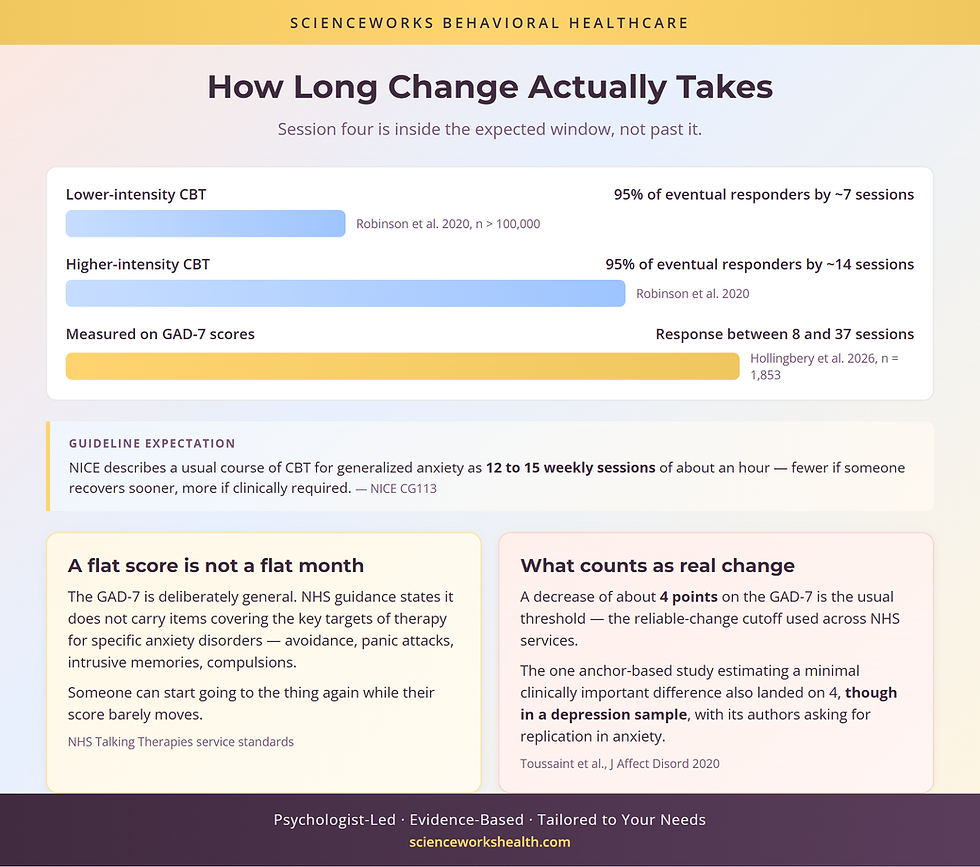
How long change actually takes
The misconception: "If I'm not clearly better after a month, this isn't the right treatment."
Here is what routine-care data show. Across more than 100,000 patients in stepped-care services, among people who eventually responded, 95% had done so within about 7 sessions of lower-intensity CBT and 14 sessions of higher-intensity CBT [1]. Anxiety presentations needing higher-intensity work — social anxiety, PTSD, OCD — tended to need the longer courses [1].
A more recent analysis using GAD-7 scores specifically, in 1,853 outpatients, found response occurring between roughly 8 and 30 sessions in lower-intensity CBT and 15 and 37 sessions in higher-intensity CBT, for 50% to 95% of patients respectively. The authors describe those as check-in points for reviewing a treatment plan [2]. NICE guidance describes a usual course for generalized anxiety as 12 to 15 weekly sessions of about an hour, fewer if someone recovers sooner and more if clinically required [3].
Put those together and session four is comfortably inside the window where change is still expected, not past it. That is not a reason to stay silent about feeling stuck — it is a reason not to conclude anything final yet. If you are still early and want a sense of what the work should feel like, we have written separately about how to prepare for CBT for anxiety.
Change also is not linear, and it does not follow one shape. When researchers modeled session-by-session anxiety scores in 256 people, five distinct trajectory classes fit the data better than any single curve: several improvement patterns differing in starting severity and pace, plus two smaller groups — one with minimal gains and one whose scores stayed high throughout [17]. Roughly 70% fell into an improvement class, which also means a substantial minority did not. Separately, some people experience sudden gains, single between-session jumps that carry a moderate effect on final outcome [4] — though these appear at significantly higher rates in depression than in anxiety [4], so it is a real phenomenon rather than something to count on.
Why a flat score is not a flat month
The misconception: "My score hasn't moved, so nothing is changing."
The GAD-7 is seven items scored 0 to 3, for a total of 0 to 21, with 10 the usual cut point for probable generalized anxiety [5]. It is an excellent brief screener. It is also, by design, general — and NHS clinical guidance is explicit that it "does not have items covering the key problems that should be targeted in therapy" for specific anxiety disorders, publishing a table of what it misses: avoidance of feared situations, panic attacks, intrusive memories, obsessions and compulsions [6].
So someone with social anxiety can start accepting invitations, going to the thing, staying an hour longer — real change in exactly the domain that matters — while their GAD-7 barely moves, because the instrument was never measuring that. This is why services pair it with disorder-specific measures and with a functional measure like the Work and Social Adjustment Scale, which asks how much the problem interferes with work, home, social and private life, and which is sensitive to treatment-related change [6][7].
On the number itself: a change of about 4 points on the GAD-7 is the usual threshold for meaningful change. NHS services define reliable change that way [6], and the one anchor-based study estimating a minimal clinically important difference also arrived at 4 — though that study was conducted in a chronic depression sample, and its authors explicitly asked for replication in anxiety-specific populations [8]. Two different methods landing on the same number is reassuring; it is not the same as a number derived in people like you.
📊 Key takeaway: Ask what is being measured, not just what the number did. Function often moves before symptom scores do.

Two people, both stuck, for different reasons
Consider someone twelve sessions into CBT for social anxiety whose GAD-7 has barely shifted. Looking closely at the last month, she has been to two work events she would previously have skipped, and she stayed at both. She also spent each of them near the door, scanning for someone she knew, rehearsing sentences before saying them, and leaving before the part she dreaded. The exposures happened. The learning that exposures are supposed to produce did not, because the safety behaviors were still doing their job. Nothing about her diagnosis is wrong and nothing about the treatment is wrong; the dose of genuinely unhedged exposure has been close to zero, and that is a fixable, specific problem.
Now consider someone six sessions into treatment for panic who is doing the work carefully and going backwards anyway. His sleep collapsed a month ago, he has stopped seeing friends, and he describes the day as something to get through. His panic symptoms are not the thing that changed — his mood is. Depression that emerges or deepens during anxiety treatment is one of the more common reasons a course stalls, is associated with poorer outcomes across treatment approaches, and is precisely why services administer a depression measure such as the PHQ-9 alongside the anxiety one at every session rather than only at intake [6][9]. If that is what is happening, adjusting the exposure plan will not touch it.
Two stalls, two entirely different next moves. This is why "it's not working" is a starting point for a conversation, not a conclusion.
What actually makes a course of therapy stall
The misconception: "A plateau means I was misdiagnosed."
Diagnosis is on the list. It is not near the top of it. When NICE describes a specialist review for someone whose anxiety has not responded, diagnosis is one of nine domains, alongside symptom duration and severity, functional impairment, co-occurring conditions, risk of self-harm and self-neglect, home environment, community support, family relationships, and — notably — a formal review of current and past treatments, including adherence to prescribed medication and the fidelity of previous psychological interventions [3].
That last item deserves attention, because it names something patients rarely consider: whether the therapy delivered was the therapy intended. There is experimental evidence here. When therapists were induced to hold negative beliefs about exposure therapy, they delivered it more cautiously — less ambitious hierarchies, less anxiety-provoking tasks, active attempts to minimise client distress during the exposure itself [10]. A course of exposure-based work delivered gently enough to be comfortable may not be delivering the active ingredient at all. That is a therapist-side variable, not a patient-side one, and it is a legitimate thing to ask about.
There is a mirror-image version of this on the patient side, and it is worth naming. The misconception: "Exposure makes me feel worse, so it must be harming me." In a study of women receiving imaginal exposure for chronic PTSD, only a minority showed reliable symptom exacerbation; those who did benefited from treatment comparably to everyone else, and exacerbation was unrelated to dropping out [18]. Discomfort during exposure is not a warning light. But quietly softening the work to avoid it — on either side of the room — is how a course loses its active ingredient.
Service-level data point the same direction: recovery rates across services vary with the average number of sessions delivered, the rate at which people are stepped up to higher-intensity treatment, and the proportion of experienced staff [9]. Plenty of non-diagnostic explanations exist before you get to "the label is wrong."
🔍 Key takeaway: Before questioning the diagnosis, ask about dose, fidelity, and what else has changed in your life. Those explain more stalls.
What the evidence says comes next
NICE sets out a decision tree that is worth knowing, because it makes the next moves concrete rather than mysterious. Where anxiety has not responded to a full course of high-intensity psychological therapy, the guidance is to offer a drug treatment. Where it has not responded to drug treatment, the guidance is to offer either a psychological intervention or a different drug. Where it has partially responded to medication, the guidance is to consider adding psychological therapy alongside it [3]. Referral for specialist review is considered where severe anxiety with marked functional impairment coincides with risk, significant comorbidity, self-neglect, or an inadequate response [3].
Three honest caveats travel with all of that.
First, medication decisions belong with a prescriber. As a clinical psychologist I can name a partial or non-response, recommend referral, and keep the psychological work going; I cannot select, dose, or switch a medication, and no psychologist should imply otherwise.
Second, combination and augmentation strategies are weakly evidenced. NICE says so directly — evidence for the effectiveness of combination treatments is lacking, side effects and interactions are more likely, and such approaches should be undertaken only by practitioners with expertise in treatment-refractory anxiety [3].
Third, switching approach is reasonable but not proven as a rescue. Sometimes the question is the clinician rather than the modality, and which type of therapist fits your anxiety is a separate question worth asking on its own terms. On modality: acceptance and commitment therapy performs comparably to CBT in head-to-head trials for mixed anxiety disorders and for social anxiety [11][12], which is why ACT is a legitimate alternative rather than a consolation prize. But those trials enrolled unselected patients. No trial I am aware of has randomized people who failed CBT to a different modality, so anyone telling you a switch will work is going beyond the evidence. It is also worth noting that guidelines themselves vary substantially in quality and recommendations across countries [13] — NICE is a well-made guideline, not a global consensus.
How to raise it with your clinician
This conversation is not a complaint or a sign of a failing alliance — it is part of how good treatment works. NICE asks practitioners to use routine outcome measures and to ensure the person is involved in reviewing whether the treatment is working [3]. NHS service standards describe supervision as the place to review outcome data, "identify points when the person becomes 'stuck,'" and plan what changes [6].
There is evidence that saying it helps. A meta-analysis of routine outcome monitoring across 24 studies found that giving therapists progress feedback reduced deterioration rates and nearly doubled rates of clinically significant improvement — with the benefit concentrated specifically among clients on track for a poor outcome [14]. The people for whom raising it matters most are the people reading this paragraph.
Some questions that make the review concrete:
"What are we measuring, and what has it done since I started?"
"Where would you expect me to be by now, and what would tell you this isn't working?"
"Are we doing enough exposure, and am I doing anything during it that lets me avoid the hard part?"
"Has anything else changed — my mood, my sleep, my drinking — that we should be treating alongside this?"
"If we give this four more sessions and nothing shifts, what is the plan after that?"
That last question is the useful one. A stall with a review date attached is a different experience from a stall with no end in sight, and it is a reasonable thing to ask for.
🗣️ Key takeaway: Saying "I think I'm stuck" is clinically useful information, not criticism. The evidence says therapists do better when they hear it.
When a stall deserves faster attention
Most stalls are worth patience and a structured review. Some are worth a quicker conversation, and it helps to know which.
Deterioration during treatment is uncommon but real and it is actively tracked — in a cohort of more than 19,000 people, about 6.6% reliably deteriorated over a course of therapy [9]. That it has a measured rate means it is expected, watched for, and something clinicians act on. Guidelines describe faster escalation where severe anxiety with marked functional impairment coincides with risk of self-harm, significant comorbidity such as substance use, or self-neglect [3].
Practically: if your symptoms are worsening rather than staying flat, if your mood has dropped, if you have started using alcohol or something else to get through the day, or if you are having thoughts of hurting yourself, make the call sooner rather than waiting for your next appointment. None of those means treatment has failed. They mean the plan needs to change, and the sooner your clinician knows, the sooner it can.
If you are in immediate crisis, contact 988 (the Suicide and Crisis Lifeline) or your local emergency services.
A way to think about your own next step
If your scores are flat but you are doing things you could not do three months ago, the treatment is likely working and the instrument is not capturing it — say that out loud and ask what else can be measured.
If nothing has moved on either axis and you are inside the expected window — under 7 sessions of low-intensity or 14 of high-intensity work — the honest answer is usually more of the same, done more ambitiously, with a review date set.
If nothing has moved and you are past that window, it is time for a structured review rather than another month of the same. And if something has actively gotten worse, that conversation happens now rather than at the review.
None of these is a decision to make alone, which is rather the point. If you would like to talk through where you have landed with someone who works with anxiety and related conditions every day, our team is available to talk — including if what you need is a second opinion on treatment you are receiving somewhere else.
Anxiety running the show?
Evidence-based therapy can turn the volume down on anxiety — a clinician can help you find the approach that fits your life rather than a one-size-fits-all plan.
Frequently Asked Questions
How long should I give CBT for anxiety before deciding it isn't working?
Longer than most people expect. In routine care, 95% of those who eventually responded did so within about 7 sessions of lower-intensity CBT and 14 sessions of higher-intensity CBT. A study using GAD-7 scores found response occurring between roughly 8 and 30 sessions depending on intensity. NICE describes a usual course for generalized anxiety as 12 to 15 weekly sessions. Session four is well inside the expected window, not outside it.
Does hitting a plateau mean I was misdiagnosed?
Not usually, and diagnosis is only one of the things a clinician reviews. NICE's specialist review looks at symptom duration and severity, functional impairment, co-occurring conditions, risk, the fidelity and adequacy of previous treatment, home environment, and social support. Several of those are far more common explanations for a stall than a wrong diagnosis. It is a fair question to raise with your clinician, just not the first place to look.
What counts as a meaningful change on the GAD-7?
A change of about 4 points is the usual threshold. NHS services define reliable change on the GAD-7 as a decrease of at least 4 points, and the one anchor-based study estimating a minimal clinically important difference also landed on 4 — though that study was conducted in a chronic depression sample rather than an anxiety-specific one, and its authors called for replication in anxiety populations.
Should I switch therapists, change approach, or add medication?
That depends on why the stall is happening, which is what a structured review with your clinician is for. Guidelines describe adding medication after a full course of psychological therapy has not produced a response, adding psychological therapy where medication has produced only partial response, and referral for specialist review where impairment is severe. Any medication decision belongs with a prescriber, not a psychologist.
Is it normal to feel worse during exposure work?
Some discomfort during exposure is expected and is not evidence of harm. In a study of women receiving imaginal exposure for chronic PTSD, only a minority showed reliable symptom exacerbation, those who did benefited from treatment comparably, and exacerbation was unrelated to dropping out. Tell your clinician what you are experiencing rather than absorbing it quietly — pacing is adjustable, and that is a normal part of the work.
About the Author
Dr. Kiesa Kelly is a licensed clinical psychologist and the founder of ScienceWorks Behavioral Healthcare, with more than 20 years of experience in psychological assessment and evidence-based treatment. Her clinical training includes work at the University of Chicago, Vanderbilt University, and the University of Wisconsin, and her practice centers on anxiety, OCD, trauma, and neurodevelopmental assessment in adolescents and adults.
Much of her work involves people who have already had treatment elsewhere and want to understand why it did not go the way they hoped. That question — what is actually maintaining this, and what would change it — is the one this article is built around.
References
1. Robinson L, Kellett S, Delgadillo J. Dose-response patterns in low and high intensity cognitive behavioral therapy for common mental health problems. Depress Anxiety. 2020;37(3):285-294. https://doi.org/10.1002/da.22999
2. Hollingbery T, Bryan M, Giovannetti O, et al. Evaluating dose response of cognitive behavioural therapy using outpatient electronic medical record data: an observational study. Can J Psychiatry. 2026;71(4):297-306. https://doi.org/10.1177/07067437251409885
3. National Institute for Health and Care Excellence. Generalised anxiety disorder and panic disorder in adults: management (CG113). https://www.nice.org.uk/guidance/cg113/chapter/Recommendations
4. Silverstone UR, Roberge P, Provencher MD, Norton PJ. An examination of sudden gain prevalence across cognitive-behavioural therapy for anxiety and depressive disorders: a quantitative analysis and meta-analytic review. J Anxiety Disord. 2023;95:102697. https://doi.org/10.1016/j.janxdis.2023.102697
5. Spitzer RL, Kroenke K, Williams JBW, Löwe B. A brief measure for assessing generalized anxiety disorder: the GAD-7. Arch Intern Med. 2006;166(10):1092-1097. https://doi.org/10.1001/archinte.166.10.1092
6. NHS England. NHS Talking Therapies for anxiety and depression: Service standards. https://www.england.nhs.uk/mental-health/adults/nhs-talking-therapies/service-standards/
7. Mundt JC, Marks IM, Shear MK, Greist JH. The Work and Social Adjustment Scale: a simple measure of impairment in functioning. Br J Psychiatry. 2002;180:461-464. https://doi.org/10.1192/bjp.180.5.461
8. Toussaint A, Hüsing P, Gumz A, et al. Sensitivity to change and minimal clinically important difference of the 7-item Generalized Anxiety Disorder Questionnaire (GAD-7). J Affect Disord. 2020;265:395-401. https://doi.org/10.1016/j.jad.2020.01.032
9. Gyani A, Shafran R, Layard R, Clark DM. Enhancing recovery rates: lessons from year one of IAPT. Behav Res Ther. 2013;51(9):597-606. https://doi.org/10.1016/j.brat.2013.06.004
10. Farrell NR, Deacon BJ, Kemp JJ, Dixon LJ, Sy JT. Do negative beliefs about exposure therapy cause its suboptimal delivery? An experimental investigation. J Anxiety Disord. 2013;27(8):763-771. https://doi.org/10.1016/j.janxdis.2013.03.007
11. Arch JJ, Eifert GH, Davies C, et al. Randomized clinical trial of cognitive behavioral therapy (CBT) versus acceptance and commitment therapy (ACT) for mixed anxiety disorders. J Consult Clin Psychol. 2012;80(5):750-765. https://doi.org/10.1037/a0028310
12. Craske MG, Niles AN, Burklund LJ, et al. Randomized controlled trial of cognitive behavioral therapy and acceptance and commitment therapy for social phobia: outcomes and moderators. J Consult Clin Psychol. 2014;82(6):1034-1048. https://doi.org/10.1037/a0037212
13. Huang C, Liu X, Liu Y, et al. Psychosocial interventions for anxiety disorders in adults: evidence mapping and guideline appraisal. Front Psychiatry. 2025;16:1677705. https://doi.org/10.3389/fpsyt.2025.1677705
14. Lambert MJ, Whipple JL, Kleinstäuber M. Collecting and delivering progress feedback: a meta-analysis of routine outcome monitoring. Psychotherapy (Chic). 2018;55(4):520-537. https://doi.org/10.1037/pst0000167
15. Loerinc AG, Meuret AE, Twohig MP, et al. Response rates for CBT for anxiety disorders: need for standardized criteria. Clin Psychol Rev. 2015;42:72-82. https://doi.org/10.1016/j.cpr.2015.08.004
16. Springer KS, Levy HC, Tolin DF. Remission in CBT for adult anxiety disorders: a meta-analysis. Clin Psychol Rev. 2018;61:1-8. https://doi.org/10.1016/j.cpr.2018.03.002
17. Cumpanasoiu DC, Enrique A, Palacios JE, et al. Trajectories of symptoms in digital interventions for depression and anxiety using routine outcome monitoring data: secondary analysis study. JMIR Mhealth Uhealth. 2023;11:e41815. https://doi.org/10.2196/41815
18. Foa EB, Zoellner LA, Feeny NC, Hembree EA, Alvarez-Conrad J. Does imaginal exposure exacerbate PTSD symptoms? J Consult Clin Psychol. 2002;70(4):1022-1028. https://doi.org/10.1037/0022-006X.70.4.1022
Disclaimer
This article is for informational purposes only and is not a substitute for individual clinical assessment, diagnosis, or treatment. It does not constitute medical advice, and reading it does not create a clinician-patient relationship. Treatment decisions — including any decision about medication — should be made with your own clinicians, who know your history. If you are in crisis or thinking about harming yourself, contact 988 (the Suicide and Crisis Lifeline) or your local emergency services.