
Diabetes Distress vs. Depression: Why the Difference Changes Treatment
- Kiesa Kelly

- 14 hours ago
- 11 min read
Last reviewed: 08/08/2026
Reviewed by: Dr. Kiesa Kelly
If you live with diabetes and you have been feeling flat, worn down, or quietly hopeless, someone has probably suggested you might be depressed. That may be right. It may also be something else with a different name, a different cause, and a different answer — and the two get mixed up constantly, including in clinical settings.
The distinction between diabetes distress and major depressive disorder is not academic. It changes what gets recommended, who you get referred to, and whether the support you receive actually targets what is wearing you down.
In this article, you'll learn:
What diabetes distress is, and why it is not a mental illness
How major depressive disorder is defined and diagnosed
Which symptoms overlap, and which ones tell the two apart
What clinicians screen for, and why one questionnaire is not enough
How the distinction changes the treatment you should expect
The short answer: how to tell diabetes distress from depression
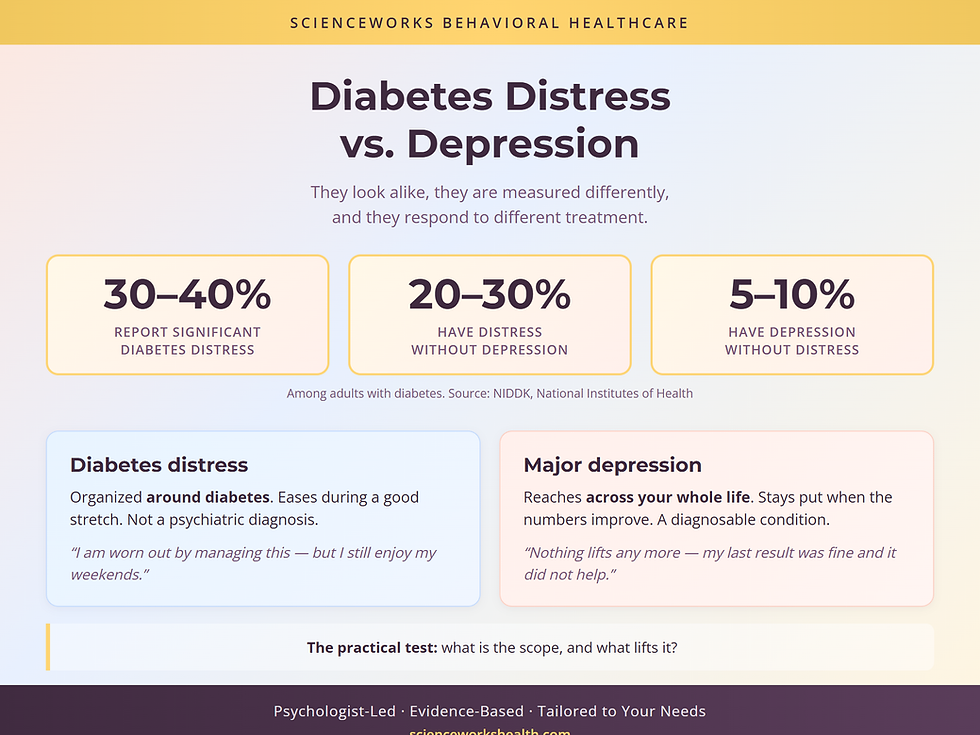
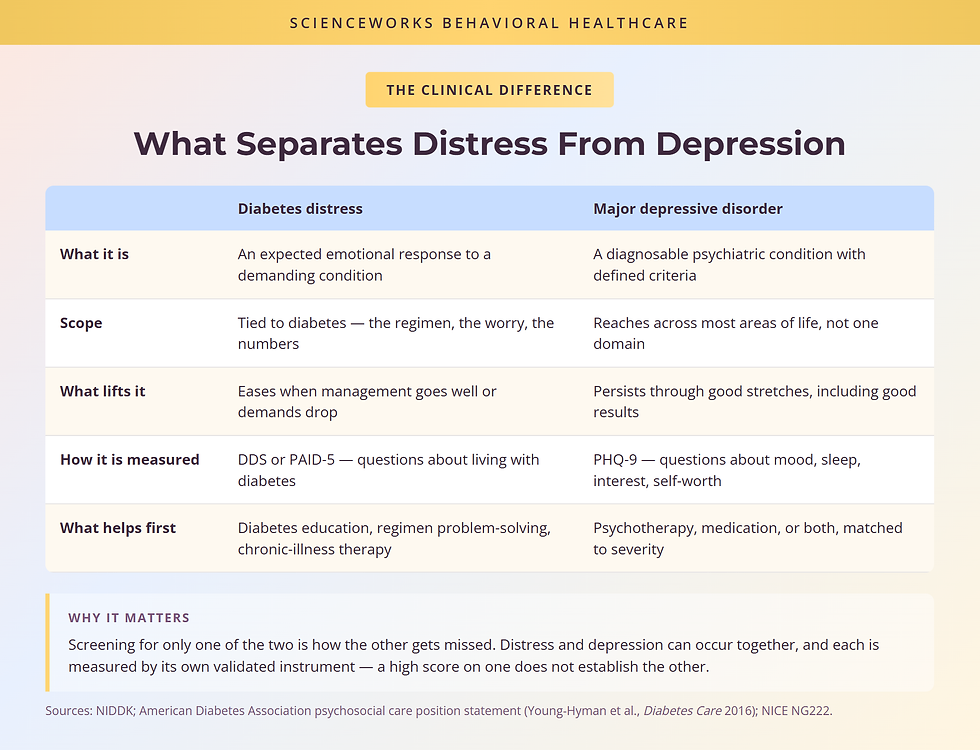
Diabetes distress is an expected emotional response to a demanding condition. It is tied to diabetes specifically — the worry about complications, the burden of constant decisions, the frustration of doing everything right and watching the numbers refuse to cooperate. It is common, it is not a psychiatric diagnosis, and it tends to persist as long as the demands that produce it persist [1].
Major depressive disorder is a diagnosable condition with defined criteria. It is not limited to one area of life, it does not lift when the diabetes is going well, and it carries features — like a pervasive loss of interest in things unrelated to diabetes — that distress does not [2].
The practical test most clinicians reach for first: what is the scope, and what lifts it? If the low mood is organized around diabetes and eases when a good stretch arrives, that points toward distress. If it covers everything and stays put through a good stretch, that points toward depression. Before you go further, it is worth knowing that a PHQ-9 depression screener measures only one side of this picture.
🔍 Key takeaway: Diabetes distress is organized around diabetes and moves with it. Depression is broader and more stubborn, and it does not lift just because your numbers improved.
What each one actually is
Diabetes distress: an expected response to a demanding condition
Diabetes asks for a stream of decisions that never stops. Somewhere between 30 and 40 percent of adults with diabetes report significant distress over time — roughly double the share who screen positive for clinical depression [1]. In a recent national sample of US adults with diagnosed diabetes, about 24 percent reported moderate diabetes distress and roughly 7 percent reported severe distress [3]. Distress runs higher still for people managing diabetes alongside other long-term conditions [12].
This is a normal reaction to an abnormal workload, not a failure of coping. The instruments built to measure it — the Diabetes Distress Scale and the shorter PAID-5 — ask about problems with diabetes: feeling overwhelmed by the regimen, worrying about the future, feeling unsupported by the people around you, feeling angry or defeated about the condition itself [4][5].
Here is what it often looks like. You are three years in, you have the routine down, and you are exhausted by it in a way you cannot explain to anyone who does not live it. You check, you dose, you plan meals around numbers, and you still get a reading that makes no sense. You start skipping the occasional check — not because you stopped caring, but because looking feels worse than not looking. You still enjoy your weekends, still laugh with friends, still want to see people. It is specifically the diabetes that has gone gray.
Or: your last A1C came back higher than you expected after a genuinely careful three months. You leave the appointment feeling like a failure, dreading the next one, and quietly certain that nothing you do matters. That feeling is sharp for two weeks, then softens. It is real, it deserves attention, and it is not the same thing as a depressive episode.
The distinguishing pattern: diabetes distress costs are condition-specific and demand-based — they cluster around the work of management and rise and fall with it.
Major depressive disorder: a DSM-5 diagnosis with its own criteria
Major depressive disorder requires a defined symptom threshold sustained over at least two weeks, including either persistently low mood or a loss of interest and pleasure, alongside changes in sleep, appetite, energy, concentration, self-worth, or thoughts of death [13]. Crucially, those symptoms are not confined to one domain of life.
What that looks like: the things that used to reliably lift you — a friend calling, a show you loved, a walk you always enjoyed — have stopped working. You are sleeping badly and waking early. You are not just tired of diabetes; you are tired of most things, and you have started to think the people around you would manage fine without you. Your last A1C was actually fine, and it did not help.
Or: you have been flat for two months. You cannot point to a trigger. Work has slipped, you have stopped answering texts, and food has lost its appeal entirely. Diabetes is one item on a long list of things you cannot make yourself care about.
The distinguishing pattern: depression costs are pervasive and self-directed — they reach across domains and attach to your sense of who you are, not just to a condition you manage.
🧭 Key takeaway: Distress asks "why is this condition so hard?" Depression asks "why is everything so hard, and what is wrong with me?"
Why the two get confused
Misconception: if you have diabetes and you feel bad, it must be depression. In reality, distress is the more common finding. Depression occurs without distress in roughly 5 to 10 percent of people with diabetes, while distress alone affects something closer to 20 to 30 percent [1]. Adults with diabetes do carry a higher rate of clinical depression than adults without it, which is exactly why depression screening belongs in diabetes care [11] — but reaching for that label first means the more likely explanation gets skipped.
Misconception: diabetes distress is just a softer word for depression. They are separate constructs, measured by different instruments, with different responses to treatment. A person can score high on a diabetes distress measure and well below threshold on a depression measure, and that combination is clinically meaningful, not a rounding error [6][10].
Misconception: because distress is "normal," it does not need attention. Normal does not mean harmless. Elevated distress is consistently associated with worse self-management and worse glycemic outcomes, which is precisely why professional guidance recommends routine assessment rather than watchful waiting [7].
Misconception: you can only have one of them. You can have both, and a meaningful share of people do. That is one of the reasons a single questionnaire is not enough — the two need to be measured separately before anyone decides what to treat.
🤝 Key takeaway: Distress and depression overlap without being the same. Ruling one in does not rule the other out.
How a clinician sorts it out
What screening actually looks at
A depression screener and a distress screener ask fundamentally different questions. The PHQ-9 asks about mood, interest, sleep, appetite, energy, concentration, and self-worth over the past two weeks [8]. The DDS and PAID-5 ask about your relationship with diabetes specifically — the regimen, the worry, the support, the sense of defeat [4][5]. The PAID-5 in particular was designed as a rapid screen and performs well at flagging diabetes-related emotional distress in a few questions [5].
Running only the depression screener is how distress gets misread as depression. Running only the distress screener is how a genuine depressive episode gets missed. Good practice runs both, then talks through what the scores actually mean — which is also why a screener is a starting point rather than an answer. Our psychological assessment process is built around that gap between a score and a picture. Where anxiety is also in play — common when complications are a live worry — a GAD-7 anxiety screener adds a third angle, and a broader measure like PROMIS-29 can show how much of your daily functioning is affected.
Why getting the distinction right changes treatment
This is the part that matters most. If the picture is primarily diabetes distress, the useful moves are aimed at the condition and its demands: diabetes education, problem-solving around the specific parts of the regimen that feel unmanageable, renegotiating an unrealistic plan with your medical team, and structured therapy focused on living with a chronic condition [9]. Antidepressant medication is not the first-line answer for distress, and starting there can leave someone medicated and still overwhelmed by the same unchanged workload.
If the picture is major depressive disorder, the evidence base points toward established depression treatment — psychotherapy, medication, or both, matched to severity [2]. And when depression has not responded to first-line treatment, that is its own clinical question with its own pathway, which we cover in our guide to treatment-resistant depression.
The broader skill set for living alongside a long-term condition — grief, acceptance, adjusting expectations, rebuilding a life that the illness has narrowed — is the same one that helps whether or not depression is in the picture. That work is what acceptance and commitment therapy for chronic illness is built around, and it sits alongside the general adjustment to a chronic-illness diagnosis that most people go through after any significant diagnosis.
⚖️ Key takeaway: Treating distress as depression risks medicating a workload problem. Treating depression as distress risks leaving a treatable illness untreated.
Which path fits your situation
A rough heuristic you can apply before you speak to anyone:
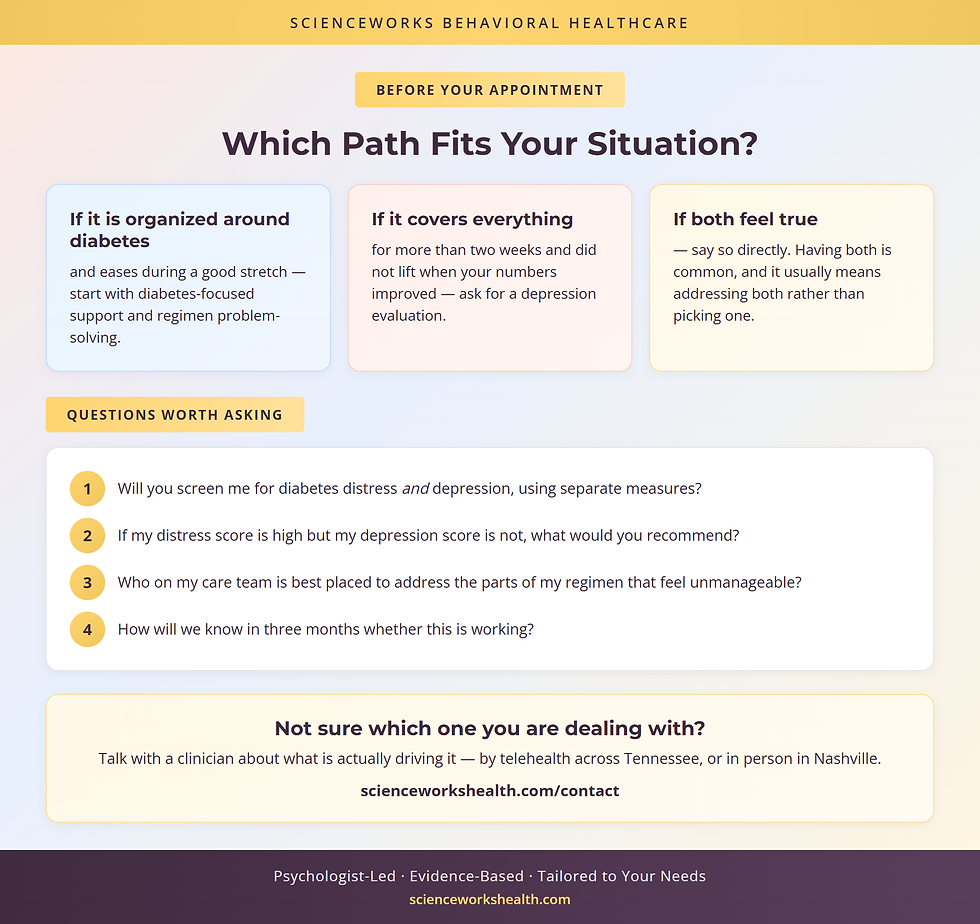
If the heaviness is organized around diabetes and eases during a good stretch, start with diabetes-focused support — education, regimen problem-solving, and therapy aimed at chronic-illness demands.
If the heaviness covers everything, has lasted more than two weeks, and did not lift when your numbers improved, ask for a depression evaluation.
If both descriptions feel accurate, say so directly. That combination is common and it changes the plan — it usually means addressing both rather than picking one.
If you are having thoughts of not wanting to be here, treat that as urgent regardless of which label fits. In the US you can call or text 988 at any time.
Questions worth asking a provider before you commit to a plan:
1. Will you screen me for diabetes distress and depression, using separate measures?
2. If my distress score is high but my depression score is not, what would you recommend — and would that recommendation involve medication?
3. Who on my care team is best placed to address the parts of my regimen that feel unmanageable?
4. If I start therapy, will it be focused on diabetes specifically, or on mood in general — and which do you think fits my picture?
5. How will we know in three months whether this is working?
The therapy we provide for people managing long-term conditions is built around that last question in particular — a plan you can actually evaluate, rather than an open-ended arrangement. If you want the broader picture of how psychological care fits alongside medical care for a chronic condition, our overview of health psychology for chronic illness covers the model.
🗓️ Key takeaway: Ask for both screens by name. The single most useful thing you can do in that appointment is make sure distress is measured, not assumed.
Next step: getting support
Living with diabetes is a long job, and the emotional part of it is real work whether or not it ever meets criteria for a diagnosis. Getting the name right is not about labels — it is about making sure the help you get is aimed at the thing that is actually wearing you down.
Feeling weighed down lately?
Depression is treatable, and the right support makes a difference — a clinician can help you understand what's going on and what would help you feel like yourself again.
Frequently Asked Questions
Is diabetes distress a mental illness?
No. Diabetes distress is not a psychiatric diagnosis and does not appear in the DSM-5. It is the emotional weight of managing a demanding, unrelenting condition — the worry about complications, the fatigue of constant decisions, the frustration when numbers do not cooperate. Naming it that way matters, because it points toward diabetes-focused support rather than treatment for a mental illness you may not have.
Can diabetes actually cause depression, or is it just the stress of managing it?
Both happen, and they are not the same thing. Adults with diabetes do have higher rates of clinical depression than adults without it, so depression is a real risk and deserves screening. But a large share of what looks like depression in diabetes is diabetes distress — a response tied specifically to the condition. The distinction is worth making carefully, because the two respond to different things.
How is diabetes distress treated if it is not depression?
Diabetes distress usually responds to support aimed at the condition itself rather than at a mood disorder. That can mean diabetes education, problem-solving around the parts of self-management that feel unmanageable, adjusting an unrealistic regimen with your medical team, and structured therapy focused on the demands of chronic illness. Antidepressants are not the first-line answer when distress is what is actually driving the picture.
What does a high score on a diabetes distress screener actually mean?
It means the emotional load of managing diabetes has reached a level worth addressing — not that you have a mental health diagnosis. Screeners like the DDS and the PAID-5 are structured self-report tools, not diagnostic tests. A high score is a signal to have a fuller conversation, ideally one that also screens for depression separately, since the two can occur together.
Does telehealth therapy work for the emotional side of diabetes?
Yes, for most people. The work of managing diabetes distress is largely conversational — problem-solving, adjusting expectations, and rebuilding a routine that fits your life — and that translates well to video. It also removes a real barrier, since adding another in-person appointment to a schedule already full of medical visits is often part of what is wearing you down in the first place.
About the Author
Dr. Kiesa Kelly is a licensed clinical psychologist and the founder of ScienceWorks Behavioral Healthcare. Her background includes more than 20 years of experience in psychological assessment and evidence-based treatment, with clinical training at the University of Chicago, Vanderbilt University, and the University of Wisconsin, and NIH-funded research training earlier in her career.
Her work centers on careful differential assessment — distinguishing conditions that present similarly but call for different treatment. That includes the distinction covered here, where an emotional response to a demanding medical condition is easily read as a mood disorder, and where getting the distinction right meaningfully changes what a person is offered.
References
1. National Institute of Diabetes and Digestive and Kidney Diseases. Diabetes Distress and Depression. https://www.niddk.nih.gov/health-information/professionals/diabetes-discoveries-practice/diabetes-distress-and-depression
2. National Institute for Health and Care Excellence. Depression in adults: treatment and management. NICE guideline NG222 — recognition, assessment, severity thresholds, and matched-care treatment. Published 2022; last reviewed 2026. https://www.nice.org.uk/guidance/ng222
3. Diabetes Distress Among US Adults With Diagnosed Diabetes, 2021. https://pmc.ncbi.nlm.nih.gov/articles/PMC11870017/
4. Polonsky WH, Fisher L, Earles J, et al. Assessing psychosocial distress in diabetes: development of the Diabetes Distress Scale. Diabetes Care. 2005;28(3):626-631. https://pubmed.ncbi.nlm.nih.gov/15735199/
5. McGuire BE, Morrison TG, Hermanns N, et al. Short-form measures of diabetes-related emotional distress: the Problem Areas in Diabetes Scale (PAID)-5 and PAID-1. Diabetologia. 2010;53(1):66-69. https://link.springer.com/article/10.1007/s00125-009-1559-5
6. Fisher L, Hessler DM, Polonsky WH, Mullan J. When is diabetes distress clinically meaningful? Diabetes Care. 2012;35(2):259-264. https://pubmed.ncbi.nlm.nih.gov/22228744/
7. Young-Hyman D, de Groot M, Hill-Briggs F, et al. Psychosocial Care for People With Diabetes: A Position Statement of the American Diabetes Association. Diabetes Care. 2016;39(12):2126-2140. https://diabetesjournals.org/care/article/39/12/2126/31378/Psychosocial-Care-for-People-With-Diabetes-A
8. Kroenke K, Spitzer RL, Williams JB. The PHQ-9: validity of a brief depression severity measure. J Gen Intern Med. 2001;16(9):606-613. https://onlinelibrary.wiley.com/doi/full/10.1046/j.1525-1497.2001.016009606.x
9. Fisher L, Polonsky WH, Hessler D. Addressing diabetes distress in clinical care: a practical guide. Diabetic Medicine. 2019;36(7):803-812. https://onlinelibrary.wiley.com/doi/abs/10.1111/dme.13967
10. Is It Distress, Depression, or Both? Exploring Differences in the Diabetes Distress Scale and the Patient Health Questionnaire in a Diabetes Specialty Clinic. Clinical Diabetes. 2019;37(2):124-130. https://diabetesjournals.org/clinical/article/37/2/124/35420/Is-It-Distress-Depression-or-Both-Exploring
11. State-Specific Prevalence of Depression Among Adults With and Without Diabetes — United States, 2011-2019. Preventing Chronic Disease. 2023. https://www.cdc.gov/pcd/issues/2023/22_0407.htm
12. Diabetes Distress in Adults with Type 2 Diabetes and Multimorbidity: A Scoping Review. 2025. https://pmc.ncbi.nlm.nih.gov/articles/PMC12922951/
13. National Institute of Mental Health. Major Depression — DSM-5 definition of a major depressive episode. https://www.nimh.nih.gov/health/statistics/major-depression
Disclaimer
This article is for informational purposes only and is not a substitute for mental health or medical diagnosis or treatment. Reading it does not create a therapist-client relationship with ScienceWorks Behavioral Healthcare. Diabetes management decisions, including any changes to medication or regimen, belong with your medical provider. If you are in crisis or may be at risk of harm to yourself or others, call 911, go to your nearest emergency room, or call or text 988 (US).