
Executive Function Coaching Cost: Session & Monthly Rates

Updated: Sep 27
Last reviewed: 06/22/2026
Reviewed by: Dr. Kiesa Kelly
If you have been researching executive function coaching cost, you have probably noticed the same frustrating pattern: vendor pages quote a price only after a discovery call, the ranges swing wildly, and almost nobody explains why insurance won't pick up the tab. This guide is meant to fix that. We will walk through what coaching actually runs in the current market, what makes one coach cost more than another, and the single most practical lever most people miss — using an FSA or HSA with a Letter of Medical Necessity.
We are a Tennessee behavioral health practice. We are private-pay and out-of-network for therapy and psychological assessment, and we provide superbills and an out-of-network billing platform for services that qualify. Coaching is a different kind of service, and the honest answer about its cost involves some trade-offs worth understanding before you spend anything. For our own executive function coaching, we offer six-month, interest-free payment plans.
In this article, you'll learn:
What executive function and ADHD coaching typically cost per session and per month
What actually drives the price difference between coaches
Why insurance rarely covers coaching when it does cover therapy and assessment
How an FSA or HSA, plus a Letter of Medical Necessity, can offset the cost
How to judge whether coaching is worth it for your situation
A note before the numbers: every figure below is a market range drawn from published provider pricing, not a ScienceWorks price. Use the ranges to set expectations, then confirm exact pricing with whichever provider you choose.
The short answer: what executive function coaching typically costs
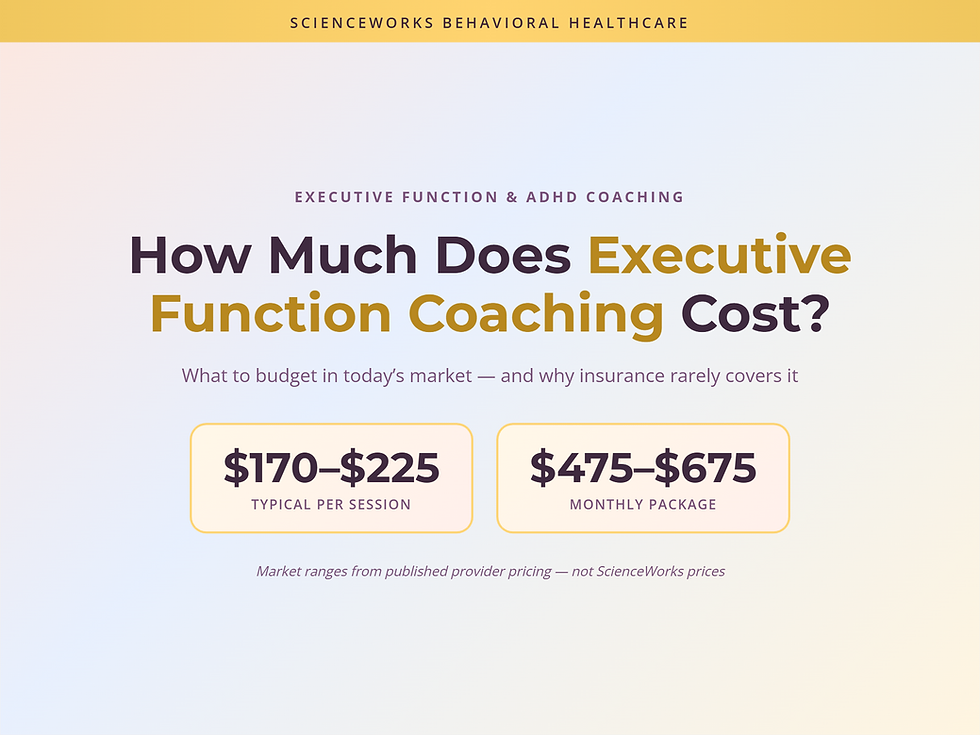
For most adults seeking private executive function or ADHD coaching, the realistic budget lands in two formats: a per-session rate or a monthly package. If you only remember one set of numbers, remember these — individual sessions commonly run $170 to $225, and structured monthly packages commonly run $475 to $675 [1][2].
That said, the broader market is wider than that core band, which is where a lot of the confusion comes from.
Per-session ranges
Across published provider pricing, ADHD and executive function coaching sessions generally fall between roughly $100 and $250, and the gap inside that range is mostly about training and specialization rather than anything arbitrary. One way providers tier it: general, non-specialized life coaches around $75 to $150 per session; certified ADHD coaches around $150 to $250 and up; and specialized executive function coaches, who often hold advanced degrees, around $200 to $350 and up [2]. For people choosing shorter formats, at least one national program starts around $124 for a typical 45-minute session, with discounts for prepaying [3].
A misconception worth clearing up early: the cheapest coach is the best value. Not necessarily. A lower hourly rate can mean more sessions spent on basics, or support that patches a calendar for a week without building the underlying skill. Price and value are not the same number, and the gap between them is usually credentials.
Here is a recognizable scenario. You find a coach charging $90 a session and feel relieved at the savings. The first month goes fine — you set up a planner, you feel motivated. By week six the planner is abandoned, because the coaching addressed what to do but never touched why starting was hard in the first place. You have spent $360 and you are back where you started. A more expensive, ADHD-trained coach might have cost more per hour but spent those same weeks building a system that actually held.
Monthly packages vs. pay-as-you-go
Most providers offer both a per-session option and a monthly package, and the structure matters as much as the rate. Pay-as-you-go gives you flexibility — useful if your schedule is unpredictable or you are testing whether coaching fits at all — but the per-session price is usually higher than the package rate [2]. Monthly packages, often $475 to $675, typically bundle a set number of sessions (frequently three) plus brief check-ins between meetings [1].
Those between-session check-ins are not a frill. For many people with ADHD, the space between sessions is exactly where follow-through either happens or quietly falls apart, so the model that includes contact in that gap often produces steadier results [2].
Key takeaway: 💵 Budget around $170 to $225 per session or $475 to $675 per month for specialized coaching, and treat anything far below that as a signal to check the coach's training, not just celebrate the savings.

Here is a second scenario, on the package side. You sign up for a $575 monthly plan: three sessions plus text check-ins. In week two you hit a wall on a work project. Instead of waiting nine days for the next session, you send a two-line message, your coach reframes the task, and you get moving the same afternoon. By the end of the month the package has effectively cost less per useful contact than three isolated sessions would have, because the cheap part — the check-in — is doing real work.
What drives the price
Once you understand the range, the next question is why two coaches can quote prices that differ by a factor of three. It usually comes down to a few concrete variables.
Coach credentials and clinical background
The biggest driver is training. There is a meaningful difference between a coach who completed a general certification and a coach who holds an advanced clinical degree, a license, and a decade of focused experience with ADHD and executive dysfunction [1]. A misconception here: all coaches are basically interchangeable. They are not. A clinically trained coach can recognize the cognitive and neurological layer beneath a behavior pattern, which means the strategies they build are grounded in how your brain actually works rather than a script that worked for someone else.
If your difficulties might be tangled up with anxiety, depression, or trauma rather than ADHD alone, that clinical literacy matters even more — because a coach who can spot when something else is in the mix can steer you toward an evaluation instead of coaching around a problem that needs a different tool. Tools like the GAD-7 anxiety screener and the PHQ-9 depression screener exist precisely because day-to-day overwhelm has more than one possible source.
Session length, frequency, and between-session support
The rest of the price is structure. Longer or more frequent sessions cost more, obviously, but the less obvious cost driver is everything that happens around the sessions: text or email access, brief mid-week calls, and the level of customization in your plan [2]. A coach who designs an individualized roadmap around your specific strengths and challenges generally charges more than one following a generic template — and for executive function work, that personalization is often where the value lives.
It also helps to know what you are not paying for. Coaching is not therapy. It does not diagnose, treat a mental health condition, or process your history [1]. That boundary is exactly why insurance treats it the way it does, which brings us to the part most pricing pages skip.
Why insurance rarely covers it
This is the section that surprises people, especially when the same practice that offers coaching also bills insurance for therapy and assessment. The short version: insurance typically does not cover executive function or ADHD coaching [1][2]. Here is why that is consistent rather than contradictory.
Coaching is a non-clinical service
Most health plans are built around a medical-necessity model. They reimburse services that fit a medical or mental health treatment framework — psychiatry, psychotherapy, diagnostic assessment — billed under specific procedure codes [2]. Therapy and psychological evaluation fit that model, which is why clients of our specialized therapy and psychological assessments may be able to seek out-of-network reimbursement, depending on their plan.
Coaching does not fit it. Executive function and ADHD coaching are categorized as educational or skills-based support — building practical systems for planning, task initiation, and time management, not diagnosing or providing clinical care [2]. Because it sits outside the medical-treatment framework, insurers generally do not assign it a service code and do not reimburse it. A misconception worth naming: if it helps a diagnosed condition, insurance should cover it. Helpfulness is not the test insurers use; billable medical treatment is. A service can be genuinely valuable and still fall outside what a plan reimburses.
If part of your goal is documentation or accommodations for a diagnosed condition, that is usually an assessment question rather than a coaching one — and assessment is the part insurance is more likely to engage with.
The FSA/HSA workaround and Letter of Medical Necessity
Here is the lever most pricing pages bury. Even though direct insurance reimbursement is uncommon, many people successfully pay for coaching using a Health Savings Account (HSA) or Flexible Spending Account (FSA) [1][2]. These let you spend pre-tax dollars on qualified medical expenses, which can meaningfully lower the effective cost.
The key that unlocks it is a Letter of Medical Necessity (LMN). If a physician, psychologist, or other qualified provider recommends executive function or ADHD coaching as part of a broader plan for a diagnosed condition, they can write a letter explaining why the coaching helps manage that condition [2]. With an LMN on file, many HSA and FSA administrators will accept coaching invoices as a qualified expense [4]. The LMN exists because some expenses are "dual purpose" — potentially personal, potentially medical — and the letter is how a provider documents that the expense was incurred to treat a specific condition [4][5].
Two honest cautions. First, this is not automatic. Requirements vary by plan, and your administrator has the final say, so confirm eligibility before you assume a reimbursement [2][5]. Second, an LMN is a provider's clinical recommendation, not a guarantee — and getting one usually means you have a diagnosis in hand, which loops back to assessment. Keep your invoices and the letter, and verify the specifics with your benefits administrator or tax professional [2].
Key takeaway: 🧾 The FSA/HSA-plus-LMN path is the most reliable way to reduce coaching cost — but it depends on a diagnosis, a provider's letter, and your plan's rules, so confirm all three early rather than after you have paid.

How to judge whether it's worth it
Cost only answers half the question. The other half is whether coaching will do something for you — and that depends heavily on what you actually need.
What good coaching should deliver for the money
Coaching tends to deliver the most for people who are already functioning at a reasonable level but feel like they are working far harder than they should to maintain it [1]. If that describes you, the return is practical: systems that help you start tasks, follow through, and manage time without burning your full mental bandwidth by noon. What coaching will not do is manufacture motivation, provide shortcuts, or replace the underlying work [1].
So here is a usable decision heuristic. If your main struggle is execution — starting, sustaining, and finishing tasks you genuinely care about — coaching is a strong candidate. If your main struggle is uncertainty about why you are struggling — whether it is ADHD, anxiety, autism, or something else — an evaluation is the better first dollar, because coaching around an unconfirmed cause is expensive guessing. And if low mood, persistent worry, or trauma is driving the difficulty, therapy or executive function coaching paired with clinical care may serve you better than coaching alone.
Before you commit your money, it is worth asking a prospective coach a few concrete questions:
Methodology: Do you use a consistent framework, or is it mostly unstructured conversation?
Progress: How do you set goals and measure whether they are being met?
Fit for my profile: What experience do you have with adults whose executive function challenges look like mine?
Pricing transparency: Can you tell me the full cost and package structure up front, without three calls first?
Documentation: If I want to pursue FSA/HSA reimbursement, what invoices or paperwork can you provide?
Transparent pricing and clear answers to those questions are themselves a quality signal. If a provider hides the price until you have invested several calls, that is worth noticing.
A worked example of the decision in action: you are a mid-career professional who performs well in meetings but consistently misses follow-up emails, loses track of time, and cannot start administrative tasks until they are urgent. You suspect ADHD but have never been evaluated. The honest sequence here is not "buy a coaching package." It is: take a screener like the ASRS, consider a structured ADHD evaluation, and then — if coaching is recommended — pursue it with a Letter of Medical Necessity already in hand so an FSA or HSA can help carry the cost. The order saves you money and gives the coaching a confirmed target to work on.
Next step: getting support
The realistic picture is this: executive function coaching usually costs $170 to $225 per session or $475 to $675 a month, insurance rarely covers it because it is a skills-based rather than medical service, and an FSA or HSA paired with a Letter of Medical Necessity is the most dependable way to soften the cost. The single most useful move before spending anything is to get clear on what you are actually solving for — execution, or the question of what is driving the struggle in the first place.
Good ideas, hard to follow through?
Executive-function coaching builds the practical systems — time, task initiation, working memory — that make follow-through possible, without pathologizing how your brain works.
Frequently Asked Questions
Does insurance cover executive function or ADHD coaching?
In most cases, no. Insurance pays for services that fit a medical-necessity model, like therapy or psychological assessment billed under specific codes. Executive function and ADHD coaching are treated as non-clinical, skills-based services, so they usually fall outside that model. The therapy and assessment we bill at ScienceWorks can be different — coaching specifically is the piece insurers rarely reimburse. Always confirm the details with your own plan.
Can I use my HSA or FSA for ADHD coaching?
Sometimes, with documentation. Many people use Health Savings Account (HSA) or Flexible Spending Account (FSA) funds for ADHD or executive function coaching when a qualified provider writes a Letter of Medical Necessity tying the coaching to a diagnosed condition. Approval is not guaranteed and rules vary by plan, so confirm eligibility with your HSA or FSA administrator before you commit. Keep your invoices and the letter for your records.
How much does an ADHD coach cost per hour?
Most private ADHD and executive function coaching runs roughly $100 to $250 per session, with specialized or clinically trained coaches often at the higher end. Some providers list specific rates near $170 to $225 per session, and at least one program starts around $124 for a typical 45-minute session. General life coaches without ADHD-specific training tend to charge less, but they may also offer less targeted help.
Is ADHD coaching worth the money?
It depends on fit and what you need. Coaching tends to help most when you are already functioning but spending far too much energy to keep up, and when you want practical systems for planning, task initiation, and follow-through. It is not therapy and not a diagnosis. If you are unsure whether your difficulties are ADHD, anxiety, or something else, an evaluation may be the more useful first step. A consultation can help you decide.
What is the difference between ADHD coaching and therapy?
Coaching builds practical, forward-looking systems for everyday executive function — time, tasks, organization, and follow-through. Therapy treats mental health conditions and can process emotions, history, and distress, and it is often covered by insurance. The two can complement each other. If low mood, anxiety, or trauma is driving the struggle, therapy or an assessment may matter more than coaching, and a clinician can help you sort out which to start with.
About ScienceWorks
ScienceWorks Behavioral Healthcare was founded by Dr. Kiesa Kelly, a licensed clinical psychologist with more than 20 years of experience in psychological assessment and evidence-based treatment. Our clinical team works with adults and older adolescents on ADHD and autism evaluations, executive function support, anxiety, OCD, trauma, and related concerns, with particular depth in neurodevelopmental assessment.
We are a telehealth-forward practice serving Tennessee. Unlike standalone coaching, our model lets us connect the dots between coaching-style executive function support and the clinical services — therapy and psychological assessment — that insurance is more likely to cover. Every article we publish is reviewed by a licensed clinician for accuracy before it goes live.
References
1. Coaching Executive Function. How Much Does ADHD Coaching Cost and Is It Worth It? 2026. https://www.coachingexecutivefunction.com/post/how-much-does-adhd-coaching-cost
2. New Frontiers Executive Function Coaching. ADHD Coaching Costs & Payment Options. 2025. https://nfil.net/neurodiversity/adhd-coaching-cost/
3. Beyond BookSmart. FAQs About Executive Function Coaching: Cost, Process, etc. 2025. https://www.beyondbooksmart.com/faqs-about-executive-function-coaching
4. FSAFEDS. Letter of Medical Necessity Form. U.S. Office of Personnel Management. https://www.fsafeds.gov/public/pdf/FSAFEDS-Letter-of-Medical-Necessity-Form%20FINAL-es.pdf
5. Internal Revenue Service. Publication 502 (2025), Medical and Dental Expenses. https://www.irs.gov/publications/p502
6. International Coaching Federation. 2025 ICF Global Coaching Study: Executive Summary. https://coachingfederation.org/research/global-coaching-study
7. ADDitude Magazine. ADHD Coach: What Is an ADHD Coach? How Much Is an ADHD Coach? https://www.additudemag.com/shopping-for-a-coach/
8. U.S. Office of Personnel Management, FSAFEDS. Eligible Health Care FSA Expenses. https://www.fsafeds.gov/explore/hcfsa/expenses
9. National Institute of Mental Health. Attention-Deficit/Hyperactivity Disorder. https://www.nimh.nih.gov/health/topics/attention-deficit-hyperactivity-disorder-adhd
Disclaimer
This article is for informational and educational purposes only and is not a substitute for professional medical, psychological, financial, or tax advice. Pricing figures are market ranges drawn from published third-party provider pages and are not ScienceWorks prices; confirm exact costs with the provider you choose. Coverage and reimbursement rules vary by insurer, plan, and account administrator — verify eligibility for any FSA, HSA, or insurance benefit with your own plan and a qualified tax professional before relying on it. If you are struggling with your mental health, please consult a licensed clinician.