
Gifted Underachievement or Twice-Exceptional? What "Not Living Up to Potential" Really Means

Last reviewed: 10/16/2026
Reviewed by: Dr. Kiesa Kelly

"Bright, but not working to potential." "Capable of so much more." If your report cards said some version of this, you may have carried the sentence into adulthood as a verdict on your character. Researchers have a name for the pattern behind those comments: gifted underachievement. They also have a second explanation that can produce the same report card, which is being twice-exceptional, or 2e. If you have already read about the labels 2e adults collect, this article picks up a narrower question: what the research actually means by underachievement, and how to tell it apart from a missed condition.
The two explanations lead to very different next steps, and sometimes both are true at once. So the goal here is not to decide which one you were. It is to give you a fair way to look back at your school history and decide whether an evaluation is worth your time.
In this article, you'll learn:
What "gifted underachievement" means in research, and what a widely cited definition leaves out
How underachievement differs from a twice-exceptional profile, and how each can hide the other
Three school-history patterns, with examples you can hold up against your own
What an adult evaluation can and cannot conclude when it looks back
What the evidence says about help, and a rule of thumb for where to start
What gifted underachievement means: the short answer
In research, gifted underachievement describes a student with superior measured ability whose grades and teacher evaluations fall well below what that ability predicts, and keep falling short over a long stretch of time [1]. A widely cited definition, published by researchers Reis and McCoach in 2000, calls itself "imperfect, yet workable," and its authors say plainly that no universally agreed definition exists [1]. A later study in one Australian school found that five commonly used methods for identifying gifted underachievers did not agree well with one another, so whether a student counts as one can depend on the method used [2].
One detail in that definition matters a great deal for adults looking back. To count as underachievement, the gap "must not be the direct result of a diagnosed learning disability" [1]. Notice the word diagnosed. The definition does not exclude a learning disorder nobody found, and it does not mention ADHD or autism at all. The same authors warn that students who seem unmotivated may have attention problems or hidden learning disabilities, and that telling a chronic underachiever apart from a gifted student with those difficulties is crucial, because the help each needs can be radically different [1].
So underachievement is a description of a gap, not an explanation for it. It is also an education term, not a clinical diagnosis, and there is no agreed adult version of it. If the stall you are worried about is mostly at work, our guide to career underachievement in high-ability adults covers that differential.
🧭 Key takeaway: "Underachiever" tells you a gap existed. It does not tell you why, and the research definition was never designed to rule out a condition that went undiagnosed.
Three misconceptions about "not living up to potential"
"If you were really that bright, you would have done better." In reality, a high score on an ability test and steady classroom performance depend on different things. In one study of gifted high school students, underachievers did not rate themselves as less academically capable than gifted high achievers. The groups differed in every other area measured, including attitudes toward school and teachers, and a student's own ratings of motivation, self-regulation and how much they valued the goals of school best predicted which group they were in [5].
"Underachievement means there was nothing wrong, just a lack of effort." In reality, the research term deliberately sets aside only a gap caused by a diagnosed learning disability [1]. A student whose ADHD or learning disorder was never identified could have been counted as an underachiever, and the authors who wrote the definition say that many twice-exceptional students underachieve in school [1].
"High intelligence protects you from ADHD." In reality, studies of children and adults with a full-scale IQ of 120 or higher found ADHD that behaved like ADHD, with the expected family patterns and real problems in daily life [16][9]. In the adult study, those patterns paralleled what is seen in adults with ADHD and average IQ, and high-IQ adults with ADHD reported lower quality of life and poorer work and family functioning than high-IQ adults without it [9]. Ability can change how the condition looks, and strong reasoning ability may even mask it on the tests themselves, which is why "you did too well in school" is not a rule-out.
Two different explanations for the same report card
What underachievement research points to
When researchers compare gifted underachievers with gifted achievers, usually without screening for ADHD or learning disorders, they mostly find differences in beliefs and motivation rather than ability. One model, the Achievement Orientation Model, describes three beliefs that work together: whether you think you can do the work, whether you think it is worth doing, and whether you expect your environment to support you [6]. The model proposes that when those beliefs line up, students tend to self-regulate, engage and achieve, which implies that effort can stall when one of them is missing, even when ability is high. The model also holds that peers, parents and teachers shape those beliefs over time [6].
That framing is useful, but it is a model, not settled science. Some researchers question the idea of underachievement altogether, arguing that cognitive ability is only a small part of what drives achievement, so "not living up to potential" may be the wrong measuring stick [15].
What twice-exceptional means
Twice-exceptional describes a person with high potential in one or more areas who also has one or more disabilities, such as a specific learning disability, ADHD or autism [3]. A widely used definition, developed through a national commission of researchers, comes from education research and was written around school eligibility rules, not adult clinical diagnosis [3]. It is also not a DSM diagnosis. In an adult, the clinical question is whether a specific condition is present alongside high ability.
How each can hide the other
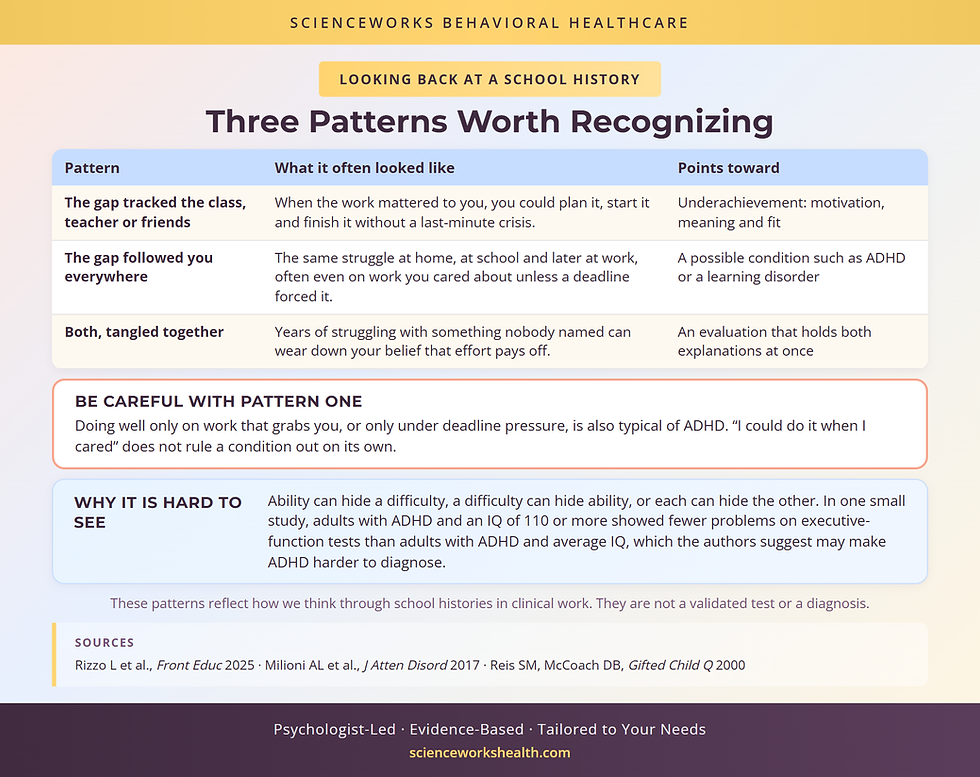
A 2025 review of twice-exceptional research describes three ways this masking can play out: the difficulty can hide the gift, the gift can hide the difficulty, or each can hide the other. In any of these cases, a student can appear to meet expectations while working below their potential [4]. Smaller studies point in the same direction. In one study of youth with ADHD, higher IQ was associated with a later age of diagnosis [11]. In a small adult study, adults with ADHD and an IQ of 110 or higher showed fewer problems on executive-function tests than adults with ADHD and average IQ, which the authors suggest may make diagnosis harder [10]. A review of ADHD in highly intelligent people names the risk in both directions: high intelligence may mimic ADHD in someone who does not have it, and compensation can hide ADHD that is really there [12].
🧩 Key takeaway: Underachievement and a twice-exceptional profile can produce the same report card. They differ in what sits underneath it: beliefs, motivation and fit in one case, a specific condition in the other, and sometimes both.
Sorting a school history: three patterns
None of these patterns diagnoses anything, and no research test exists for sorting an adult's school history this way. They reflect how we think through school histories in our clinical work, as mirrors to hold up against your own history before you decide whether to ask for an evaluation.
Pattern 1: the gap tracked the class, the teacher or the friends
You were capable of excellent work and you knew it. The trouble showed up in specific places: a class that felt pointless, a teacher you did not respect, a school where your friends made a point of not trying. In a different setting, with a subject you cared about, the work got done, sometimes brilliantly. You procrastinated, but when something mattered to you, you could plan it and see it through. Your memories of underperforming come with reasons attached: "I didn't see the point," "Everyone I liked was failing that class," "I was bored out of my mind."
Or: you coasted through elementary school on ability alone and hit a wall in high school or college, when the work finally required steady effort you had never needed to build. Once you saw the problem, you could build the habits, slowly, and your grades followed. One study of gifted students in demanding high schools in Korea found that early interest in the subject separated achievers from underachievers, and that moves into harder settings were a vulnerable point [17].
The distinguishing pattern: in classic underachievement, the gap tends to follow the meaning of the work, and when the work mattered, you could plan it, start it and finish it without a crisis. Be careful with this one: doing well only on work that grabs you, or only under deadline pressure, is also typical of ADHD, so "I could do it when I cared" does not rule a condition out on its own.
Pattern 2: the gap followed you everywhere
You cared, and it did not help. You wanted to finish the project, you started it the night it was due anyway, and you could not explain why even to yourself. The same thing happened in the class you loved and the class you hated, at home and at school, and later at your first job. Report cards said "careless" and "inconsistent" next to strong test scores. You lost assignments you had finished. Teachers told your parents you were capable of so much more, and you agreed with them, which made it worse.
Or: reading always took you far longer than anyone seemed to think it should. You were quick in discussion and slow on the page, and you built elaborate workarounds, like listening closely in class so you did not have to rely on the textbook. The struggle became obvious only when the reading load outgrew your workarounds, in college or a demanding job. That timing fits the way learning disorders are described: the difficulties begin in the school years but may not become fully evident until demands exceed what a person can manage [8].
The distinguishing pattern: in a twice-exceptional profile, the gap tends to be cross-setting and stubborn. It shows up at home, at school and later at work, often even on work you cared about unless a deadline forced it, and effort alone does not close it.
Pattern 3: both, tangled together
Many adults recognize pieces of both patterns. In our clinical experience, years of struggling with something nobody named can wear down the very beliefs underachievement research describes. If assignments kept slipping no matter how hard you tried, it would be reasonable to stop believing effort pays off, and to stop valuing the goals of a school that kept calling you lazy. By adulthood, the motivation problem is real, but it may have grown out of an earlier, unrecognized difficulty. Reis and McCoach's warning applies here too: the help that fits a chronic underachiever and the help that fits a student with an attention or learning problem can be very different [1].
🔍 Key takeaway: The most useful question about your history is not "Was I lazy?" It is "When the work mattered to me, could I plan it and finish it, or did the same struggle follow me from school to home to work?"
What an adult evaluation can and cannot conclude
What an evaluation looks at
For ADHD, the diagnostic criteria in the DSM-5-TR, as summarized in a 2025 commentary, require several symptoms before age 12, symptoms in two or more settings, and clear evidence that they interfere with functioning; adults need five symptoms rather than six [7]. NICE guidance in the UK says an ADHD diagnosis should rest on a full clinical assessment, a developmental and psychiatric history, and reports from people who know you, and should never be based on rating scales alone [18]. A screener such as the ASRS adult ADHD screener can help you decide whether to ask the question. It cannot answer it.
A careful evaluation also checks the other conditions that can cause inattention in capable adults, including anxiety, depression, trauma and learning disorders [7]. If worry or low mood is part of your picture, the GAD-7 anxiety screener and the PHQ-9 depression screener are reasonable to take alongside it.
The limits of looking back
No one can measure a gap between your ability and your grades from twenty years ago. Adult testing describes you now. Memory is also not a neutral record: when people try to recall childhood symptoms, their recollections tend to be shaped by how they are functioning today [7]. That is why collateral information, such as a parent's account or old school records, is considered more reliable than self-report alone [7]. In our clinical experience, report-card comments can be more useful than grades, because they put a teacher's view of your ability next to what got in the way. If your records are thin or missing, that does not automatically end the question. NICE advises that an uncertain time of onset should not, by itself, rule out an ADHD diagnosis [18].
Learning disorders raise their own wrinkle. As summarized in a clinical reference, the DSM criteria for a specific learning disorder compare a person's academic skills with what is expected for their age [8]. That means a bright adult whose reading is average but far below their reasoning may not meet the formal criteria, even if education researchers would describe the same person as twice-exceptional. A good evaluation will say which of those situations you are in, rather than leave you guessing.
📋 Key takeaway: An adult evaluation cannot rewind to your school years. It can gather the best available evidence about them and test which explanation fits both your history and your present.
Our psychological assessment services describe how we approach adult evaluations, including when a history is hard to reconstruct.

What actually helps
What the evidence shows for underachievement
The research on reversing gifted underachievement is less encouraging than you might expect. A 2020 meta-analysis of 14 recent studies found that interventions did not significantly improve the grades of gifted underachievers, though they produced a small improvement in measures such as self-efficacy, goal valuation and motivation; the authors rated the quality of the evidence as relatively low [13]. A broader 2019 meta-analysis of 53 studies of underachieving students in general found interventions moderately effective, and its authors called for rigorous studies of help that fits each student's reason for underachieving [14]. Most of this research is in school-age students, not adults.
Evidence-based options when a condition is present
If an evaluation finds ADHD, a learning disorder, anxiety or depression, treatment is planned around that condition, whatever your IQ. For ADHD specifically, a review of the research in highly intelligent people found early evidence of a characteristic response to treatment, though the number of studies is limited [12]. If you are in Tennessee and want to understand what ADHD and autism evaluations involve here, our page on ADHD and autism testing in Tennessee walks through the process.
What to be cautious of
Be wary of anything that treats high ability as the diagnosis, or promises to "unlock your potential." Potential is usually not what is missing. Be just as wary of the opposite error, in which every stall in a bright adult gets read as a hidden disorder. An underachiever's history is not, by itself, evidence of a hidden disorder, and an honest evaluation will tell you when none is present.
⚖️ Key takeaway: The evidence does not show that any one program reliably reverses underachievement. Researchers' own advice is to understand the reason first, and that is the sensible place to start.
A rule of thumb: where to start
This rule of thumb comes from our clinical experience, not from a validated test. If your gap tracked particular classes, teachers or friend groups, and when you cared about the work you could plan, start and finish it without relying on last-minute pressure, underachievement is a reasonable first explanation, and the useful work is often about motivation, meaning and fit. If the same difficulty followed you across home, school and work, showed up even on work you cared about, survived real effort and is still costing you now, ask for an evaluation that looks for ADHD and learning disorders with your ability in mind. If both descriptions fit, do not talk yourself out of it. Ask for an evaluation that can hold both explanations at once.
Signs that an evaluation is worth booking now, rather than someday:
The same difficulty showed up at home, at school and later at work
You can trace it to childhood, before about age 12, in records or in someone else's memory
It is costing you something real today: jobs, money, relationships or health
Low mood, constant worry or exhaustion has joined the picture
Questions worth asking any provider before you book:
Scope: "Will the evaluation look at ADHD and learning disorders together, or only one of them?"
Methodology: "How do you account for high ability and years of compensating, so strong test scores do not hide a real difficulty?"
Developmental history: "What will you use if I have no school records, or no parent who can describe my childhood?"
Learning disorders: "If my skills are average but far below my reasoning, how will you describe that in the report?"
Output: "Will I get specific recommendations, and a clear statement if no condition is found?"
🛠️ Key takeaway: Start with where your gap showed up and what it took to close it. A gap tied to particular classes that closed when the work mattered points one way. A gap that followed you across home, school and work points another. If you cannot tell, or both fit, that points to an evaluation that does not force a choice.
If you have thoughts of not wanting to be alive, do not wait for an evaluation. Call or text 988, or call 911 in an emergency.
Next step: getting support
Being told for years that you were capable of more can leave you believing the problem was you. The more accurate story is usually more specific than that: a gap that came from beliefs and fit, a condition nobody looked for, or both. Finding out which one is what makes the next step make sense.
Strengths and struggles that don't line up?
When high ability and a neurodivergent profile sit together, each can mask the other — an evaluation that looks at both at once can make sense of a pattern that partial explanations have missed.
Frequently Asked Questions
Is gifted underachievement a diagnosis?
No. Gifted underachievement is a term from education research, not a clinical diagnosis, and researchers still do not agree on one definition. It describes a lasting gap between a student's measured ability and their grades. An evaluation does not diagnose underachievement. It looks for anything that could explain the gap, such as ADHD, a learning disorder, anxiety or depression, and says plainly when none of those fits.
Can you be twice-exceptional and an underachiever at the same time?
Yes. Researchers who study gifted underachievement note that many twice-exceptional students underachieve in school. A widely cited research definition of underachievement leaves out only a gap caused directly by a diagnosed learning disability, so a student with ADHD, or with a learning disorder nobody diagnosed, could still be counted as an underachiever. That overlap is one reason a school label alone cannot tell you which explanation fits.
Is being called lazy as a gifted kid a sign of ADHD?
Not on its own. Lazy describes what adults saw, not why it happened. The same report-card comment can come from ADHD, a learning disorder, anxiety, low interest in the work, or a poor fit between a student and school. What points toward ADHD is a broader pattern: several symptoms before age 12, showing up in more than one setting and causing real problems, which an evaluation checks directly.
Do programs for gifted underachievers actually work?
The evidence is mixed. A 2020 review of 14 studies in gifted students found no significant effect on grades and a small benefit for motivation and related outcomes, and its authors rated the evidence as relatively low quality. A broader 2019 review of underachieving students found moderate effects, and its authors called for better studies of help that fits each student's reason for underachieving. Almost all of this research is in school-age students, not adults.
Can an adult evaluation tell whether I was an underachiever as a child?
Not directly. No one can measure your school-age ability gap after the fact, and memories of childhood are colored by how you feel today. What an adult evaluation can do is gather your developmental history, ideally with school records or a parent's account, and check whether a condition such as ADHD or a learning disorder explains both the old pattern and your current struggles.
About the Author
Dr. Kiesa Kelly is a licensed clinical psychologist and the founder of ScienceWorks Behavioral Healthcare. She earned her PhD in clinical psychology, with a concentration in neuropsychology, from Rosalind Franklin University of Medicine and Science, and completed practica, internship and an NIH-funded postdoctoral fellowship at the University of Chicago, the University of Wisconsin, the University of Florida and Vanderbilt University.
Trained as a neuropsychologist, Dr. Kelly has more than 20 years of experience with psychological assessment. Her NIH postdoctoral fellowship focused on ADHD in both research and clinical work, and she has since trained in neurodiversity-affirming assessment methods that capture ADHD and autism in adults who were never diagnosed earlier in life.
References
1. Reis SM, McCoach DB. The underachievement of gifted students: what do we know and where do we go? Gifted Child Quarterly. 2000;44(3):152-170. https://doi.org/10.1177/001698620004400302
2. Jackson RL, Jung JY. The identification of gifted underachievement: validity evidence for the commonly used methods. Br J Educ Psychol. 2022;92(3):1133-1159. https://doi.org/10.1111/bjep.12492
3. Reis SM, Baum SM, Burke E. An operational definition of twice-exceptional learners: implications and applications. Gifted Child Quarterly. 2014;58(3):217-230. https://doi.org/10.1177/0016986214534976
4. Rizzo L, Pinnelli S, Minnaert A. Twice-exceptional students: a systematic review to outline the distinctive characteristics through a multidimensional lens. Front Educ. 2025;10:1696805. https://doi.org/10.3389/feduc.2025.1696805
5. McCoach DB, Siegle D. Factors that differentiate underachieving gifted students from high-achieving gifted students. Gifted Child Quarterly. 2003;47(2):144-154. https://eric.ed.gov/?id=EJ669615
6. Siegle D, McCoach DB, Roberts A. Why I believe I achieve determines whether I achieve. High Ability Studies. 2017;28(1):59-72. https://doi.org/10.1080/13598139.2017.1302873
7. Weber SR. Commentary on sources of attention-deficit/hyperactivity overdiagnosis among U.S. adults. Healthcare (Basel). 2025;13(18):2367. https://doi.org/10.3390/healthcare13182367
8. Aslam SP, Carugno P. Learning disorder. In: StatPearls. Treasure Island (FL): StatPearls Publishing; 2026. https://europepmc.org/article/MED/32119258
9. Antshel KM, Faraone SV, Maglione K, et al. Is adult attention deficit hyperactivity disorder a valid diagnosis in the presence of high IQ? Psychol Med. 2009;39(8):1325-1335. https://doi.org/10.1017/S0033291708004959
10. Milioni AL, Chaim TM, Cavallet M, et al. High IQ may "mask" the diagnosis of ADHD by compensating for deficits in executive functions in treatment-naive adults with ADHD. J Atten Disord. 2017;21(6):455-464. https://doi.org/10.1177/1087054714554933
11. Hare C, Leslie AC, Bodell LP, et al. Sex and intelligence quotient differences in age of diagnosis among youth with attention-deficit hyperactivity disorder. Br J Clin Psychol. 2024;63(4):627-645. https://doi.org/10.1111/bjc.12485
12. Rommelse N, van der Kruijs M, Damhuis J, et al. An evidenced-based perspective on the validity of attention-deficit/hyperactivity disorder in the context of high intelligence. Neurosci Biobehav Rev. 2016;71:21-47. https://doi.org/10.1016/j.neubiorev.2016.08.032
13. Steenbergen-Hu S, Olszewski-Kubilius P, Calvert E. The effectiveness of current interventions to reverse the underachievement of gifted students: findings of a meta-analysis and systematic review. Gifted Child Quarterly. 2020;64(2):132-165. https://doi.org/10.1177/0016986220908601
14. Snyder KE, Fong CJ, Painter JK, Pittard CM, Barr SM, Patall EA. Interventions for academically underachieving students: a systematic review and meta-analysis. Educational Research Review. 2019;28:100294. https://doi.org/10.1016/j.edurev.2019.100294
15. Sternberg RJ, Soleimani Dashtaki A. Effectivity: an alternative to conceptions of gifted under- and over-achievement. Gifted Education International. 2025;41(2):182-210. https://doi.org/10.1177/02614294241280862
16. Antshel KM, Faraone SV, Stallone K, et al. Is attention deficit hyperactivity disorder a valid diagnosis in the presence of high IQ? Results from the MGH Longitudinal Family Studies of ADHD. J Child Psychol Psychiatry. 2007;48(7):687-694. https://doi.org/10.1111/j.1469-7610.2007.01735.x
17. Yang J, Cho S. Exploring the divide: academic pathways of gifted high-achievers and underachievers in magnet schools. Educational Research and Development Journal. 2024;27(2):57-78. https://eric.ed.gov/?id=EJ1462856
18. National Institute for Health and Care Excellence. Attention deficit hyperactivity disorder: diagnosis and management [NG87]. Published March 14, 2018; last updated September 13, 2019. Accessed October 16, 2026. https://www.nice.org.uk/guidance/ng87/chapter/Recommendations
Disclaimer
This article is for informational and educational purposes only and is not a substitute for professional medical or mental health advice, diagnosis, or treatment. Reading it does not create a clinician-patient relationship, and screeners such as the ASRS cannot diagnose ADHD or any other condition on their own. If you are in crisis or thinking about harming yourself, call or text 988, or call 911 in an emergency.