
How to Build a Therapy Caseload in Tennessee Without Feeling Salesy

Updated: Jul 31
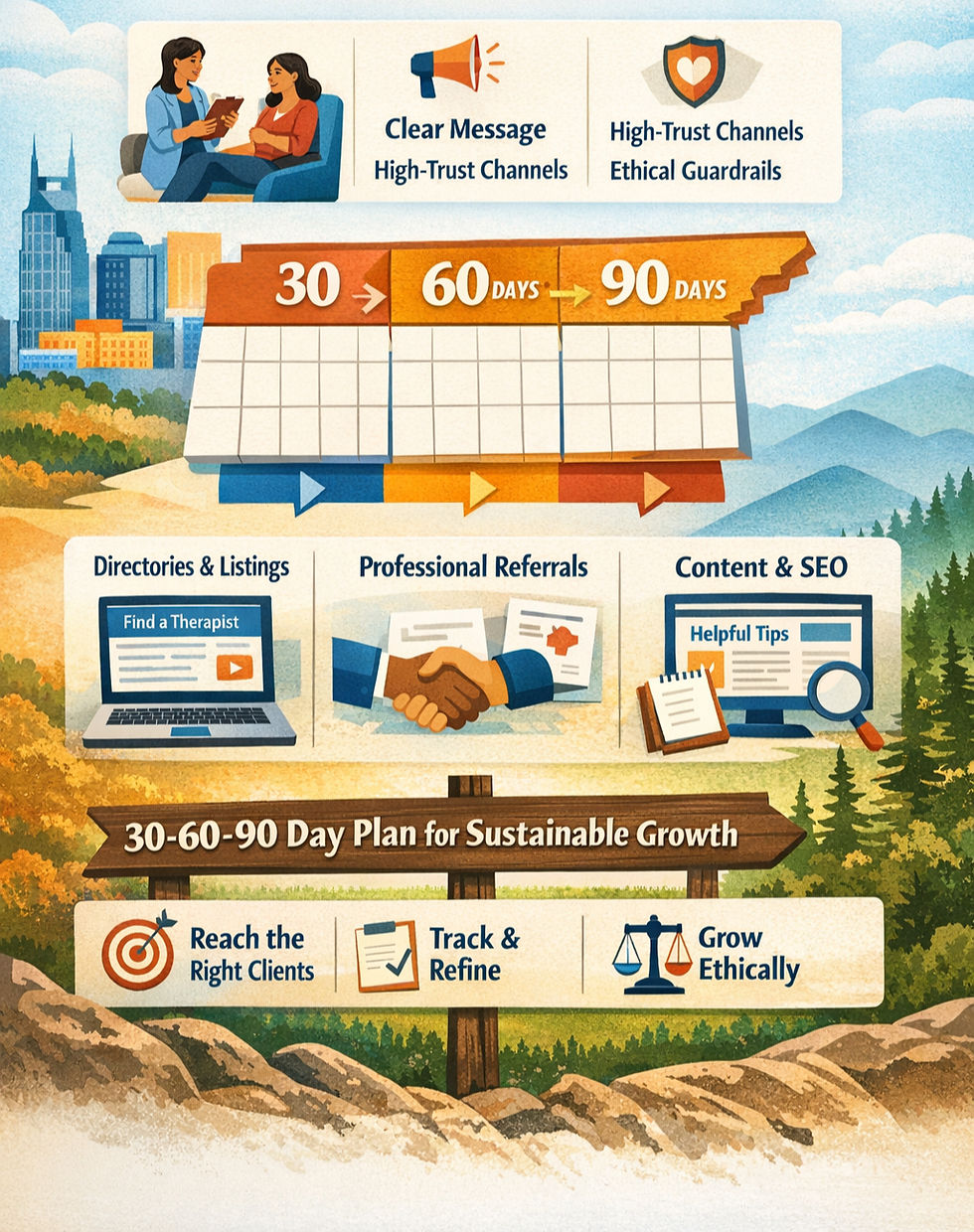
If you’re trying to build a therapy caseload Tennessee clinicians can sustain, feeling “salesy” is a common speed bump. Most therapists aren’t uncomfortable with helping, they’re uncomfortable with sounding pushy or making promises they can’t ethically make.
In this article, you’ll learn:
How to reframe marketing as a client-access skill (not persuasion)
How to set a simple caseload goal and track what’s working
The highest-trust foundations that make any marketing channel easier
Three reliable client sources and how to use each without burnout
A practical 30-60-90 day plan you can follow with limited time
Key takeaway: 🧭 Ethical marketing is mostly clarity. When your message is clear, you don’t have to “sell” anyone on therapy.
The Mindset Shift: Marketing ≠ Manipulation
A sustainable caseload starts with a mindset shift: marketing is not manipulation. It’s communication and accessibility.
“Helping the right people find you” as an ethical frame
Ethical marketing is a way to reduce friction for the people who are already looking for help. Professional ethics codes emphasize accurate, non-deceptive public statements and avoiding misleading claims.[1]
A practical ethical frame is:
Clarity over persuasion: explain who you help and how you work
Fit over volume: aim for better matches, not more clicks
Consent over pressure: invite next steps without urgency or fear
Key takeaway: 🧩 You’re not “convincing” someone to do therapy. You’re helping the right-fit client recognize themselves in your message.
Why feeling salesy usually means your message is unclear
Feeling salesy often shows up when you’re trying to market a general “I help with everything” practice. When your scope is broad, you end up over-explaining, and that can feel like pushing.
Three clarity upgrades that usually reduce the salesy feeling:
Lead with a specific “who I help” statement
Name 1 to 3 primary problems you’re best at treating
Describe what the first step looks like (a free consult or intake)
Common misconception #1: “If I’m ethical, I shouldn’t market.”Ethics doesn’t require invisibility. It requires accuracy, humility, and respect for autonomy.[1]
Pick a Simple Caseload Goal (So You Can Choose the Right Channel)
Caseload-building gets easier when you stop trying to do everything and choose the smallest goal that meets your needs.
Your “minimum viable caseload” and a realistic ramp-up
Your minimum viable caseload is the smallest, sustainable weekly schedule that covers your needs (income, hours, energy) without pushing you into burnout.
A realistic ramp-up often looks like:
Weeks 1 to 4: clarify your niche and activate one channel
Weeks 5 to 8: add a second channel and tighten follow-up
Weeks 9 to 12: improve fit so you’re working with the clients you do best with
Key takeaway: 📏 A simple caseload target helps you choose the right channel. Without a target, every tactic feels urgent.
What to track weekly (inquiries, consults, conversions)
Track the full path from interest to intake. You can do this in a notes app or spreadsheet.
Weekly metrics to track:
Inquiries (calls, emails, contact forms)
Free consults scheduled
Free consults completed
Intakes booked
Conversions (consult → intake)
Source (directory, referral partner, website/content)
Practical example: if you get 6 inquiries, 4 consults, and 2 intakes, your “bottleneck” may be consult scheduling or fit. That tells you what to improve next.
Common misconception #2: “I need to be on every platform.” Most clinicians do better with one strong channel plus one supportive channel than five inconsistent efforts.
Start With the Highest-Trust Foundations to Build a Therapy Caseload Tennessee Clients Trust
Before you invest energy into marketing, build trust foundations that make it easier for clients and referral partners to say yes.
A clear niche + a clear “who I help” statement
You don’t need a niche so narrow it excludes most people. You need language that helps the right people recognize you.
A strong “who I help” statement includes:
Who: the population (life stage, identity, role)
What: the pattern (not just a diagnosis list)
How: your approach or what sessions feel like
Practical examples:
“I help adults who feel stuck in anxiety spirals learn skills that make daily life feel steadier.”
“I help clients with OCD patterns build a different relationship with intrusive thoughts using evidence-based approaches.”
“I help teens and parents reduce conflict cycles and improve communication with clear, teachable tools.”
Key takeaway: 🎯 When your niche is clear, your referrals improve and your marketing feels less personal and more precise.
A basic online presence that converts (services, specialties, availability)
Your online presence doesn’t need to be fancy. It needs to answer the questions people ask when they’re deciding.
Make sure clients can quickly find:
Services and specialties (plain language)
Location and telehealth availability
Fees and/or insurance information (as applicable)
How to take the next step
If you’re building a telehealth caseload, be explicit about who telehealth is best for and what clients can expect from sessions.
If you offer specialty services (like therapy programs or assessment services), it can help to clearly explain them on your site. For examples of how we describe specialized care, see our page on specialized therapy services and our overview of psychological assessments.
The 3 Most Reliable Client Sources (and How to Use Them)
You can build a sustainable caseload using three main sources. The “best” one depends on your timeline and energy.
Directories (what they’re good for, what they’re not)
Directories work because they connect you with people who are actively searching. Psychology Today, for example, markets the directory as a place where clients find therapists and where clinicians can create a listing.[6,7]
Directories are good for:
Early momentum when your website has low traffic
Clients who are already ready to book
Testing your niche language (what gets inquiries)
Directories are not great for:
Deep differentiation (profiles can look similar)
“Set it and forget it” results
Building a long-term brand without additional foundations
A few non-salesy profile upgrades:
Put your niche in the first 2 to 3 lines
Describe what a first session is like
State who you’re currently accepting (age range, telehealth vs in-person)
Common misconception #3: “A Psychology Today profile should sound clinical.”Clients often respond better to clear, human language they can picture themselves in.[7]
Professional referrals (how to build them without “schmoozing”)
Referral building is not schmoozing. It’s making it easy for trusted professionals to connect clients with the right level of care.
Start with a short list:
Primary care, psychiatry, OB/GYN
School counselors, pediatric practices
Other therapists with complementary niches
Local organizations with aligned communities
Use a simple “referral snapshot”:
Who you help
What you treat
What you’re currently accepting
How to refer
Sample outreach email (edit to fit your voice):
Subject: Referral fit for [population/concern]
Hi [Name],
I’m a [credential] clinician in Tennessee and I specialize in supporting [who you help] with [top 1 to 2 concerns]. I’m currently accepting new clients for [telehealth/in-person] and I offer a free consult to help people find the right fit.
If it’s helpful, I’m happy to share my referral snapshot or hop on a brief 10 to 15 minute call so you know what I’m best for.
Warmly,[Your name]
Key takeaway: 🤝 Referral partners don’t need a pitch. They need clarity about fit, availability, and how to refer.
Content/SEO (why it compounds over time)
Content is slower at first, but it compounds. One clear post that answers a real question can bring steady inquiries long after you publish it.
A simple SEO approach:
Write one post per month that answers one client question
Use plain, search-friendly headings
Include a calm call to action (free consult, contact form, or next step)
If you’re building a practice platform with broader services, helpful resources can support both clients and clinicians. For example, you can point readers to mental health screening tools when the next step is “get clarity,” not “book immediately.”
A 30–60–90 Day Caseload-Building Plan
Pick one channel to start. Consistency beats intensity.
Weeks 1–4: clarity + one channel
Week 1: Clarify your fit
Write your “who I help” statement
Choose your minimum viable caseload goal
Decide what you will and won’t accept (scope and schedule)
Week 2: Tighten your conversion basics
Update your services and availability
Create a simple consult flow (questions you ask, next steps you offer)
Week 3: Activate one channel
Directory: build or refresh your profile
Referrals: reach out to 5 referral partners
Content: draft one post answering one client question
Week 4: Track and refine
Track inquiries, consults, and conversions
Adjust your message based on common questions
Weeks 5–8: add a second channel
Keep your first channel steady and add one supportive channel.
Simple weekly rhythm:
30 minutes: update your profile or website based on real inquiries
30 minutes: reach out to 3 to 5 referral partners
60 minutes: draft or refine content
Weeks 9–12: refine for better-fit clients
At this stage, you’re optimizing for fit.
Refine by:
Noticing your best-fit patterns (who converts and stays)
Updating your messaging to attract more of those clients
Tightening boundaries so growth doesn’t equal burnout
Ethical Guardrails for Growth
Ethics is not a speed bump. It’s what makes growth sustainable.
Avoiding overreach, scope creep, and burnout
As your caseload grows, it’s easy to say yes to everything. Over time, that can lead to scope creep and exhaustion.
Try these guardrails:
Keep your niche and scope visible in your referral snapshot
Limit free consults to set days and times
Build buffer time for notes and admin tasks
Refer out when care needs exceed your scope
Privacy and professionalism (no client-identifying stories)
Marketing should never put client privacy at risk. Even when you remove names, details can still identify someone, especially in small communities.[4,5]
Safer alternatives:
Use education: patterns, skills, and what therapy is like
Speak in generalities (avoid dates, locations, unique specifics)
Avoid stories about current clients or recent situations
If You Want a Practice Platform That Supports Self-Starters
Some clinicians love entrepreneurship but don’t want to carry every admin and marketing task alone.
What “marketing + admin support” can look like in real life
Support can look like:
Reliable referral pathways (without pressure tactics)
Scheduling and admin infrastructure
Collaboration and consultation
Systems that protect boundaries and reduce burnout
If you’re curious about how our services are structured for clients (and how we explain them clearly), you can explore who we are at ScienceWorks and see our group offerings.
CTA: Contact through the Careers page (what to include in your message)
If you’re a Tennessee clinician interested in joining a practice platform built to support ethical growth, contact us through our Careers page.
You can nclude:
Your credentials and licensure status
Your location in Tennessee and whether you prefer telehealth, in-person, or hybrid
Your clinical interests and specialties
Your ideal weekly schedule and target caseload range
Your preferred start timeline
Summary and next steps
Building a caseload doesn’t require hype. It requires a clear message, one or two trust-based channels, and ethical guardrails that keep you steady as you grow.
Next steps:
Write your “who I help” statement today
Choose one channel (directory, referrals, or content) for the next four weeks
Track inquiries, consults, and conversions weekly
Refine for fit, not just volume
Frequently Asked Questions
How long does it take to build a full cash-pay therapy caseload in Tennessee?
Building a full cash-pay caseload in Tennessee typically takes 6 to 18 months depending on your niche, marketing approach, referral network, and fee structure. Therapists who specialize in a specific population or evidence-based modality (such as OCD or trauma) tend to fill faster because they are searchable by specialty. Starting with a partial caseload while working at a group practice or community setting reduces income pressure during the ramp-up period. Consistent online presence and active referral relationships are the primary drivers of caseload growth.
Are therapists in Tennessee currently accepting new clients?
Many Tennessee therapists have significant wait times for new clients, particularly in specialty areas like OCD, trauma, and neurodivergent-affirming care. Telehealth has expanded access to specialists statewide, reducing geographic barriers. If you are searching, contacting practices directly is more reliable than checking Psychology Today listings, which may not be updated regularly. ScienceWorks Behavioral Health accepts new clients via telehealth across Tennessee.
What marketing strategies work for building a therapy practice without feeling salesy?
The most sustainable approaches involve content-based visibility rather than direct selling: writing for potential clients searching online, building referral relationships with primary care providers and psychiatrists, and participating in professional communities. Specializing in a specific modality or population creates natural referral pathways because other clinicians know exactly who to send to you. Authenticity in describing your approach and the clients you work with best tends to attract good clinical fits more effectively than broad marketing language.
About ScienceWorks
ScienceWorks Behavioral Healthcare is a clinician-led practice providing specialized mental health care for clients across Tennessee, with telehealth availability in many states. Our team offers evidence-based therapy, psychological assessments, and executive function coaching - designed to support real-world functioning, sustainable change, and individualized care.
We prioritize:
Thoughtful, ethically grounded care planning
Clear communication and collaboration
Specialty-informed services (including therapy, assessments, and coaching)
Infrastructure that supports clinicians doing great clinical work
References
American Psychological Association. Ethical principles of psychologists and code of conduct. Section 5: Advertising and Other Public Statements. Available from: https://www.apa.org/ethics/code. Accessed 2026 Feb 1.
APA Services. How to take charge of online reviews. Available from: https://www.apaservices.org/practice/business/marketing/take-charge-online-reviews. Accessed 2026 Feb 1.
American Counseling Association. 2014 ACA code of ethics. Available from: https://www.counseling.org/docs/default-source/default-document-library/ethics/2014-aca-code-of-ethics.pdf. Accessed 2026 Feb 1.
Electronic Code of Federal Regulations. 45 CFR §164.514: Other requirements relating to uses and disclosures of protected health information. Available from: https://www.ecfr.gov/current/title-45/subtitle-A/subchapter-C/part-164/subpart-E/section-164.514. Accessed 2026 Feb 1.
U.S. Department of Health and Human Services. Guidance regarding methods for de-identification of protected health information in accordance with the HIPAA Privacy Rule. Available from: https://www.hhs.gov/hipaa/for-professionals/special-topics/de-identification/index.html. Accessed 2026 Feb 1.
Psychology Today. Join Psychology Today (directory listing for professionals). Available from: https://join.psychologytoday.com/us/signup. Accessed 2026 Feb 1.
Psychology Today. How to find a therapist. Available from: https://www.psychologytoday.com/us/basics/therapy/how-to-find-a-therapist. Accessed 2026 Feb 1.
ScienceWorks Behavioral Healthcare. Kiesa Kelly, PhD. Available from: https://www.scienceworkshealth.com/kiesakelly. Accessed 2026 Feb 1.
Disclaimer
This article is for informational purposes only.