
Illness Anxiety Disorder (Health Anxiety): Signs and How CBT Helps

Last reviewed: 07/15/2026
Reviewed by: Dr. Kiesa Kelly

You have been to the doctor. The tests came back clear. And yet within days — sometimes within hours — the fear is back: a new twinge, a headline about a rare disease, a mark on your skin you do not remember. If worry about your health keeps returning no matter how much reassurance you get, you are not imagining it, and you are not alone. This pattern has a clinical name: illness anxiety disorder, more commonly called health anxiety.
Health anxiety is exhausting in part because it can feel responsible. It can seem like vigilance is the only thing standing between you and a missed diagnosis, so easing up feels dangerous. The good news is that health anxiety is well understood and genuinely treatable. This article explains what illness anxiety disorder is, how to recognize it, how it differs from conditions it is often confused with, and how cognitive behavioral therapy — the best-studied approach — helps people step out of the loop.
In this article, you'll learn:
What illness anxiety disorder is, in plain terms, and how it differs from ordinary health concern
The signs that separate health anxiety from careful self-care
How health anxiety differs from OCD and from somatic symptom disorder
What CBT for health anxiety actually involves, and how long it usually takes
When to seek an evaluation — and what telehealth can offer
What illness anxiety disorder is
Illness anxiety disorder is a preoccupation with having or acquiring a serious illness that persists for at least six months and causes real distress or disruption, even though physical symptoms are absent or mild [1][2]. In the current diagnostic manual, the DSM-5-TR, it sits within a group called somatic symptom and related disorders. What defines it is not how sick you actually are — it is how much of your attention and energy the fear of illness consumes.
Everyone worries about their health sometimes. A persistent cough during flu season, a family history of heart disease, a concerning symptom — these deserve attention, and getting them checked is sensible. Health anxiety is different in degree and in pattern. The worry is out of proportion to any real medical risk, it does not settle when reassurance arrives, and it drives behaviors that take over ordinary life. Clinicians often notice two styles: some people seek care constantly, booking appointment after appointment, while others avoid doctors entirely because the possibility of bad news feels unbearable [1]. Both are health anxiety. If you are unsure where your own experience falls, a structured psychological assessment can help sort ordinary concern from a pattern worth treating.
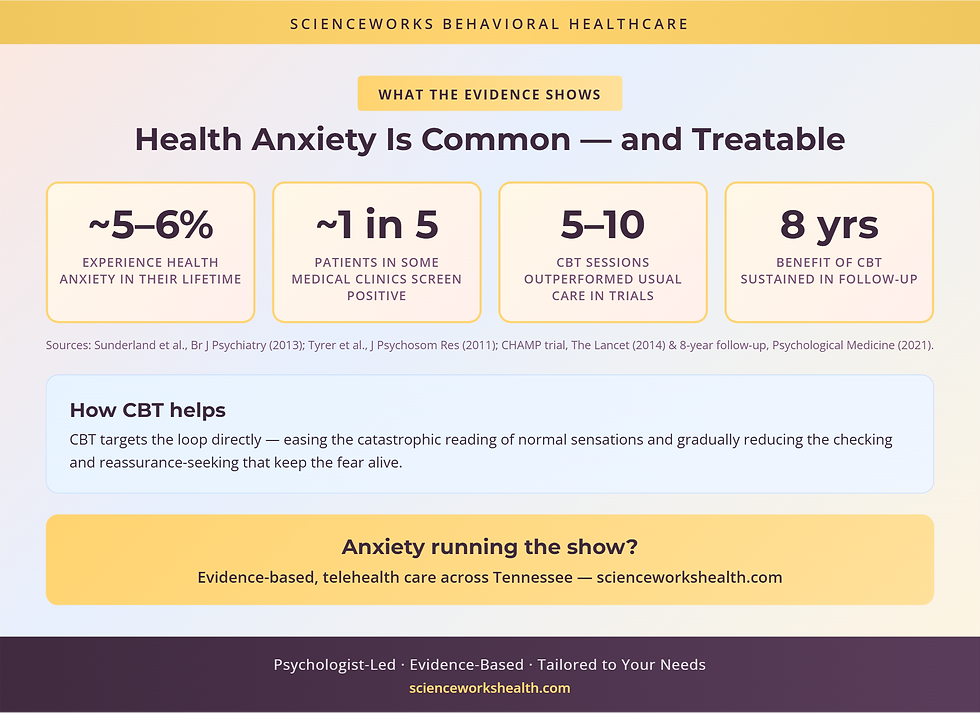
Health anxiety is common. Around 5 to 6 percent of people experience clinically significant health anxiety at some point in their lives, and it is far more common in medical settings — in some specialty clinics, close to one in five patients screens positive [4][5]. The narrower DSM-5-TR diagnosis of illness anxiety disorder is less common than everyday health worry, but the underlying experience is familiar to a great many people.
Common misconceptions about health anxiety
Health anxiety is often misunderstood, and the misunderstandings tend to keep people stuck. A few are worth naming directly.
"Health anxiety means the symptoms are fake or all in your head." They are not fake. The physical sensations people with health anxiety notice — a racing heart, muscle tension, stomach upset, dizziness — are real bodily events, often produced by anxiety itself. The difficulty is not invented symptoms; it is the catastrophic meaning attached to normal sensations [9].
"If my medical tests are normal, I should feel reassured." It seems logical, but reassurance rarely lasts. For someone with health anxiety, a clear test result brings relief for hours or days, and then doubt creeps back: What if they missed something? What if it develops later? This is one of the most important features of the disorder — reassurance soothes in the short term but strengthens the cycle over time [9]. If reassurance worked, health anxiety would resolve itself after the first normal result.
"Being anxious about my health just means I'm being careful." Careful self-care is flexible and proportionate: you get a symptom checked, you get an answer, and you move on. Health anxiety is rigid and self-perpetuating. It rarely reduces risk, and it consistently reduces quality of life. The distinguishing question is not do you pay attention to your health but does the attention ever let you rest.
"Health anxiety is untreatable — it's just how I'm wired." This one costs people the most, because it stops them from seeking help. Health anxiety responds well to treatment. In the largest randomized trial to date, people who received a brief course of CBT were still doing significantly better eight years afterward [6][7].
Signs of illness anxiety disorder
Health anxiety shows up less as a single symptom and more as a set of habits built around fear. Common signs include preoccupation with health that crowds out other thoughts, repeatedly checking the body for signs of disease, seeking reassurance from doctors, family, or the internet, and either over-using or entirely avoiding medical care. Two worked examples make the pattern easier to recognize.
Consider a version many people know well. You feel a flutter in your chest during a quiet moment. Within seconds your mind has moved from that was strange to that could be my heart. You check your pulse, then check it again ten minutes later to compare. You open a search engine and type the symptom, and forty minutes later you have read about arrhythmias, blood clots, and early warning signs you might have ignored. That night you lie awake scanning your body for anything else that feels off. The next morning you feel foolish and promise yourself you will stop — until the next sensation arrives and the whole sequence begins again.
Or picture the avoidant version. You have had a mild, nagging symptom for weeks, and part of you knows you should get it looked at. But every time you reach for the phone to book an appointment, a wave of dread stops you: if you go, they might find something, and then it will be real. So you put it off. You avoid the news stories about that illness, change the subject when a friend mentions their diagnosis, and try not to touch the area that worries you. The not-knowing is its own kind of torment, but the possibility of confirmation feels worse. Weeks turn into months of low-grade fear that never resolves because you never let yourself find out.
Both scenarios share the same engine: a frightening interpretation of uncertainty, followed by behaviors — checking, googling, seeking reassurance, or avoiding — that lower the fear briefly and lock it in for the long run.

Health anxiety, OCD, and somatic symptom disorder
Health anxiety is frequently confused with two other conditions, and telling them apart matters for treatment. It shares features with obsessive-compulsive disorder: both can involve intrusive fears and repetitive reassurance-seeking or checking. The difference is focus and breadth. Health anxiety centers specifically on the fear of illness, while OCD involves intrusive thoughts across many themes — contamination, harm, symmetry, morality — paired with compulsions meant to neutralize them. When the picture is genuinely mixed, a brief screener such as the DOCS for obsessive-compulsive symptoms can help a clinician see which pattern is driving the distress. If you want the full side-by-side, we cover it in depth in our guide to health anxiety versus OCD and somatic symptom disorder.
Illness anxiety disorder also differs from somatic symptom disorder, even though the DSM groups them together. In illness anxiety disorder, physical symptoms are absent or mild, and the fear of illness itself is the problem. In somatic symptom disorder, distressing physical symptoms are prominent and central, and the distress organizes around those symptoms rather than around a feared diagnosis [8]. Because health anxiety so often travels with generalized anxiety and low mood, clinicians frequently check for those too; a short measure like the GAD-7 for anxiety can round out the picture and make sure nothing co-occurring is missed.
The distinguishing pattern: health anxiety is defined by the fear of being ill, not by the presence of unexplained symptoms or by wide-ranging obsessions — and that focus is exactly what makes it so responsive to the right kind of therapy.
How CBT helps
Cognitive behavioral therapy is the most thoroughly studied treatment for health anxiety, and it works by targeting the specific loop that keeps the fear alive rather than by arguing you out of your worries.
The cognitive-behavioral model in plain language
The influential model developed by Warwick and Salkovskis describes health anxiety as a cycle of catastrophic misinterpretation [9]. A normal or ambiguous body sensation — a headache, a skipped heartbeat, a patch of dry skin — gets read as evidence of serious illness. That interpretation spikes anxiety, which produces more body sensations (anxiety is physical), which seem to confirm the fear. To cope, you check, google, or seek reassurance, and each of those behaviors calms you briefly. The trouble is that the relief teaches your brain that the danger was real and that only checking kept you safe, so the next sensation triggers the same response even faster. CBT is built to interrupt this loop at the points where it can actually be changed.
What a typical course looks like
CBT for health anxiety is active and structured. Early on, you and your therapist map your own version of the cycle: your triggers, your interpretations, and the specific safety behaviors — reassurance-seeking, body-checking, symptom-searching, avoidance — that maintain it. From there, the work usually involves gradually reducing those behaviors, learning to sit with uncertainty rather than resolve it instantly, and testing the frightening predictions to see whether they hold up. Many people find that cutting back on reassurance and checking is the hardest and most powerful step, because those habits feel protective; our overview of safety behaviors in anxiety explains why loosening them, rather than doing them better, is what brings relief. Tracking how physical symptoms and quality of life shift over the course of treatment — sometimes with a measure like the PROMIS-29 — can make progress visible when it is easy to overlook.
How long does it take? In the largest randomized trial, a course of about 5 to 10 sessions of CBT produced significantly greater improvement in health anxiety than standard medical care [6]. In everyday practice, a course often runs somewhat longer — roughly 6 to 16 sessions — depending on how long the pattern has been in place and what else is going on. What is striking is how durable the benefit is: in that same trial, people who received CBT were still better off eight years later [7]. This is the kind of structured, evidence-based care we provide through specialized therapy, and it is available across Tennessee through CBT delivered by telehealth.
Who it is right for — and when something else may fit
CBT is a strong first choice for most people whose main difficulty is fear of illness, checking, reassurance-seeking, or avoidance. A simple way to think about the decision: if your distress is driven by what a sensation might mean and by the behaviors you use to feel safe, health-anxiety-focused CBT is likely the most direct route. If intrusive thoughts range far beyond health and come with strong compulsions, an OCD-focused approach may fit better. And if prominent, distressing physical symptoms are the center of the experience, the plan should account for that. These are not either-or choices you have to make alone — a good evaluation is designed to sort them out. For some people, medication is a helpful addition alongside therapy, a decision best made with a prescribing clinician.
Getting evaluated, and what telehealth offers
If you are considering an evaluation, it helps to know what to ask. Useful questions for any provider include: How will you tell health anxiety apart from OCD or from a physical condition? What does treatment involve week to week, and roughly how many sessions? How will we handle reassurance-seeking, given that reassurance is part of the problem? And what will I walk away able to do differently? Clear answers to those questions are a good sign you have found the right fit.
Telehealth deserves a specific mention here, because health anxiety and telehealth fit together well. CBT for health anxiety is a talking-and-practicing therapy, which translates cleanly to video, and remote sessions remove the travel and scheduling barriers that keep many people from starting. For those who prefer it, an in-person option is available at our Nashville office.
Health anxiety can feel like a fixed part of who you are. It is not. It is a well-mapped, treatable pattern, and the same vigilance that fuels it can be redirected — with the right support — toward a life that is no longer organized around fear.
Anxiety running the show?
Evidence-based therapy can turn the volume down on anxiety — a clinician can help you find the approach that fits your life rather than a one-size-fits-all plan.
Frequently Asked Questions
How do you treat health anxiety?
The best-studied treatment is cognitive behavioral therapy (CBT). CBT helps you notice the catastrophic interpretations of normal body sensations that fuel the fear, and gradually reduce the checking and reassurance-seeking that keep it going. In the largest trial, a course of about 5 to 10 sessions worked better than standard medical care, and the benefit lasted for years.
Does health anxiety ever go away?
It can improve a great deal. Health anxiety tends to come and go in waves rather than vanish overnight, but treatment works: people who completed CBT in one large study kept their gains up to eight years later. The goal is not to never think about health again — it is to respond to those thoughts differently, so they no longer run your day.
How do I know if I have health anxiety or OCD?
They overlap but differ in focus. Health anxiety centers on the fear of having or developing a serious illness. OCD involves intrusive thoughts across many themes and compulsions done to neutralize them. Reassurance-seeking and body-checking appear in both. A clinician can tell them apart and, importantly, both respond to related cognitive behavioral approaches.
Is illness anxiety disorder the same as somatic symptom disorder?
No. In illness anxiety disorder, physical symptoms are absent or mild, and the distress is driven by fear of illness itself. In somatic symptom disorder, distressing physical symptoms are prominent and central. The two were separated in the DSM-5 for this reason, and telling them apart shapes the right treatment plan.
Can health anxiety be treated through telehealth?
Yes. CBT for health anxiety translates well to video sessions, and for many people telehealth removes the barriers of travel and scheduling. Our practice is telehealth-forward across Tennessee, with an in-person option in Nashville, so you can start care in the format that fits your life.
About the Author
Dr. Kiesa Kelly is a licensed clinical psychologist and the founder of ScienceWorks Behavioral Healthcare, with more than 20 years of experience in psychological assessment and evidence-based treatment. Her background includes extensive work with anxiety-spectrum conditions and the cognitive behavioral approaches — including exposure-based and reassurance-reduction methods — that are first-line for health anxiety.
Dr. Kelly's clinical training emphasized careful differential assessment, the skill at the center of distinguishing health anxiety from OCD, somatic symptom disorder, and medical conditions. At ScienceWorks, she leads a telehealth-forward practice serving Tennessee, with an in-person option in Nashville, and reviews the practice's clinical content for accuracy.
References
1. French JH, Hameed S. Illness Anxiety Disorder. StatPearls [Internet]. Treasure Island (FL): StatPearls Publishing; 2023. https://www.ncbi.nlm.nih.gov/books/NBK554399/
2. Kikas K, Werner-Seidler A, Upton E, Newby J. Illness Anxiety Disorder: A Review of the Current Research and Future Directions. Current Psychiatry Reports. 2024;26(7):331–342. https://doi.org/10.1007/s11920-024-01507-2
3. Association for Behavioral and Cognitive Therapies. Health Anxiety (Fact Sheet). https://www.abct.org/fact-sheets/health-anxiety/
4. Sunderland M, Newby JM, Andrews G. Health anxiety in Australia: prevalence, comorbidity, disability and service use. British Journal of Psychiatry. 2013;202(1):56–61. https://doi.org/10.1192/bjp.bp.111.103960
5. Tyrer P, Cooper S, Crawford M, et al. Prevalence of health anxiety problems in medical clinics. Journal of Psychosomatic Research. 2011;71(6):392–394. https://doi.org/10.1016/j.jpsychores.2011.07.004
6. Tyrer P, Cooper S, Salkovskis P, et al. Clinical and cost-effectiveness of cognitive behaviour therapy for health anxiety in medical patients (CHAMP): a multicentre randomised controlled trial. The Lancet. 2014;383(9913):219–225. https://doi.org/10.1016/S0140-6736(13)61905-4
7. Tyrer P, Wang D, Crawford M, et al. Sustained benefit of cognitive behaviour therapy for health anxiety in medical patients (CHAMP) over 8 years: a randomised-controlled trial. Psychological Medicine. 2021;51(10):1714–1722. https://doi.org/10.1017/S003329172000046X
8. Scarella TM, Boland RJ, Barsky AJ. Illness Anxiety Disorder: Psychopathology, Epidemiology, Clinical Characteristics, and Treatment. Psychosomatic Medicine. 2019;81(5):398–407. https://doi.org/10.1097/PSY.0000000000000691
9. Warwick HMC, Salkovskis PM. Hypochondriasis. Behaviour Research and Therapy. 1990;28(2):105–117. https://doi.org/10.1016/0005-7967(90)90023-C
10. Cleveland Clinic. Illness Anxiety Disorder (Hypochondria, Hypochondriasis). 2024. https://my.clevelandclinic.org/health/diseases/9886-illness-anxiety-disorder-hypochondria-hypochondriasis
11. NHS. Health anxiety. 2023. https://www.nhs.uk/conditions/health-anxiety/
12. Holden C, et al. Symptom Attributions in Illness Anxiety Disorder. Journal of Clinical Psychology. 2025. https://doi.org/10.1002/jclp.23765
Disclaimer
This article is for informational and educational purposes only and is not a substitute for professional medical or mental health advice, diagnosis, or treatment. Reading it does not create a clinician–patient relationship. If you are concerned about your health or mental health, consult a qualified professional. If you are in crisis or thinking about harming yourself, call or text 988 (the Suicide and Crisis Lifeline) or go to your nearest emergency room.