
Intrusive Thoughts vs OCD: Can You Have Them Without OCD?

Updated: 5 days ago
Last reviewed: 09/02/2026
Reviewed by: Dr. Kiesa Kelly

If you’ve ever had a sudden, disturbing thought (“What if I hurt someone?” “What if I’m secretly a bad person?”), you’re not alone. In intrusive thoughts vs OCD, the difference usually isn’t the content of the thought — it’s the response that follows.
In this article, you’ll learn:
Why the brain produces odd, unwanted thoughts
The key difference between intrusive thoughts and OCD intrusive thoughts
Compulsions examples people often miss (including mental compulsions OCD)
When an OCD screening test or Y-BOCS assessment might be a useful next step
What evidence-based help looks like (without feeding reassurance seeking OCD patterns)
💡 Key takeaway: Intrusive thoughts are common. OCD is less about the thought itself and more about the urgent need to feel certain or safe after the thought shows up. [1,3]
Intrusive Thoughts vs OCD: When Intrusive Thoughts Become OCD-Like
Why the brain generates “weird” thoughts
Brains generate a constant stream of mental content — including random “what if” predictions. When your stress and anxiety system is activated, that content can get more vivid, more alarming, and more frequent.
Research has long shown that unwanted intrusive thoughts occur in people with and without OCD. The difference is not that “OCD brains have weird thoughts and everyone else doesn’t.” [1]
The difference: how you respond to the thought
Here’s a helpful divider line:
Intrusive thoughts + anxiety: “That was upsetting.” You might feel uneasy, but you move on.
OCD-like looping: “I can’t let this go until I feel sure.” You start doing things to neutralize the thought or reduce anxiety. Those “things” are compulsions — including mental acts. [2]
🧠 Key takeaway: OCD thrives on the belief that uncertainty is dangerous — and that you must do something right now to make the feeling go away. [3,4]
What Makes Intrusive Thoughts Stick
Threat interpretation + intolerance of uncertainty
OCD tends to involve a “threat interpretation” style: the brain treats the thought like a meaningful warning instead of random mental noise. Cognitive-behavioral models describe appraisals like responsibility (“If I don’t prevent harm, it’s my fault”) and threat (“This could be catastrophic”) as fuel for compulsions. [3]
A related factor is intolerance of uncertainty: the feeling that “maybe” is unbearable. Studies link intolerance of uncertainty to OCD symptoms, especially doubt and checking. [4,5]
“Meaning-making” and mental checking
When a thought feels threatening, it’s natural to start searching for meaning:
“What does it say about me that I had that thought?”
“Did I enjoy it?”
“What if it’s a sign I’ll act?”
These are forms of mental checking. The goal is certainty — but the cost is that you keep returning to the thought, which keeps the alarm system on. [3]
🔁 Key takeaway: The more you try to figure out an intrusive thought, the more your brain learns that the thought is important and worth returning to. [3]
The OCD Cycle (Thought → Anxiety → Compulsion → Temporary Relief)
Compulsions can be visible or invisible
A classic cycle looks like this:
Intrusive thought (obsession)
Anxiety / disgust / dread
Compulsion (behavioral or mental)
Temporary relief
Stronger urge next time
OCD includes repetitive behaviors and mental rituals (silent praying, “undoing,” repeating phrases, reviewing, neutralizing). [2,7]
This is why “pure o ocd” can be confusing. People may say “Pure O” because they don’t see outward rituals — but research suggests “pure obsessional” is often a misnomer because mental compulsions and reassurance seeking are still present. [6]
✅ Key takeaway: If it’s repetitive, driven, and aimed at getting certainty or relief, it may be a compulsion — even if nobody else can see it. [2,6,7]
Why relief reinforces the loop
Relief is a powerful teacher. When anxiety drops right after a ritual, your brain links compulsion = safety. That reinforcement is one reason OCD can escalate over time. [3]
Compulsions People Don’t Realize Are Compulsions
Reassurance seeking
Reassurance seeking OCD patterns can look like “being responsible,” but function like a ritual for certainty.
Examples include:
Asking loved ones to confirm you’re safe, good, or not “a danger”
Confessing thoughts to feel “cleared”
Repeatedly asking a partner, doctor, or friend for certainty
Research links reassurance seeking with obsessive-compulsive symptoms and with beliefs that can maintain OCD. [11,12]
🤝 Key takeaway: Reassurance can feel supportive — but when it becomes a ritual for certainty, it often feeds the cycle long-term. [11]
Avoidance and “just in case” behaviors
Avoidance is often the quietest compulsion.
Compulsions examples include:
Avoiding triggers (objects, places, people, topics) “just in case”
Over-preparing, over-researching, or making extra backup plans
Changing routines to prevent a feared outcome
Avoidance offers quick relief, but it teaches the brain that the trigger truly was dangerous. [3]
Mental rituals (reviewing, undoing, neutralizing)
Mental compulsions OCD can include:
Reviewing memories to check intent (“What did I really mean?”)
Neutralizing an image with a “good” image
Repeating words, numbers, prayers, or phrases until it feels “right”
Treatment literature notes that mental rituals are easy to miss — and missing them can slow progress. [7,8]
Common Intrusive Thought Themes (and Why the Content Doesn't Equal Intent)
Harm, taboo, and "what if I'm secretly..." themes
Intrusive thoughts tend to cluster around a handful of themes, and they almost always target what a person would find most upsetting. Naming the common categories can make them feel less mysterious and less personal. They often include:
Harm ("What if I lose control and hurt someone?")
Sexual or taboo images that feel shameful or "wrong"
Religious or moral scrupulosity ("What if that thought means I'm a bad person?")
Relationship doubt ("What if I don't really love my partner?")
Contamination or responsibility ("What if I made someone sick?")
A single point runs through all of them: the content of the thought does not reveal
hidden intent. Unwanted intrusive thoughts show up across the general population, and their presence says nothing about a person's character or wishes. [1] In fact, the themes that stick tend to be the ones that clash hardest with someone's values - which is exactly why they feel so distressing rather than appealing. What turns a passing thought into an OCD pattern is the meaning assigned to it and the compulsions that follow, not the thought itself. [6]
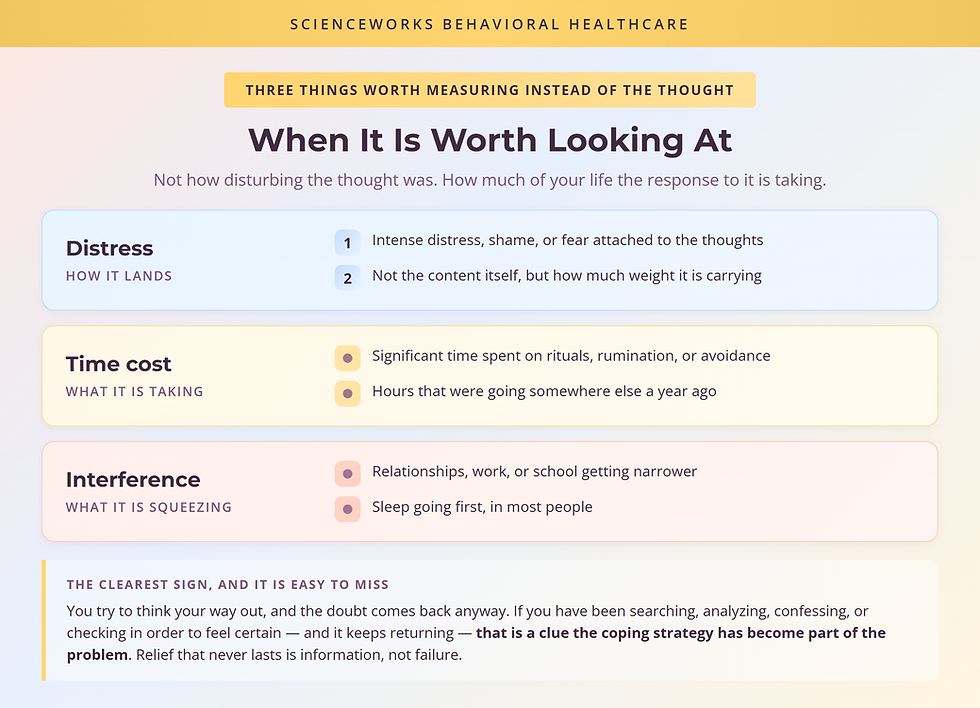
When to Consider Screening
Distress + time cost + interference
Consider a screening if:
Intrusive thoughts cause intense distress, shame, or fear
You spend significant time on rituals, rumination, or avoidance
Your relationships, work, school, or sleep are getting squeezed
Clinicians often assess severity and impairment with structured tools. The Yale-Brown Obsessive Compulsive Scale (Y-BOCS) is one widely used measure to rate obsession and compulsion severity. [9]
When you feel “stuck” no matter what you try
A common sign is: you try to “think your way out,” but the doubt returns again and again. If you’ve been Googling, analyzing, confessing, or checking to feel certain — and it keeps coming back — that’s a clue the strategy has become part of the problem. [3]
🧭 Key takeaway: When coping strategies start to look like rituals (and relief never lasts), it’s time to consider an OCD-informed assessment and plan. [3,9]
What Helps (Non-DIY, Safety-First)
Learning the pattern without feeding reassurance
A practical first step is learning to name what’s happening:
Intrusive thought (brain noise)
Alarm feeling (anxiety)
Urgency (“Fix this now”)
Ritual (the compulsion)
Noticing the pattern is different from debating the content of the thought. OCD treatment typically focuses on changing the response rather than proving the thought false. [3]
If you want to learn more about our approach, see OCD therapy and support at ScienceWorks and our overview of specialized therapy options.
Getting evidence-based support (ERP mentioned at a high level)
Evidence-based care for OCD often includes cognitive-behavioral therapy with Exposure and Response Prevention (ERP). At a high level, ERP helps you practice facing triggers while reducing rituals (including reassurance seeking and mental compulsions), so your brain can relearn that uncertainty and discomfort are tolerable. Guidelines and systematic reviews support CBT with ERP as a core treatment approach for OCD. [10,13]
If you’re searching for an online OCD therapist in Tennessee, telehealth can make OCD-specialized support more accessible. If telehealth isn’t a fit for your situation, an in-person evaluation may be the better starting point.
If you’re unsure whether what you’re experiencing is OCD, anxiety, trauma, or something else, a structured evaluation can help clarify next steps. You can learn more about psychological assessments.
Take the Screener + Next Steps
Access the Y-BOCS
If you want a quick, structured snapshot, you can start with our OCD screening page. It’s not a diagnosis — but it can help you organize symptoms (obsessions, compulsions, and impairment) and decide what to do next. [9]
Review additional screeners
You can also explore our broader mental health screening hub to see related screeners (like anxiety and depression measures) and choose the best fit for your concerns.
If reading this made you think, “This is me,” you don’t have to keep doing it alone. A calm next step is to reach out for a free consultation. We can help you decide whether therapy, assessment, or a combined approach makes the most sense right now.
Frequently Asked Questions
What's the difference between intrusive thoughts and OCD?
Intrusive thoughts are common — most people experience unwanted images, urges, or "what if" thoughts that feel out of character. They're typically transient and don't carry a strong meaning. OCD is when those thoughts become sticky because of the meaning your brain assigns ("if I can think it, it must say something true") and the rituals that follow (mental review, reassurance-seeking, avoidance). The thought itself isn't OCD; the response loop around it is.
Can you have intrusive thoughts without OCD?
Yes, and it's the norm. Research shows that unwanted intrusive thoughts occur in roughly 90% of the general population — covering taboo themes (harm, sex, religion, accidents) that don't reflect the person's values or intent. What separates OCD is what happens next: people without OCD let the thought pass, while people with OCD interpret it as meaningful or dangerous and engage in compulsions to neutralize it. Frequency, duration, and distress are what distinguish the two.
When does an intrusive thought become a compulsion?
A thought becomes part of the OCD cycle when it triggers a response designed to reduce uncertainty or distress — checking, washing, reviewing, asking for reassurance, mentally counting, avoiding triggers. The compulsion can be visible (asking "are you sure?") or hidden (silent reviewing, mental rituals). The defining feature is the function: if the response is meant to neutralize the thought or prevent a feared outcome, it's a compulsion, even if it looks like ordinary thinking.
Are intrusive thoughts dangerous, or a sign I'll act on them?
For most people, having a disturbing thought is not a sign of danger or hidden desire. Ego-dystonic thoughts - the ones that feel foreign and distressing - run opposite to what a person actually wants, which is why they cause anxiety rather than pleasure. Research going back decades shows these thoughts are common and are not predictive of acting on them. [1] The distress itself is a signal that the thought conflicts with a person's values, not evidence that anything will be acted on. That said, if a thought is tied to a genuine urge, a plan, or thoughts of harming yourself, that is a reason to reach out to a professional or emergency services right away.
Why do intrusive thoughts latch onto what I care about most?
It can feel cruel that the mind targets the exact things a person values most - being a good parent, a loyal partner, or a moral person. This tends to happen because the brain flags high-stakes topics as important, so a stray thought about something that matters grabs more attention and feels more urgent. When that thought is met with alarm and a search for certainty, the loop tightens. Understanding this pattern is usually more useful than trying to prove the thought false, which is one reason OCD treatment focuses on changing the response rather than debating the content. [3]
About ScienceWorks
Dr. Kiesa Kelly leads the ScienceWorks Behavioral Healthcare team and supports adults and teens with evidence-informed, specialized care. She has a PhD in Clinical Psychology with a concentration in Neuropsychology. [14]
Her training includes practica, internship, and an NIH-funded postdoctoral fellowship in university and medical settings. At ScienceWorks, she stays engaged in ongoing professional training and consultation. [14]
References
Rachman S, de Silva P. Abnormal and normal obsessions. Behav Res Ther. 1978;16(4):233-248. https://doi.org/10.1016/0005-7967(78)90022-0
American Psychiatric Association. What is obsessive-compulsive disorder? https://www.psychiatry.org/patients-families/obsessive-compulsive-disorder/what-is-obsessive-compulsive-disorder
Salkovskis PM. Obsessional-compulsive problems: a cognitive-behavioural analysis. Behav Res Ther. 1985;23(5):571-583. https://doi.org/10.1016/0005-7967(85)90105-6
Tolin DF, Abramowitz JS, Brigidi BD, Foa EB. Intolerance of uncertainty in obsessive-compulsive disorder. J Anxiety Disord. 2003;17(2):233-242. https://pubmed.ncbi.nlm.nih.gov/12614665/
Gentes EL, Ruscio AM. A meta-analysis of the relation of intolerance of uncertainty to symptoms of generalized anxiety disorder, major depressive disorder, and obsessive-compulsive disorder. Clin Psychol Rev. 2011;31(6):923-933. https://pubmed.ncbi.nlm.nih.gov/21664339/
Williams MT, Farris SG, Turkheimer E, et al. The myth of the pure obsessional type in obsessive-compulsive disorder. Depress Anxiety. 2011;28(6):495-500. https://pmc.ncbi.nlm.nih.gov/articles/PMC3227121/
Gillihan SJ, Williams MT, Malcoun E, Yadin E, Foa EB. Common pitfalls in exposure and response prevention (EX/RP) for OCD. J Obsessive Compuls Relat Disord. 2012;1(4):251-257. https://pmc.ncbi.nlm.nih.gov/articles/PMC3423997/
Sibrava NJ, Boisseau CL, Eisen JL, et al. Prevalence and clinical characteristics of mental rituals in a longitudinal study of obsessive-compulsive disorder. Depress Anxiety. 2011;28(10):892-898. https://pmc.ncbi.nlm.nih.gov/articles/PMC3188668/
Goodman WK, Price LH, Rasmussen SA, et al. The Yale-Brown Obsessive Compulsive Scale. I. Development, use, and reliability. Arch Gen Psychiatry. 1989;46(11):1006-1011. https://pubmed.ncbi.nlm.nih.gov/2684084/
National Institute for Health and Care Excellence (NICE). Obsessive-compulsive disorder and body dysmorphic disorder: treatment (CG31). 2005. https://www.nice.org.uk/guidance/cg31
Kobori O, Salkovskis PM. Patterns of reassurance seeking and reassurance-related behaviours in obsessive-compulsive disorder and anxiety disorders. Behav Cogn Psychother. 2013. https://www.cambridge.org/core/journals/behavioural-and-cognitive-psychotherapy/article/patterns-of-reassurance-seeking-and-reassurancerelated-behaviours-in-ocd-and-anxiety-disorders/34C1F20E285643D8D7FAD482052F3EA7
Haciomeroglu B. The role of reassurance seeking in obsessive compulsive disorder: the associations between reassurance seeking, dysfunctional beliefs, negative emotions, and obsessive-compulsive symptoms. BMC Psychiatry. 2020;20(1):356. https://pmc.ncbi.nlm.nih.gov/articles/PMC7339499/
Reid JE, Laws KR, Drummond L, et al. Cognitive behavioural therapy with exposure and response prevention in the treatment of obsessive-compulsive disorder: A systematic review and meta-analysis of randomised controlled trials. Compr Psychiatry. 2021;106:152223. https://pubmed.ncbi.nlm.nih.gov/33618297/
ScienceWorks Behavioral Healthcare. Dr. Kiesa Kelly. https://www.scienceworkshealth.com/kiesakelly
Disclaimer
This article is for informational purposes only and is not a substitute for professional diagnosis or treatment.