
How to Find Your Therapy Niche (or Stay a Generalist)

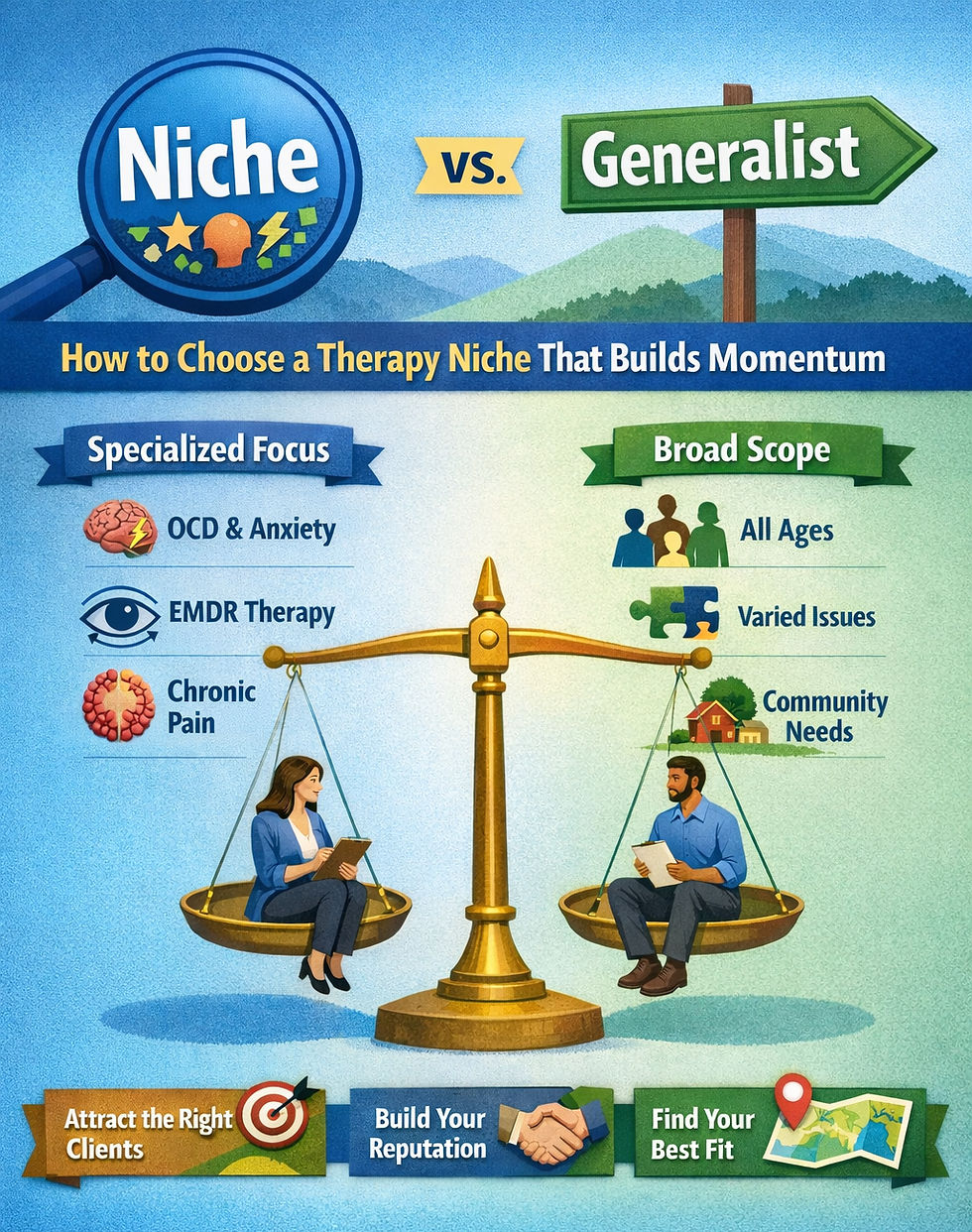
If you’re figuring out how to choose a therapy niche, you’re really deciding what you want to be known for. A niche can speed up referrals and marketing because it makes your message easier to understand. But being a generalist can be the most ethical option in some settings, especially early career or in rural/underserved areas.
In this article, you’ll learn:
When niches tend to build caseloads faster (and why)
When a generalist or “focused generalist” approach makes sense
Three ways to specialize as a therapist without boxing yourself in
How to position your private practice so referrals stick
A simple plan to start niche marketing for therapists
Why Niches Build Caseloads Faster (Most of the Time)
A niche is a clarity tool. It tells clients and referral partners, “Here’s what I help with, and here’s what you can expect.”
🔎 Key takeaway: Specificity reduces decision fatigue - and clarity earns trust.
Clarity earns trust
Most people don’t have the time (or the clinical language) to compare providers. They look for cues that signal “fit.” Research on specialist vs generalist sources shows that “specialist” framing can trigger higher trust, especially when people are processing information quickly.[1] In private practice, your niche does the same job: it makes your positioning feel safer and more credible.
A simple therapist positioning sentence can do a lot:
“I help adults with OCD using ERP and I-CBT.”
“I help teens with panic and avoidance using CBT and ACT.”
If you’re building a group practice message, you can also lead with a specialty “front door” like specialized therapy while still supporting a range of needs behind the scenes.
Referrers remember specialists
Referrals run on memory and relationships. In health care research, referrers often recommend a named specialist, and the choice is influenced by who they know and how easy it is to access and communicate with that clinician.[2][3]
Therapy is similar: a school counselor or prescriber will keep sending to the therapist who is easy to refer to, clear about fit, and reliable in follow-up.
🤝 Key takeaway: Referrers don’t just want “good clinicians” - they want a clear fit and a smooth handoff.
When Being a Generalist Makes Sense
Early-career learning curves
Early on, breadth helps you build clinical judgment. If you’re still accumulating supervised hours and figuring out your preferred approach, it’s okay if your “niche” is simply: skills-based therapy for common concerns.
To stay marketable without overclaiming, try a starter specialty:
One population (college students, parents, teens)
One problem cluster (anxiety + panic + sleep)
One style (CBT/ACT, trauma-informed, relational)
🌱 Key takeaway: You can market a direction while you’re still building depth.
Rural/underserved markets and access needs
In many communities, access is the niche. HRSA’s behavioral health workforce brief notes that more than half of the U.S. population lived in a Mental Health Professional Shortage Area as of December 2023.[4] Rural mental health guidance also highlights long travel distances, fewer providers, and limited specialty options.[5] In these settings, a broad scope can be a public good.
A “focused generalist” approach
A focused generalist is not “I treat everything.” It’s: “I’m broadly available, but I have a clear center of gravity.” Your website can name:
The top 3 issues you treat most often
The 1-2 populations you understand well
What you don’t treat (or when you refer out)
🧭 Key takeaway: A focused generalist message stays inclusive while still being memorable.
Three Ways to Choose a Therapy Niche (Without Boxing Yourself In)
Problem-based niche (e.g., panic, burnout, insomnia)
Problem-based niches are easy for clients to search and for referrers to remember. They also make content creation simple.
Example: an insomnia niche pairs well with structured treatment and can work via telehealth. A page like insomnia care shows the kind of clarity clients look for.
Population-based niche (e.g., teens, parents, neurodivergent adults)
Population-based niches help you speak the client’s language and build the right referral network.
Example: neurodivergent adults and parents often need both therapy and skills support. Many benefit from services like executive function coaching, which can clarify “therapy vs coaching” conversations.
Modality-based niche (e.g., ERP, EMDR, CBT-I) with guardrails
Modality-based niches can differentiate you quickly, but only if you have training and consultation to match. When you market a modality, include guardrails: what you treat, how you work, and what’s outside scope.
Example: ERP for OCD is highly recognizable. A specialty page like OCD treatment illustrates how a modality niche can be explained in plain language.
Common misconceptions (and what to say instead)
“A niche means I turn people away.” Try: “This is my primary focus, and I can help you find a better fit if needed.”
“I can’t niche until I’m an expert.” Ethical specialization is about honesty and competence-building, not perfection.[7][8]
“Niches are exclusionary.” You can be specific about what you often treat and still invite people to reach out.
🛠️ Key takeaway: Your niche is your headline; your scope statement is the fine print.
The “Overlap Method”: The Niche You Can Sustain
What you’re good at
Look for patterns in your best work: the cases that move, the sessions that feel grounded, the problems you can explain simply.
What you enjoy
Enjoyment predicts consistency. If you dread the work, you won’t market it, and your niche won’t stick.
What the market needs (and you can ethically serve)
“Need” includes waitlists, referral gaps, and access barriers. Telehealth can widen reach, and a national study of outpatient mental health treatment facilities found telehealth availability rose from 2019 to 2022.[6] Choose a niche where demand is real and your competence is clear.
📌 Key takeaway: Sustainable niches live at the intersection of skill, energy, and real-world demand.
A Worked Example of the Overlap Method
The Overlap Method is easier to trust when you can see it run. Picture a therapist three years into practice. Under "what I'm good at," a pattern keeps showing up: structured, skills-based work with anxious teens tends to move, and those sessions feel grounded in a way others don't. Under "what I enjoy," the same population lands near the top — the energy is there even at the end of a long week. Under "what the market needs," a scan of local referral sources turns up school counselors with nowhere to send anxious adolescents and long waitlists at the two nearby practices that take teens.
Where those three circles meet is the niche: structured anxiety therapy for adolescents. Notice what the method screened out. The therapist is also *competent* with adult couples, but doesn't enjoy it — that fails the "enjoy" test and would quietly erode over time. There's real demand for substance-use work locally, but it sits outside current training, so it fails the "ethically serve" test. The niche that survives all three filters is the one you can market consistently and sustain without burning out — which is the whole point.
How to Message Your Niche Without Excluding People
Inclusive language that still stays specific
Use “often,” “especially,” and “commonly” to stay open:
“I often work with…”
“This is especially common for…”
A simple template: “I help [population] with [problem cluster] using [approach], so they can [goal].”
Scope-of-practice and “when I refer out” statements
A short scope statement builds trust and reduces mismatched inquiries:
“If your needs are outside my scope, I’ll help you find a better-fit referral.”
Ethics codes emphasize practicing within competence and using supervision, training, or referral when extending into new areas.[7][8]
🔐 Key takeaway: Clear boundaries are a client-care practice, not a marketing trick.
How to Test Niche Demand Before You Commit
Before rebranding around a niche, it's worth checking that the demand is real, and a few low-cost signals do most of the work. Start with access gaps: more than half of the U.S. population lives in a designated Mental Health Professional Shortage Area, so in many regions the constraint isn't interest but availability — and the specific problems people can't get seen for point straight at underserved niches.[4] Ask the referral sources you already have what they struggle to place, and watch which of your own inquiries you currently turn away for lack of fit.
Reach is the other half of the test. A national study of outpatient mental health facilities found telehealth availability rose sharply from 2019 to 2022, which means a niche no longer has to be limited to who can drive to your office — a focused specialty can draw from a much wider area than a generalist practice down the street.[6] Practically, that lets you validate demand cheaply: publish one focused page, mention the niche to a handful of referral partners, and see whether relevant inquiries actually come in before you commit your whole brand to it.
Turning One Good Referral Source Into Five
Referrals run on memory and relationships: partners tend to keep sending to the clinician who is clear about fit, easy to reach, and reliable in follow-up.[2,3] The fastest way to grow is usually not to find five new sources at once, but to deepen the one relationship already working and let it model the rest. Start by making that partner's job effortless — a one-line description of exactly who you're best for, a simple way to reach you, and a quick note back when a referral lands so they know the loop closed.
From there, expand deliberately. Ask your best source who *they* refer to for the cases you don't take; those adjacent providers are natural two-way partners. Aim for five relationships, not fifty — a school counselor, a prescriber, a primary-care contact, one adjacent specialist, and one former colleague is plenty to keep a focused caseload full. Each one only needs to remember a single, clear sentence about your niche, which is exactly why a specific focus outperforms "I see everyone" when someone is deciding where to send a person who needs help.
Niche Growth Plan: One Channel + One Referral Path
Content topics that match your niche
Pick one channel for 90 days and repeat 6-8 topics that match your niche. For example:
“Panic vs anxiety: what’s the difference?”
“Burnout signs and recovery basics”
“What to expect from CBT-I”
“ERP myths that keep people stuck”
The 5 people who can send you ideal referrals
Choose five referral partners and build real relationships:
Primary care clinics
Psychiatrists / psychiatric NPs
School counselors
Pediatricians (for teen anxiety + ADHD overlap)
Therapists who don’t treat your niche
Your outreach can be one simple email: who you’re best for, what you offer, and how to refer.
🤝 Key takeaway: Momentum comes from repetition - in message, channel, and referral relationships.
If You Want to Build a Niche With Practice-Level Support
What support should include (content, systems, admin)
Practice-level support should reduce friction: admin help, consult groups, strong systems, and content support so your message stays consistent. It should also offer a team who can receive and redirect referrals when someone isn’t a fit.
You can meet our clinicians and specialty areas on our Meet Us page.
If you’re exploring team-based specialty care, reach out through our careers page.
Frequently Asked Questions
Does a therapist who has a specific niche rank better on Google?
Niches help on search the same way they help in conversation: they make your message easy to understand. Problem-based niches in particular are easy for clients to search for and for referrers to remember, which supports your visibility on a niche-specific page over time. SEO ranking depends on many factors, but a clear, specific niche gives you a stronger claim to a focused topic than a generalist page covering everything.
How do generalist therapists attract clients compared to specialists?
Generalists often attract clients through breadth, access, and relationships rather than specialty positioning. In rural or underserved areas, where more than half of the U.S. population lives in a Mental Health Professional Shortage Area, broad scope is itself a public good. A "focused generalist" approach can also work: be broadly available, but name the top three issues you treat most often, the populations you understand well, and what you don't treat or refer out.
How do you figure out your niche as a therapist?
Use the Overlap Method: look for the intersection of what you're good at, what you enjoy, and what the market actually needs. "Good at" shows up in patterns - the cases that move, the sessions that feel grounded. Enjoyment predicts consistency, because if you dread the work you won't market it. "Need" includes waitlists, referral gaps, and access barriers in your area. A sustainable niche lives where all three overlap.
About ScienceWorks
Dr. Kiesa Kelly the founder and clinical psychologist (neuropsychologist by training) at ScienceWorks Behavioral Healthcare. She earned her PhD in Clinical Psychology (Neuropsychology) from Rosalind Franklin University of Medicine and Science and completed practica, internship, and an NIH-funded postdoctoral fellowship at the University of Chicago, the University of Wisconsin, the University of Florida, and Vanderbilt University.
Her clinical work includes specialized therapy and assessment, with a focus on OCD, trauma, insomnia, and neurodivergence, and she provides telehealth across many states.
References
Koh YJ, Sundar SS. Heuristic versus systematic processing of specialist versus generalist sources in online media. Hum Commun Res. 2010;36(2):103-124. doi: https://doi.org/10.1111/j.1468-2958.2010.01370.x
Forrest CB, Nutting PA, Starfield B, von Schrader S. Family physicians’ referral decisions: results from the ASPN referral study. J Fam Pract. 2002;51(3):215-222.
Barnett ML, Keating NL, Christakis NA, O’Malley AJ, Landon BE. Reasons for choice of referral physician among primary care and specialist physicians. J Gen Intern Med. 2012;27(5):506-512. doi: https://doi.org/10.1007/s11606-011-1861-z
Health Resources and Services Administration (HRSA), National Center for Health Workforce Analysis. Behavioral Health Workforce, 2023. December 2023. https://bhw.hrsa.gov/sites/default/files/bureau-health-workforce/Behavioral-Health-Workforce-Brief-2023.pdf
Rural Health Information Hub. Rural Mental Health. https://www.ruralhealthinfo.org/topics/mental-health
McBain RK, Schuler MS, Qureshi N, et al. Expansion of telehealth availability for mental health care after state-level policy changes from 2019 to 2022. JAMA Netw Open. 2023;6(6):e2318045. doi: https://doi.org/10.1001/jamanetworkopen.2023.18045
American Psychological Association. Ethical Principles of Psychologists and Code of Conduct (with 2010 amendments). https://dchealth.dc.gov/sites/default/files/dc/sites/doh/publication/attachments/ETHICAL%20PRINCIPLES%20OF%20PSYCHOLOGISTS%20and%20CODE%20OF%20CONDUCT.pdf
American Counseling Association. ACA Code of Ethics. 2014. https://www.counseling.org/resources/aca-code-of-ethics.pdf
Disclaimer
This content is for informational purposes only and is not a substitute for professional clinical, legal, or business advice.