
PDA in an AuDHD Child: When Demand Avoidance Sits on Top of Both Profiles

Last reviewed: 09/08/2026
Reviewed by: Dr. Kiesa Kelly

You already know what demand avoidance looks like in your house. What is harder to see is that the same refusal can come from two different places on two different days. That is the particular problem of PDA in an AuDHD child — a child who is both autistic and ADHD — and it is why a strategy that worked beautifully last month can stop working without warning.
Before anything else: PDA is not a diagnosis. It appears in neither the DSM-5-TR nor ICD-11 [6][7]. It is a descriptive label for a pattern of behaviour, not something a clinician can diagnose your child with, and we have written separately about what clinicians actually mean when they say PDA.
So this is not another explainer on what demand avoidance is. It is about the interaction — what changes when both profiles are present at once, and why the supports that help one can quietly undo the other.
In this article, you'll learn:
What parents are usually describing when both profiles are in the room at once
Why the same refusal can come from autistic uncertainty or from ADHD activation cost
What the research actually says about the ADHD link, and what it does not say
Where low-demand and ADHD strategies pull against each other, and what to do when one backfires
What to bring to an assessment, and what an assessment can and cannot settle
What parents describe when both profiles are in the room
Most parents who come to us are not confused about whether something is going on. They are confused about the inconsistency.
Here is one version. Your son will not put his shoes on. On Tuesday you gave him a five-minute warning, a visual timer and a calm script, and he was out the door. On Thursday you did the same thing and he ended up under the kitchen table shouting that you never listen to him. Nothing about the shoes changed. What changed is that Thursday came after an unannounced school assembly, and by three o'clock his capacity for anything that felt imposed was gone. From the outside it reads as inconsistency, or as you being inconsistent. From the inside it is two different systems running out of room on different days.
Or: your daughter cannot start a ten-minute worksheet. She has not been able to start it for three days and she cries when you mention it. That same afternoon she reorganises her whole bedroom unprompted and makes a labelled inventory of everything in it. When you point out the contradiction she agrees with you completely, and still cannot start the worksheet. This is the pattern that most often gets a child called lazy, and one of the clearest signs that something structural is happening rather than something motivational.
Or: you ask "do you want a sandwich?" and get a flat no. You put a sandwich on the table without comment and it gets eaten. Being asked created a demand that eating did not. Parents usually find this by accident and then feel odd about it, as though sidestepping the question were a trick. It is not. It is an observation about where the pressure actually sits, and it is one of the most useful things to bring to a comprehensive psychological assessment.
If you are still working out whether what you are seeing is demand avoidance at all, our parent's guide to PDA in neurodivergent kids covers the ground-level signs. This article assumes you are past that point.
🧩 Key takeaway: When both profiles are present, the inconsistency is usually the signal — not noise on top of the real problem.
Three things you have probably been told that do not hold here
"He can do it when he wants to, so it is a choice." In reality, capacity for demands fluctuates with load in both profiles, and for different reasons. A child can be genuinely unable to start something at four o'clock that they managed at ten. What a child can do on their best day tells you about their ceiling, not their average, and parenting to the ceiling is what produces the escalations.
"You need to be more consistent." Consistency of expectation helps. Consistency of delivery — the same script, the same tone, the same sequence every time — can make things worse for a child already reading every repeated instruction as a rising demand. Keep the boundary steady. Let how you get there flex.
"It is an autism thing, so treat the autism and the rest follows." This is the assumption most competing pages make, and it is the one that costs AuDHD families the most. Newson's original account proposed demand avoidance as a distinct entity within the pervasive developmental disorders, explicitly contrasting it with classic autism and Asperger's [5], but the research has not established it as a valid independent syndrome. A 2018 Viewpoint in The Lancet Child & Adolescent Health — expert opinion rather than a trial — concluded that the evidence does not support its validity as an independent syndrome, and that these difficulties are best understood through a child's autism-related social, sensory and cognitive sensitivities together with the conditions that frequently co-occur alongside them [3]. Those co-occurring conditions are exactly what an autism-only evaluation stops short of, and in an AuDHD child ADHD is one of them.
🔍 Key takeaway: Treating demand avoidance as a behaviour problem to be out-consistented is the single most common way a support plan for an AuDHD child fails.
Why the same refusal comes from two different places
Autism and ADHD co-occur often enough that treating them as alternatives is a mistake. A meta-analysis pooling 56 studies found a current prevalence of ADHD among autistic individuals of 38.5% (95% CI 34.0–43.2); across the 13 studies reporting lifetime rates the figure was 40.2% [2]. Roughly two in five autistic people also meet criteria for ADHD, which means the AuDHD child is not an exotic case.
The most decision-relevant finding here comes from an adult study. Egan, Bull and Trundle recruited 132 community adults, 126 of them with complete data, and asked which traits predicted self-reported demand avoidance. ADHD traits correlated with demand avoidance at r = 0.71 (p < 0.001), while the correlation with autistic traits was small and autistic traits did not predict demand-avoidance scores [1]. That sample was adult, community-recruited and entirely self-report, so it is not a finding about children and cannot be read as one. What it does is unsettle a common assumption: in adults, the ADHD link is the stronger one, which is why a child with both profiles is not simply an autistic child with extra difficulty.
Hold that alongside the mechanisms, because the mechanisms are what you can act on.
On the autistic side, the cost is usually about uncertainty and control. A systematic review and meta-analysis found a consistent relationship between intolerance of uncertainty and anxiety in autistic people [8]. A demand is not just a task; it is a commitment to an outcome the child cannot yet see. Refusal here clusters around transitions, changes to a plan, instructions with unstated endings ("we'll tidy for a bit"), and anything that removes the child's ability to predict what happens next.
On the ADHD side, the cost is usually about activation and effort. The task is not threatening — it is boring, or effortful, or has no immediate payoff, and the system that turns intention into movement does not engage. Refusal here clusters around low-interest tasks regardless of predictability, around a delay between effort and reward, and around the second and third steps rather than the first. It lifts sharply when the task becomes interesting or urgent, which is the pattern the bedroom example describes. We cover the adult version of this overlap in our piece on demand avoidance in an ADHD brain.
The distinguishing pattern: autistic-side avoidance is shaped by uncertainty — it rises when the world becomes unpredictable and falls when it becomes legible. ADHD-side avoidance is shaped by effort and interest — it rises when a task is dull or delayed and falls when it becomes engaging or urgent.
One aside worth naming: many parents recognise the second description in themselves while reading it, and that matters, because running low-demand scaffolding is an executive-function-heavy job. The ASRS is an adult self-report screener with published validation [15]. It is a starting point for an adult, not a tool for your child, and no screener diagnoses anyone.
⚖️ Key takeaway: Ask what the refusal is protecting against. Uncertainty and effort feel identical from the doorway and call for opposite responses.

When one profile's supports backfire on the other
Predictability versus novelty
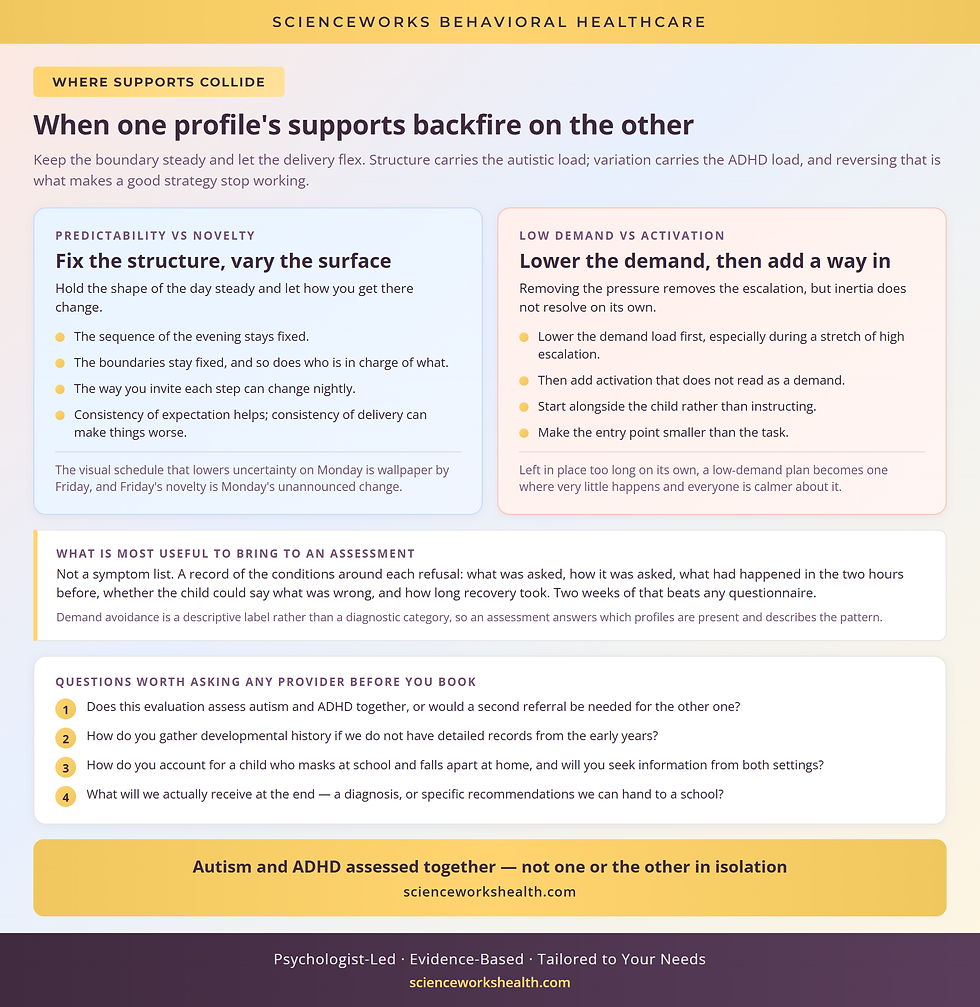
Autism-informed support leans on predictability: visual schedules, advance warning, the same order every time, no surprises — the emphasis running through the NICE guidance on supporting autistic children [11]. ADHD-informed support leans on novelty and salience: change the format, make it a race, add music, do it somewhere different, because the same routine loses its grip.
Run both on the same child and they collide. The visual schedule that lowers uncertainty on Monday is wallpaper by Friday. The novelty that gets a task started on Friday is an unannounced change on Monday.
What we look for is which cost is louder. Keep the structure stable — the sequence of the evening, the boundaries, who is in charge of what — and let the surface vary. The order of the bedtime routine stays fixed; the way you invite each step can change nightly. Structure carries the autistic load; variation carries the ADHD load.
Low demand versus activation
Lowering the demand load is what parents and clinicians most often report helping when a child's system is saturated, and it is a reasonable place to start during a period of high escalation — though the intervention evidence behind it is still early, as the evidence section below sets out. Our companion piece on low-demand parenting for a PDA child covers how to triage which demands to drop, defer or keep.
The tension is that ADHD-side inertia does not resolve on its own when pressure is removed. Removing the demand removes the escalation, which is a real gain, but the task still does not start. Left in place too long, a low-demand approach can become a plan where very little happens and everyone is calmer about it.
The move is not to choose. It is to lower the demand and then add activation that does not read as a demand — starting alongside the child rather than instructing, doing the first step out loud, making the entry point smaller than the task. This gets built collaboratively rather than prescribed, and it is a common focus of specialized therapy work with neurodivergent families.
For older children and teenagers, the scaffolding side overlaps with executive-function coaching.
A decision rule you can use tonight
If the refusal came with fear, rigidity or a need to control the terms — if it spiked at a change of plan, an unclear ending or a loss of choice — treat it as an uncertainty cost. Lower the stakes, make the ending visible, give real choices, stop negotiating.
If it came with flatness, drift or "I'll do it in a minute" repeated for two hours — if it lifted the moment the task got interesting — treat it as an activation cost. Shrink the first step, start it with them, add interest rather than pressure.
If both are true at once, which is common, handle the uncertainty first. A dysregulated child is rarely reachable by activation strategies; a regulated child often is.
🔋 Key takeaway: Structure the day for the autistic load and vary the surface for the ADHD load. Reversing that is what makes a good strategy stop working.
What to bring to an assessment, and what it can and cannot settle
Be clear about what an assessment is for. Because PDA is not a diagnostic category, no assessment will come back saying your child has PDA. What a good one can do is assess whether autism, ADHD, or both are present, and describe the demand-avoidance pattern in enough detail to build a plan around. Both the NICE autism guidance for under-19s [10] and the NICE ADHD guidance [9] describe a diagnostic process built on developmental history and information from more than one setting, and the American Academy of Pediatrics guideline makes the same point about ADHD in children [12].
What is most useful to bring is not a symptom list. It is a record of the conditions around each refusal: what was asked, how it was asked, what had happened in the two hours before, whether the child could say what was wrong, how long recovery took. Two weeks of that beats any questionnaire.
Questions worth asking any provider before you book:
Does this evaluation assess autism and ADHD together, or would a second referral be needed for the other one?
How do you gather developmental history if we do not have detailed records from the early years?
How do you account for a child who masks at school and falls apart at home, and will you seek information from both settings?
What will we actually receive at the end — a diagnosis, or specific recommendations we can hand to a school?
How do you describe demand avoidance in a report, given that it is not a diagnostic category?
The last one matters more than it sounds. A report that only records "non-compliance" will follow your child through school; a report that describes the conditions under which demands succeed or fail is a document you can use. You can read about our clinicians on the meet our team page.
Our PDA and demand-avoidance support for families in Tennessee page sets out what family-facing support looks like here.
📋 Key takeaway: An assessment cannot diagnose PDA. It can usually tell you which profiles are present and describe the pattern precisely enough to be useful at school.
Where the evidence actually stands
We would rather say this plainly than let a confident tone imply more than the literature supports. The demand-avoidance profile is described consistently by parents and clinicians, but it is not a recognised diagnosis, its prevalence and cause are not established [14], and a 2026 systematic review found the identification tools inconsistent and the underlying studies at high risk of bias [4]. Intervention research is early too: a 2026 pilot of a twelve-week parent training programme reported good acceptability and improved parent quality of life, but it was a single-group study with no control condition [13]. None of that makes what you are seeing less real. It means the pattern is well described and poorly explained, and anyone promising a protocol with strong evidence behind it is ahead of the field.
🌱 Key takeaway: The pattern is real and well described. The science behind it is early, and a support plan should be treated as a working hypothesis you revise.
Where this leaves you
If you have been running a support plan that half works, the odds are good that it is well matched to one of your child's profiles and poorly matched to the other. That is a fixable problem, and a much better one than most parents think they have.
Start by separating the two costs. For a week, note whether each refusal looked more like uncertainty or more like inertia. Keep the boundaries steady and let the delivery change. When something stops working, ask which load went up rather than assuming the strategy was wrong. And if you cannot tell which profile you are looking at — a legitimate place to be, not a failure of observation — that is exactly the question an evaluation is built to answer.
Ready for an AuDHD-specialized evaluation?
If the patterns above feel familiar, an evaluation that looks at autism and ADHD together — not one or the other in isolation — can help name what's actually driving the overload.
Frequently Asked Questions
Is demand avoidance a symptom of ADHD or autism?
Demand avoidance is not a diagnostic symptom of either condition. It is a description of behaviour that can appear in autistic children, in children with ADHD, and in children who have both. The evidence is still unsettled about which profile drives it. In one adult community study, ADHD traits tracked demand-avoidance scores far more closely than autistic traits did, but that finding has not been established in children.
Is PDA a trauma response in children?
The research has not established a cause for PDA-style demand avoidance, and there is no established evidence that it is caused by trauma, but the two can look very similar from the outside and can occur in the same child. A child who has learned that demands usually end badly may resist them in ways that resemble a PDA profile, and a child with a PDA profile can also have a trauma history. This is why a careful developmental and family history matters more than reading the behaviour alone.
What does a PDA meltdown look like?
It usually looks like a nervous system that has run out of room rather than a tantrum with a goal. Escalation often builds from a demand the child could not negotiate around, and it can include shouting, fleeing, freezing, going silent, or shutting down completely. Afterwards many children are exhausted and remorseful rather than satisfied. Regular escalation to that point is usually a signal that the demand load is too high, not that firmer consequences are needed.
About the Author
Dr. Kiesa Kelly is a licensed clinical psychologist, a neuropsychologist by training, and owner of ScienceWorks Behavioral Healthcare. She holds a PhD in Clinical Psychology with a concentration in Neuropsychology from Rosalind Franklin University of Medicine and Science, and she has more than 20 years of experience with psychological assessment.
Dr. Kelly's background is directly relevant to this article. Her NIH National Research Service Award postdoctoral fellowship, held at Vanderbilt University and the University of Florida, focused on ADHD in both a research and a clinical capacity, including an original study of cognitive control processes in children with ADHD and clinical neuropsychological work with children. Her practica and internship were completed at the University of Chicago, the University of Wisconsin and the University of Florida. She has since sought out further consultation in neuroaffirming ADHD and autism assessment, and she is also the parent of an autistic young adult.
References
1. Egan V, Bull E, Trundle G. Individual differences, ADHD, adult pathological demand avoidance, and delinquency. Research in Developmental Disabilities. 2020;105:103733. https://doi.org/10.1016/j.ridd.2020.103733
2. Rong Y, Yang CJ, Jin Y, Wang Y. Prevalence of attention-deficit/hyperactivity disorder in individuals with autism spectrum disorder: A meta-analysis. Research in Autism Spectrum Disorders. 2021;83:101759. https://doi.org/10.1016/j.rasd.2021.101759
3. Green J, Absoud M, Grahame V, Malik O, Simonoff E, Le Couteur A, Baird G. Pathological Demand Avoidance: symptoms but not a syndrome. The Lancet Child & Adolescent Health. 2018;2(6):455-464. https://doi.org/10.1016/S2352-4642(18)30044-0
4. Company D, Rotella JA. A Systematic Review of Pathological Demand Avoidance (PDA): A Veritable Diagnosis or a Case of Circular Logic? Journal of Autism and Developmental Disorders. 2026. https://doi.org/10.1007/s10803-026-07432-y
5. Newson E, Le Marechal K, David C. Pathological demand avoidance syndrome: a necessary distinction within the pervasive developmental disorders. Archives of Disease in Childhood. 2003;88(7):595-600. https://doi.org/10.1136/adc.88.7.595
6. American Psychiatric Association. Diagnostic and Statistical Manual of Mental Disorders, Fifth Edition, Text Revision (DSM-5-TR). https://www.psychiatry.org/psychiatrists/practice/dsm
7. World Health Organization. ICD-11 for Mortality and Morbidity Statistics. https://icd.who.int/browse11/l-m/en
8. Jenkinson R, Milne E, Thompson A. The relationship between intolerance of uncertainty and anxiety in autism: A systematic literature review and meta-analysis. Autism. 2020;24(8):1933-1944. https://doi.org/10.1177/1362361320932437
9. National Institute for Health and Care Excellence. Attention deficit hyperactivity disorder: diagnosis and management. NICE guideline NG87. https://www.nice.org.uk/guidance/ng87
10. National Institute for Health and Care Excellence. Autism spectrum disorder in under 19s: recognition, referral and diagnosis. Clinical guideline CG128. https://www.nice.org.uk/guidance/cg128
11. National Institute for Health and Care Excellence. Autism spectrum disorder in under 19s: support and management. Clinical guideline CG170. https://www.nice.org.uk/guidance/cg170
12. Wolraich ML, Hagan JF, Allan C, et al. Clinical Practice Guideline for the Diagnosis, Evaluation, and Treatment of Attention-Deficit/Hyperactivity Disorder in Children and Adolescents. Pediatrics. 2019;144(4):e20192528. https://doi.org/10.1542/peds.2019-2528
13. Carlozzi NE, Lombard WL, Troost JP, Graves CM, Miner JA, Fauser AT, Ehrlich C. A comprehensive parent training program for parents of neurodivergent children with pathological demand avoidance: The Paradigm Shift Program Pilot Study. Pediatric Investigation. 2026;10(3):249-257. https://doi.org/10.1002/ped4.70028
14. Gillberg C, Larsson Y, Billstedt E. Extreme or pathological demand avoidance: prioritising research to understand the prevalence and cause. The Lancet Child & Adolescent Health. 2024;8(7):471-473. https://doi.org/10.1016/S2352-4642(24)00057-9
15. Kessler RC, Adler LA, Gruber MJ, Sarawate CA, Spencer T, Van Brunt DL. Validity of the World Health Organization Adult ADHD Self-Report Scale (ASRS) Screener in a representative sample of health plan members. International Journal of Methods in Psychiatric Research. 2007;16(2):52-65. https://doi.org/10.1002/mpr.208
Disclaimer
This article is for informational purposes only and is not a substitute for individual clinical assessment, diagnosis or treatment. Reading it does not create a clinician-patient relationship. If you have concerns about your child's development or wellbeing, speak with a qualified clinician. If you or your child are in crisis, contact 988 (Suicide and Crisis Lifeline) or your local emergency services.