
Perfectionism OCD: When "It Has to Be Right" Becomes a Compulsion (and How I-CBT Helps)

Updated: 4 days ago
Last reviewed: 07/10/2026
Reviewed by: Dr. Kiesa Kelly
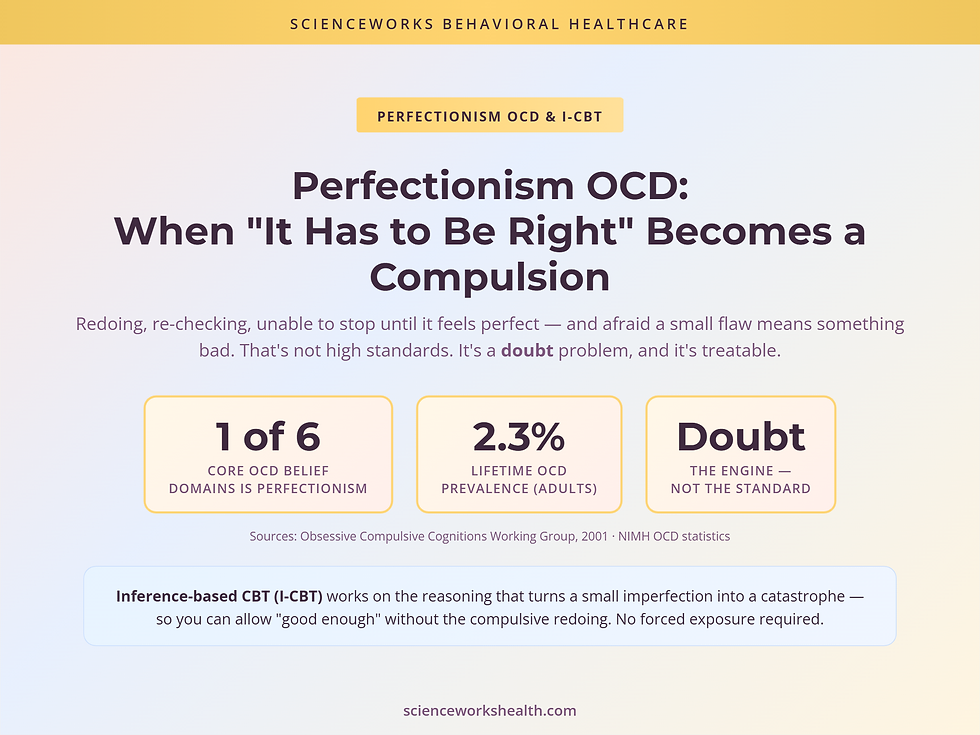
You rewrite the email for the fifth time. You reread the report looking for the mistake you are sure is hiding somewhere. You cannot start the project because starting means risking doing it imperfectly, and imperfectly feels unbearable — like proof you are careless, or that something bad will follow. If your "perfectionism" has stopped being a strength and started running your days, you may be dealing with something more specific than a personality trait. Clinicians call it perfectionism OCD.
This is one of the more misunderstood faces of obsessive-compulsive disorder, because our culture praises perfectionism and treats it as ambition. But when the standard becomes a compulsion — when you cannot stop, and imperfection carries catastrophic meaning — it behaves like OCD and responds to OCD treatment.
In this article, you'll learn:
What perfectionism OCD is, and why it is a compulsion rather than a character trait
What it looks like from the inside, with recognizable examples
How to tell healthy high standards apart from perfectionism OCD — and from autistic perfectionism
Why "just try harder" and "just lower your standards" both fail
How inference-based CBT (I-CBT) works on the doubt behind perfectionism OCD
The short answer: when perfectionism is OCD, not just a personality trait
Perfectionism OCD is a presentation of OCD in which the obsession is organized around getting things right and the fear of what an imperfect result would mean. It is not a stand-alone diagnosis. But perfectionism is one of the well-established belief patterns at the heart of OCD: the international research group that mapped OCD's core cognitions identified perfectionism — "beliefs that imperfection and mistakes cannot be tolerated" — as one of six central domains, alongside intolerance of uncertainty and inflated responsibility [1]. This is exactly the reasoning that I-CBT for perfectionism is designed to address.
The core feature is not high standards. It is the compulsive, distressing pursuit of an impossible certainty that a thing is "right," paired with a catastrophic meaning attached to getting it wrong. In OCD, the mind treats an imagined possibility as if it were a probability [2] — here, the imagined possibility that a small flaw signals something dangerous about you or the future. The standard is not the problem. The doubt, and the compulsion it drives, are.
🧩 Key takeaway: Perfectionism OCD is not about wanting things to be good. It is about a fear that imperfection is dangerous, and a compulsion to redo, re-check, or avoid until an impossible feeling of "right" is reached — which is exactly why it never lasts.
If this pattern is familiar, it helps to understand where it sits within OCD. Our overview of OCD services explains how obsessions and compulsions show up across themes, and a validated screener like the OCD symptom screener can help you see whether what you are living with matches the OCD pattern.
What perfectionism OCD looks like
Picture writing a two-line message to a colleague. You draft it, reread it, and something feels off — not wrong exactly, just not right. You rewrite it. Now a different word bothers you. Twenty minutes later you have sent nothing, and the small task has eaten a chunk of your afternoon and a lot of your energy. The relief when you finally hit send lasts about as long as it takes for the next task to start the cycle again.
Or picture finishing a piece of work that is, by any reasonable measure, fine. But you cannot let it go, because a thought has taken hold: *what if I missed something, and it turns out badly, and it is my fault?* So you check it again. And again. Each pass is supposed to deliver certainty, and each pass instead surfaces a new thing to doubt. The checking does not calm the fear; it feeds it.
What these share is the shape of OCD, not the content. There is an intrusive doubt about correctness or consequence, a spike of distress, and a compulsion — redoing, re-reading, checking, seeking reassurance, or avoiding the task entirely — that briefly lowers the distress and then strengthens it. The uncomfortable "not right until it's perfect" sensation that drives the redoing is well documented in OCD research, where it is closely tied to maladaptive perfectionism and a felt sense of incompleteness [3].
Healthy high standards vs. perfectionism OCD vs. autistic perfectionism
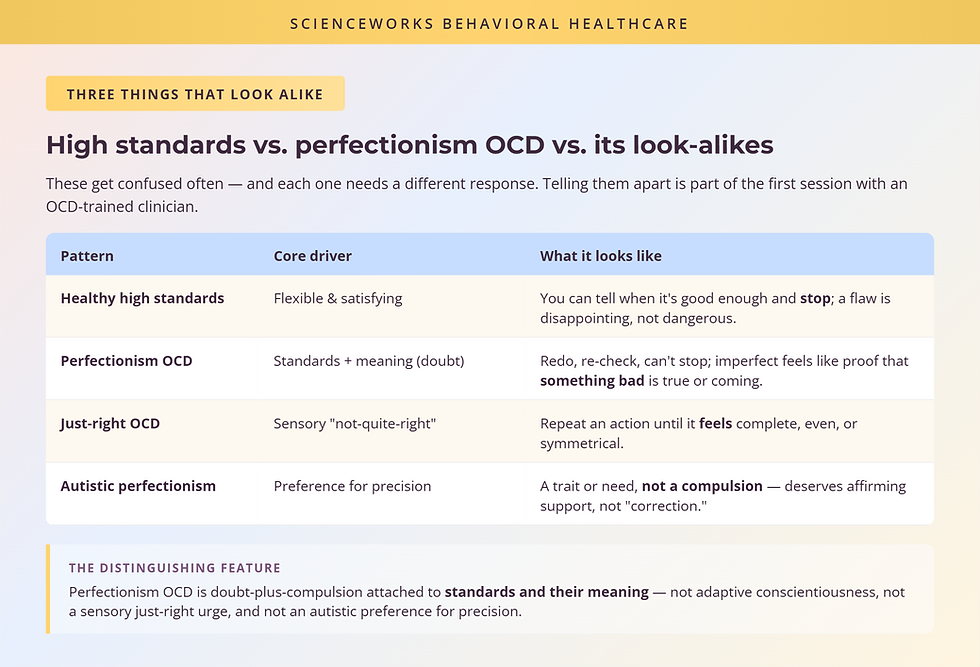
Three things that look similar from the outside are quite different underneath, and telling them apart changes what helps.
"If I have high standards, that just means I'm conscientious." Healthy high standards are flexible and, ultimately, satisfying. You can tell when something is good enough, you can stop, and a small imperfection is disappointing rather than dangerous. Perfectionism OCD is rigid and distressing: you cannot reliably tell when to stop, the doubt persists even when the work is objectively fine, and imperfection feels catastrophic. The presence of distress and compulsion — not the height of the standard — is what points to OCD.
"Perfectionism OCD is the same as needing things to feel 'just right.'" They overlap, but they are not identical. Just-right OCD tends to center on a sensory *not-quite-right* feeling — repeating an action until it feels complete, even or symmetrical. Perfectionism OCD tends to center on standards and *meaning* — the fear that an imperfect result proves something bad about you or predicts a bad outcome. Both are recognized OCD presentations, and the felt sense of incompleteness can appear in each [3]; a clinician can help you see which pattern is driving your loop.
"This is just how my autistic brain works." For some neurodivergent people, a strong preference for precision, routine, or a particular way of doing things is part of an autistic profile — not an OCD compulsion, and not something to be "corrected." Autistic perfectionism and the exhaustion of masking are a different lane, with different support needs, and they deserve their own care rather than being folded into an OCD frame. Sorting out which is which matters, because pathologizing an autistic trait as a compulsion is its own kind of harm.
📋 Key takeaway: The distinguishing feature of perfectionism OCD is doubt-plus-compulsion attached to *standards and their meaning* — not adaptive conscientiousness, not a sensory just-right urge, and not an autistic preference for precision.
Why "just try harder" and "just lower your standards" both fail
The two most common pieces of advice given to perfectionists are opposite, and both miss.
"Just try harder to get it perfect" pours fuel on the fire — it treats the impossible certainty as reachable, so you chase it longer. "Just lower your standards" misreads the problem entirely: perfectionism OCD is not driven by standards that are too high, it is driven by a fear that imperfection is *dangerous*. Telling someone to care less does not touch the fear, and it often lands as shaming — as if the person is choosing to be rigid. Neither approach addresses the actual mechanism, which is the doubt-driven leap from "this has a small flaw" to "therefore something bad is true or coming."
🔁 Key takeaway: Redoing, re-checking, and reassurance-seeking are compulsions. They lower distress for a moment and deepen the doubt over time — which is why "try harder" makes it worse and "lower your standards" misses the point.
How I-CBT helps with perfectionism OCD
Two evidence-based psychotherapies address OCD directly, and both are worth understanding. This is where inference-based cognitive behavioral therapy, or I-CBT, is often a strong fit for perfectionism, because of where it aims. Our specialized therapy team includes clinicians trained in this approach.
The doubt behind "it's not good enough"
I-CBT starts from the idea that an OCD episode begins with a reasoning error: trusting an imagined story over the evidence in front of you [2][4]. In perfectionism OCD, that looks like a small, neutral fact — a typo, an unfinished edge, a task done at 90 percent — getting spun into a catastrophe: *this proves I am careless; something will go wrong; it will be my fault.* The imperfection is real; the meaning your mind attaches to it is the invented part. I-CBT treats that leap as the target.
Loosening the perfectionistic reasoning story
Rather than arguing about whether the work is good enough, or drilling you to tolerate imperfection through repeated exposure, I-CBT helps you notice the moment your reasoning departs from reality and drifts into the "it has to be perfect or else" story. You learn to recognize that story as a story, and to return to reality-based judgment — the ordinary, workable sense of "this is finished and fine" that OCD has hijacked. As the doubt loses its authority, the compulsion to redo and re-check loses its fuel.
I-CBT and ERP for perfectionism — how they complement
Exposure and response prevention (ERP) is the long-established, first-line psychotherapy for OCD, recommended by major clinical practice guidelines, with the strongest track record of any psychological treatment for the condition [5][6]. For perfectionism, ERP might involve deliberately leaving something imperfect and resisting the urge to fix it, so the anxiety subsides on its own.
I-CBT is a more recently studied, evidence-based alternative that does not rely on exposure. In a 2024 multisite randomized controlled trial comparing I-CBT and CBT (including ERP) for OCD, the two produced comparable reductions in symptom severity with no statistically significant difference between them, and participants rated I-CBT as more acceptable — though the trial's formal non-inferiority test was inconclusive, so I-CBT is best understood as a promising, well-supported option rather than a proven equal on every measure [7][8]. Neither is a cure, and neither asks you to abandon caring about your work. For doubt-driven perfectionism, many people find the inference-based angle a natural fit, and a clinician can help you choose.

What treatment looks like at ScienceWorks
Care here starts with sorting out what you are dealing with. In an early session, we map how the perfectionism shows up — the triggers, the specific fear, the redoing and checking — and we distinguish perfectionism OCD from adaptive high standards, from just-right OCD, and from an autistic profile, so the plan fits the pattern. We match you with a clinician experienced in OCD, and the work draws on I-CBT and, when it fits, ERP. When procrastination-by-perfection is part of the picture, we may also weave in executive-function coaching so the practical follow-through improves alongside the doubt work.
We provide this care by secure telehealth across Tennessee, with in-person visits available at our Nashville office. As a neurodivergent-affirming practice, we never treat your standards as a character flaw or tell you to simply care less — we help ease the fear while protecting what genuinely matters to you.
When perfectionism is worth getting help for
Consider reaching out when the perfectionism is costing you real time, energy, or opportunities — hours lost to redoing and re-checking, tasks avoided or missed because starting imperfectly feels unbearable, procrastination driven by dread rather than laziness, or a steady background fear that one mistake will prove something terrible. You do not need to be certain it is OCD before booking a consultation; sorting that out is part of the first conversation.
Think it might be OCD?
OCD responds well to the right approach — a clinician trained in ERP and I-CBT can help you tell OCD apart from anxiety and build a plan that fits.
Frequently Asked Questions
Is perfectionism a form of OCD?
Perfectionism is not a diagnosis on its own, but it is one of the core belief patterns clinicians recognize in OCD. When perfectionism becomes compulsive — redoing, re-checking, and unable to move on until it feels right, driven by a fear that a mistake means something catastrophic — it can be part of an OCD picture that responds to OCD-specific treatment.
How do I know if my perfectionism is OCD or just high standards?
Healthy high standards are flexible and satisfying when met; you can stop, and a small flaw does not carry catastrophic meaning. Perfectionism OCD is rigid and distressing: the doubt does not resolve when the work is objectively fine, you feel driven to redo or check, and imperfection feels dangerous rather than disappointing. The distress and the compulsion, not the standard itself, mark OCD.
Is perfectionism OCD the same as just right OCD?
They overlap but are not identical. Just-right OCD centers on a sensory not-quite-right feeling — needing to repeat an action until it feels complete or symmetrical. Perfectionism OCD centers more on standards and meaning: a fear that an imperfect result proves you are careless, bad, or will cause harm. Both are OCD presentations, and a clinician can tell which pattern fits you.
How does I-CBT treat perfectionism?
Inference-based cognitive behavioral therapy (I-CBT) targets the reasoning that turns a small imperfection into a catastrophe — the leap from a neutral situation to it must be perfect or something bad will happen. It helps you notice that jump and return to reality-based judgment, so you can allow reasonable imperfection without the compulsive redoing. It does not require exposure exercises.
Can I get help for perfectionism OCD in Tennessee?
Yes. We provide OCD-focused care across Tennessee by secure telehealth, with in-person visits available at our Nashville office. A clinician trained in I-CBT and exposure and response prevention (ERP) can help you tell perfectionism OCD apart from adaptive high standards and build a plan that reduces the checking and redoing without shaming your standards.
About the Author
Dr. Kiesa Kelly is a licensed clinical psychologist and the founder of ScienceWorks Behavioral Healthcare, with more than 20 years of experience in psychological assessment and evidence-based treatment. Her background includes clinical training and research focused on the reasoning and belief patterns that drive anxiety and obsessive-compulsive presentations, including perfectionism and intolerance of uncertainty.
At ScienceWorks, Dr. Kelly leads a clinical team that specializes in OCD, anxiety, trauma, and neurodivergent-affirming care for adults and adolescents. Every article on this site is reviewed by a licensed clinician for accuracy before publication.
References
1. Obsessive Compulsive Cognitions Working Group. Development and initial validation of the Obsessive Beliefs Questionnaire and the Interpretation of Intrusions Inventory. Behav Res Ther. 2001;39(8):987-1006. https://pubmed.ncbi.nlm.nih.gov/11480839/
2. Aardema F, O'Connor KP, Emmelkamp PMG, Marchand A, Todorov C. Inferential confusion in obsessive-compulsive disorder: the Inferential Confusion Questionnaire. Behav Res Ther. 2005;43(3):293-308. https://pubmed.ncbi.nlm.nih.gov/15680927/
3. Coles ME, Frost RO, Heimberg RG, Rhéaume J. "Not just right experiences": perfectionism, obsessive-compulsive features and general psychopathology. Behav Res Ther. 2003;41(6):681-700. https://pubmed.ncbi.nlm.nih.gov/12732376/
4. Obsessive Compulsive Cognitions Working Group. Psychometric validation of the Obsessive Beliefs Questionnaire and the Interpretation of Intrusions Inventory: Part 2. Behav Res Ther. 2005;43(11):1527-1542. https://www.sciencedirect.com/science/article/abs/pii/S0005796705001300
5. American Psychiatric Association. Practice Guideline for the Treatment of Patients With Obsessive-Compulsive Disorder. https://psychiatryonline.org/pb/assets/raw/sitewide/practice_guidelines/guidelines/ocd-1410197738287.pdf
6. Hezel DM, Simpson HB. Exposure and response prevention for obsessive-compulsive disorder: A review and new directions. Indian J Psychiatry. 2019;61(Suppl 1):S85-S92. https://pmc.ncbi.nlm.nih.gov/articles/PMC6935308/
7. Aardema F, O'Connor K, Delorme MÈ, et al. Inference-Based Cognitive Behavioral Therapy versus Cognitive Behavioral Therapy for Obsessive-Compulsive Disorder: A Multisite Randomized Controlled Non-Inferiority Trial. Psychother Psychosom. 2024;93(6):397-411. https://pubmed.ncbi.nlm.nih.gov/39427635/
8. O'Connor K, Aardema F, et al. Evaluation of Inference-Based Cognitive-Behavioral Therapy for Obsessive-Compulsive Disorder: A Multicenter Randomized Controlled Trial with Three Treatment Modalities. Psychother Psychosom. 2022;91(5):348-350. https://karger.com/pps/article/91/5/348/826583/Evaluation-of-Inference-Based-Cognitive-Behavioral
9. National Institute of Mental Health. Obsessive-Compulsive Disorder (OCD) statistics. https://www.nimh.nih.gov/health/statistics/obsessive-compulsive-disorder-ocd
Disclaimer
This article is for informational and educational purposes only and is not a substitute for professional mental health diagnosis or treatment. Reading it does not create a therapist–client relationship with ScienceWorks Behavioral Healthcare. If you are in crisis or may be at risk of harm to yourself or others, call or text 988 (U.S.), call 911, or go to your nearest emergency room.