
Restless Legs or Insomnia? Why the Difference Changes What Treatment Helps

Last reviewed: 09/13/2026
Reviewed by: Dr. Kiesa Kelly
You have been treating this as insomnia for a while now. Maybe you have done the sleep hygiene, cut the caffeine, held a steady wake time. Maybe you have done a proper course of CBT-I and found it helped less than you were told it would. If that is where you are, there is a question worth asking that often goes unasked: are you certain the problem is insomnia?
For a meaningful number of people, it isn't. It is restless legs syndrome, which produces a sleep picture close enough to chronic insomnia that even sleep clinicians have to work to tell them apart — and which responds to a completely different kind of treatment. This article is about how that distinction gets made, and why it matters more than almost any other question in chronic insomnia care.
In this article, you'll learn:
The single fastest way to tell the two apart
Why they get confused so often, including one overlap that actively misleads clinicians
What restless legs syndrome and chronic insomnia each actually are
The signs a clinician uses to separate them, and what happens in an assessment
Why getting it wrong matters, and what to do depending on which one fits
The short answer
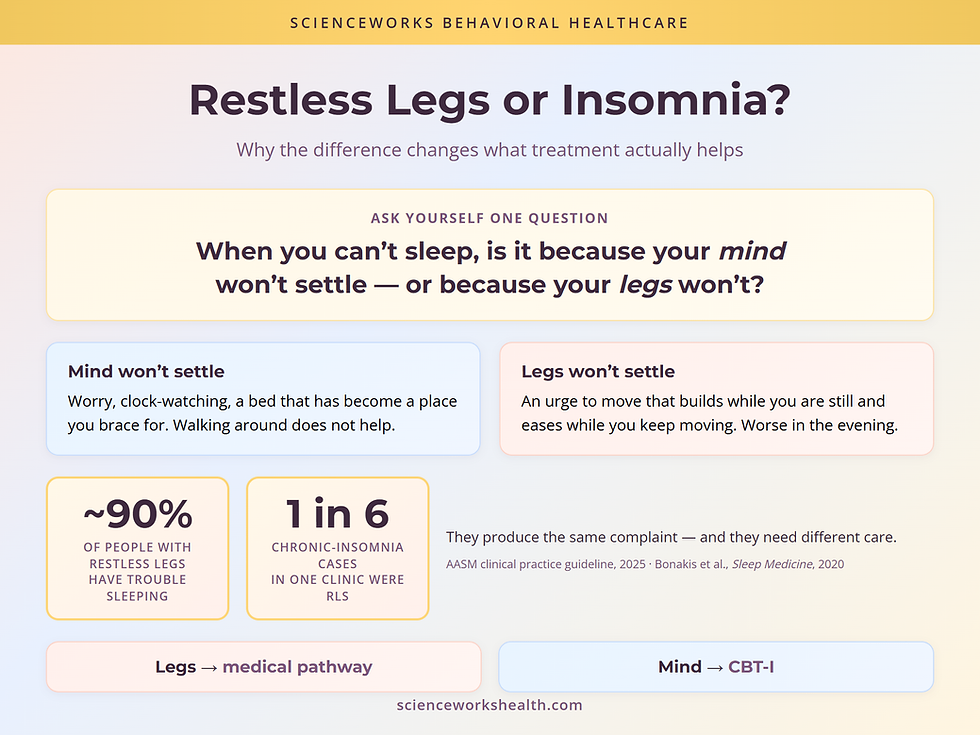
Ask yourself one question: when you cannot sleep, is it because your mind will not settle, or because your legs will not?
Chronic insomnia is fundamentally about wakefulness — a mind that will not power down, worry about sleep itself, a body that is tired but wired. Restless legs syndrome is about an urge to move. There is a sensation in the legs, hard to describe and often not painful, though some people do experience it as painful [4], that builds while you are still and eases when you move. It is worse in the evening. Lying in bed is the worst possible position for it.
If the honest answer is "my legs," that changes what should happen next, and it changes it substantially.
🦵 Key takeaway: Insomnia is a problem of not being able to sleep. Restless legs is a problem of not being able to be still. They produce the same complaint and need different care.
Why these two get confused
The confusion is not carelessness. It is built into how the conditions present.
Start with how tightly they are bound together. Difficulty falling or staying asleep is present in roughly 90% of people with restless legs syndrome — insomnia is the primary way the condition causes harm [1]. So a person with restless legs syndrome will describe insomnia, accurately, because they have it.
The reverse direction has been measured too. In a study of 532 patients presenting with chronic insomnia, 83 of them — about one in six — turned out to have restless legs syndrome [2]. The authors' conclusion is worth stating plainly: the two groups showed a very similar profile, which complicates the differential, and clinicians who work with insomnia need an active suspicion of restless legs because the two have entirely different therapeutic approaches [2].
Restless legs syndrome is also common enough that this is not a rare-disease problem. Global prevalence among adults aged 20 to 79 was estimated at 7.12% in 2019 [3], with roughly 7 to 10% reported in European and North American populations [4]. Estimates vary by how strictly criteria are applied [5], but the clinically significant form — at least twice weekly, with at least moderate distress — sits at around 2 to 3% of adults [1]. That is still millions of people.
Three misconceptions do most of the damage.
"Restless legs means my legs twitch while I'm asleep." Restless legs syndrome is something you experience while awake. It is a conscious urge to move, with sensations you can describe, occurring when you are still and trying to rest. Movements during sleep are a related but separate phenomenon, and they are not what the diagnosis turns on.
"If I can't sleep, that's insomnia." Insomnia is a description of a symptom. It is not, by itself, an explanation. Restless legs syndrome is one of the specific things that produces it, and treating the symptom without identifying the driver is how people end up two years into sleep work with modest results.
"It's probably just anxiety." This one is worth dwelling on, because the evidence runs opposite to intuition. In that study of chronic-insomnia patients, anxiety levels were higher in the group who turned out to have restless legs syndrome, not lower [2]. Anxiety is not evidence against restless legs. If anything, its presence makes a psychological explanation more tempting and a correct diagnosis less likely.
🧩 Key takeaway: In one sleep-clinic series, around one in six people presenting with chronic insomnia turned out to have restless legs syndrome — and the anxiety that makes it look psychological was more common in that group, not less.
What each one actually is
Restless legs syndrome
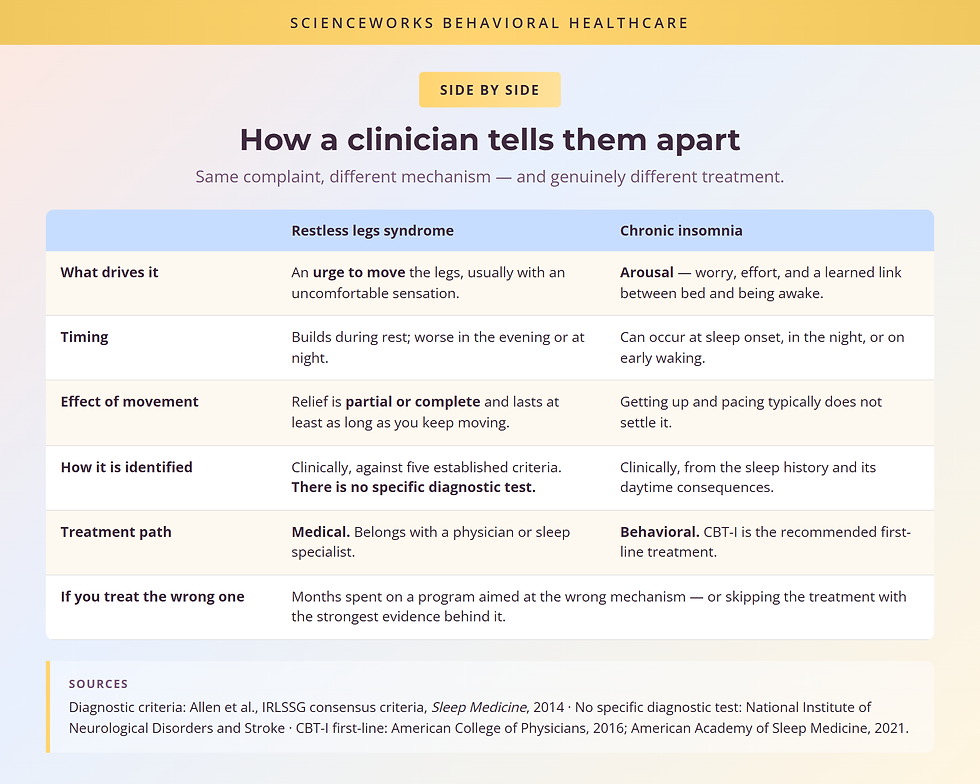
Restless legs syndrome is a sensorimotor condition diagnosed against five established criteria [6]. In plain terms: an urge to move the legs, usually accompanied by uncomfortable sensations; symptoms that begin or worsen during rest or inactivity; relief that is partial or complete with movement, such as walking or stretching, lasting at least as long as you keep moving; symptoms that only occur, or are worse, in the evening or night than in the daytime; and a picture not better accounted for by something else, such as leg cramps, positional discomfort, or habitual foot tapping.
Those five sit together for a reason. Any one alone means little. It is the combination — an urge, triggered by rest, relieved by movement, on an evening clock — that identifies the condition.
Here is what that looks like. You get into bed reasonably tired. Within twenty minutes something starts in your calves that you have never found the right word for — not a cramp, more a fizzing or pulling that builds until moving is no longer optional. You get up, walk to the kitchen, and it stops. You return to bed and ten minutes later it starts again. By 2 a.m. you have done this five times, and what you tell the doctor next week is that you cannot sleep.
Or: long flights and car journeys are genuinely difficult for you in a way other people find odd, and evening cinema trips have quietly dropped off your list. You have never connected any of that to your sleep, because it does not feel like a sleep problem during the day.
The distinguishing pattern: restless legs costs are positional and time-locked — they show up whenever you are still, worsen as evening comes, and are relieved by movement rather than by relaxation.
Chronic insomnia
Chronic insomnia is persistent difficulty falling asleep, staying asleep, or waking too early, despite adequate opportunity, with daytime consequences. Its engine is typically cognitive and behavioral: worry about sleep, effort to produce it, and a learned association between the bed and being awake. The bed becomes a cue for alertness, and trying harder makes it worse.
What that looks like: you fall asleep fine on the sofa at 10 p.m., then wake fully the moment you get into bed. Or you wake at 3 a.m., start counting the hours left, and the counting finishes the night. Or Sunday is worse than Saturday, because Sunday is when tomorrow matters.
Notice what is missing from all three: any sensation in the legs, and any relief from walking around. A person with insomnia who gets up and paces typically finds that walking around does not settle it. A person with restless legs syndrome usually feels relief, partial or complete, for as long as they keep moving.
The distinguishing pattern: insomnia costs are cognitive and conditioned — driven by arousal, worry and learned association, and worsened rather than relieved by effort.
🛏️ Key takeaway: Movement is the most useful discriminator available to you at home. Walking eases restless legs, partly or completely, while it does little for insomnia — but it is a clue to bring to a clinician, not a test that settles the question.
How a clinician sorts it out
What a good assessment clarifies
There is no specific diagnostic test for restless legs syndrome [7]. It is diagnosed clinically, from a careful history taken against those five criteria — which is precisely why it gets missed when nobody asks.
A thorough sleep assessment should therefore ask about sensation and urge, not just about hours. It should establish the evening pattern, ask about rest situations other than bed, and take a family history, since restless legs syndrome runs in families [4]. It should ask what has already been tried, including whether a properly delivered course of CBT-I underperformed — because that is a data point, not a failure. And it should ask about the medicines you take, since some commonly used for sleep, allergies and mood are recognized as aggravating factors and are worth reviewing with your prescriber [1].
It is also worth knowing that this is hard even for specialists. In a recent review of the differential, specialists estimated that diagnosis is accurate in about 85% of cases even in expert hands, with misdiagnosis against so-called mimics appearing to be high [8]. Two different things get confused here, and the distinction changes what you should ask. Some conditions are genuine mimics — nocturnal leg cramps, painful nerve damage in the legs, fibromyalgia and myofascial pain, or restlessness caused by a medication — where the person does not have restless legs syndrome at all [4]. Separately, real restless legs syndrome is often secondary to something else, including iron deficiency, thyroid disease and kidney disease [8]. Those are different problems with different answers. That 85% figure is not a reason to distrust clinicians; it is a reason to ask, rather than to assume the question has already been settled.
Where the picture is mixed, structured mental health screening helps separate what is driving what — sleeplessness, low mood and anxiety commonly travel together, and knowing which is primary shapes the plan.
Why getting the distinction right changes treatment
This is the part that makes the question worth your time.
For chronic insomnia, cognitive behavioral therapy for insomnia is the recommended first-line treatment. The American College of Physicians recommends that all adults receive CBT-I as the initial treatment for chronic insomnia disorder [9], and the American Academy of Sleep Medicine gives multicomponent CBT-I its strongest recommendation [10]. It is effective, and it does not depend on medication.
For restless legs syndrome, the treatment pathway is medical, and it changed significantly in the 2025 American Academy of Sleep Medicine guideline [1]. The guideline's first step is addressing aggravating factors, including certain medication classes and untreated sleep apnea, and it places substantially more emphasis on assessing iron status than earlier guidance did. Notably, a class of medication that the 2012 guideline treated as a standard treatment is, in most circumstances, now advised against, because of evidence that it can drive a progressive worsening of symptoms over time.
We are a psychology practice. We do not prescribe and we do not order blood work, so this article names no medication, no dose and no laboratory threshold — those belong with a physician or sleep specialist who knows your history. What matters for your decision is simpler: an effective medical pathway for restless legs syndrome exists, it has been revised recently, and it is not something a behavioral sleep program can substitute for.
One thing to be clear about, since this section mentions medication at all: nothing here is a reason to stop or change a medication on your own. Any change — including stopping something that turns out to be aggravating the symptoms — belongs with the clinician who prescribed it.
The cost of getting it backwards runs both ways. Treat restless legs syndrome as insomnia and you will spend months on a program aimed at the wrong mechanism. Treat insomnia as a medical problem and you skip the treatment with the strongest evidence behind it. And because insomnia that looks like one thing and is another is a recurring pattern in sleep medicine generally, the habit of asking "what is actually driving this?" is worth keeping.
⚖️ Key takeaway: These conditions have genuinely different treatments — one behavioral, one medical. Neither is a reasonable substitute for the other, which is why the diagnosis has to come first.
Some leg symptoms need a prompt look, not a scheduled one
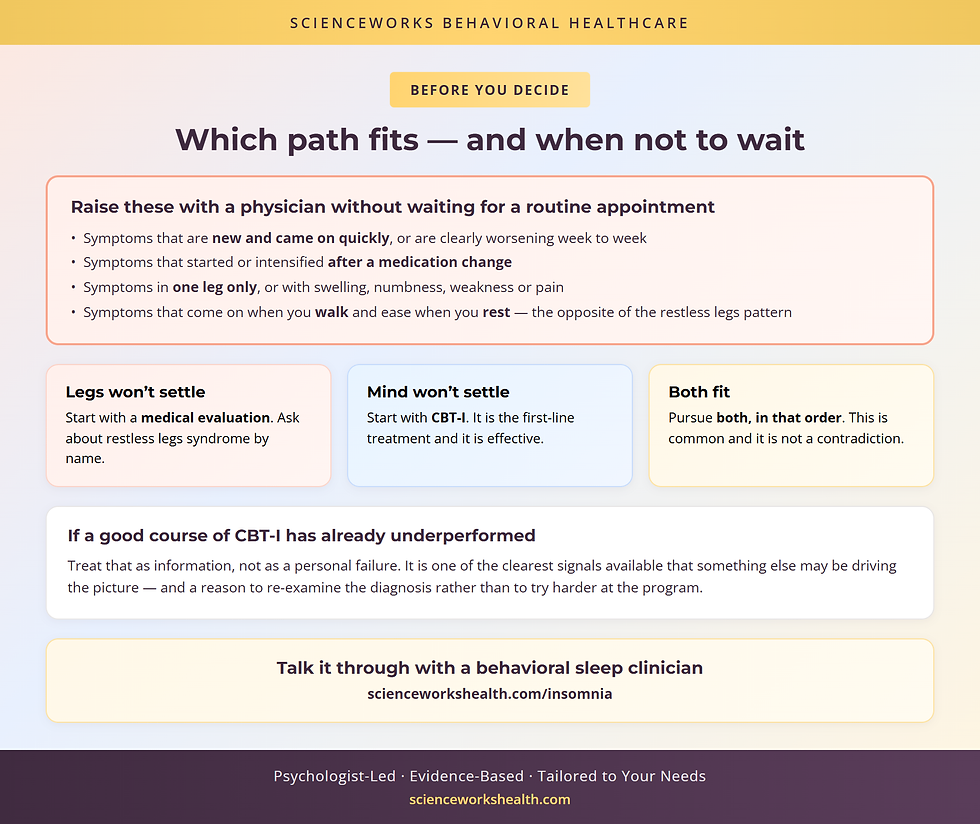
Before the decision framework, one safety note. Most restless legs symptoms are not urgent, and the pathway above is the usual one. But a few patterns point somewhere other than restless legs syndrome, and they are worth raising with a physician without waiting for a routine appointment:
Symptoms that are new and came on quickly, or that are clearly worsening week to week
Symptoms that started or intensified after a change in medication
Symptoms in one leg only, or accompanied by swelling, numbness, weakness, or pain
Symptoms that come on when you walk and ease when you rest — that is the opposite of the restless legs pattern and points to a different cause
None of these means something is certainly wrong. They mean the question belongs with a medical clinician sooner rather than later.
Which path fits your situation
A decision framework you can apply before you leave this page.
If the urge to move is the thing that gets you out of bed — sensations in the legs, relief while walking, worse in the evening — at least when the symptoms first began — start with a medical evaluation. Ask a physician or sleep specialist about restless legs syndrome by name. That is the fastest route to the treatment that fits.
If your mind is the thing that will not settle — worry, planning, clock-watching, a bed that has become a place you brace for — start with CBT-I. It is the first-line treatment and it is effective.
If both descriptions fit, pursue both, in that order. This is common and it is not a contradiction. Have restless legs syndrome assessed medically, and do the behavioral work on the insomnia that sits alongside it. Our specialized therapy team is set up to work this way, alongside your medical clinician rather than instead of them.
If a good course of CBT-I has already underperformed, treat that as information. It is one of the more useful signals available that something else is driving the picture — whether restless legs syndrome, sleep apnea, a circadian problem, or trauma-related nighttime hypervigilance.
Questions worth asking any provider directly:
Have you assessed me against the five diagnostic criteria for restless legs syndrome, and what did each one show?
Is anything I am currently taking known to aggravate restless legs, and should it be reviewed?
Should my iron status be checked as part of this, and who is arranging that?
If I have both restless legs syndrome and insomnia, who is handling which half, and how will you two coordinate?
It is also worth naming that chronic poor sleep wears people down. If low mood or anxiety has built up alongside the sleeplessness, a depression screener or an anxiety screener is a reasonable starting point, and worth raising with a clinician rather than carrying alone.
📋 Key takeaway: If CBT-I has been delivered well and underperformed, that is not a personal failure. It is one of the clearest signals that the diagnosis deserves a second look.
Next step — getting support
The distinction in this article is not academic. It determines whether your next stretch of treatment is aimed at the right mechanism or the wrong one. If you have been working on your sleep and the results have not matched the effort, the most useful thing you can do is stop optimizing the program and re-examine the diagnosis.
If it turns out to be restless legs syndrome, a physician is the right destination and we will say so plainly. If it turns out to be insomnia — or, as is common, both — the behavioral work has strong evidence behind it and our clinicians can help you do it properly.
For the insomnia half of the picture:
Sleep not coming easily?
CBT-I is the first-line, evidence-based treatment for chronic insomnia — a clinician can help you rebuild sleep without relying on medication alone.
Frequently Asked Questions
Can restless legs syndrome cause insomnia, or is it a separate problem?
Both, in a sense. Restless legs syndrome is its own condition, but trouble falling or staying asleep is its main consequence, and difficulty sleeping is present in roughly nine out of ten people who have it. So the insomnia is real. It is a downstream effect of something treatable rather than the primary problem, which is why treating the sleeplessness alone can produce disappointing results.
Is there a test that diagnoses restless legs syndrome?
No. There is no specific diagnostic test for restless legs syndrome. A clinician diagnoses it from your history against a set of established criteria: an urge to move the legs, usually with uncomfortable sensations, that worsens at rest, is relieved by movement, is worse in the evening or at night, and is not better explained by another condition. Blood work to check iron status is a standard part of the medical workup and helps rule out other causes, but that is a physician's decision and it is not a diagnostic test for the condition itself.
Can a therapist help if my sleep problem turns out to be restless legs?
Honestly, a therapist does not treat restless legs syndrome, and we would not claim to. The value is different: accurate assessment that identifies what is actually going on, a referral to the right medical clinician, and treatment for the insomnia that frequently sits alongside it. Many people have both. Where that is the case, the insomnia is still chronic insomnia, and CBT-I is the first-line treatment for it, pursued alongside the medical work rather than instead of it.
Why would CBT-I not work for my insomnia?
One possibility is that something other than insomnia is driving the sleeplessness. CBT-I is the first-line treatment for chronic insomnia and works well, but it targets the thoughts, habits and conditioning that keep insomnia going. If an urge to move your legs is what actually gets you out of bed, those are not the mechanism. There are other explanations too, including how much of the program was completed, so it is worth raising with your clinician rather than concluding anything alone.
What does restless legs actually feel like?
People describe it as an urge to move rather than as pain, often with an uncomfortable sensation deep in the legs that is hard to name: crawling, pulling, fizzing, or simply wrong. The defining feature is the relationship to movement and to time of day. It builds when you are still, eases when you walk or stretch for as long as you keep moving, and is worse in the evening and at night than during the day.
About the Author
Dr. Kiesa Kelly is a licensed clinical psychologist in Tennessee with more than 20 years of experience in psychological assessment, and insomnia is one of her core clinical specializations. She earned her PhD in clinical psychology, with a concentration in neuropsychology, from Rosalind Franklin University of Medicine and Science, following an undergraduate degree in psychology and neuroscience at Bowdoin College.
Her clinical training includes work at the University of Chicago, Vanderbilt University, the University of Wisconsin, and the University of Florida, and she completed an NIH National Research Service Award postdoctoral fellowship researching dual pathway models of ADHD. Alongside insomnia, her assessment practice focuses on ADHD and autism evaluations, OCD, and trauma. She is a member of the American Psychological Association, the Anxiety and Depression Association of America, the Tennessee Psychological Association, and the Association for Behavioral and Cognitive Therapies.
References
1. Winkelman JW, Berkowski JA, DelRosso LM, Koo BB, Scharf MT, Sharon D, et al. Treatment of restless legs syndrome and periodic limb movement disorder: an American Academy of Sleep Medicine clinical practice guideline. Journal of Clinical Sleep Medicine. 2025;21(1):137-152. https://doi.org/10.5664/jcsm.11390
2. Bonakis A, Androutsou A, Koloutsou ME, Vagiakis E. Restless legs syndrome masquerades as chronic insomnia. Sleep Medicine. 2020;75:106-111. https://doi.org/10.1016/j.sleep.2020.06.003
3. Song P, Wu J, Cao J, Sun W, Li X, Zhou T, et al. The global and regional prevalence of restless legs syndrome among adults: A systematic review and modelling analysis. Journal of Global Health. 2024;14:04113. https://doi.org/10.7189/jogh.14.04113
4. Gossard TR, Trotti LM, Videnovic A, St Louis EK. Restless legs syndrome: contemporary diagnosis and treatment. Neurotherapeutics. 2021;18(1):140-155. https://doi.org/10.1007/s13311-021-01019-4
5. Innes KE, Selfe TK, Agarwal P. Prevalence of restless legs syndrome in North American and Western European populations: a systematic review. Sleep Medicine. 2011;12(7):623-634. https://doi.org/10.1016/j.sleep.2010.12.018
6. Allen RP, Picchietti DL, Garcia-Borreguero D, Ondo WG, Walters AS, Winkelman JW, et al. Restless legs syndrome/Willis-Ekbom disease diagnostic criteria: updated International Restless Legs Syndrome Study Group (IRLSSG) consensus criteria. Sleep Medicine. 2014;15(8):860-873. https://doi.org/10.1016/j.sleep.2014.03.025
7. National Institute of Neurological Disorders and Stroke. Restless legs syndrome. Bethesda (MD): NINDS. https://www.ninds.nih.gov/health-information/disorders/restless-legs-syndrome
8. Poplawska-Domaszewicz K, Rota S, Qamar MA, Chaudhuri KR. The complexities in the differential diagnosis of restless legs syndrome (Willis-Ekbom disease). Expert Review of Neurotherapeutics. 2025;25(2):157-173. https://doi.org/10.1080/14737175.2025.2450639
9. Qaseem A, Kansagara D, Forciea MA, Cooke M, Denberg TD. Management of chronic insomnia disorder in adults: a clinical practice guideline from the American College of Physicians. Annals of Internal Medicine. 2016;165(2):125-133. https://doi.org/10.7326/M15-2175
10. Edinger JD, Arnedt JT, Bertisch SM, Carney CE, Harrington JJ, Lichstein KL, et al. Behavioral and psychological treatments for chronic insomnia disorder in adults: an American Academy of Sleep Medicine clinical practice guideline. Journal of Clinical Sleep Medicine. 2021;17(2):255-262. https://doi.org/10.5664/jcsm.8986
Disclaimer
This article is for informational purposes only and is not a substitute for individualized medical or psychological advice, diagnosis, or treatment. It does not describe medication options and should not be used to make decisions about medication. Reading it does not create a clinician-patient relationship. If you have questions about your own health, please consult a qualified healthcare provider. If you are in crisis or thinking about harming yourself, call or text 988 in the United States to reach the Suicide and Crisis Lifeline.