
Therapy for PMDD in Tennessee: What a Treatment Course Involves and What It Costs

Last reviewed: 08/21/2026
Reviewed by: Dr. Kiesa Kelly
Most pages about premenstrual dysphoric disorder explain what it is. Far fewer answer the question people actually get stuck on once they have decided to do something about it: how long will this take, how many appointments is it, and what is it going to cost me.
This article is about the logistics. It is not a clinical guide — if you are still working out whether what you are dealing with is PMDD, our explainer on PMDD versus ordinary premenstrual symptoms covers that ground properly. What follows is the practical shape of a treatment course in Tennessee, including the one scheduling feature that makes PMDD different from almost anything else you might seek therapy for.
In this article, you'll learn:
Why treatment usually begins with two months of tracking, and what that does to your timeline
What a typical course looks like in sessions and calendar time
What it costs in Tennessee, self-pay and through insurance
How the therapy-or-medication question gets decided, and by whom
Who this fits, and who should start somewhere else first
The short answer — what a PMDD treatment course involves
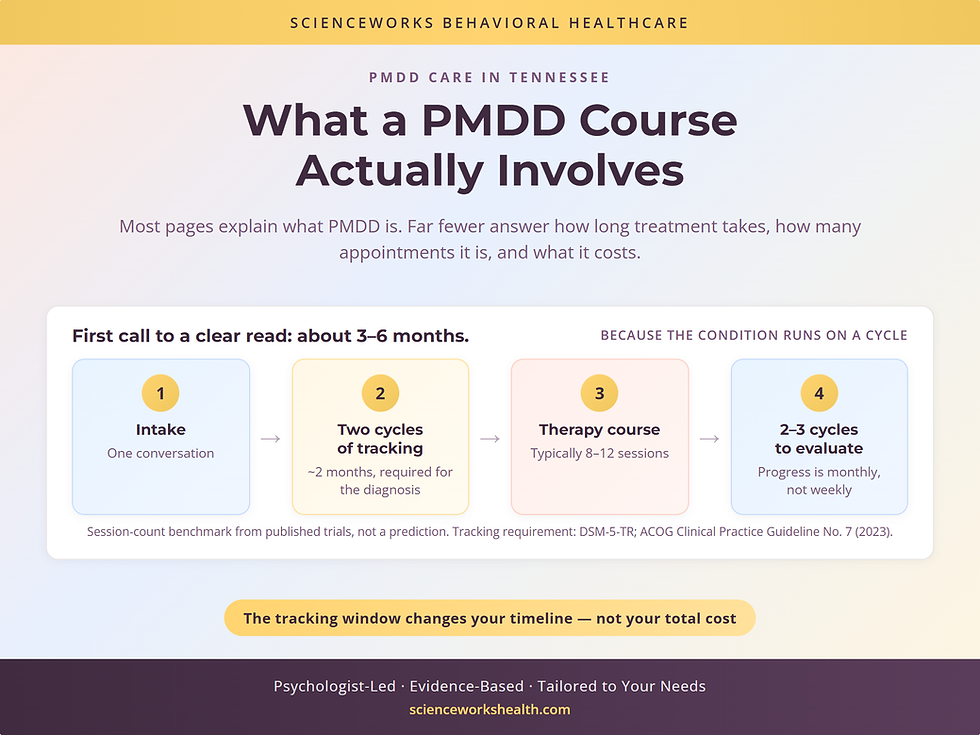
A realistic sequence looks like this: an intake conversation, a stretch of daily symptom tracking across two menstrual cycles to confirm the pattern, and then a course of therapy typically measured in eight to twelve sessions, often spread across several months so that change can be observed over more than one cycle.
That means the honest answer to "how long will this take" is usually three to six months from first call to a clear read on whether it is working — not because therapy is slow, but because the condition is defined by a monthly pattern and you cannot evaluate a monthly pattern quickly.
The cost follows from the session count more than from anything PMDD-specific. Where PMDD is genuinely different is the front end.
Three assumptions are worth correcting before you plan around them.
"I can describe the pattern, so the assessment should be quick." Recalled history is not what the diagnosis rests on. Prospective daily ratings are, and no amount of accurate recall substitutes for them.
"Waiting two cycles will make it cost more." It makes it take longer, not cost more. The tracking window is your time plus a small number of appointments; the expensive part is the therapy course, and that costs the same whenever it starts.
"Insurance either covers therapy or it doesn't." Coverage is not binary. Whether you have out-of-network benefits, whether you have met a deductible, and what your plan considers an allowed amount will produce three very different bills for the same course of care.
Step one is two cycles of tracking
This is the part that surprises people, so it is worth stating plainly: the diagnosis requires prospective daily ratings across at least two symptomatic cycles [1]. Not a recalled history, not a single appointment — daily ratings, recorded as the cycles happen.
The reason is that PMDD is defined by timing. Symptoms cluster in the luteal phase and remit shortly after menstruation begins, and that pattern is what separates it from a mood or anxiety condition that happens to worsen premenstrually [1,2]. Retrospective recall is unreliable for this, which is why the clinical guidance is built around prospective charting rather than memory.
It is also part of why PMDD is so often diagnosed late — a review of the condition's burden points to delayed recognition as a recurring problem rather than an unlucky exception [11]. For planning purposes, what matters here is the timeline consequence.
What the tracking period means for your timeline
Two cycles is roughly two months, and it happens before the treatment course rather than during it. Practically:
Your first appointments are assessment, not treatment. That can feel like a delay when you have finally worked up to making the call.
The tracking period costs relatively little — it is your time and a small number of appointments, not a long course of sessions.
It affects your timeline more than your total cost. A twelve-session course costs the same whether it starts in September or November.
If you are choosing between providers, ask each one how they handle this period specifically. Some build it into a structured intake; some ask you to start charting before the first appointment, which can save you weeks.
📅 Key takeaway: The two-cycle requirement is the single biggest difference between a PMDD timeline and an ordinary therapy timeline — and starting to chart today, before you have booked anything, is the one thing that shortens it.
What a typical course looks like
Once the pattern is confirmed, the course itself is not unusual in shape.
Session count and cadence
Published trials give a reasonable benchmark. Randomized studies of cognitive behavioral approaches for premenstrual disorders have used courses in the range of roughly eight to twelve sessions, sometimes delivered weekly and sometimes spread over several months to span multiple cycles [3,4,5]. A meta-analysis of psychological and pharmacological interventions for premenstrual disorders found small-to-medium effects for cognitive-behavioral interventions, with effects that held or improved at follow-up [6]. A 2025 systematic review of psychotherapy modalities for premenstrual change reached broadly similar conclusions while noting how variable the underlying trials are [7].
Two honest caveats. The literature is smaller than the literature behind, say, depression treatment. And a benchmark from a trial protocol is not a prediction about you — trials enrol selected participants and deliver a fixed dose. Treat eight to twelve as a planning figure, and ask your provider for their own typical range.
For what each approach actually targets and how they compare, our post on PMDD treatment options goes into that properly; this one stays on the arithmetic.
What progress looks like month to month
Because the condition runs on a cycle, so does the feedback. You will generally not be able to judge progress week to week — the useful comparison is this month's luteal phase against last month's, which is another reason the daily charting usually continues into treatment.
That has a practical implication for how you budget both money and patience: plan on at least two or three cycles after starting therapy before you and your provider have enough information to say whether the approach is working or should change.
What it costs in Tennessee
Before the numbers: we are a private-pay practice for therapy and do not bill insurance directly, so what follows is the general Tennessee and national picture rather than a quote. For our current rates, contact us and we will give you a straight answer.
Self-pay ranges and what drives them
Nationally in 2026, self-pay individual therapy sessions commonly run about $100 to $250, with the variation driven by geography, the clinician's license and experience, and session length. Tennessee generally sits at or below national averages rather than at the top of the range, and telehealth sessions often land toward the lower end.
Applying the course benchmark: at $150 per session, an eight-session course is around $1,200 and a twelve-session course around $1,800. At $200 per session, the same courses run roughly $1,600 and $2,400. Add the intake and the assessment appointments during the tracking window and you have a planning range in the low thousands for a full course.
One right worth knowing: if you are uninsured, or insured but choosing not to use your benefits, providers must give you a written good faith estimate of expected charges under the No Surprises Act, and there is a federal dispute process if the final bill exceeds it substantially [8]. Any practice should produce one without friction.
💵 Key takeaway: The session rate is the smaller half of the answer. What actually decides your bill is whether you have an out-of-network benefit, whether you have met a deductible, and what your plan calls an allowed amount.

Insurance, telehealth parity, and what to ask your plan
Two things are true at once here, and conflating them causes most of the confusion.
Tennessee's telehealth statute is genuinely strong. State law requires health insurance entities to cover services delivered by telehealth consistently with what the policy provides for in-person encounters for the same service, without distinction based on geographic location, and to reimburse out-of-network providers for telehealth under the same policies applied to other out-of-network care [9]. Format alone should not cost you coverage.
That is separate from whether your plan covers the care well. Parity between formats says nothing about your deductible, your out-of-network benefit, or whether your specific plan has one. The mechanics of deductibles, allowed amounts, and superbill reimbursement are the same across conditions, and we have laid them out step by step in our guide to therapy costs and insurance rather than repeating them here.
Four questions worth asking your plan before you begin:
1. Does my plan include out-of-network mental health benefits, and is there a separate out-of-network deductible?
2. What is the allowed amount for a standard individual therapy session in my area, and what percentage is reimbursed after the deductible?
3. Are telehealth sessions reimbursed at the same rate as in-person sessions for the same service?
4. Is there any limit on the number of outpatient mental health visits per year?
📝 Key takeaway: Two phone calls — one to your plan, one to a provider — produce a real number in a day. Most people spend far longer researching than the calls would have taken.

And four worth asking any provider you are considering:
1. What is your self-pay rate, and do you provide superbills for out-of-network reimbursement?
2. How do you handle the two-cycle tracking period — is it built into intake, or do I start before the first appointment?
3. What is your typical session count for PMDD, and how often would we meet?
4. If medication becomes part of the picture, how do you coordinate with a prescriber?
Between those answers and your plan's, you can usually produce a real number within a day.
Here is what that looks like in practice. Someone calls in early September and is asked to start charting immediately, so the two cycles run through September and October while she has an intake and one review appointment. Therapy proper begins in early November at $175 a session, weekly. By mid-December she and her clinician have one full luteal phase to compare against her baseline charts; by February they have three, which is enough to say whether the approach is working. Total: about twelve sessions, roughly $2,100 before any out-of-network reimbursement, spread across five months — of which the first two were tracking rather than treatment.
Therapy, medication, or both
This decision is a clinical one, and it belongs with a qualified clinician — a prescriber for anything involving medication. What we can usefully say is how the conversation is normally structured.
How that decision gets made, and who makes it
The ACOG clinical practice guideline on premenstrual disorders sets out the evidence for the available management options, including pharmacological and psychological approaches, and notes that many patients benefit from a multimodal approach combining several interventions [10]. Which combination fits you depends on severity, what you have tried, other conditions in the picture, and your own preferences — including whether you want to avoid medication.
Two practical notes. First, a therapist who is not a prescriber cannot start or adjust medication; if that is on the table, you will need a prescriber involved, and it is fair to ask early how a practice coordinates that. Second, the two paths are not exclusive or sequential by default — the guideline explicitly contemplates combined management [10].
We do not give medication guidance here, and you should be skeptical of any non-clinical page that does. Take that question to a clinician who can assess your situation directly.
Who this is a fit for — and who should start elsewhere
Therapy for PMDD is a reasonable place to start if the pattern is cyclical and clears after menstruation, if you are able to chart daily for a couple of months, and if the disruption is real but you are safe.
Some situations are better served by starting somewhere else first:
If symptoms do not clear after your period. A mood or anxiety condition that persists across the cycle is a different clinical picture, and worth sorting out first. Our screening tools — including the PHQ-9 and GAD-7 — are a low-cost starting point, though none of them can diagnose. If perimenopause is also in the frame, PMDD versus perimenopause covers how clinicians separate them.
If there is any concern about safety. That takes priority over a tracking period and over any question in this article. Contact a clinician or emergency services now rather than working through a timeline.
If the picture is genuinely unclear. When several possibilities are live at once, a psychological evaluation can be a more efficient starting point than a course of therapy aimed at the wrong target.
If you would rather see who you would actually be working with before committing to anything, you can meet our clinicians first.
Next step — getting started
The most useful thing you can do today costs nothing: start charting. Two cycles of daily ratings is the piece of this that takes the longest and that no provider can do for you, and beginning now means the assessment is largely complete by the time you are sitting down with someone.
After that, the sequence is straightforward — an intake conversation, a review of what your charting shows, and a plan with a session count and a cost attached to it. If you would like to talk through whether a course of specialized therapy is the right fit, or simply want a clear number for your situation, we are glad to have that conversation before you commit to anything.
Frequently Asked Questions
How many therapy sessions does PMDD treatment usually take?
Published trials give a useful benchmark rather than a rule. Randomized studies of CBT for premenstrual disorders have used courses of roughly eight to twelve sessions, sometimes spread across several months so that progress can be observed over multiple cycles. Your own course depends on severity, what else is going on, and how you respond. Ask any provider for their typical range before you start, so the arithmetic is not a surprise.
Is PMDD therapy covered by insurance in Tennessee?
It depends on your plan and on whether the provider bills insurance. Tennessee law requires health insurance entities to cover telehealth services consistently with in-person care for the same service, so format alone should not change coverage. But whether PMDD therapy is covered at all, and at what rate, is a question for your specific plan. ScienceWorks is a private-pay practice and provides superbills for out-of-network reimbursement.
What does PMDD therapy cost without insurance in Tennessee?
Self-pay individual therapy nationally runs roughly $100 to $250 per session, with Tennessee generally at or below national averages and telehealth often toward the lower end. Multiply by a course of eight to twelve sessions for a planning figure. If you are uninsured or not using benefits, you can request a written good faith estimate of expected charges before beginning, under the No Surprises Act.
Why does PMDD treatment start with two months of tracking?
Because the diagnosis requires it. PMDD is defined by a symptom pattern tied to the luteal phase that clears after menstruation, and confirming that pattern takes prospective daily ratings across at least two symptomatic cycles rather than a recalled history. Practically, this means the first stretch of care is often assessment rather than treatment — which affects your timeline more than it affects your total cost.
Does online therapy work for PMDD in Tennessee?
Trials of internet-delivered and remotely supported CBT for premenstrual disorders have reported benefit, and telehealth removes a real barrier when symptoms are worst during a predictable part of the month. Tennessee's telehealth statute requires covered services to be reimbursed consistently with in-person care. Whether it is the right format for you is worth raising directly with a provider during a first conversation.
About ScienceWorks
ScienceWorks Behavioral Healthcare was founded by Dr. Kiesa Kelly, a licensed clinical psychologist with more than twenty years of experience in psychological assessment and evidence-based treatment. Our clinical team works with adults and adolescents across mood, anxiety, trauma, OCD, insomnia, and neurodevelopmental presentations, including the cyclical mood conditions that are frequently mistaken for something else before they are properly assessed.
We operate a telehealth-forward model serving clients throughout Tennessee, with an in-person option at our Nashville office. We are a private-pay practice for therapy and provide superbills for clients pursuing out-of-network reimbursement. Every article we publish is reviewed by a licensed clinician for accuracy before it goes live.
References
1. American Psychiatric Association. Diagnostic and Statistical Manual of Mental Disorders, Fifth Edition, Text Revision (DSM-5-TR). Washington, DC: American Psychiatric Association Publishing; 2022. https://doi.org/10.1176/appi.books.9780890425787
2. Diagnostic validity of premenstrual dysphoric disorder: revisited. Front Glob Womens Health. 2023;4:1181583. https://doi.org/10.3389/fgwh.2023.1181583
3. Hunter MS, Ussher JM, Browne SJ, Cariss M, Jelley R, Katz M. A randomized comparison of psychological (cognitive behavior therapy), medical (fluoxetine) and combined treatment for women with premenstrual dysphoric disorder. J Psychosom Obstet Gynaecol. 2002. https://pubmed.ncbi.nlm.nih.gov/12436805/
4. Internet-Based Cognitive-Behavioural Intervention for Women with Premenstrual Dysphoric Disorder: A Randomized Controlled Trial. Psychother Psychosom. https://www.karger.com/Article/Pdf/496237
5. Ussher JM, Perz J. Evaluation of the relative efficacy of a couple cognitive-behaviour therapy (CBT) for Premenstrual Disorders (PMDs), in comparison to one-to-one CBT and a wait list control: A randomized controlled trial. PLoS One. 2017. https://doi.org/10.1371/journal.pone.0175068
6. Kleinstäuber M, Witthöft M, Hiller W. Cognitive-behavioral and pharmacological interventions for premenstrual syndrome or premenstrual dysphoric disorder: a meta-analysis. J Clin Psychol Med Settings. 2012. https://pubmed.ncbi.nlm.nih.gov/22426857/
7. Psychotherapy Modalities for Premenstrual Change: A Systematic Review. Women & Therapy. 2025. https://doi.org/10.1080/02703149.2025.2534636
8. Centers for Medicare & Medicaid Services. No Surprises Act: good faith estimates for uninsured and self-pay individuals. https://www.cms.gov/nosurprises
9. Tennessee Code § 56-7-1002. Telehealth services. https://law.justia.com/codes/tennessee/title-56/chapter-7/part-10/section-56-7-1002/
10. American College of Obstetricians and Gynecologists. Management of Premenstrual Disorders: ACOG Clinical Practice Guideline No. 7. Obstet Gynecol. 2023;142(6):1516–1533. https://www.acog.org/clinical/clinical-guidance/clinical-practice-guideline/articles/2023/12/management-of-premenstrual-disorders
11. Unveiling the burden of premenstrual dysphoric disorder: a narrative review to call for gender perspective and intersectional approaches. Front Psychiatry. 2024;15:1458114. https://doi.org/10.3389/fpsyt.2024.1458114
Disclaimer
This article is for informational purposes only and is not a substitute for individualized clinical advice, diagnosis, or treatment. It does not provide medication guidance; decisions about medication belong with a qualified prescriber. Costs described here are general market figures rather than a quote, and coverage depends entirely on your specific plan. Reading this article does not create a clinician-patient relationship. If you are concerned about your safety, contact a qualified clinician or emergency services.