
Thyroid or Mood Disorder? When Thyroid Hormones Mimic Depression and Anxiety in Women

Last reviewed: 10/02/2026
Reviewed by: Dr. Kiesa Kelly

For months you have felt flat, tired, and slower than usual. Or the opposite: wired, jumpy, and unable to sleep. Someone suggests depression or anxiety. Someone else asks whether you have had your thyroid checked. Both are fair questions, and the thyroid-or-mood-disorder question comes up often for women, because thyroid conditions, especially an underactive thyroid, are more common in women than in men [1][2][3].
This guide explains how the two can look alike and what a careful evaluation does with that possibility. If you are weighing an evaluation, our psychological assessments page explains how we approach diagnosis. It is also honest about what research has not settled: a thyroid problem can cause symptoms that look like depression or anxiety, but an abnormal thyroid result does not automatically explain a mood disorder [4].
In this article, you'll learn:
How an underactive or overactive thyroid can look like depression or anxiety
Four common misconceptions about thyroid tests and mood
The physical clues that point toward the thyroid, and why single symptoms mislead
What your primary care provider usually tests, and what results can and cannot tell you
Where the year after birth and midlife fit in
How to decide your next step, with questions to ask before you book
Thyroid or mood disorder: the short answer
Your thyroid makes hormones that help set the pace of your body. When it makes too little (hypothyroidism), the body slows down. When it makes too much (hyperthyroidism), it speeds up [5][3]. Depression is listed among the symptoms of an underactive thyroid. Nervousness, irritability, and trouble sleeping are listed among the symptoms of an overactive one [1][3].
That overlap is why careful evaluations treat the thyroid as something to rule out. The diagnostic manual's criteria for generalized anxiety disorder name hyperthyroidism as the example of a medical condition that must be ruled out [6]. UK guidance advises clinicians to consider thyroid tests for adults with depression or unexplained anxiety [7]. The word there is "consider." It is not a rule that every person needs a blood test.
Both thyroid problems and confusing thyroid results are common. Nearly 5 in 100 Americans aged 12 and older have hypothyroidism, although most cases are mild, and about 1 in 100 have hyperthyroidism [1][3]. At the same time, up to one-third of psychiatric patients may show abnormal thyroid tests that do not reflect true thyroid disease [4]. Both facts matter. The thyroid is worth considering, and a single result is worth confirming.
🧭 Key takeaway: Thyroid problems can produce symptoms that look like depression or anxiety, so a careful evaluation considers them. An abnormal result is a reason to look closer, not proof that the thyroid explains how you feel.
Four misconceptions about thyroid tests and mood
"Every depression or anxiety workup starts with a blood test." In reality, a depression evaluation starts with a conversation. A clinician interviews you about your symptoms and your personal, medical, and family history, and a physical exam screens for medical conditions that can mimic depression. Lab tests may be part of that medical screening [8]. For anxiety, the first step is often a visit to your doctor to rule out medical causes [9], while a brief questionnaire such as the GAD-7 anxiety screener can help put the worry itself into numbers [10]. In the US, routine thyroid screening for nonpregnant adults with no symptoms is not recommended either way, because the evidence is not strong enough to weigh benefits against harms [11].
"If my thyroid result is abnormal, that explains my depression." Not necessarily. Other illness, the psychiatric condition itself, substance use, and some psychiatric medications can all shift thyroid results without true thyroid disease, and these changes often settle on their own [4]. That is why an abnormal result is usually confirmed with repeat or follow-up tests before anyone acts on it [11][7].
"A normal thyroid test means it's all in my head." A normal result rules out one explanation. It does not make your symptoms any less real. Depression and anxiety disorders are diagnosed through a clinical interview and history, not a blood test, and both are treatable [8][9]. Brief questionnaires such as the PHQ-9 depression screener can help you put words and numbers to what you are feeling, though a screener is not a diagnosis [12].
"Treating the thyroid will fix my mood." Sometimes it helps, but not always. In a Swedish study of women with Graves' disease, anxiety and depression scores fell with treatment but were still somewhat higher than in comparison women 15 months later [13]. Mood symptoms that continue once thyroid levels are back in range deserve their own evaluation and care.
How an underactive or overactive thyroid shows up
An underactive thyroid (hypothyroidism)
When thyroid hormone runs low, the symptoms tend to build slowly, sometimes over months or years [1]. They can include fatigue, weight gain, feeling cold when others are comfortable, joint and muscle aches, dry skin or thinning hair, heavier or irregular periods, a slower heart rate, and depression [1]. People also describe feeling sad or down and forgetting things more easily [5]. The most common cause is Hashimoto's disease, an autoimmune condition that is 4 to 10 times more common in women than in men and, in women, most often develops between ages 30 and 50 [2].
Picture a 42-year-old teacher who has slowly stopped looking forward to anything over the past year. She is in bed by nine and still tired in the morning. She is cold in rooms where her coworkers are comfortable, her skin is dry, and she has gained weight without changing how she eats. Her periods have become heavier. The low mood is real, but the cold intolerance, weight gain, and period changes are the kind of physical clues that make a thyroid check reasonable alongside a look at her mood.
An overactive thyroid (hyperthyroidism)
Too much thyroid hormone tends to push the body into overdrive. Symptoms can include weight loss despite a bigger appetite, a rapid or irregular heartbeat, nervousness, irritability, trouble sleeping, shaky hands, muscle weakness, sweating or trouble tolerating heat, more frequent bowel movements, and a swelling at the front of the neck called a goiter [3]. Weight loss is typical but not universal: about 1 in 10 people gain weight because their appetite rises [14]. In older adults, an overactive thyroid is sometimes mistaken for depression, and it can show up as poor appetite or withdrawal from people [3].
Or: a 29-year-old who has never thought of herself as anxious starts waking at 3 a.m. with her heart pounding. Her hands shake when she holds a coffee cup. She feels hot in rooms where others want a sweater, and she has lost weight even though she is hungrier than usual. She wonders whether these are panic attacks. Some of what she feels does overlap with panic, especially the pounding heart. But feeling hot when others are cold, and losing weight while eating more, are reasons to check her thyroid before anyone settles on an anxiety diagnosis.
🌡️ Key takeaway: An underactive thyroid tends to slow things down (cold, tired, heavier), and an overactive one tends to speed things up (hot, shaky, racing heart). Those physical clues are what raise the thyroid question.
The key differences that matter
Overlapping symptoms that cause confusion
Fatigue, poor sleep, low or irritable mood, and trouble concentrating or forgetfulness show up in depression, in anxiety disorders, and in thyroid disease [8][9][1][3][5]. A racing heart and fatigue appear on the symptom lists for both anxiety disorders and an overactive thyroid [9][3]. UK guideline authors concluded that most single common symptoms are not predictive of thyroid problems, and that the decision to test should rest on an overall clinical picture [7]. Fatigue and weight gain in particular are common and do not necessarily mean a thyroid problem [1].
Even when symptoms share a name, they can come from different places. In hyperthyroidism, the racing heart, tremor, and restlessness come from a body running in overdrive: excess thyroid hormone is thought to ramp up the adrenergic, or "fight or flight," nervous system [15][14]. In an anxiety disorder, the heart may race too, but the defining feature is excessive fear, worry, or nervousness that is out of proportion to the situation and gets in the way of daily life [9]. In hypothyroidism, tiredness travels with physical slowing: feeling cold, constipation, dry skin, a slower heart rate [5][1]. In depression, tiredness travels with losing interest or pleasure in things you used to enjoy, feeling worthless or guilty, and, for some people, thoughts of death, for most of the day, nearly every day, for more than two weeks [8].
The distinguishing signs clinicians look for
The clues that point toward the thyroid are mostly physical and measurable: feeling unusually cold or hot, weight loss despite a bigger appetite or unexplained weight gain, a tremor, a heartbeat that is unusually fast, irregular, or slow, dry skin or thinning hair, changes in your periods, and a goiter [1][3][14]. Eye changes such as bulging eyes are seen in Graves' disease specifically [14]. No single one of these settles the question. A racing heart also happens in anxiety, and a change in weight in depression [9][8], which is why clinicians look for a cluster and why your doctor, not a symptom list, decides whether to test [7].
The distinguishing pattern: thyroid clues tend to be body-level and metabolic (temperature, weight, heart rate, skin, a neck swelling) arriving alongside the mood change. Depression and anxiety disorders are defined by the mood and thinking pattern itself, and they are diagnosed by interview, not by a lab value.
How an evaluation sorts it out (and what your PCP orders)
What a good assessment clarifies
ScienceWorks is a psychology practice, and our clinicians do not order blood tests. When a medical cause such as the thyroid needs ruling out, your primary care provider orders the labs and we coordinate with them. Our part is the mental health side: a structured interview, your history, and validated measures such as the PHQ-9 and GAD-7 [12][10]. What we listen for is how your mood and worry behave over time, and whether the physical clues above are part of the picture. Our guide to what to expect from a depression assessment walks through that process step by step.
If your doctor checks your thyroid, the usual first test is TSH (thyroid-stimulating hormone). If TSH is high, free T4 is measured, and if it is low, free T4 and free T3 are measured [7]. Thyroid antibody tests may follow a high TSH [7]. A few practical points can change the result. Testing during an acute illness can give misleading numbers [7]. High-dose biotin supplements can falsely raise or lower some thyroid results, so mention them to your doctor [7]. And because mildly abnormal results can come and go, US guidance describes repeat testing over 3 to 6 months to confirm an abnormal finding [11].
A mildly high TSH with a normal free T4 is called subclinical hypothyroidism. It is common, affecting about 5% of US women [11], and its link to depression is genuinely unsettled. One meta-analysis found no overall association, with a borderline link only in adults under 60 [16]. Another, published about ten weeks later, found one, and also found that people with depression did not have higher average TSH than people without it [17]. Trials of levothyroxine in adults 65 and older with this pattern found no improvement in thyroid-related symptoms or tiredness, and no effect on depressive symptoms, though most participants had few depressive symptoms to begin with [18][19]. The two meta-analyses' smaller pooled analyses of levothyroxine also found no clear mood benefit [16][17]. Whether treatment helps mood in younger women with this pattern has not been settled, so nobody can promise either way.
Why getting the distinction right changes treatment
If an overactive thyroid is driving a racing heart and sleepless nights, that is a medical problem that needs medical treatment, and calling it panic disorder would miss it. If thyroid results are normal, or an abnormal result turns out to be a passing blip, labeling the mood problem as "just thyroid" can delay effective care for depression or anxiety, which are treatable [8][9]. And when both are present, which happens, each deserves its own treatment, and our specialized therapy services are built for the mental health side of that. For people given a trial of thyroid medication for mildly abnormal results, UK guidance suggests considering stopping it if symptoms persist once TSH is back in the normal range [7], which suggests the remaining symptoms may have another source.
Consider a 37-year-old who was diagnosed with Graves' disease last spring. Her thyroid levels have been in range for months, and her heart no longer races. But she still lies awake running through worst-case scenarios about her children and her job, and she has stopped seeing friends because it feels like too much. Her endocrinologist is pleased with her labs. What is left is not something a medication adjustment is likely to fix. It is anxiety that deserves its own assessment and therapy. Research on Graves' disease finds that anxiety and low mood can outlast the return of normal thyroid levels [13][15].
🔍 Key takeaway: Your PCP handles the thyroid tests, usually starting with TSH and confirming anything abnormal. A mental health evaluation handles the mood and worry pattern. Both questions deserve an answer, and one does not cancel the other.

The year after birth, and midlife
Postpartum thyroiditis affects roughly 5 to 10% of women in the year after giving birth [20]. In its classic pattern, an overactive phase comes first, 1 to 4 months after delivery, and not everyone goes through both phases [20]. The overactive phase can bring anxiety, insomnia, a racing heart, fatigue, weight loss, and irritability. Because new parents expect to feel exhausted and on edge, this phase is often overlooked [20]. Women more often come to attention in the underactive phase, which typically begins 4 to 8 months after delivery, with fatigue, weight gain, constipation, dry skin, and depression [20]. Most women's thyroid function returns to normal within 12 to 18 months after symptoms start, though about 1 in 5 of those who go through the underactive phase stay hypothyroid [20].
Postpartum thyroiditis and postpartum depression can overlap in timing and symptoms, but the 2026 American Thyroid Association guideline reports no apparent association between postpartum thyroiditis, thyroid antibodies, and the risk of postpartum depression [21]. It advises that thyroid testing for depression after birth follow general screening recommendations [21]. Depression after a baby is not "just thyroid," and it deserves care in its own right. Our guide to postpartum depression versus the baby blues explains how that is assessed.
Midlife brings a three-way overlap. Perimenopause and thyroid problems can both bring mood changes, anxiety or low mood, sleep trouble, sweating, and irregular periods, which makes them hard to tell apart without specific signs such as a goiter or eye changes [22]. Depression or anxiety can also be present on top of either. A position statement from the European Menopause and Andropause Society advises clinicians who see women at this stage to keep a low threshold for checking the thyroid when these symptoms appear [22], and UK guidance cautions that thyroid symptoms in menopausal women may be mistaken for menopause [7]. Our article on perimenopause, depression, and anxiety covers the hormonal side in depth.
Picture a 48-year-old whose periods have become irregular. She wakes drenched at 2 a.m., snaps at her family, and has lost interest in the running club she loved. Her doctor checks her thyroid, and the result is normal. That rules out one explanation, but it does not settle the rest. Perimenopause may be part of what she is feeling, and so may depression, and a mental health evaluation can look at whether her low mood and loss of interest have taken on a life of their own. Normal labs are not the end of the story; they are one piece of it.
Hashimoto's disease adds one more layer. Some studies find more depression and anxiety in people with Hashimoto's [23], including in people whose thyroid hormone levels are normal [24]. A 2026 meta-analysis of larger, population-based studies found only small, uncertain links between thyroid conditions and anxiety, though [25], so these findings point to a possible association, not a cause.
🤱 Key takeaway: After birth and in midlife, thyroid symptoms and mood symptoms can arrive at the same time. Overlap is a reason to check, not a reason to assume one explains the other.
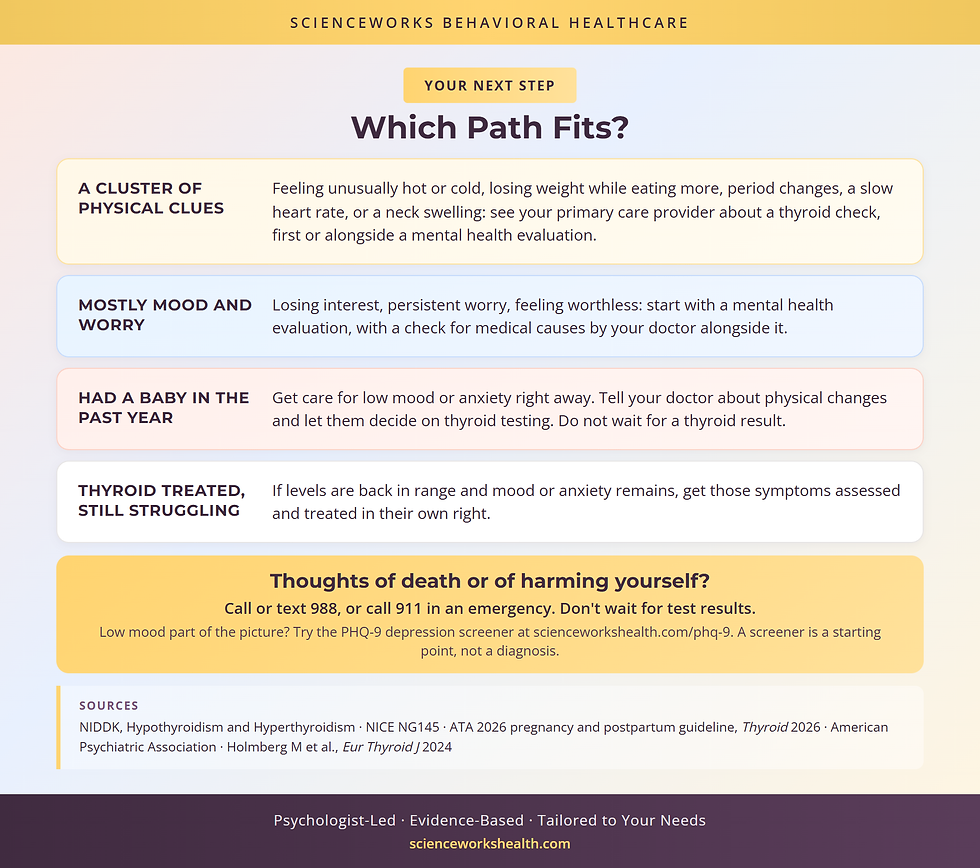
Which path fits your situation
If you have a cluster of thyroid-pointing clues (feeling unusually cold or hot most of the time, weight loss despite a bigger appetite or unexplained weight gain, a slow heart rate, changes in your periods, a swelling at the front of the neck, or eye changes): see your primary care provider about a thyroid check first or alongside a mental health evaluation. A racing heart or a change in weight on its own also happens in anxiety or depression.
If your symptoms are mostly mood and worry, such as losing interest in things, persistent worry, or feeling worthless: a mental health evaluation is a reasonable place to start, and a check with your primary care provider for medical causes belongs alongside it, especially if you have not had a recent checkup or are over 60.
If you had a baby in the past year: depression and anxiety after birth deserve care right away. Tell your doctor about any physical changes, such as feeling hot or cold, a racing heart, or weight change, and let them decide about thyroid testing. Do not wait for a thyroid result to get help for your mood.
If your thyroid is already treated and in range, but mood or anxiety symptoms remain: treat those symptoms as their own problem and get them assessed.
If more than one of these fits: that is common. A thyroid check and a mental health evaluation can run side by side.
If you are having thoughts of death or of harming yourself: do not wait for test results. Call or text 988, or call 911 in an emergency.
Before you book an evaluation, these questions can help you choose well:
Scope: "Do you consider medical causes, such as thyroid problems, and how do you coordinate with my primary care provider?"
Methodology: "Which structured interview and validated questionnaires do you use to assess depression and anxiety?"
History: "How will you use my medical history, recent lab results, and any pregnancy, postpartum, or menstrual changes?"
Output: "What will I receive afterward: a diagnosis, specific treatment recommendations, and a summary I can share with my doctor?"
Both conditions: "If my thyroid is being treated, can you still assess and treat my mood symptoms at the same time?"
🗺️ Key takeaway: Physical clues point to your doctor first, mood-and-worry patterns point to a mental health evaluation, and many people need both at once.
Next step: getting support
You do not have to answer the thyroid-or-mood question alone or in the right order. A primary care provider can check your thyroid, and a mental health clinician can look carefully at the mood and worry pattern. Whatever the thyroid result turns out to be, your symptoms deserve attention. If hormones, a recent pregnancy, or midlife changes are part of your picture, a clinician who works where physical and mental health meet can help you sort through it.
Navigating a women's-health or hormonal change?
Hannah Pollok works at the intersection of physical and mental health — hormones, reproductive changes, and the mood and cognitive shifts that come with them.
Frequently Asked Questions
Can thyroid problems cause depression and anxiety?
They can cause symptoms that look like both. An underactive thyroid can bring low mood, tiredness and slowed thinking, and an overactive thyroid can bring nervousness, irritability, a racing heart and poor sleep. Not every abnormal thyroid result explains a mood problem, though, and mood symptoms can continue after the thyroid is treated. That is why a careful evaluation looks at both.
Can a slightly high TSH cause depression?
The research is mixed. A mildly high TSH with a normal free T4 is called subclinical hypothyroidism. Two meta-analyses published about ten weeks apart reached different conclusions about whether it is linked to depression. Trials of thyroid medication in older adults with this pattern found no improvement in tiredness or depressive symptoms, though most had few symptoms to start, and the benefit for younger women is unsettled. A mild result is usually rechecked before anyone acts on it.
Does postpartum thyroiditis cause postpartum depression?
Current evidence says no clear link has been found. The 2026 American Thyroid Association guideline reports no apparent association between postpartum thyroiditis, thyroid antibodies, and the risk of postpartum depression. The two can still overlap in timing and symptoms, so a doctor may still check thyroid function in line with general screening recommendations. Depression after birth deserves care in its own right either way.
Why do I still feel depressed after my thyroid was treated?
This happens. UK guidance on mildly abnormal thyroid results even plans for symptoms that persist once levels are normal. If your thyroid levels are back in range and low mood or anxiety remains, the thyroid is less likely to be the whole explanation. In one study of women with Graves' disease, anxiety and depression scores were still somewhat higher than in comparison women 15 months after treatment began. Persistent symptoms deserve their own evaluation and treatment.
Is it perimenopause, my thyroid, or depression?
It can be hard to tell, and more than one can be present. Perimenopause and thyroid problems share symptoms such as mood changes, poor sleep, sweating and irregular periods, and depression can sit on top of either. The European Menopause and Andropause Society advises clinicians to keep thyroid disease in mind for women at this stage. Your doctor can check your thyroid while a mental health evaluation looks at the mood pattern itself.
About the Author
Dr. Kiesa Kelly is a licensed clinical psychologist and the founder of ScienceWorks Behavioral Healthcare, with more than 20 years of experience in psychological assessment. She earned her PhD in Clinical Psychology, with a concentration in Neuropsychology, from Rosalind Franklin University of Medicine and Science. She completed practica, internship, and an NIH-funded postdoctoral fellowship at the University of Chicago, the University of Wisconsin, the University of Florida, and Vanderbilt University. Her internship at the University of Florida Health Science Center included medical psychology and general clinical assessments with adult inpatients and outpatients.
Dr. Kelly's pre-doctoral training at the University of Wisconsin-Madison Psychiatric Institute and Clinics included psychotherapy with adult outpatients with major depression and generalized anxiety disorder, along with intake evaluations that led to diagnoses and treatment recommendations. She is a psychologist, not a physician: she does not order laboratory tests, diagnose thyroid disease, or prescribe medication, and she coordinates with each client's medical providers when a medical cause needs ruling out.
References
1. National Institute of Diabetes and Digestive and Kidney Diseases. Hypothyroidism (underactive thyroid). Last reviewed March 2021. https://www.niddk.nih.gov/health-information/endocrine-diseases/hypothyroidism
2. National Institute of Diabetes and Digestive and Kidney Diseases. Hashimoto's disease. Last reviewed June 2021. https://www.niddk.nih.gov/health-information/endocrine-diseases/hashimotos-disease
3. National Institute of Diabetes and Digestive and Kidney Diseases. Hyperthyroidism (overactive thyroid). Last reviewed August 2021. https://www.niddk.nih.gov/health-information/endocrine-diseases/hyperthyroidism
4. Dickerman AL, Barnhill JW. Abnormal thyroid function tests in psychiatric patients: a red herring? Am J Psychiatry. 2012;169(2):127-133. https://doi.org/10.1176/appi.ajp.2011.11040631
5. American Thyroid Association. Hypothyroidism. https://www.thyroid.org/hypothyroidism/
6. Center for Behavioral Health Statistics and Quality. Impact of the DSM-IV to DSM-5 changes on the National Survey on Drug Use and Health [Internet]. Substance Abuse and Mental Health Services Administration. Table 3.15, DSM-IV to DSM-5 generalized anxiety disorder comparison. https://www.ncbi.nlm.nih.gov/books/NBK519704/table/ch3.t15/
7. National Institute for Health and Care Excellence. Thyroid disease: assessment and management. NICE guideline NG145. Published November 2019; updated October 2023. https://www.nice.org.uk/guidance/ng145
8. American Psychiatric Association. What is depression? Physician review: Chinenye Onyemaechi, MD. April 2024. https://www.psychiatry.org/patients-families/depression/what-is-depression
9. American Psychiatric Association. What are anxiety disorders? Physician review: Judith A. Gutierrez, MD, MPH, and Josepha Immanuel, MD. May 2026. https://www.psychiatry.org/patients-families/anxiety-disorders/what-are-anxiety-disorders
10. Spitzer RL, Kroenke K, Williams JB, Löwe B. A brief measure for assessing generalized anxiety disorder: the GAD-7. Arch Intern Med. 2006;166(10):1092-1097. https://doi.org/10.1001/archinte.166.10.1092
11. US Preventive Services Task Force. Thyroid dysfunction: screening. Final recommendation statement. March 24, 2015. https://www.uspreventiveservicestaskforce.org/uspstf/recommendation/thyroid-dysfunction-screening
12. Kroenke K, Spitzer RL, Williams JB. The PHQ-9: validity of a brief depression severity measure. J Gen Intern Med. 2001;16(9):606-613. https://doi.org/10.1046/j.1525-1497.2001.016009606.x
13. Holmberg M, Malmgren H, Berglund PF, Johansson B, Nyström HF. Psychiatric complications in Graves' disease. Eur Thyroid J. 2024;13(1):e230247. https://doi.org/10.1530/ETJ-23-0247
14. Mathew P, Kaur J, Rawla P. Hyperthyroidism. In: StatPearls [Internet]. Treasure Island (FL): StatPearls Publishing; updated March 19, 2023. https://www.ncbi.nlm.nih.gov/books/NBK537053/
15. Bunevicius R, Prange AJ Jr. Psychiatric manifestations of Graves' hyperthyroidism: pathophysiology and treatment options. CNS Drugs. 2006;20(11):897-909. https://doi.org/10.2165/00023210-200620110-00003
16. Zhao T, Chen BM, Zhao XM, Shan ZY. Subclinical hypothyroidism and depression: a meta-analysis. Transl Psychiatry. 2018;8(1):239. https://doi.org/10.1038/s41398-018-0283-7
17. Loh HH, Lim LL, Yee A, Loh HS. Association between subclinical hypothyroidism and depression: an updated systematic review and meta-analysis. BMC Psychiatry. 2019;19(1):12. https://doi.org/10.1186/s12888-018-2006-2
18. Stott DJ, Rodondi N, Kearney PM, et al. Thyroid hormone therapy for older adults with subclinical hypothyroidism. N Engl J Med. 2017;376(26):2534-2544. https://doi.org/10.1056/NEJMoa1603825
19. Wildisen L, Feller M, Del Giovane C, et al. Effect of levothyroxine therapy on the development of depressive symptoms in older adults with subclinical hypothyroidism: an ancillary study of a randomized clinical trial. JAMA Netw Open. 2021;4(2):e2036645. https://doi.org/10.1001/jamanetworkopen.2020.36645
20. American Thyroid Association. Postpartum thyroiditis. https://www.thyroid.org/postpartum-thyroiditis/
21. Korevaar TIM, Leung AM, Alexander EK, et al. American Thyroid Association 2026 guidelines for thyroid disease in preconception, pregnancy, and postpartum. Thyroid. 2026;36(5):481-544. https://doi.org/10.1177/10507256261445624
22. Mintziori G, Veneti S, Poppe K, et al. EMAS position statement: thyroid disease and menopause. Maturitas. 2024;185:107991. https://doi.org/10.1016/j.maturitas.2024.107991
23. Siegmann EM, Müller HHO, Luecke C, Philipsen A, Kornhuber J, Grömer TW. Association of depression and anxiety disorders with autoimmune thyroiditis: a systematic review and meta-analysis. JAMA Psychiatry. 2018;75(6):577-584. https://doi.org/10.1001/jamapsychiatry.2018.0190
24. Wang B, Huang J, Chen L. Association between depression and anxiety disorders with euthyroid Hashimoto's thyroiditis: a systematic review and meta-analysis. Compr Psychoneuroendocrinol. 2024;20:100279. https://doi.org/10.1016/j.cpnec.2024.100279
25. Ivens B, Bode H, Bschor T, Henssler J, Baethge C. Thyroid disorders, thyroid autoimmunity, and anxiety: a systematic review and meta-analysis of population-based studies. PeerJ. 2026;14:e21446. https://doi.org/10.7717/peerj.21446
Disclaimer
This article is for informational and educational purposes only and is not a substitute for professional medical or mental health advice, diagnosis, or treatment. Thyroid conditions are diagnosed and treated by medical providers; talk with your doctor about testing. Reading this article does not establish a clinician-client relationship. If you are in crisis or thinking about harming yourself, call or text 988, or call 911 in an emergency.