
What to Expect from ACT for Trauma, and When It Fits

Last reviewed: 09/06/2026
Reviewed by: Dr. Kiesa Kelly
Most people searching for ACT for trauma are not shopping for a theory. They have either tried something that did not stick, or they have been circling therapy for months and want to know what the room looks like before they book.
So here is the honest version first. Acceptance and Commitment Therapy, usually shortened to ACT, is a well-developed therapy with a real and growing research base for trauma-related distress. It is not one of the treatments the 2023 VA/DoD clinical practice guideline recommends first for PTSD [1]. That guideline gives its strong recommendation to three trauma-focused psychotherapies, and it places ACT in the group where the evidence is not yet sufficient to recommend for or against [1], [2]. That does not make ACT useless. It makes it a tool for a specific situation, and knowing which situation is the point of this article.
In this article, you will learn:
What a course of ACT for trauma involves, session by session
Where ACT sits in the trauma-treatment evidence, in plain language
Signs it may fit you now, and signs it should wait
How to prepare so the first sessions are not wasted
What to ask a therapist, and how to tell if it is working
What ACT for trauma is, in one paragraph
ACT is a behavioral therapy built around two moves: stop fighting your own internal experience, and start moving toward what you actually care about. In trauma work specifically, the target is experiential avoidance, the exhausting full-time job of keeping certain thoughts, images, sensations and feelings out of reach, and the psychological flexibility that avoidance costs you [5]. A clinician trained in ACT will not ask you to recount the trauma in detail as the engine of treatment. They will ask what the memory has cost you, what you have stopped doing because of it, and what you would be doing if the fight took less energy. If you want the local version of this, our page on ACT for trauma in Nashville covers who we see, how sessions run, and how to get started here.
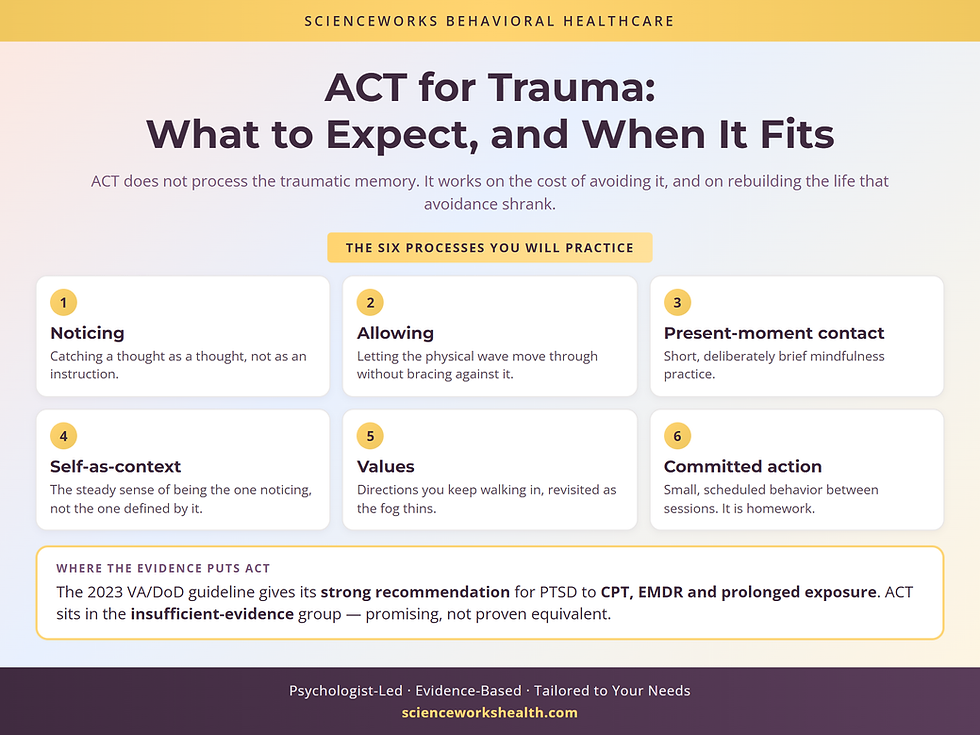
Key takeaway: 🧭 ACT does not process the traumatic memory. It works on the cost of avoiding it, and on rebuilding the life that avoidance shrank.
Where ACT sits in the trauma-treatment evidence
The 2023 VA/DoD Clinical Practice Guideline for PTSD makes a strong recommendation for three individual, manualized, trauma-focused psychotherapies: cognitive processing therapy, EMDR, and prolonged exposure [1]. It gives a weaker suggestion to Ehlers cognitive therapy, present-centered therapy, and written exposure therapy. It then lists a long set of therapies for which the evidence was judged insufficient to recommend for or against, and acceptance and commitment therapy is on that list [1], [2]. The UK's NICE guideline reaches a similar place from a different direction: it says to offer trauma-focused cognitive behavioral therapy to adults with PTSD, and to offer EMDR to adults who present more than three months after a non-combat-related trauma. It says to consider symptom-targeted, non-trauma-focused CBT only when someone is unable or unwilling to engage in trauma-focused work, or has symptoms left over after it [3]. NICE does not mention acceptance-based therapy for adult PTSD at all.
What ACT does have is a real and improving body of evidence for trauma-related symptoms generally. A 2025 systematic review and between-groups meta-analysis of eleven studies found a moderate, statistically significant effect of ACT on trauma symptom reduction at immediate post-test compared with various control groups, with a Hedges' g of -0.42 [4]. A 2025 clinical review describes the picture accurately: growing evidence for potential efficacy, mostly from pilot trials, with larger trials still needed [5]. A randomized trial of an app-delivered ACT program in 221 Chinese adults with elevated PTSD symptoms beat a waitlist but showed no advantage over an app-delivered mindfulness program on symptom outcomes, with one exception: psychological flexibility improved more in the ACT arm [6]. A single-country sample limits how far that result travels. A single-arm pilot of an eleven-week virtual group ACT program found significant pre-to-post improvement in depression and anxiety but not in PTSD symptoms, in a sample of five women [7]. A randomized trial in 160 veterans — enrolled for anxiety or depressive disorders rather than PTSD — found improvement across the whole sample, but the authors concluded ACT's efficacy was modest and did not differ from present-centered therapy on the primary outcome [8]. Dropout in that trial was high, at 41.9 percent.
Taken together, the fair conclusion is this: ACT is a legitimate therapy that helps many trauma-affected people function better. It has not been shown to match the recommended trauma-focused protocols at reducing PTSD symptoms, and nobody should tell you otherwise. If you want to see the three approaches side by side, our comparison of EMDR, CPT, and ACT for trauma walks through how a clinician actually chooses.
Key takeaway: ⚖️ Strong guideline recommendation goes to CPT, EMDR, and prolonged exposure. ACT sits in the insufficient-evidence group — promising, not proven equivalent.

Three things people get wrong about ACT for trauma
"ACT means accepting what happened to me." It does not. Acceptance in ACT refers to your relationship with present-moment internal experience — the wave of dread, the tightness in your chest, the intrusive image — not to the event, and not to anyone's behavior. Nobody is asking you to be at peace with harm. The work is about stopping the second fight, the one against your own nervous system's response.
"ACT is the gentle option, so it is safer." Not exactly. It is true that ACT does not require a detailed trauma narrative, and for some people that lowers the barrier to starting. But "does not require retelling" is not the same as "carries no distress," and choosing the gentler-sounding option over a recommended protocol you could tolerate is a trade you should make deliberately, not by default. Our piece on whether prolonged exposure is the right fit lays out what that protocol actually asks of you, which is usually less frightening than people imagine.
"If I have PTSD, any trauma therapy will do." Also no. The 2023 guideline reviewed each psychotherapy independently rather than as a class, which is precisely why three of them ended up with a strong recommendation and the rest did not [1]. The name on the door matters.
Who it is for
Signs ACT may be a good fit
The clearest signal is that your main complaint is not the memory itself but the shape your life has taken around it. You are functioning, more or less, but the radius of your life keeps shrinking. You have stopped driving certain routes, seeing certain people, applying for certain jobs. You are spending real energy every day on not-thinking-about-it, and that energy is coming out of everything else.
Here is one version of that. You were in a car accident four years ago. You do not have flashbacks the way you assumed you would, and you can talk about the crash without falling apart. But you have not driven on the interstate since. You take a route to work that adds twenty-five minutes each way, you have declined two family trips, and when your partner suggests a drive to the coast you feel a flash of resentment you cannot explain. The memory is not haunting you. The perimeter you built around it is running your calendar. Whether that picture meets criteria for PTSD is not something to settle on one symptom either way — flashbacks are one of five kinds of intrusion symptom in the DSM-5 criteria, and that unexplained flash of resentment at a cue may be another — so it is a question for a proper diagnostic assessment rather than your own read.
Or: you finished a course of trauma-focused therapy two years ago and your symptom scores genuinely came down. The nightmares are rare now. But you have not gone back to the things you used to care about. You work, you sleep, you scroll. When someone asks what you are looking forward to, you cannot produce an answer. Nothing is wrong, exactly. Nothing is happening, either. NICE does describe a residual-symptom situation after trauma-focused work, though what it recommends there is symptom-targeted CBT [3]. What that describes is closer to values disconnection than to leftover symptoms, and in our clinical judgment that is a reasonable place for values-based work.
ACT also comes up when a recommended trauma-focused protocol is not currently available to you, or when you have declined it for reasons you have thought through. That is a legitimate path — it is just worth naming out loud rather than sliding into.
Key takeaway: 🚦 ACT fits best when avoidance and a shrinking life are the main cost, not when the traumatic memory itself is the active problem.
Who it is not the right fit for
If you meet criteria for PTSD, a recommended trauma-focused therapy is available, and you are able to engage in it, that should be the opening move [1], [3]. Choosing ACT instead in that situation means choosing the option with weaker evidence for the outcome you came in for. A clinician who does not tell you that is not doing their job. Our trauma services page lays out which protocols we offer and how we decide between them.
ACT is also not the right first step when something more urgent is in the way. Acute intoxication or withdrawal, immediate danger at home, acute suicidal risk, or a level of dysregulation that makes any session hard to finish all need direct attention first. That is the subject of phase-based trauma therapy, and it is not a delay tactic — it is what makes the later work survivable. A co-occurring substance use disorder by itself is a different matter: the 2023 VA/DoD guideline specifically suggests it should not preclude one of the recommended trauma-focused therapies [2].
One more: if what you actually want is for the memory to stop feeling close, ACT is aimed somewhere else. That is what EMDR and bilateral stimulation are built for, and it is Dr. Kelly's preferred trauma approach for exactly that reason.

What actually happens, step by step
Before you start
The first one to three sessions are assessment and orientation, and they are not filler. A trauma clinician will take a history, ask what you have already tried, and get a baseline symptom measure. We use the PCL-5, a twenty-item self-report scale that maps onto the DSM-5 PTSD criteria and has strong reliability and validity [10]. The VA/DoD guideline suggests using a validated instrument like this specifically to track change over time [1], and you can take the PCL-5 before your first appointment if you want a starting number.
You will also do something that surprises people: a values conversation. Not goals — values. Goals are things you can finish. Values are directions you can keep walking in. What kind of parent, partner, or friend do you want to be, whether or not your symptoms cooperate? This conversation is the spine of everything that follows; if a clinician skips it, you are not doing ACT.
There is no single standard ACT-for-PTSD protocol with a fixed session count, which is a real difference from the recommended options. NICE describes trauma-focused CBT and EMDR as typically running eight to twelve sessions, more when clinically indicated [3]. ACT trials have varied widely in length. Ask your clinician up front how many sessions they are planning and when you will sit down together to review whether it is working.
During the work
Sessions tend to move through six overlapping processes rather than a numbered sequence, the same set described in our explainer on how ACT works for anxiety. In practice it feels like this.
You will practice noticing — catching a thought as a thought rather than as an instruction. A clinician might have you say "I am having the thought that I am not safe here" instead of "I am not safe here." It sounds like a word game for about two weeks, then it stops.
You will practice allowing the physical wave without either bracing against it or being swept off. This is where the acceptance piece actually lives, and it is more physical than most people expect.
You will practice contact with the present, usually through short mindfulness exercises that are deliberately brief and unmystical, because long eyes-closed practices can be destabilizing for trauma survivors.
You will build an observer perspective, the process ACT calls self-as-context — the steady sense of being the one noticing your thoughts and feelings rather than being defined by them. After trauma this carries more weight than it sounds like it should, because "I am a person having a fear response" holds together in a way that "I am damaged" does not.
You will do values clarification repeatedly, not once, because what matters gets clearer as the fog thins.
And you will do committed action — small, concrete, scheduled behavior in the direction of those values. Driving one exit on the interstate. Texting the friend. This is the part that changes your week, and it is homework.
Key takeaway: 🧩 ACT is skills plus behavior change between sessions. If nothing is different in your actual week, the therapy is not landing yet.
How to prepare
Three things make the first month more useful.
Bring a baseline. A PCL-5 score from before you start gives you and your clinician something to measure against, and it takes about five minutes.
Bring a list of what you have stopped doing. Not symptoms — activities. Places, people, routes, plans. This list is the raw material for committed action, and it is more useful in session one than a symptom list you have already given three providers.
Decide what you are willing to try. If you have ruled out any approach that involves discussing the trauma directly, say so at intake and say why. That is a legitimate preference, and it changes the recommendation. But make it a decision, not an avoidance you never examined. If you are not sure, our overview of specialized therapy options shows the range.
After a course of ACT: what to expect, and how to tell if it is working
Be precise about what you are measuring. PTSD symptom scores and quality-of-life measures do not always move together in ACT, and the research reflects that. The virtual group pilot — a single-arm study of five women, the weakest design cited here — found real improvement in depression, anxiety, emotion regulation and experiential avoidance, but not in PTSD symptoms specifically [7]. The veteran trial — whose sample was enrolled for anxiety or depressive disorders rather than PTSD — found whole-sample improvement in distress and functioning that was not distinguishable from the comparison therapy [8]. The meta-analysis found a moderate effect on trauma symptoms across eleven studies [4]. So: expect the honest possibility that your life gets wider while your symptom score moves less than you hoped.
Concretely, at around the eight-to-twelve session mark — a review point borrowed from NICE's window for the recommended protocols [3], not an ACT dose, since ACT for PTSD has no standard length — ask three questions. Is my PCL-5 score lower? Is my radius bigger — am I doing things I had stopped doing? And is the daily effort of managing this lower? If the answer to all three is no, that is not a personal failure and it is not a reason to quit therapy. It is information, and the right response is to revisit the plan. In many cases the next step is a trauma-focused protocol, and starting one after ACT is a normal path, not a restart from zero. Our prolonged exposure for trauma page describes what that transition looks like locally.
Key takeaway: 📈 Track two things, not one — your symptom score and the size of your life. ACT often moves the second more than the first.
Questions to ask before you book
Ask these verbatim. A clinician who answers them clearly is worth your time.
Scope: "Given what I have described, do you think a trauma-focused protocol like CPT, prolonged exposure, or EMDR should come first? If not, why not?"
Training: "What is your specific training in ACT, and how many trauma clients have you used it with?"
Structure: "How many sessions are you planning, and at what point will we formally review whether this is working?"
Measurement: "What symptom measure will you use, how often, and will you show me the numbers?"
Sequencing: "If ACT does not move my symptoms, what is your plan B, and can you deliver it here or would I need a referral?"
Key takeaway: 🤝 A good answer to question five is the single strongest signal you are with the right clinician.
Next step: deciding where to start
In a national U.S. sample, close to nine in ten adults reported exposure to a traumatic event under DSM-5 criteria, and roughly eight percent met lifetime criteria for PTSD, with higher rates in women [9]. The question is almost never whether something happened. It is what to do about it now.
Here is the heuristic we would give you in the room. If you meet criteria for PTSD, the memory still feels close, and you can tolerate a structured course of work, start with a recommended trauma-focused therapy — CPT, prolonged exposure, or EMDR. If you have already done that and the symptoms are down but your life has not reopened, ACT is a strong second move. If you genuinely cannot or will not do trauma-focused work right now, ACT is a reasonable and honest place to begin, provided your clinician names the trade-off out loud and agrees to revisit it. And if you are in crisis or unsafe, none of the above is the first step — stabilization is.
You do not have to arrive at a consultation having decided. Bringing the question is enough.
Carrying something that still feels close?
Trauma-focused care — including approaches like EMDR — can help you process what happened at a pace that feels safe, with a clinician who understands trauma responses.
Frequently Asked Questions
Is ACT the right approach for trauma?
Sometimes, but it is usually not the first thing to try for PTSD. The 2023 VA/DoD guideline recommends cognitive processing therapy, EMDR, or prolonged exposure as the trauma-focused psychotherapies for PTSD, and lists acceptance and commitment therapy among the approaches with insufficient evidence either way. ACT fits best when trauma-focused work is not possible yet, has already been done, or when avoidance and lost values are the main problem rather than the memory itself.
Is ACT the same thing as EMDR for trauma?
No. EMDR is a trauma-focused protocol that works directly on specific traumatic memories using repeated bilateral stimulation until those memories are less distressing, and it carries a strong recommendation for PTSD in the 2023 VA/DoD guideline; NICE recommends it for adults presenting more than three months after a non-combat-related trauma. ACT does not process the memory. It works on your relationship to the thoughts and feelings that follow, and on rebuilding the life the trauma narrowed. The two answer different questions, and many people end up doing one after the other.
Who is ACT therapy not suitable for?
ACT is not the right starting point when a recommended trauma-focused therapy is available and you are able to engage in it, because those protocols have the stronger evidence for reducing PTSD symptoms. It is also not the right first step during immediate danger, acute crisis, acute suicidal risk, or acute intoxication or withdrawal, which need direct attention first. A co-occurring substance use disorder by itself is not a reason to wait: the 2023 VA/DoD guideline suggests it should not preclude a recommended trauma-focused therapy.
Can I do ACT therapy on my own?
Partly, and the evidence here is genuinely mixed. One randomized trial of an app-delivered ACT program in 221 Chinese adults with elevated PTSD symptoms found larger symptom improvement than a waitlist, but no advantage on symptom outcomes over an app-delivered mindfulness program, though psychological flexibility improved more with ACT. Self-help can build real skills, but it has not been shown to match a clinician-delivered trauma-focused protocol, and roughly a quarter of that trial's ACT participants dropped out. Use it as a supplement, not a substitute.
Is ACT better than CBT for trauma?
Not for PTSD symptoms, on the evidence we have. The trauma-focused cognitive behavioral protocols, especially cognitive processing therapy and prolonged exposure, carry a strong recommendation in the 2023 VA/DoD guideline, while ACT sits in the insufficient-evidence group. Where ACT can add something is in what a narrowed life costs you: avoidance, disconnection from what matters, and the effort of fighting your own internal experience.
About the Author
Dr. Kiesa Kelly, PhD, is the owner and licensed clinical psychologist at ScienceWorks Behavioral Healthcare. She holds a PhD in Clinical Psychology with a concentration in neuropsychology from Rosalind Franklin University of Medicine and Science, and completed practica, internship, and an NIH-funded postdoctoral fellowship at the University of Chicago, the University of Wisconsin, the University of Florida, and Vanderbilt University. She has more than 20 years of experience with psychological assessment.
Dr. Kelly's clinical training spans several of the approaches this article discusses. She is trained in Acceptance and Commitment Therapy, Exposure and Response Prevention, Inference-based Cognitive Behavioral Therapy, Cognitive Behavioral Therapy, CBT for Insomnia, and EMDR, including EMDR basic training, EMDR for attachment injuries, and the Flash Technique. Her preferred approach for treating trauma is EMDR, which she selects for its evidence base and because it requires minimal talking about the event and no homework.
References
1. Schnurr PP, Hamblen JL, Wolf J, et al. The Management of Posttraumatic Stress Disorder and Acute Stress Disorder: Synopsis of the 2023 U.S. Department of Veterans Affairs and U.S. Department of Defense Clinical Practice Guideline. Annals of Internal Medicine. 2024;177(3):363-374. https://doi.org/10.7326/M23-2757
2. U.S. Department of Veterans Affairs, U.S. Department of Defense. VA/DoD Clinical Practice Guideline for the Management of Posttraumatic Stress Disorder and Acute Stress Disorder. 2023. https://www.healthquality.va.gov/HEALTHQUALITY/guidelines/MH/ptsd/VA-DoD-CPG-PTSD-Full-CPG-Edited-111624-V5-81825.pdf
3. National Institute for Health and Care Excellence. Post-traumatic stress disorder. NICE guideline NG116. 2018. https://www.nice.org.uk/guidance/ng116/chapter/Recommendations
4. Rowe-Johnson MK, Browning B, Scott B. Effects of acceptance and commitment therapy on trauma-related symptoms: A systematic review and meta-analysis. Psychological Trauma: Theory, Research, Practice, and Policy. 2025;17(3):668-675. https://doi.org/10.1037/tra0001785
5. Kelly MM, Grigorian H, Wolkowicz NR, Zegel M. Acceptance and Commitment Therapy for Posttraumatic Stress Disorder. Psychiatric Clinics of North America. 2025;48(3):551-562. https://doi.org/10.1016/j.psc.2025.02.009
6. Zhao C, Zhao Z, Levin ME, et al. Efficacy and acceptability of mobile application-delivered acceptance and commitment therapy for posttraumatic stress disorder in China: A randomized controlled trial. Behaviour Research and Therapy. 2023;171:104440. https://doi.org/10.1016/j.brat.2023.104440
7. Thomas JL, Yarrington JS, Chen T, Benedicto R, Sumner JA, Keenan-Miller D. Acceptance and Commitment Therapy for Posttraumatic Psychopathology: A Group-Based Telehealth Intervention. American Journal of Psychotherapy. 2025;78(4):231-237. https://doi.org/10.1176/appi.psychotherapy.20240030
8. Lang AJ, Schnurr PP, Jain S, et al. Randomized controlled trial of acceptance and commitment therapy for distress and impairment in OEF/OIF/OND veterans. Psychological Trauma: Theory, Research, Practice, and Policy. 2017;9(Suppl 1):74-84. https://doi.org/10.1037/tra0000127
9. Kilpatrick DG, Resnick HS, Milanak ME, Miller MW, Keyes KM, Friedman MJ. National estimates of exposure to traumatic events and PTSD prevalence using DSM-IV and DSM-5 criteria. Journal of Traumatic Stress. 2013;26(5):537-547. https://doi.org/10.1002/jts.21848
10. Blevins CA, Weathers FW, Davis MT, Witte TK, Domino JL. The Posttraumatic Stress Disorder Checklist for DSM-5 (PCL-5): Development and Initial Psychometric Evaluation. Journal of Traumatic Stress. 2015;28(6):489-498. https://doi.org/10.1002/jts.22059
Disclaimer
This article is for informational purposes only and is not a substitute for individualized clinical advice, diagnosis, or treatment. Reading it does not create a therapist-client relationship. If you are in immediate danger or thinking about harming yourself, call or text 988 in the United States, or call 911.