
Hyperfocus at Work: What the Research Says, How It Differs From Flow, and How to Get Out of It on Time

Last reviewed: 10/07/2026
Reviewed by: Dr. Kiesa Kelly
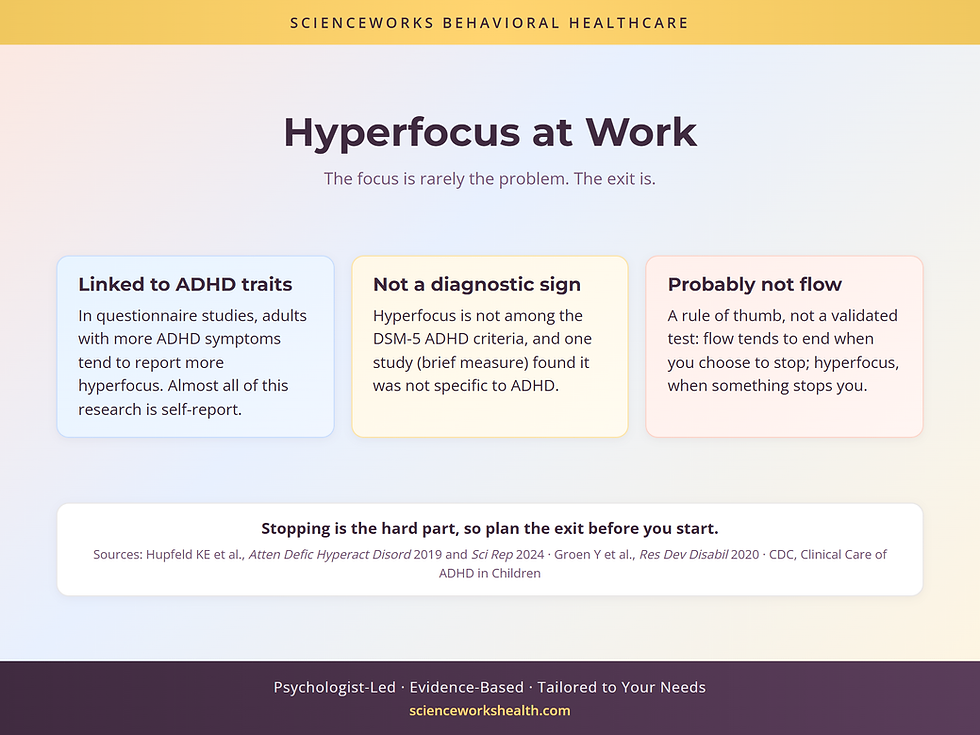
You sat down at 1 o'clock to fix one formula in a spreadsheet. When you look up, it is 4:40. The spreadsheet is better than it has ever been. You also missed the 3 o'clock check-in, skipped lunch without noticing, and have nine unread messages, two of them from your manager asking where you are. The rest of the afternoon goes to apologizing and catching up, and by evening you are hungry, wired and behind.
That pattern has a common name: hyperfocus at work. It can feel like the best and worst part of how your attention works, sometimes in the same afternoon. If it is one piece of a wider pattern of attention problems, a psychological assessment can help sort out what is going on. This article looks at what research actually says about hyperfocus, why it is not the same as flow, what it costs at work, and how to get out of it on time without giving up what it does well.
In this article, you'll learn:
What hyperfocus is, and how researchers have measured it
What the evidence does and does not say about hyperfocus and ADHD
How hyperfocus differs from flow, and a rule of thumb for telling them apart
Where hyperfocus tends to cost you at work
Practical ways to bound it, and when it is worth an evaluation
The short answer: what hyperfocus is and why it shows up at work
Hyperfocus usually means a long stretch of intense absorption in a task, so complete that everything else seems to fade out [1]. There is no single agreed definition, and almost all of the research relies on people describing their own experience on questionnaires [1][2]. Still, the pattern is consistent enough that researchers have studied it seriously, mostly in students and online volunteers rather than in workplaces.
Work is where hyperfocus often shows up most visibly, because jobs mix deep tasks with fixed times: meetings, handoffs, deadlines, a lunch break. Our article on ADHD in software engineers describes how this plays out in one field. The same pattern appears in many jobs, from writing to design to accounting to clinical work. Hyperfocus usually starts with a task you find engaging [1], and its costs show up at the edges, when something else needs your attention and you cannot shift.
🎯 Key takeaway: Hyperfocus is widely reported, but it is still loosely defined and mostly measured by self-report. Treat confident claims about it, including online ones, with some caution.
Three misconceptions about hyperfocus
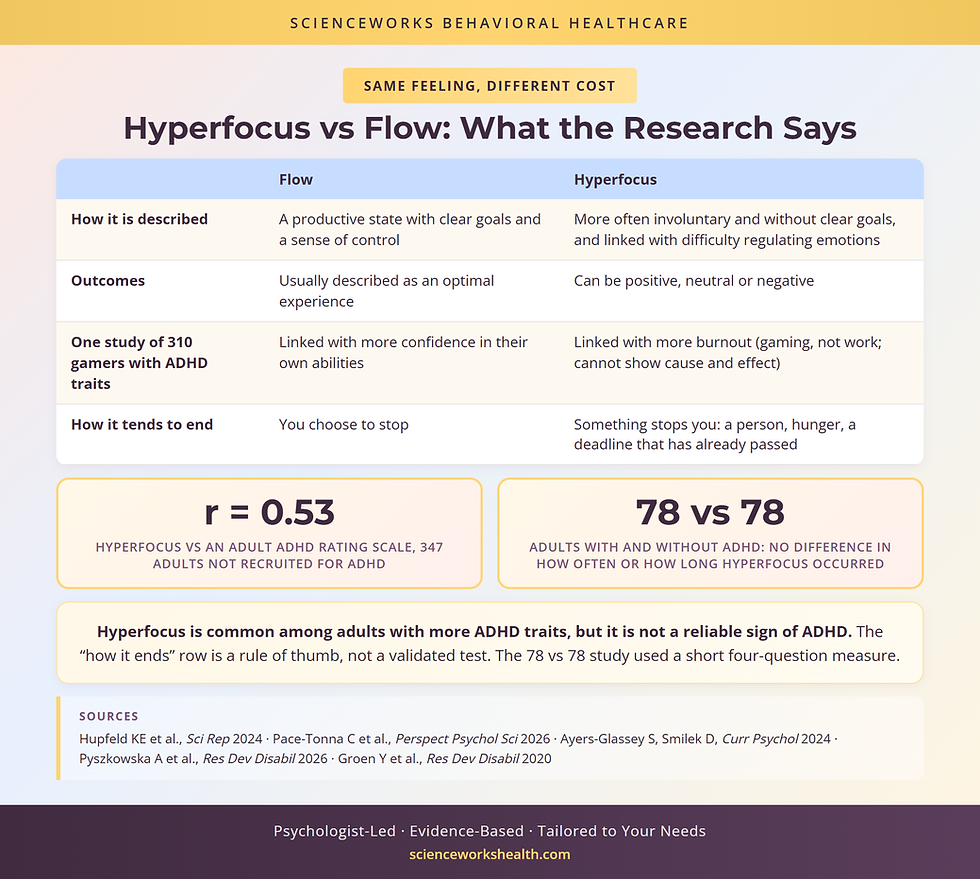
"Hyperfocus is just flow with a different name." Some researchers proposed exactly that in a review first published online in 2019, noting that psychiatry tends to say "hyperfocus" while positive psychology says "flow" [1]. Newer studies point the other way. In a 2024 validation study of 347 adults, hyperfocus scores were only weakly related to flow scores, and the authors described them as "distinct but related" [3]. A study of 85 college students found most parts of hyperfocus were not related, or were negatively related, to most parts of flow, although the authors noted this could partly reflect how the questions were worded [4]. A 2026 review described hyperfocus as like flow in concentration but "often involuntary" and lacking clear goals [5]. The question is not settled: the 2024 authors also suggested hyperfocus might be an especially intense, "deep" kind of flow [3].
"If you hyperfocus, you must have ADHD." Hyperfocus is not one of the DSM-5 symptom criteria for ADHD, as the CDC lists them [6]. In questionnaire studies, people with more ADHD symptoms tend to report more hyperfocus [2][3][7]. But when one research team compared 78 people diagnosed with ADHD with 78 matched adults without it, they found no difference in how often or how long hyperfocus occurred, and concluded hyperfocus was not specific to ADHD [8]. That study used a short, four-question measure, so its result is not directly comparable to the longer questionnaires [3]. Hyperfocus is also described in autism, although mostly in anecdotal reports rather than studies [1]. If you are wondering about ADHD, the ASRS adult screener asks about the core ADHD symptoms clinicians look at. It is a screener, not a diagnosis.
"Hyperfocus is a superpower, so the costs are worth it." It can produce excellent work. But researchers note that hyperfocus can lead to positive, neutral or negative outcomes, unlike flow, which is usually described as an optimal experience [3]. In a 2026 study of 310 adult video gamers with ADHD traits, hyperfocus was linked with more burnout, while flow was linked with more confidence in their own abilities [9]. That study was about gaming, not work, and it cannot show cause and effect. But it fits what many people describe: the same intensity that solves the problem can also cost you the rest of the day.
💡 Key takeaway: Hyperfocus is related to ADHD traits but is neither a diagnostic criterion nor unique to ADHD, and it is probably not the same thing as flow.
What the research says
How hyperfocus relates to ADHD in adults
Several studies, all using questionnaires, point in the same direction. In two samples of 251 and 372 adults, people with more ADHD symptoms reported more hyperfocus, in settings like school, hobbies and screen time [2]. A study of adult patients at two ADHD clinics found higher hyperfocus scores than in a comparison group of university students, whether or not patients were taking stimulant medication [7]. In the 2024 validation study, hyperfocus scores correlated moderately with an adult ADHD rating scale (r = 0.53), though participants were not recruited because they had ADHD [3].
Other studies add detail. In a one-time survey of 380 university students, self-reported difficulties with executive functions (skills like planning and self-management) partly accounted for the link between ADHD symptoms and hyperfocus [10]. If you want a structured look at your own executive skills, the ESQ-R questionnaire is one place to start. In a large study of adults, a general tendency to be distracted was also linked with hyperfocus, suggesting that hyperfocus may partly reflect attention problems [11]. One online survey of 529 undergraduates found hyperfocus was most closely tied to ADHD symptoms and to difficulty regulating emotions [12].
Two cautions matter. None of these studies was done in workplaces, and nearly all relied on self-report. So the evidence supports saying hyperfocus is common among adults with more ADHD traits, not that it is a reliable sign of ADHD.
Why it is not a diagnostic criterion
The DSM-5 criteria clinicians use to diagnose ADHD, as the CDC summarizes them, describe trouble holding attention, being easily distracted, forgetfulness, and hyperactivity or impulsivity, along with clear interference with daily life [6]. Hyperfocus is not among them, which researchers who study it have pointed out directly [1]. That does not make your experience less real. It means that hyperfocus on its own cannot tell you whether you have ADHD, and that an evaluation looks at the whole pattern instead.
Hyperfocus vs flow: same feeling, different cost
From the inside, both feel like being in the zone, and both involve losing track of time [1][3]. The differences show up in how they start, how they end, and what they leave behind. Flow, as most questionnaires measure it, is described as a productive state with clear goals and a sense of control [3]. Hyperfocus is more often described as involuntary, without clear goals, and linked with difficulty regulating emotions [5][12].
Here is how the difference can look. On Monday you spend two hours drafting a proposal. You know what the section needs, you are absorbed, and when your 11 o'clock alarm goes off you finish the sentence, save, and walk to the meeting feeling good. On Wednesday you open the same document to fix one heading, notice the formatting is off, start restyling every table, and then fall into researching fonts. Your alarm goes off and you dismiss it without registering it. When a coworker knocks on your door, the meeting is half over, and you feel both proud of the tables and irritated with yourself.
The distinguishing pattern: flow tends to end when you choose to stop. Hyperfocus tends to end when something stops you: a person, hunger, a deadline that has already passed. This is a rule of thumb drawn from how researchers describe the two states, not a validated test, but it is a useful question to ask yourself after a long stretch of focus.
🧭 Key takeaway: Ask how the focus ended. If you chose to stop, it was probably closer to flow. If something had to stop you, you were probably hyperfocused.
Where hyperfocus costs you at work
Missed transitions, meetings and handoffs
The main cost of hyperfocus is not the focus. It is the exit. One clinical research team described hyperfocus in ADHD as an inability to shift attention away from things that capture a person's interest [7], and a 2026 review noted that the shifting, intense attention described in autism and ADHD can bring difficulty disengaging from tasks [5]. At work, that shows up as missed meetings, late handoffs, and colleagues who were waiting on an answer that took two seconds to give. No study has measured the exact cost of these missed transitions, but many people who hyperfocus can list their own examples.
Consider a second, illustrative version of the opening story. Marcus, a nurse manager, sits down after rounds to update the staffing schedule. The puzzle of fitting everyone's requests together is genuinely satisfying, and he gets it nearly perfect. In the meantime he misses a page about a supply delivery, so a colleague has to handle it. The schedule is excellent, and Marcus still ends the day feeling like he dropped something important, because he did.
The crash afterward
People often describe coming out of hyperfocus hungry, stiff, dehydrated, or behind on everything else, and clinical descriptions note that people can lose track of their surroundings while absorbed [1]. That is clinical observation rather than measured data, but it is a consistent theme. The cost can also spill into the evening. A late burst of focus that runs past bedtime is common enough that we cover it in our article on ADHD, late body clocks and racing thoughts at night.
If losing hours is part of a wider pattern of misjudging time, time blindness in adults with ADHD is a related but separate topic. In one small lab study of adults with ADHD, hyperfocus scores did not predict errors in judging intervals of a few seconds [13]. That hints the two may be separate problems, although the study did not look at losing hours.
⏱️ Key takeaway: The cost of hyperfocus usually lands at the edges: the meeting you missed, the meal you skipped, and the evening that started late.
Getting out on time without losing what works
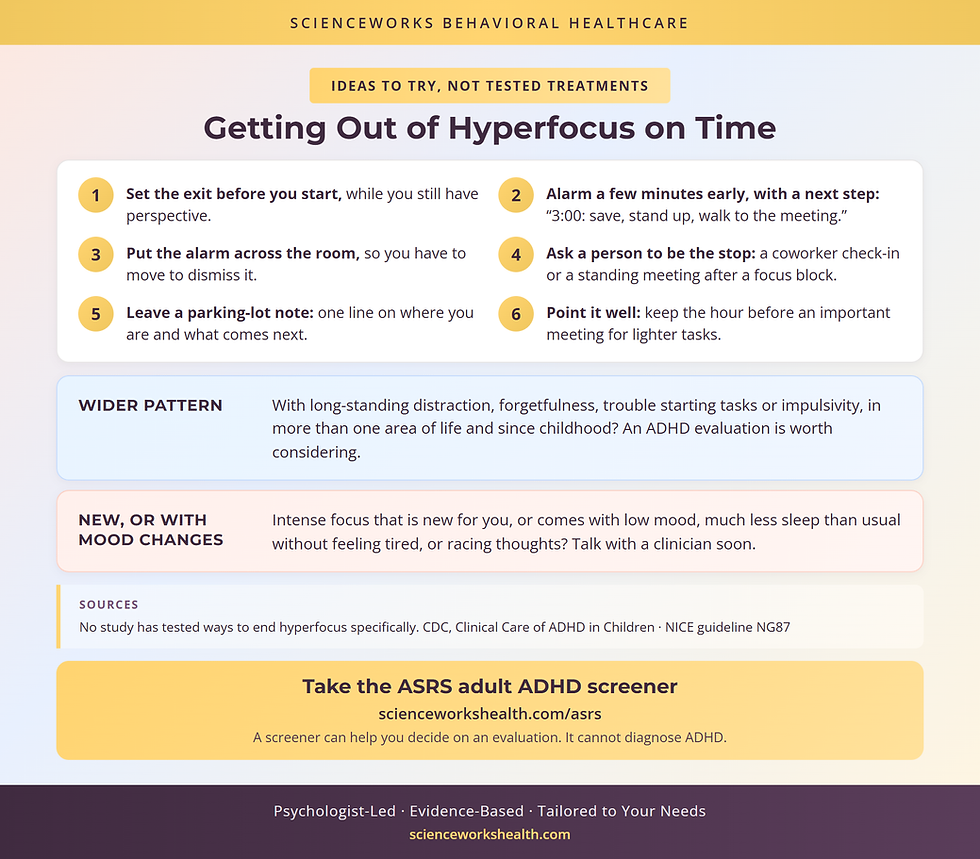
No study has tested strategies for ending hyperfocus specifically. The suggestions below are practical approaches drawn from clinical experience and from broader ADHD research, so treat them as experiments and keep what works. UK guidance on ADHD does list working in shorter periods of focus with movement breaks as one example of a helpful environmental change [14]. In a trial of cognitive behavioral therapy for adults with ADHD who were already on medication, therapy that included planning skills and ways to manage distraction improved symptoms more than relaxation training with educational support [15], and a 2026 meta-analysis found the largest functional gains from CBT for adult ADHD were at work [16]. None of these sources looked at hyperfocus directly; the NICE example is general ADHD advice.
External stops
Our article on external systems for ADHD at work covers the broader toolkit. These are the pieces aimed specifically at stopping on time.
Set the exit before you start. Decide the stopping time while you still have perspective, not once you are absorbed.
Use an alarm a few minutes early, with a specific next step. "3:00: save, stand up, walk to the meeting" may be harder to ignore than a bare tone you will swipe away.
Put the alarm somewhere you have to move to. A phone across the room is harder to dismiss on autopilot.
Ask a person to be the stop. A coworker who checks in at a set time, or a standing meeting right after a focus block, can do what an alarm cannot.
Leave a parking-lot note. Before stopping, write one line about where you are and what comes next. Stopping feels less costly when you know you can pick it back up.
Choosing where to point it
Hyperfocus is more useful when it lands on the right task at the right time. Schedule absorbing work in blocks that have a natural, firm end, and keep the hour before an important meeting for lighter tasks you can drop. If your days need more structure overall, executive function coaching focuses on building exactly these kinds of systems.
🔔 Key takeaway: Stopping is the hard part, so plan the exit before you start. Alarms with a next step, a person who checks in, and a stopping plan made in advance are worth trying. None has been tested for hyperfocus specifically, so keep what works for you.
When hyperfocus is a reason to get evaluated
Hyperfocus alone is not a reason to assume ADHD, and it is not one of the diagnostic criteria [6]. UK guidance also says ADHD should be diagnosed by a qualified professional and not from rating scales alone [14]. What matters is the wider pattern. Here is a rule of thumb:
If you hyperfocus now and then but otherwise manage attention, time and tasks reasonably well, the strategies above are a sensible place to start.
If hyperfocus sits alongside long-standing trouble with distraction, forgetfulness, starting tasks or impulsivity, in more than one area of life and going back to childhood, an ADHD evaluation is worth considering. The diagnostic criteria require symptoms in two or more settings that clearly interfere with daily life [6].
If you already have an ADHD diagnosis and hyperfocus is causing real problems at work, raise it with your treating clinician and consider coaching or therapy aimed at the specific situations where it costs you.
If intense, absorbed focus is new for you, or comes with low mood, a stretch of needing much less sleep than usual without feeling tired, or racing thoughts, talk with a clinician soon. Those changes can point to something other than ADHD, such as a mood condition, and are worth checking promptly.
If you decide to book an evaluation, these questions can help you choose a provider:
Will the evaluation consider other explanations, such as sleep problems, anxiety, depression or autism, as well as ADHD?
How do you assess adults who have learned to compensate, and will you gather input about work as well as home?
What developmental history do you need, and what if I do not have childhood records?
What will I receive afterward: a diagnosis only, or specific recommendations for how I work?
Our page on ADHD and autism testing in Tennessee explains how our evaluations work.
Next step: getting support
Hyperfocus is not a flaw to eliminate or a superpower to protect at any cost. It is a way your attention sometimes works, with real benefits and predictable costs at the edges. The research is still young, and much of it rests on self-report, but it supports a practical stance: notice how your focus ends, build exits that do not depend on willpower, and look at the wider pattern before drawing conclusions about ADHD.
Wondering if ADHD explains the pattern?
A structured ADHD evaluation can tell you whether what you're noticing is ADHD, something else, or both — and what would actually help.
Frequently Asked Questions
Is hyperfocus the same thing as flow?
They overlap but are probably not the same. Both involve deep absorption and losing track of time. Flow is usually described as an optimal state with clear goals and a sense of control. In recent questionnaire studies, hyperfocus scores were only weakly related, unrelated or even negatively related to flow scores, and a 2026 review described hyperfocus as often involuntary and lacking clear goals. One rule of thumb, not a validated test: flow tends to end when you choose to stop, hyperfocus when something stops you.
How do you break out of hyperfocus at work?
Plan the exit before you start, because stopping is the hard part. Set an alarm for a few minutes before the time you need to stop, decide in advance what you will do when it goes off, and leave yourself a short note about where you are so stopping costs less. No study has tested these strategies for hyperfocus specifically, so treat them as practical experiments and keep the ones that work for you.
Why is it so hard to stop hyperfocusing?
Researchers describe hyperfocus as a state that is difficult to end and that may be partly outside a person's control. In questionnaire studies, it tends to go along with more ADHD symptoms, more executive-function difficulty and more trouble regulating emotions, although these studies cannot show what makes stopping hard. That is one reason many people find external cues, like an alarm or a coworker who checks in, more reliable than willpower, although no study has tested this for hyperfocus.
Is hyperfocus a good thing or a bad thing?
It can be either, which is why it is worth managing rather than celebrating or fighting. Hyperfocus can produce excellent, sustained work. It can also eat hours you needed for other things, and in one 2026 survey of adult video gamers with ADHD traits, hyperfocus was linked with more burnout while flow was linked with more confidence. That study was about gaming, not work, and cannot show cause and effect. In practice, much seems to depend on where the focus lands and whether you can get out on time.
About the Author
Dr. Kiesa Kelly is a licensed clinical psychologist and the founder of ScienceWorks Behavioral Healthcare. A neuropsychologist by training with more than 20 years of experience in psychological assessment, she completed an NIH-funded postdoctoral fellowship focused on ADHD in both research and clinical practice, including research on cognitive control in ADHD. She has also trained in neurodiversity-affirming ADHD and autism assessment through individual consultation with Dr. Paige Victorine, PsyD.
Dr. Kelly earned her PhD in Clinical Psychology, with a concentration in Neuropsychology, from Rosalind Franklin University of Medicine and Science. She completed practica, internship, and postdoctoral training at the University of Chicago, the University of Wisconsin, the University of Florida, and Vanderbilt University. She is a psychologist, not a physician, and does not prescribe medication.
References
1. Ashinoff BK, Abu-Akel A. Hyperfocus: the forgotten frontier of attention. Psychol Res. 2021;85(1):1-19. https://doi.org/10.1007/s00426-019-01245-8
2. Hupfeld KE, Abagis TR, Shah P. Living "in the zone": hyperfocus in adult ADHD. Atten Defic Hyperact Disord. 2019;11(2):191-208. https://doi.org/10.1007/s12402-018-0272-y. Correction in: Atten Defic Hyperact Disord. 2019;11(2):209.
3. Hupfeld KE, Osborne JB, Tran QT, Hyatt HW, Abagis TR, Shah P. Validation of the dispositional adult hyperfocus questionnaire (AHQ-D). Sci Rep. 2024;14(1):19460. https://doi.org/10.1038/s41598-024-70028-y
4. Grotewiel MM, Crenshaw ME, Dorsey A, Street E. Experiences of hyperfocus and flow in college students with and without Attention Deficit Hyperactivity Disorder (ADHD). Curr Psychol. 2023;42:13265-13275. https://doi.org/10.1007/s12144-021-02539-0
5. Pace-Tonna C, Murtaza M, Rodak T, Farb N, Ryan W, Lai MC. Flow and Similar Attentional States in Autism and ADHD: A Scoping Review of Similarities and Differences. Perspect Psychol Sci. Published online October 1, 2026 (online ahead of print). https://doi.org/10.1177/17456916261470783
6. Centers for Disease Control and Prevention. Clinical Care of ADHD in Children. Updated July 30, 2026. Accessed October 7, 2026. https://www.cdc.gov/adhd/hcp/clinical-care/index.html
7. Ozel-Kizil ET, Kokurcan A, Aksoy UM, Kanat BB, Sakarya D, Bastug G, Colak B, Altunoz U, Kirici S, Demirbas H, Oncu B. Hyperfocusing as a dimension of adult attention deficit hyperactivity disorder. Res Dev Disabil. 2016;59:351-358. https://doi.org/10.1016/j.ridd.2016.09.016
8. Groen Y, Priegnitz U, Fuermaier ABM, Tucha L, Tucha O, Aschenbrenner S, Weisbrod M, Garcia Pimenta M. Testing the relation between ADHD and hyperfocus experiences. Res Dev Disabil. 2020;107:103789. https://doi.org/10.1016/j.ridd.2020.103789
9. Pyszkowska A, Nowacki A, Dziura N. Game on but pay the price: Hyperfocus, flow, escapism, self-efficacy, and burnout among video gamers with ADHD traits. Res Dev Disabil. 2026;170:105241. https://doi.org/10.1016/j.ridd.2026.105241
10. Garcia Pimenta M, Gruhnert RK, Fuermaier ABM, Groen Y. The role of executive functions in mediating the relationship between adult ADHD symptoms and hyperfocus in university students. Res Dev Disabil. 2023;144:104639. https://doi.org/10.1016/j.ridd.2023.104639
11. Zhang H, Miyake A, Osborne J, Shah P, Jonides J. A d factor? Understanding trait distractibility and its relationships with ADHD symptomatology and hyperfocus. PLoS One. 2023;18(10):e0292215. https://doi.org/10.1371/journal.pone.0292215
12. Ayers-Glassey S, Smilek D. The relations between hyperfocus and similar attentional states, adult ADHD symptoms, and affective dysfunction. Curr Psychol. 2024;43:11254-11266. https://doi.org/10.1007/s12144-023-05235-3
13. Tas Dolek G, Ozel-Kizil ET, Bastug G, Baran Z, Colak B. Impaired auditory and visual time reproduction in adult patients with attention deficit-hyperactivity disorder. J Clin Exp Neuropsychol. 2021;43(2):176-186. https://doi.org/10.1080/13803395.2021.1898549
14. National Institute for Health and Care Excellence. Attention deficit hyperactivity disorder: diagnosis and management. NICE guideline NG87. 2018, updated 2019. https://www.nice.org.uk/guidance/ng87/chapter/Recommendations
15. Safren SA, Sprich S, Mimiaga MJ, Surman C, Knouse L, Groves M, Otto MW. Cognitive behavioral therapy vs relaxation with educational support for medication-treated adults with ADHD and persistent symptoms: a randomized controlled trial. JAMA. 2010;304(8):875-880. https://doi.org/10.1001/jama.2010.1192
16. Lopez-Pinar C, Selaskowski B, Schulze M, Oscarsson M, Fenollar-Cortes J, Sibley MH, Philipsen A, Hirvikoski T. Cognitive behavioral therapy effects on global functioning, domain-specific functioning, and quality of life in adult ADHD: A comprehensive meta-analysis. Behav Res Ther. 2026;201:105026. https://doi.org/10.1016/j.brat.2026.105026
Disclaimer
This article is for informational and educational purposes only and is not a substitute for professional medical or mental health advice, diagnosis, or treatment. Online screeners cannot diagnose ADHD or any other condition. If you are worried about your attention, mood or sleep, talk with a qualified clinician. If you are in crisis or thinking about harming yourself, call or text 988, or call 911 in an emergency.