
ADHD and Irritability: The Short Fuse Nobody Warned You About, and What It Isn't

Last reviewed: 09/28/2026
Reviewed by: Dr. Kiesa Kelly
You were fine a minute ago. Then someone interrupted you mid-thought, or a page froze just as you hit submit, or a plan changed at the last minute, and the anger arrived before you could stop it. You snapped. A little while later the feeling is gone, and what is left is embarrassment and a quiet question: what is wrong with me? For many adults, ADHD and irritability travel together, and nobody mentioned it when they read about attention and focus.
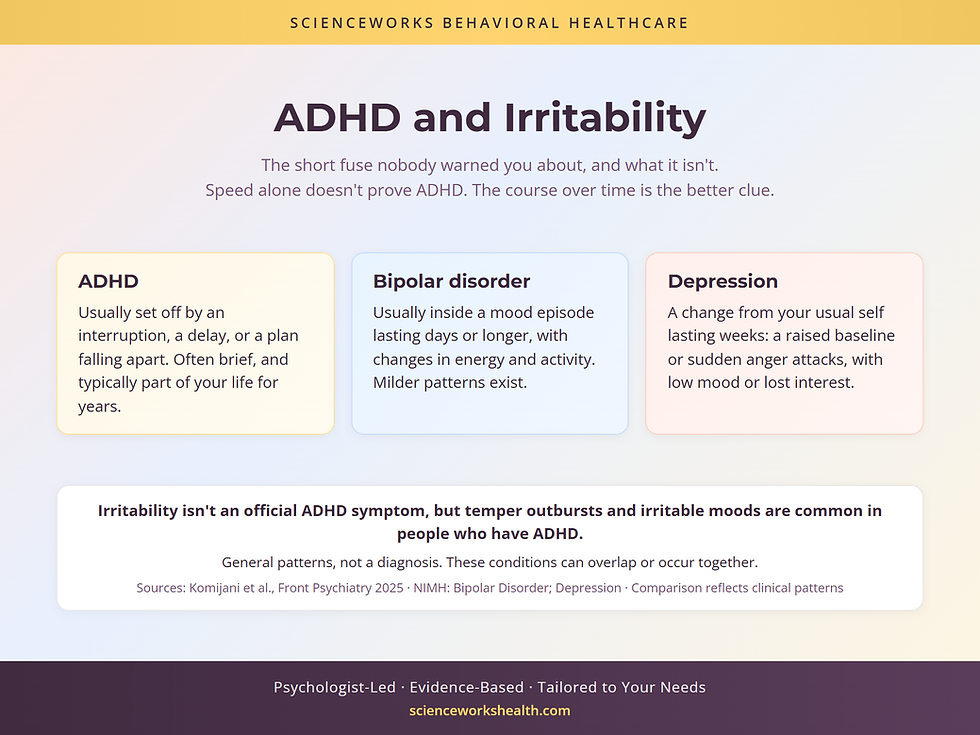
Irritability is not one of the official symptoms of ADHD. Even so, temper outbursts and irritable moods are common in people who have it [1]. That gap is why a short fuse gets misread so often, as a personality problem, as depression, or as bipolar disorder. If you want a first, low-stakes look at whether ADHD fits your wider pattern, a brief adult ADHD screener is a reasonable place to start [2].
In this article, you'll learn:
Why irritability shows up so often with ADHD, even though it is not a diagnostic symptom
What the ADHD short fuse tends to look like at work and at home
How it differs from the irritability of bipolar disorder and depression
How medication timing can play a part, and what to do about it
What actually helps, and when it is time to get evaluated
What ADHD irritability is: the short answer
ADHD irritability is a quick, often outsized flash of frustration or anger, usually set off by something in the moment: an interruption, a delay, a noise, a plan that falls apart. In clinical practice, it tends to rise fast and fade fairly fast, and many people feel regret or shame once it passes.
Researchers describe this as part of emotion dysregulation, meaning difficulty managing how strongly and how long emotions run. A major review concluded that emotion dysregulation is common in ADHD across the lifespan and is a major contributor to impairment [3]. In adults, a meta-analysis of 13 studies found that people with ADHD scored much higher than healthy comparison groups on emotional lability, the quick up-and-down shifting of emotions [4]. Whether this belongs inside ADHD itself or runs alongside it is still being debated [3][5]. What is not in doubt is that it causes real problems.
⏱️ Key takeaway: The ADHD short fuse is usually triggered and brief, and it has been part of your life for a long time. Speed alone does not prove ADHD, because depression can also cause sudden anger attacks. The long-running pattern is the better clue.
Three things people get wrong about ADHD and anger
"If irritability isn't an ADHD symptom, it can't be ADHD." It is true that irritability is not on the diagnostic list. But emotion-regulation difficulties have long been recognized in ADHD [3], and temper outbursts and irritable moods are common [1]. The official checklist was never meant to capture everything ADHD costs you. Our overview of emotional dysregulation across ADHD, autism, and BPD explains why the same surface emotion can come from different engines.
"Explosive anger means bipolar disorder." Intensity alone does not point to bipolar disorder. Bipolar irritability usually comes inside a mood episode that lasts days or longer and changes energy and activity along with mood, although milder bipolar-spectrum patterns exist, and ADHD and bipolar disorder can occur together [6]. The course over time matters far more than the size of the outburst, which is why our guide to telling bipolar mood swings from ADHD starts with timing.
"You just need to try harder to stay calm." Trying harder is hard to sustain when ADHD is already taxing your day. Adults with ADHD tend to rely more often on emotion regulation strategies that do not work well [5]. That is a skill and capacity problem, not a character flaw, and skills can be learned.
🧩 Key takeaway: A short fuse is not proof of a mood disorder, and it is not a moral failing. It is a pattern worth understanding.
What the short fuse looks like day to day
The flash and the aftermath
Picture a Tuesday morning at work. You finally have momentum on a report that took an hour to start. A coworker stops by with "just a quick question," and the thread you were holding snaps. The irritation is instant and physical: jaw tight, voice sharper than you intended. You answer curtly, they leave, and within twenty minutes you feel fine again, except for the replay. Was I rude? Do they think I am difficult? The flare took seconds. The shame lasts the rest of the morning.
Or: you are running late, you cannot find your keys, and your partner asks, reasonably, whether you checked the counter. You bark back. You find the keys in your coat pocket. On the drive, the anger drains out and leaves a heavy, familiar guilt. The trigger was small. It landed on a system that was already stretched by lateness, lost items, and the effort of holding the morning together.
How it shows up at home and in the evening
For many adults, the fuse is shortest at home, at the end of the day. You have spent hours managing distractions and deadlines, and by 6 p.m. there is nothing left in reserve. The dishwasher is loaded wrong, the kids are loud, a notification pings for the fifth time. Each one is small. Stacked together, they tip you over, and the people you love most get the sharpest version of you. For some adults, this at-home pattern is what finally raises the question of whether ADHD is part of the picture.
Or: you are waiting in a slow line, or stuck behind a car that will not turn, or listening to someone explain something you already understood. Waiting is its own trigger. The impatience builds under the surface until a small thing releases it all at once.
🔋 Key takeaway: For many people, ADHD irritability seems to track depletion. The same interruption that rolls off you in the morning can set you off at night.

Why it happens
A leading explanation is that ADHD affects how emotions are regulated, not only how attention is, though researchers have not reached consensus on how to understand it [3]. One review suggests the difficulty may begin with how attention is directed toward, and applied to, emotional information [3]. In everyday terms, a feeling can build faster than you can step back from it.
The research supports a few specific links. Adults with more severe ADHD symptoms tend to report more emotion dysregulation [4]. A 2023 systematic review found that adults with ADHD more often use regulation strategies that do not work well, and that emotion dysregulation was tied to symptom severity, executive functioning, and other mental health conditions [5]. The same review noted that the studies are few and very varied, so the details are still being worked out [5].
Daily life adds fuel. Much of ADHD is about friction: lost time, forgotten steps, tasks that take three tries. Each small failure adds frustration, and frustration is the raw material of irritability. When you are also short on sleep or running on empty, the margin for the next interruption gets thinner. That last point is clinical observation rather than a tested finding, but it is one most people with ADHD recognize.
What it isn't: telling ADHD irritability apart from look-alikes
Irritability is not specific to any one condition. It shows up in ADHD, depression, and bipolar disorder [1][6][7], and in everyday stress too. So the useful question is not "am I irritable?" but "what is the shape of it, and how long has it been there?"
Bipolar disorder and depression: the course over time
In bipolar disorder, irritability can be part of a manic or hypomanic episode, a stretch of unusually elevated, irritable, or energized mood [6]. Manic episodes in bipolar I last at least seven days, or are severe enough to need hospital care [6]. Depression can also show up as anger: irritability, frustration, and increased anger are among its signs [7]. Sometimes that looks like a constantly raised baseline, where everything feels abrasive for weeks. Sometimes it looks like sudden anger attacks that resemble an ADHD flare.
What usually separates them is the course, not the speed. ADHD irritability has typically been part of your life for years. Depression and bipolar disorder tend to arrive as a change from your usual self, alongside shifts in mood, interest, energy, or sleep, and clinicians look at the past days and weeks rather than one moment [6]. If low mood or lost interest is part of your picture, a PHQ-9 depression screener can help you and a clinician gauge it [8].
Anger-forward depression can be easy to miss, especially when there is no single incident to point to. Our article on depression that looks like anger describes that pattern in detail.
Medication timing
If you take stimulant medication, its relationship with irritability is mixed. Irritability is listed as a common side effect of stimulants [9]. Yet in a meta-analysis of 32 trials in children, methylphenidate was linked to slightly less reported irritability than placebo, while amphetamine-type stimulants were linked to more [9]. That finding came from children, rested on only five amphetamine trials, and the authors called for it to be replicated [9]. In adults, a separate meta-analysis found that stimulants and atomoxetine reduced emotional lability on average [10].
Some adults notice that their shortest fuse lines up with a specific time of day, such as late afternoon, when a dose may be wearing off. That is a clinical observation, not a settled finding. It is worth writing down and bringing to your prescriber. Please do not change or stop a medication on your own.
🧭 The distinguishing pattern: ADHD irritability is triggered, brief, and long-standing, part of your life for years across settings. Bipolar irritability comes inside a sustained episode that changes energy and activity. Depression irritability is a change from your usual self lasting weeks, either as a raised baseline or as sudden anger attacks, alongside low mood or lost interest. Medication-related irritability may follow the clock of your doses.
How ADHD irritability is assessed
There is no test for irritability on its own. A good evaluation treats the short fuse as one clue and asks where it fits. UK clinical guidance (NICE) says an ADHD assessment should include coexisting conditions and physical health [11]. Our psychological assessments are built around that wider question.
What an evaluation looks at
A clinician will usually want to know when the irritability started and whether it has been present for much of your life. They will ask what sets it off, how long it lasts, and how you feel afterward. Sleep, energy, and mood over weeks matter too, because they help separate an ADHD flare from a mood episode. If you take ADHD medication, the timing of your worst moments is useful information. Input from a partner or family member can help, since they often see the pattern more clearly than you do in the moment.
What else gets ruled out
A clinician will also ask about alcohol and substance use, other medications, and physical health. Some conditions, such as thyroid disease, and some prescribed, recreational, or illicit drugs can mimic or worsen mood symptoms [6]. Your primary care provider may be part of ruling those out. More than one explanation can be true at once.
Questions worth asking a provider before you book:
Scope: Will the evaluation look at mood disorders as well as ADHD, so irritability is not assumed to be one or the other?
Method: How do you tell a triggered ADHD flare from irritability that is part of a mood episode?
History: If I do not have childhood records, what history will you gather, and from whom?
Output: Will I leave with specific recommendations for managing the irritability, not just a diagnosis?
What actually helps
Evidence-based options
Treating the ADHD itself. People with more severe ADHD symptoms tend to have more emotion dysregulation [4], and ADHD treatment often eases emotion dysregulation as well [3]. In adults, stimulants and atomoxetine reduced emotional lability, though by about half as much as they reduced core ADHD symptoms, in trials that did not specifically recruit people with strong emotional swings [10]. The authors suggested that some people may also need psychotherapy for the emotional side [10].
Cognitive behavioral therapy adapted for ADHD. A 2023 meta-analysis of 28 studies found that CBT for adults with ADHD reduced core symptoms and also depression and anxiety; the authors called the support cautiously optimistic [12]. A 2025 commentary in World Psychiatry described a meta-analysis, in which most comparisons (12 of 20) were uncontrolled, where CBT for ADHD also improved emotion dysregulation, possibly as a knock-on effect of better daily functioning. It also noted that CBT adds to the benefits of medication [13]. UK guidance suggests considering a structured psychological intervention focused on ADHD, which may include CBT, when medication is not the right fit or is not enough on its own [11].
Anger-focused skills. Anger treatments, including cognitive approaches, showed medium-to-large effects in a meta-analysis of adults with anger problems [14]. Those studies did not focus on ADHD, so they show what anger work can do in general rather than proving it for ADHD. In our clinical experience, the core skills often carry over: noticing the early body signals, having a pause-and-exit plan, and repairing after an outburst. A therapist in our specialized therapy program can adapt these to how your ADHD actually works.
Fewer flashpoints. If much of your irritation comes from chaos, like being late, losing things, and dropped tasks, reducing that chaos lowers how often the fuse gets lit. Executive-function coaching focuses on building those day-to-day systems.
🛠️ Key takeaway: The most durable help usually works on two fronts at once: the ADHD that lowers your threshold, and the in-the-moment skills for when the fuse is already lit.
What to be cautious of
Be cautious about treating anger as the whole problem. A class that teaches calming techniques can help, but if it never names the ADHD underneath, the triggers keep coming. And be wary of labels applied from a single outburst. One explosive moment is not a diagnosis of anything.

When to get evaluated
Here is a practical rule of thumb. If your irritability is triggered, brief, and has been part of you for years, alongside long-running trouble with attention, time, or organization, an ADHD evaluation is a sensible first question. If it arrived as a change from your usual self, in stretches of days or weeks with shifts in energy and activity, raise bipolar disorder specifically, and make sure it is considered before any medication decision [6]. If the change comes with low mood or lost interest, whether as a heavy, constant floor or as sudden anger attacks, start with depression. If you cannot tell, that is exactly what an evaluation is for.
Some things should not wait. If your anger has led you to hurt someone, or you are afraid you might, reach out for help now. If you are in crisis or thinking about harming yourself, call or text 988, or call 911 in an emergency.
🤝 Key takeaway: You do not need to figure out the label yourself. Noticing the shape of your irritability, and how long it has been there, is enough to start the right conversation.
Next step: getting support
A short fuse can quietly shape your relationships, your work, and how you see yourself. Whether it turns out to be ADHD, a mood condition, or both, understanding the pattern is what makes the right help possible.
Wondering if ADHD explains the pattern?
A structured ADHD evaluation can tell you whether what you're noticing is ADHD, something else, or both — and what would actually help.
Frequently Asked Questions
Can ADHD medication make me more irritable?
It can for some people. Irritability is a listed side effect of stimulants. In a meta-analysis of children's trials, methylphenidate was linked to slightly less reported irritability than placebo, while amphetamine-type stimulants were linked to more, a finding based on only five trials that still needs replication. If you notice a change, note when it happens and tell your prescriber rather than changing the dose yourself.
Why am I calm at work but snap at my family in the evening?
One common reason, in clinical experience, is that the evening is when your reserves are lowest. Many adults with ADHD spend the workday compensating hard, so small frustrations at home land on a system that is already spent. If you take medication, some people notice irritability as a dose wears off. Tracking when your worst moments happen, and what came right before them, gives you and a clinician something concrete to work with.
Is ADHD irritability the same thing as rejection sensitivity?
They overlap but are not the same. Rejection sensitivity, a descriptive term rather than a formal diagnosis, refers to a sharp emotional reaction to real or perceived criticism or rejection. ADHD irritability is broader: frustration and anger set off by interruptions, delays, or things going wrong. Our article on emotional dysregulation across ADHD, autism, and BPD explains how these reactions differ.
Can anger management help if my short fuse comes from ADHD?
It may help with the anger itself. A meta-analysis found that anger treatments helped adults with anger problems in general, though those studies did not focus on ADHD and the authors called for more research in clinical populations. What a general class can miss is the ADHD underneath: the overload, the lost track of time, the depleted evenings. Help that addresses both, or an evaluation first if ADHD has never been assessed, usually makes more sense.
About the Author
Dr. Kiesa Kelly is a licensed clinical psychologist and the founder of ScienceWorks Behavioral Healthcare. Sorting out whether symptoms like irritability come from ADHD, a mood condition, or both is a core part of the differential diagnosis at the center of her assessment practice. She earned her PhD in Clinical Psychology with a concentration in Neuropsychology from Rosalind Franklin University of Medicine and Science, and has more than 20 years of experience with psychological assessment.
She completed practica, internship, and an NIH-funded National Research Service Award postdoctoral fellowship at the University of Chicago, the University of Wisconsin, the University of Florida, and Vanderbilt University. Dr. Kelly is a psychologist, not a physician, and does not prescribe medication.
References
1. Komijani S, Ghosal D, Singh MK, Schweitzer JB, Mukherjee P. A novel framework to predict ADHD symptoms using irritability in adolescents and young adults with and without ADHD. Front Psychiatry. 2025;15:1467486. https://doi.org/10.3389/fpsyt.2024.1467486
2. Kessler RC, Adler L, Ames M, et al. The World Health Organization Adult ADHD Self-Report Scale (ASRS): a short screening scale for use in the general population. Psychol Med. 2005;35(2):245-256. https://pubmed.ncbi.nlm.nih.gov/15841682/
3. Shaw P, Stringaris A, Nigg J, Leibenluft E. Emotion dysregulation in attention deficit hyperactivity disorder. Am J Psychiatry. 2014;171(3):276-293. https://doi.org/10.1176/appi.ajp.2013.13070966
4. Beheshti A, Chavanon ML, Christiansen H. Emotion dysregulation in adults with attention deficit hyperactivity disorder: a meta-analysis. BMC Psychiatry. 2020;20(1):120. https://doi.org/10.1186/s12888-020-2442-7
5. Soler-Gutiérrez AM, Pérez-González JC, Mayas J. Evidence of emotion dysregulation as a core symptom of adult ADHD: a systematic review. PLoS One. 2023;18(1):e0280131. https://doi.org/10.1371/journal.pone.0280131
6. National Institute of Mental Health. Bipolar disorder. https://www.nimh.nih.gov/health/publications/bipolar-disorder
7. National Institute of Mental Health. Depression. https://www.nimh.nih.gov/health/publications/depression
8. Kroenke K, Spitzer RL, Williams JB. The PHQ-9: validity of a brief depression severity measure. J Gen Intern Med. 2001;16(9):606-613. https://pubmed.ncbi.nlm.nih.gov/11556941/
9. Stuckelman ZD, Mulqueen JM, Ferracioli-Oda E, et al. Risk of irritability with psychostimulant treatment in children with ADHD: a meta-analysis. J Clin Psychiatry. 2017;78(6):e648-e655. https://doi.org/10.4088/JCP.15r10601
10. Moukhtarian TR, Cooper RE, Vassos E, Moran P, Asherson P. Effects of stimulants and atomoxetine on emotional lability in adults: a systematic review and meta-analysis. Eur Psychiatry. 2017;44:198-207. https://doi.org/10.1016/j.eurpsy.2017.05.021
11. National Institute for Health and Care Excellence. Attention deficit hyperactivity disorder: diagnosis and management (NG87). Recommendations. https://www.nice.org.uk/guidance/ng87/chapter/Recommendations
12. Liu CI, Hua MH, Lu ML, Goh KK. Effectiveness of cognitive behavioural-based interventions for adults with attention-deficit/hyperactivity disorder extends beyond core symptoms: a meta-analysis of randomized controlled trials. Psychol Psychother. 2023;96(3):543-559. https://doi.org/10.1111/papt.12455
13. Solanto MV. The efficacy of cognitive-behavioral therapy for adults with ADHD. World Psychiatry. 2025;24(3):378-379. https://doi.org/10.1002/wps.21349
14. Del Vecchio T, O'Leary KD. Effectiveness of anger treatments for specific anger problems: a meta-analytic review. Clin Psychol Rev. 2004;24(1):15-34. https://doi.org/10.1016/j.cpr.2003.09.006
Disclaimer
This article is for informational and educational purposes only and is not a substitute for professional medical or mental health advice, diagnosis, or treatment. It is not a self-assessment tool. Decisions about medication belong with a prescribing provider. If you are in crisis or thinking about harming yourself, call or text 988, or call 911 in an emergency.