
ADHD Burnout vs Depression: How to Tell the Difference

Updated: Sep 2
Last reviewed: 09/02/2026
Reviewed by: Dr. Kiesa Kelly
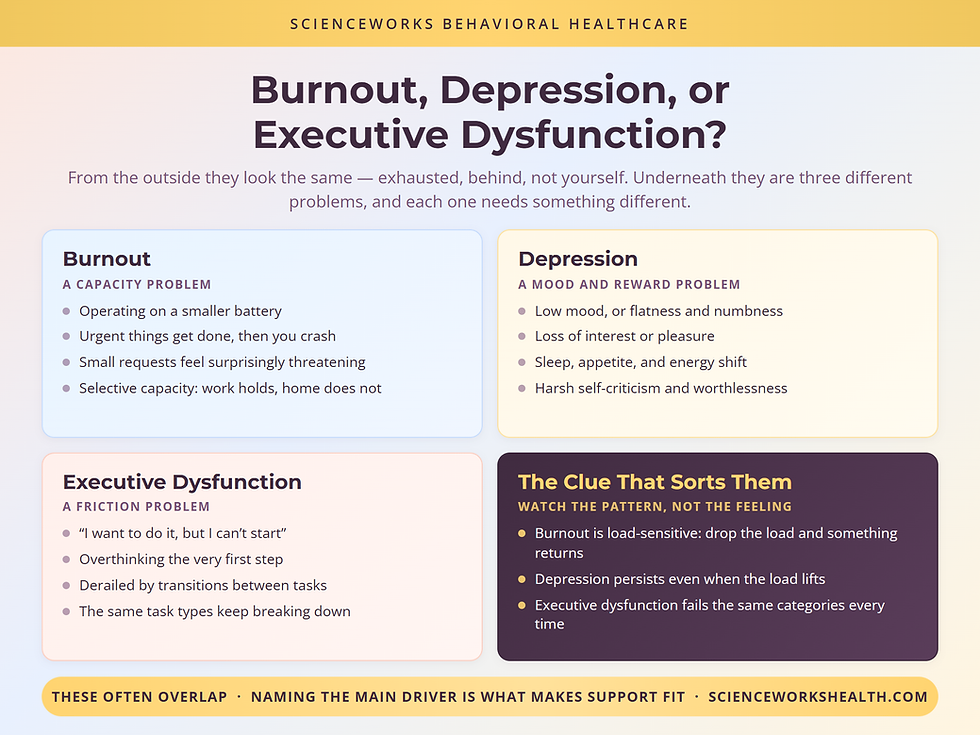
If you’re googling burnout vs depression symptoms, you’re probably not being dramatic. When you’re mentally exhausted and can’t function the way you used to, burnout, depression, and executive dysfunction can look the same. The goal is to spot the main driver so the first support you try actually fits.
In this article, you’ll learn:
Why these issues share the same “surface symptoms”
Clues that point toward burnout, depression, or executive dysfunction
Common overlap patterns (including burnout vs ADHD and autistic burnout signs)
How tools like the ESQ-R questionnaire and PHQ-9 depression screening tool can help you sort the picture
What next steps tend to help most, including Tennessee telehealth options
🧭 Key takeaway: You’re looking for the dominant pattern, not a forever diagnosis. “What’s driving this right now?” is often the most helpful question.
Burnout vs depression symptoms: why everything can look like “I’m failing”
Burnout, depression, and executive dysfunction share the same surface signs
All three can show up as brain fog, low motivation, irritability, shutdown, and missed deadlines.
Burnout is described by the World Health Organization as an occupational phenomenon tied to chronic workplace stress that hasn’t been successfully managed, not a medical diagnosis. [1]
The goal: identify the main driver so support fits
A simple way to frame it:
Burnout: capacity is depleted (load > bandwidth)
Depression: mood/interest has shifted (sadness, numbness, hopelessness)
Executive dysfunction: high friction in starting, organizing, shifting, and sustaining
You can have more than one. But a “first domino” is often there.
What burnout often feels like (capacity problem)
Emotional/physical exhaustion + reduced bandwidth
Burnout often feels like operating on a smaller battery:
Urgent tasks happen, but you crash after
Small requests feel surprisingly threatening
Your tolerance for decisions and interruptions drops [1]
Shutdown, irritability, and “I can’t do one more thing”
When capacity is gone, the nervous system defaults to protection: snapping, going numb, avoiding people, or zoning out because it’s the only low-demand option.
Misconception #1: “If I can do some things, I should be able to do everything.” Burnout often creates selective capacity: you might manage work but have nothing left for dishes, texts, or paperwork.
What changes when load is reduced (clue)
A strong burnout clue is load sensitivity. If the load genuinely drops (even for a day), you may notice some return of initiation, patience, or clarity.
🌿 Key takeaway: Burnout is usually “capacity math,” not a character flaw. When the load drops, functioning often improves at least a little.
What depression often feels like (mood/reward system problem)
Low mood or numbness + loss of interest
Depression can look like sadness, but it can also look like flatness, emptiness, or “nothing matters.” It commonly includes low mood or irritability plus loss of interest/pleasure. [2]
Misconception #2: “If I’m still going to work, it can’t be depression.” Many people “function” while feeling disconnected and hopeless. [2]
Energy changes, sleep changes, self-worth spiral
Depression often changes body rhythms and self-talk: sleep/appetite shifts, low energy, concentration problems, and harsh self-criticism or worthlessness. [2]
When to reach out sooner (including safety note)
If symptoms are present most days for 2+ weeks, impair daily life, or include thoughts of self-harm, it’s time to reach out. If you’re in immediate danger, call/text 988 (24/7) or call 911. [8] TN residents can find state 988 info on TN.gov. [9]
🧠 Key takeaway: Depression is more than tiredness. A persistent shift in mood, interest, and self-worth is a strong reason to get clinical support and monitor symptoms.
What executive dysfunction often feels like (friction problem)
Starting is hardest, even when you care
Executive dysfunction is difficulty using the brain’s “management” skills: initiating, planning, prioritizing, switching, and sustaining. People often say, “I want to do it, but I can’t start.”
This is why burnout vs ADHD searches are common. Executive function weaknesses are frequently seen in ADHD groups on average, even though no single test pattern fits everyone. [5]
Misconception #3: “If I care, starting should be easy.” Caring and starting are different brain processes.
Decision fatigue and “stuck” moments
Executive dysfunction often looks like:
Overthinking the first step
Getting derailed by transitions
Needing urgency to activate
Patterns: certain tasks consistently break down
A key clue is consistency. The same task categories keep failing: time estimation, deadlines, paperwork, routines with multiple steps, or keeping track of details.
🧩 Key takeaway: Executive dysfunction is often a friction problem, not a motivation problem. Helpful support adds structure and reduces decisions, instead of adding shame.
Common overlap patterns
Burnout → executive dysfunction → depressed mood
Chronic load can drain cognitive resources. Then tasks collapse. Then shame and isolation can feed a depressed mood spiral.
Depression/anxiety → executive function collapses
Mood and anxiety symptoms can also reduce initiation and follow-through, because attention and energy get pulled into survival mode.
Neurodivergent burnout and masking (if relevant to you)
Autistic adults have described a burnout pattern involving chronic exhaustion, loss of skills, and reduced tolerance to sensory input. [6] Research also links higher masking (camouflaging) to poorer mental health and burnout-related outcomes in autistic people. [7]
🔁 Key takeaway: Overlap doesn’t mean you’re “too complicated.” It usually means multiple systems are strained, and you’re starting to run out of margin.
How screeners can help you sort the picture
Screeners don’t diagnose you. They help you organize symptoms and decide what to explore next. The U.S. Preventive Services Task Force recommends screening adults for depression, paired with systems for accurate diagnosis and follow-up care. [14]
ESQ-R for executive skill profile
The ESQ-R executive skills questionnaire is a brief self-report snapshot of where executive skills feel hardest (time, planning, organization, emotional regulation, behavioral regulation). It’s designed to guide practical supports, not to diagnose. [10]
PHQ-9 for depression symptoms
The PHQ-9 depression screener tracks symptoms over the past two weeks. In validation research, scores of 5, 10, 15, and 20 are commonly used as cutpoints for increasing severity. [3,4,11]
ABO for autistic burnout experiences
If autistic burnout signs resonate, the ABO is a brief self-report screener focused on burnout-related patterns over the past month (exhaustion, masking fatigue, cognitive strain, reduced functioning). [12]
Why results can overlap—and that’s okay
It’s common to score higher on more than one tool. Burnout can raise depressive symptoms. Depression can worsen executive functioning. The overlap is often the point: it tells you where support needs to be layered.
📍 Key takeaway: Use screeners as a map, not a verdict. The most useful outcome is a clearer conversation with yourself and, if needed, a clinician.

Next steps: what support looks like by driver
If burnout is primary: reduce load + rebuild capacity
Start with one concrete load reduction and one recovery protection:
Drop or delay one nonessential commitment
Simplify one routine (meals, laundry, scheduling)
Protect sleep and decompression time
Example: If you can perform at work but collapse at home, reduce “after-work demands” for two weeks and watch what returns first: patience, initiation, or interest.
If depression is primary: clinical support + monitoring
Depression is treatable, and many people benefit from therapy, medication, or both. [2] If symptoms are impacting daily life, consider an evaluation and structured monitoring rather than trying to push through alone.
If executive dysfunction is primary: skills + accommodations
Support usually works best when it lowers friction:
Externalize the plan (visual cues, reminders, body doubling)
Make the first step tiny and obvious
Reduce decision points (templates, defaults)
Example: If starting is the main barrier, try a “2-minute launch” (open the doc, name the file, write one sentence) before you decide whether to continue.
If you want skills-forward support, executive function coaching can be a practical fit.
Take the right tools (and get help if you need it)
A structured starting point:
Start with the ESQ-R to map executive dysfunction burnout patterns
Use the PHQ-9 to understand PHQ-9 score meaning and track symptoms
If relevant, take the ABO for autistic burnout experiences
Explore our full list of mental health screening tools
If you’re looking for online therapy in Tennessee or a telehealth assessment in Tennessee, a comprehensive evaluation can help sort burnout vs ADHD, depression, anxiety, autistic burnout, and sleep contributors. [13] Learn more about our psychological assessments and reach our team through the contact page.
If you’re unsure, start with one screener and one small change in load. Clarity often comes from noticing what improves first.
You’re trying to understand what’s driving the struggle so your next step is targeted.
Frequently Asked Questions
What is ADHD burnout and how does it develop?
ADHD burnout is a state of depletion that develops when someone with ADHD has been overextending compensatory strategies—working harder than neurotypical peers to mask executive function deficits and maintain adequate functioning—for an extended period. It is distinct from burnout in neurotypical adults and tends to involve a collapse in previously effective coping, cognitive fog, emotional flatness, and a feeling that compensating is no longer possible.
Is ADHD burnout the same as depression?
ADHD burnout and depression share surface features—low motivation, withdrawal, fatigue, cognitive slowing, and reduced capacity—but they have different underlying drivers and often respond to different interventions. ADHD burnout is primarily a depletion state driven by overextension; depression is a mood disorder with characteristic affective, cognitive, and neurobiological features. The distinction matters because the primary intervention for burnout is rest and load reduction, while depression typically requires psychotherapy and sometimes medication.
How do I know if I have ADHD burnout or depression?
Some distinguishing features: ADHD burnout often has a clearer precipitant—a major project, life transition, or period of sustained high demand—and tends to improve meaningfully with rest and reduced obligations. Depression is more pervasive across contexts, less tied to a specific depletion mechanism, and is characterized by persistent low mood, anhedonia (loss of pleasure), and often more prominent hopelessness. Both can co-occur, and a comprehensive evaluation is the most reliable way to distinguish them when the picture is unclear.
What causes ADHD burnout in adults?
ADHD burnout is caused by the cumulative toll of compensating for executive function deficits in environments that demand sustained performance, organization, and emotional regulation. Adults with ADHD often work significantly harder than neurotypical peers to achieve the same outcomes—expending substantial cognitive and emotional resources on tasks that others find routine. When this overexertion continues without adequate recovery, compensatory capacity is depleted and burnout results.
About ScienceWorks
Dr. Kiesa Kelly, PhD, is a psychologist and the owner of ScienceWorks Behavioral Healthcare. Her clinical interests include OCD, trauma, insomnia, and neurodivergent-affirming care (ADHD and autism). [13]
She offers therapy, assessments, and coaching via HIPAA-compliant telehealth, including services for clients located in Tennessee. [13]
References
World Health Organization. Burn-out: an “occupational phenomenon” [Internet]. Geneva: WHO; 2019 [cited 2026 Feb 19]. Available from: https://www.who.int/news/item/28-05-2019-burn-out-an-occupational-phenomenon-international-classification-of-diseases
National Institute of Mental Health. Depression [Internet]. Bethesda (MD): NIMH; n.d. [cited 2026 Feb 19]. Available from: https://www.nimh.nih.gov/health/topics/depression
Kroenke K, Spitzer RL, Williams JBW. The PHQ-9: validity of a brief depression severity measure. J Gen Intern Med. 2001;16(9):606-613. doi:10.1046/j.1525-1497.2001.016009606.x. Available from: https://doi.org/10.1046/j.1525-1497.2001.016009606.x
University of Washington HIV Web Study. Patient Health Questionnaire-9 (PHQ-9) [Internet]. Seattle (WA): UW; n.d. [cited 2026 Feb 19]. Available from: https://www.hiv.uw.edu/page/mental-health-screening/phq-9
Willcutt EG, Doyle AE, Nigg JT, Faraone SV, Pennington BF. Validity of the executive function theory of attention-deficit/hyperactivity disorder: a meta-analytic review. Biol Psychiatry. 2005;57(11):1336-1346. doi:10.1016/j.biopsych.2005.02.006. Available from: https://doi.org/10.1016/j.biopsych.2005.02.006
Raymaker DM, Teo AR, Steckler NA, et al. “Having All of Your Internal Resources Exhausted Beyond Measure and Being Left with No Clean-Up Crew”: Defining Autistic Burnout. Autism Adulthood. 2020;2(2):132-143. doi:10.1089/aut.2019.0079. Available from: https://doi.org/10.1089/aut.2019.0079
Evans CJ, Kapadia M, Pinto A, et al. Associations between autistic masking and burnout and mental health in autistic adults. Autism Adulthood. 2024. doi:10.1089/aut.2022.0115. Available from: https://doi.org/10.1089/aut.2022.0115
988 Suicide & Crisis Lifeline. 988 Lifeline [Internet]. United States: 988 Lifeline; n.d. [cited 2026 Feb 19]. Available from: https://988lifeline.org/
Tennessee Department of Mental Health and Substance Abuse Services. 988 Suicide & Crisis Lifeline [Internet]. Nashville (TN): TN.gov; n.d. [cited 2026 Feb 19]. Available from: https://www.tn.gov/behavioral-health/988.html
ScienceWorks Behavioral Healthcare. ESQ-R: Executive Skills Questionnaire - Revised [Internet]. [cited 2026 Feb 19]. Available from: https://www.scienceworkshealth.com/esq-r
ScienceWorks Behavioral Healthcare. PHQ-9 depression screener [Internet]. [cited 2026 Feb 19]. Available from: https://www.scienceworkshealth.com/phq-9
ScienceWorks Behavioral Healthcare. ABO: Autistic Burnout Construct [Internet]. [cited 2026 Feb 19]. Available from: https://www.scienceworkshealth.com/abo
ScienceWorks Behavioral Healthcare. Dr. Kiesa Kelly [Internet]. [cited 2026 Feb 19]. Available from: https://www.scienceworkshealth.com/kiesakelly
U.S. Preventive Services Task Force. Depression and Suicide Risk in Adults: Screening [Internet]. USPSTF; 2023 [cited 2026 Feb 19]. Available from: https://www.uspreventiveservicestaskforce.org/uspstf/recommendation/screening-depression-suicide-risk-adults
Disclaimer
This article is for educational purposes only and is not a substitute for professional diagnosis or treatment. If you think you may be experiencing depression, burnout, or executive functioning concerns, consider contacting a qualified clinician. If you are in immediate danger or thinking about self-harm, call 911 or contact the 988 Suicide & Crisis Lifeline.