
How Many CBT Sessions for Anxiety and When CBT Isn't the Fit

Last reviewed: 09/02/2026
Reviewed by: Dr. Kiesa Kelly

Almost everyone who calls about therapy for anxiety asks the same two questions in the first five minutes: how long is this going to take, and is it actually going to work. Both are fair, and both usually get answered vaguely.
So here is the direct version. How many CBT sessions for anxiety is not an open-ended question — the treatment is manualized, the course has a shape, and the research puts a real number on it. What varies is where you start in that course, which a measure like the GAD-7 helps establish, and whether cognitive behavioral therapy is the right thing to be doing at all right now.
In this article, you'll learn:
The actual session count for a full course of CBT for anxiety, and where that number comes from
What each stretch of the course involves, and what tends to shift when
Three things people are told about CBT that do not hold up
When CBT is not recommended — or not recommended yet
What to do if you are six sessions in and nothing has moved
The tension underneath the question is usually not curiosity about scheduling. It is a fear of signing up for something open-ended and expensive that might not help. Naming the endpoint is part of making the decision possible.
The short answer: 12 to 15 sessions, once you get to that step
For generalized anxiety disorder, the NICE clinical guideline is specific: CBT "should usually consist of 12 to 15 weekly sessions (fewer if the person recovers sooner; more if clinically required), each lasting 1 hour" [1]. That is the number to hold in your head.
But the same guideline places that course inside a stepped-care model, and the step matters more than most people realize. Step one is identification and education; step two is a low-intensity intervention such as guided self-help. The 12-to-15-session individual course is step three, offered when anxiety comes with marked functional impairment or has not responded adequately to step two [1].
A large share of people improve at step two and never need the full course. If your anxiety is genuinely interfering with work, sleep, relationships, or your ability to leave the house, you are likely looking at step three from the start. If it is uncomfortable but not yet costing you those things, a clinician who moves you straight to the longest protocol without asking is skipping a question.
If you want a sense of what the opening of a course feels like in the room, our walkthrough of what the first sessions of anxiety therapy look like covers that ground in more detail than this article will.
⏱️ Key takeaway: 12 to 15 weekly hour-long sessions is the guideline course for CBT for generalized anxiety — but it is the high-intensity step, and plenty of people improve before reaching it.
Three things people get told about CBT that aren't quite right
Each of these changes what someone expects, and expectations shape whether people stay.
"CBT is just positive thinking." It is close to the opposite. The work is not replacing an anxious thought with a cheerful one; it is testing a prediction against what actually happens. If the belief is if I speak up in the meeting I will humiliate myself, the intervention is a small, specific experiment — run it, look at the result. It works because the prediction turns out wrong in a way that repeats.
"CBT is short-term, so it must be shallow." The course has an endpoint because it has a target: the maintaining cycle that keeps anxiety going, rather than every contributing factor in a person's history. In a unified series of meta-analyses across mental disorders in adults, CBT showed effects comparable to other bona fide psychotherapies while carrying a much larger evidence base [2]. Brevity is a design decision, not a compromise.
"If I need more than 15 sessions, CBT failed." No. The guideline itself says "more if clinically required" [1]. Co-occurring depression, long-standing avoidance, or a complicated history routinely extends a course. What should not happen is drifting past twenty-five sessions with no measurement and no plan — that is a different problem, and it is addressed further down.
🧪 Key takeaway: CBT is a set of experiments, not a set of affirmations. Its shortness is a design choice about scope, not a claim that anxiety is simple.
What actually happens across a course
The first two or three sessions
You spend most of this talking. Your clinician is building a formulation — a map of what triggers your anxiety, what you do in response, and how the response accidentally keeps it alive. That last part is the whole engine: checking, avoiding, over-preparing, and reassurance-seeking all reduce anxiety in the moment and strengthen it over the week.
You will almost certainly complete the GAD-7 at the start and repeatedly afterward. This is not paperwork — it is the only way either of you can tell whether the course is working.
Consider Marcus, a project manager who came in because of "work stress." He runs every presentation four times the night before, rewrites emails until they feel unobjectionable, and has started declining anything client-facing. He describes himself as thorough. In the first session, what surfaced was not that he is anxious in meetings — it is that he has spent three years building an elaborate structure so that he is never in a meeting unprepared, and the structure has quietly narrowed his job. The over-preparation felt like competence. It was a compulsion wearing competence as a costume, and it was the thing keeping his anxiety perfectly intact.
The middle stretch, where most of the change happens
Sessions four through ten or so are the working part of the course, and they are the part people underestimate. You identify the specific predictions your anxiety makes, then design experiments to test them — deliberately sending an email without rereading it, deliberately going into a meeting with one rehearsal instead of four, and recording what actually happened.
The between-session work is not optional homework in the school sense. It is where the learning occurs. An hour a week in a room cannot outweigh a hundred and sixty-seven hours of the old pattern; the experiments are how the new information gets into the rest of the week.
Or take Priya, who is not a worrier by temperament but has had three panic attacks in six months, the first in a grocery store. She has stopped going to that store. Then she stopped going to any large store alone. Then she started checking her pulse in the car before going in. Nothing about her worrying changed much; what changed was the size of her map. In the middle stretch, the work is not talking her out of the fear — it is going back into the store, on purpose, without the pulse-checking, and finding out what her body actually does. If panic specifically is the pattern, our article on what panic-focused therapy involves goes further into that particular course.
The last two or three sessions
The end of a course is relapse prevention, and it is not a formality. You write down what you learned, what your early warning signs are, and what you will do if things slip. This is part of why the gains tend to hold: a long-term outcomes review found that improvements from CBT for anxiety-related disorders were largely maintained at follow-up, though effects were smaller at longer intervals [3].
📈 Key takeaway: Change concentrates in the middle of the course, and it is driven by what happens between sessions — not by insight arriving in the room.

What changes, and roughly when
The first thing to shift is usually not how often anxiety shows up. It is how long it lasts and how much it dictates.
Around weeks two to four, most people notice they can name what is happening while it happens — "this is the prediction, not the fact." That sounds small; it is the hinge. Around weeks four to eight, the avoided things start coming back, in the order you and your clinician chose rather than the order fear would have chosen. The frequency usually drops last, once the behaviors feeding the loop have stopped running.
Across randomized placebo-controlled trials, CBT produces meaningful reductions in anxiety symptoms [4], and a network meta-analysis of generalized anxiety disorder treatments placed it among the most effective options studied [5]. Those are averages, not promises — but they describe a treatment with a real signal.
When CBT is not the right fit — or not the right first step
This is the question that gets asked and rarely answered honestly, so here it is plainly.
When something else needs attention first
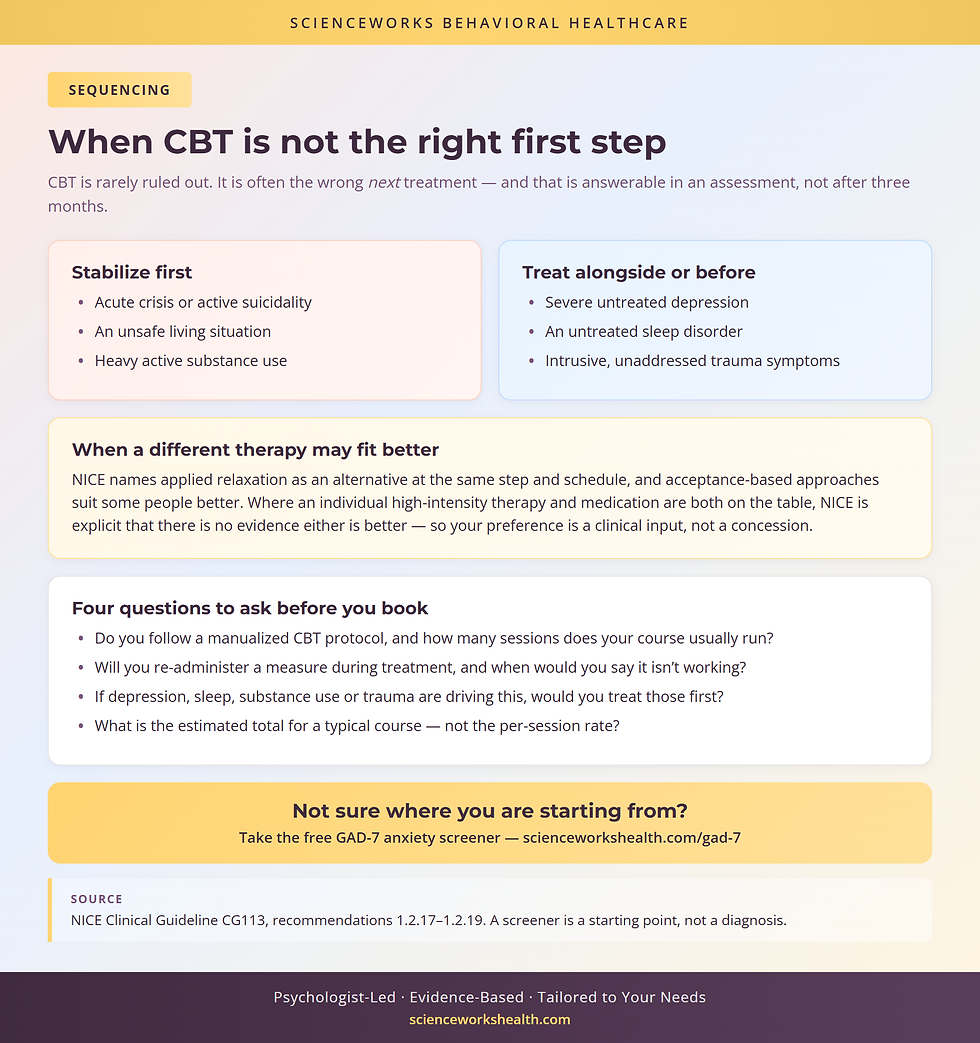
CBT is not usually the wrong treatment. It is often the wrong next treatment. Sequencing matters when:
You are in acute crisis or actively suicidal. Safety and stabilization come first; a structured anxiety protocol is not the intervention for that week.
Active heavy substance use is in the picture. Between-session experiments do not land reliably when substance use is doing the regulating.
Severe depression dominates. When getting out of bed is the barrier, an anxiety protocol asks for activation the depression is blocking. It is worth completing a PHQ-9 early precisely because this changes the plan.
An untreated sleep disorder is underneath. Chronic insomnia amplifies anxiety and blunts new learning; treating the sleep first sometimes shrinks the anxiety problem considerably.
Unaddressed trauma keeps intruding. If flashbacks or hypervigilance are the core, a trauma-focused therapy is the better opening move.
Your living situation is genuinely unsafe. Anxiety in an unsafe environment is accurate. Therapy that treats it as a distortion is doing harm.
When a different therapy may fit better
Where NICE offers a genuine alternative at the same step, it names applied relaxation, delivered on the same 12-to-15-session schedule [1]. Beyond that, acceptance-based approaches suit some people better — particularly those who find the "test the thought" framing adversarial toward their own mind. Our comparison of CBT, ACT, and exposure therapy for anxiety sits with that choice properly. And NICE is explicit that where an individual high-intensity psychological intervention and medication are both on the table, there is no evidence either is better, so the choice is based on your preference [1] — which means preference is a clinical input here, not a concession.
⚖️ Key takeaway: "CBT isn't recommended" almost always means "not first." The question is sequencing, and it is answerable in an assessment rather than after three months of a course that was never going to move.
If you're several sessions in and nothing has moved
By around session four to six, your clinician should be looking at your repeat scores and saying something out loud about them. If that is not happening, ask.
The usual causes are unglamorous and fixable. The formulation is wrong, so the experiments are testing the wrong prediction. The between-session work is not actually happening, often for a practical reason nobody named. The pace is too fast, so every experiment feels like a cliff. Or something in the list above is underneath, still untreated.
What should not happen is politeness. People stay in unhelpful courses because saying "this isn't working" feels like an accusation. It is not — it is the most useful thing you can say. Dose-response research using outpatient records shows improvement accrues unevenly across a course rather than in a straight line [6], so a slow start is not automatically a failed one; but nobody can tell the difference without measurement.
🗣️ Key takeaway: Around session six, a flat measured score is a conversation, not a verdict. Raise it. Adjusting the plan is ordinary practice.
Finding CBT for anxiety in Nashville
Two practical things shape this locally. "CBT" is not a protected term — plenty of clinicians describe their work as cognitive behavioral without having trained in a manualized protocol, and the difference shows up in whether your course has a structure and a measurable endpoint. And availability for the specific protocol you need is uneven across Middle Tennessee, which is a large part of why telehealth matters here rather than being a lesser option.
If you are searching locally, our overview of CBT for anxiety in Nashville covers how we work with people in the city and across the state. On our side, Dr. Brittany Lippert works with anxiety alongside OCD, depression, and trauma — which matters when the picture is not purely anxiety, and most pictures are not.
Bring these questions to any consultation, verbatim:
1. Scope: "Which anxiety presentation are you treating here — generalized worry, panic, social anxiety, health anxiety? Do you use a different protocol for each?"
2. Methodology: "Do you follow a manualized CBT protocol, and roughly how many sessions does your course usually run?"
3. Measurement: "Will you re-administer a measure like the GAD-7 during treatment, and at what point would you tell me it isn't working?"
4. Sequencing: "If depression, sleep, substance use, or trauma turn out to be driving this, would you treat those first or run them alongside?"
5. Cost: "What is the per-session cost, and can you give me an estimated total for a typical course rather than a per-session figure?"
Question five is the one people skip and later wish they had asked: a course, not a session, is the unit you are actually buying. Coverage varies by plan, so ask your insurer about outpatient behavioral health specifically rather than assuming from a network listing. If you are still deciding whether any of this applies, our screening tools are a reasonable place to start, and a therapy consultation can sort the sequencing question before you commit to anything.
How to decide whether to start
A heuristic you can apply before you close this page:
If anxiety is costing you specific things — declined opportunities, avoided places, lost sleep, strained relationships — and none of the sequencing flags above apply, a full 12-to-15-session course is a reasonable, well-evidenced commitment to make.
If it is uncomfortable but not yet costing you those things, ask about a lower-intensity option first. You may not need step three, and being offered it anyway is worth a question.
If one of the sequencing flags does apply — crisis, heavy substance use, dominant depression, untreated sleep problems, intrusive trauma — the right first appointment is an assessment that sorts the order, not an intake for a specific protocol.
And if you have been in something CBT-shaped for months with no measurement, that is not evidence CBT does not work for you. It is evidence you have not yet had a structured course with an endpoint, which is a different thing entirely.
Anxiety running the show?
Evidence-based therapy can turn the volume down on anxiety — a clinician can help you find the approach that fits your life rather than a one-size-fits-all plan.
Frequently Asked Questions
How many CBT sessions does it take to treat anxiety?
NICE guidance for generalized anxiety disorder puts a full course of CBT at 12 to 15 weekly hour-long sessions, fewer if you improve sooner and more if clinically needed. That is the high-intensity step in a stepped-care model. Many people start with a shorter guided self-help course first and never need the full course. Your own number depends on severity, how long the pattern has run, and whether anything else is running alongside it.
when is CBT not recommended for anxiety?
CBT is rarely ruled out, but it is often not the right first step. If you are in acute crisis, actively suicidal, in an unsafe living situation, or in heavy active substance use, stabilizing that comes first. Untreated severe depression, unaddressed trauma symptoms, or an untreated sleep disorder can also blunt CBT until they are handled. A good assessment sorts the sequence before anyone starts protocol work.
Does CBT actually help with anxiety, or does it just teach coping skills?
It reduces symptoms, not just your tolerance of them. Meta-analyses of randomized placebo-controlled trials show CBT produces meaningful reductions in anxiety symptoms across anxiety-related disorders, and a network meta-analysis of generalized anxiety disorder treatments placed CBT among the most effective options studied. Coping skills are part of the work, but the target is the pattern that keeps anxiety self-sustaining.
What should I do if CBT for anxiety is not working after several sessions?
Say so directly, and say it early. By around session four to six your clinician should be reviewing measured scores rather than impressions, and a flat line is information rather than failure. The common fixes are concrete: the formulation is off, between-session practice is not actually happening, the pace is wrong, or something untreated underneath is holding the pattern in place. Changing the plan is normal; quietly enduring an unhelpful course is not.
Do the gains from CBT for anxiety last after therapy ends?
For many people, yes. A systematic review and meta-analysis of long-term outcomes found gains from CBT for anxiety-related disorders were largely maintained at follow-up, though effects tended to shrink over longer intervals and relapse remains possible. Relapse-prevention work in the final sessions is part of why they hold. If symptoms return later, a short booster course usually costs far less than starting over.
About the Author
Dr. Kiesa Kelly is a licensed clinical psychologist and the founder of ScienceWorks Behavioral Healthcare, with more than 20 years of experience in psychological assessment and evidence-based treatment. Her clinical focus includes anxiety and obsessive-compulsive spectrum disorders, trauma, and neurodevelopmental assessment across the lifespan — including the differential-diagnosis work that determines whether an anxiety protocol is the right starting point.
Dr. Kelly's clinical training includes work at the University of Chicago, Vanderbilt University, and the University of Wisconsin, and her background includes NIH-funded research training. She leads a telehealth-forward practice serving people throughout Tennessee, and every article published here is reviewed by a licensed clinician for accuracy before publication.
References
1. National Institute for Health and Care Excellence. Generalised anxiety disorder and panic disorder in adults: management (CG113) — Recommendations. https://www.nice.org.uk/guidance/cg113/chapter/Recommendations
2. Cuijpers P, Harrer M, Miguel C, et al. Cognitive Behavior Therapy for Mental Disorders in Adults: A Unified Series of Meta-Analyses. JAMA Psychiatry. 2025;82(6):563-571. doi:10.1001/jamapsychiatry.2025.0482. https://pubmed.ncbi.nlm.nih.gov/40238104/
3. van Dis EAM, van Veen SC, Hagenaars MA, et al. Long-term Outcomes of Cognitive Behavioral Therapy for Anxiety-Related Disorders: A Systematic Review and Meta-analysis. JAMA Psychiatry. 2020;77(3):265-273. doi:10.1001/jamapsychiatry.2019.3986. https://pubmed.ncbi.nlm.nih.gov/31758858/
4. Carpenter JK, Andrews LA, Witcraft SM, et al. Cognitive behavioral therapy for anxiety and related disorders: A meta-analysis of randomized placebo-controlled trials. Depression and Anxiety. 2018;35(6):502-514. doi:10.1002/da.22728. https://pubmed.ncbi.nlm.nih.gov/29451967/
5. Papola D, Miguel C, Mazzaglia M, et al. Psychotherapies for Generalized Anxiety Disorder in Adults: A Systematic Review and Network Meta-Analysis of Randomized Clinical Trials. JAMA Psychiatry. 2024;81(3):250-259. doi:10.1001/jamapsychiatry.2023.3971. https://pubmed.ncbi.nlm.nih.gov/37851421/
6. Hollingbery T, Bryan M, Giovannetti O, et al. Evaluating Dose Response of Cognitive Behavioural Therapy Using Outpatient Electronic Medical Record Data: An Observational Study. Canadian Journal of Psychiatry. 2026;71(4):297-306. doi:10.1177/07067437251409885. https://pubmed.ncbi.nlm.nih.gov/41564249/
7. Bhattacharya S, Goicoechea C, Heshmati S, et al. Efficacy of Cognitive Behavioral Therapy for Anxiety-Related Disorders: A Meta-Analysis of Recent Literature. Current Psychiatry Reports. 2023;25(1):19-30. doi:10.1007/s11920-022-01402-8. https://pubmed.ncbi.nlm.nih.gov/36534317/
8. Bandelow B, Michaelis S, Wedekind D. Treatment of anxiety disorders. Dialogues in Clinical Neuroscience. 2017;19(2):93-107. https://pubmed.ncbi.nlm.nih.gov/28867934/
9. National Institute of Mental Health. Anxiety Disorders. https://www.nimh.nih.gov/health/topics/anxiety-disorders
Disclaimer
This article is for informational purposes only and is not a substitute for individualized clinical assessment, diagnosis, or treatment. Reading it does not create a clinician-patient relationship. Session counts described here are guideline averages, not predictions about any individual course. If you are concerned about anxiety, mood, or your safety, contact a qualified clinician. If you are experiencing a mental health emergency, call or text 988 in the United States or go to your nearest emergency department.