
Contamination OCD: Signs and How ERP and I-CBT Help

Updated: Oct 12
Last reviewed: 07/18/2026
Reviewed by: Dr. Kiesa Kelly
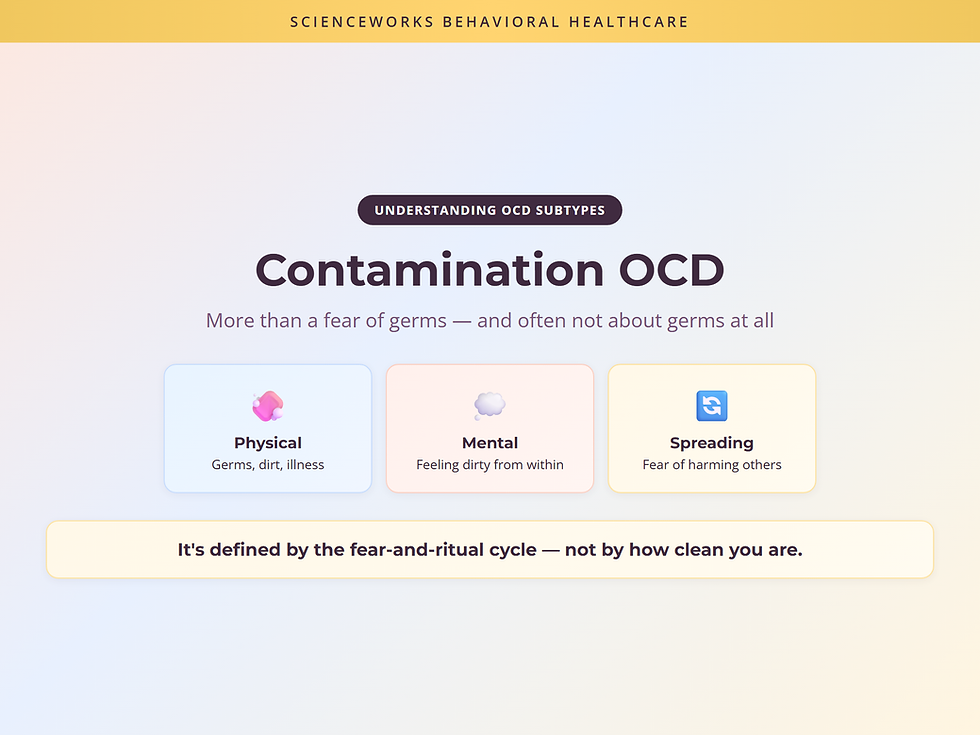
Most people picture contamination OCD as someone who washes their hands too much or carries hand sanitizer everywhere. That picture is not wrong, but it is far too small. Contamination OCD is not fussiness about cleanliness or a personality quirk — it is a recognized pattern of intrusive fear and the exhausting rituals people use to feel safe from it. And for many people it does not even involve germs at all.
If you have found yourself trapped in cycles of washing, avoiding, or feeling "unclean" in a way you cannot shake, this article is for you. We will walk through what contamination OCD actually is, the surprising range of forms it takes, how it shows up on a screener like the DOCS, how clinicians tell it apart from ordinary hygiene or a real health worry, and what genuinely helps.
In this article, you'll learn:
What contamination OCD really is, beyond the "germaphobe" stereotype
The physical, mental, and spreading forms contamination fear can take
The compulsions it drives — and why they backfire
How it maps to the contamination theme on the DOCS
How ERP and I-CBT help, framed honestly
What contamination OCD actually is
Contamination OCD is a common presentation of obsessive-compulsive disorder in which intrusive fears of being dirtied, infected, or "contaminated" drive repetitive behaviors meant to restore a feeling of safety or cleanliness. It is one of the four symptom themes measured by the DOCS, the OCD screener on our site. Like all forms of OCD, it runs on a cycle: an intrusive thought or feeling (the obsession) creates intense distress, and a behavior (the compulsion) briefly relieves it — which teaches the brain to run the whole loop again. OCD affects roughly 1 to 2 percent of adults in a given year, and contamination fears are among its most common themes [9][10].
A few misconceptions are worth clearing up right away, because they keep people from recognizing themselves.
"Contamination OCD is just being a germaphobe or extra clean." Being tidy or health-conscious is a preference; contamination OCD is a distressing, time-consuming cycle you would stop if you could. The difference is not how clean you are — it is how much fear and ritual are running underneath.
"It's always about physical germs." It is not. A large share of contamination fear involves mental contamination — feeling dirty or polluted with no physical contaminant at all. We will come back to this, because it is one of the most misunderstood parts of the condition.
"If you're afraid of getting sick, that must be contamination OCD." Not necessarily. Fear of having or developing an illness is more the territory of health anxiety, which overlaps with but is distinct from contamination OCD — a difference we will draw clearly below and that our guide on health anxiety versus OCD unpacks further.
The many faces of contamination fear
Contamination OCD is far more varied than the stereotype suggests. It usually shows up in one or more of these forms.
Physical contamination
This is the most recognizable form: fear of germs, bodily fluids, chemicals, dirt, or illness. Someone might scrub until their hands crack, refuse to touch doorknobs, shower for an hour after any outing, or throw away "contaminated" clothes. The fear feels concrete — this surface is dangerous — even when the actual risk is tiny.
"Emotional" or mental contamination
Here the sense of being dirty comes from the inside, with no physical contaminant involved [2]. Mental contamination can be triggered by a memory, an intrusive thought, or contact with a person associated with betrayal, humiliation, or a moral violation [2][3]. A person might feel "polluted" after remembering a distressing event and try to wash the feeling away — but because there is nothing physical to remove, the washing never quite works. This form is easy to miss precisely because it does not fit the germ stereotype.
Contact and spreading fears
Some people fear not only being contaminated but spreading contamination to others. The worry might be that they will make a loved one sick, transfer something harmful by touch, or "pass on" a contaminant they cannot see. This drives elaborate avoidance and decontamination routines aimed at protecting other people, often at great personal cost.
Key takeaway: 🧼 Contamination OCD is defined by the fear-and-ritual cycle, not by germs specifically. It can be physical, mental, or focused on spreading — and it is often more than one of these at once.

The compulsions it drives
The obsessions are only half of the cycle. The compulsions are the behaviors done to neutralize the fear, and they are what quietly take over a person's life:
Washing and cleaning — hands, body, surfaces, objects, sometimes to the point of physical damage.
Avoidance — of places, people, objects, or situations that feel contaminated. Avoidance feels protective but actually feeds the fear, because you never learn the feared outcome was unlikely.
Decontamination rituals — specific, often lengthy routines for "resetting" to clean (particular sequences, numbers of repetitions, or steps that must feel "right").
Reassurance-seeking — repeatedly asking others, or searching online, for confirmation that something is safe or clean.
Here is the cruel logic at the center of it: each compulsion works, briefly. The relief is real, which is exactly why the behavior repeats — and why "just wash one more time and you'll feel better" is a trap rather than a solution. The relief teaches the brain that the danger was real and the ritual saved you, so the fear comes back stronger.
How it shows up on the DOCS
If you have taken the DOCS (Dimensional Obsessive-Compulsive Scale), contamination is one of the four symptom themes it measures, each scored from 0 to 20 [1]. A prominent contamination score means this theme is loud for you relative to the others — responsibility for harm, unacceptable thoughts, and symmetry.
But a score is not a diagnosis, and this is the load-bearing point. The DOCS is a self-report screener that maps the shape of obsessive-compulsive symptoms; it cannot confirm you have OCD, weigh how much your life is affected, or rule out another explanation [1]. A high contamination score is a useful signal worth bringing to a clinician — not a verdict. Understanding what OCD is and how the cycle works helps put any screener result in context.
Contamination OCD versus ordinary hygiene or a real health concern
One of the most useful things a clinician does is sort contamination OCD from things it resembles. Two distinctions matter most.
Ordinary hygiene. Washing your hands before dinner, cleaning up after handling raw chicken, or being more careful during flu season is proportionate, flexible, and doesn't distress you. Contamination OCD is disproportionate to the actual risk, rigid, distressing, and time-consuming. Consider two mornings: one person wipes the counter, notices it's clean, and moves on; another wipes it, feels a spike of doubt that it's "really" clean, wipes it again in a specific pattern, avoids touching it for the rest of the day, and loses forty minutes to the loop. Same surface, completely different relationship to it. The tell is not the action — it's the doubt, the distress, and the time.
A real health concern. Fear of catching or spreading a contaminant (contamination OCD) is different from fear of already having or developing a disease (health anxiety, sometimes called illness anxiety). Picture someone who avoids the hospital, won't touch anything there, and showers for an hour afterward because they might have "picked something up" — that is contamination OCD's fear of catching something. Now picture someone who repeatedly checks their body for lumps, googles symptoms for hours, and seeks reassurance from doctors because they are sure a disease is already growing inside them — that is closer to health anxiety. The two can overlap, and both are treatable, but they respond best to care aimed at the right target.
Key takeaway: 🧭 The question is never "are you clean enough?" It is whether fear and ritual are running your day. That is what separates OCD from a preference — and what treatment actually addresses.
What helps — ERP and I-CBT
The genuinely hopeful part: contamination OCD is one of the more treatable presentations of OCD, and there are two evidence-based first-line psychotherapies [4][5][8].
Exposure and Response Prevention (ERP) is the most extensively studied psychotherapy for OCD [4][5]. In ERP, you gradually and deliberately face contamination triggers — at a pace you help set — while resisting the washing, avoiding, or reassurance that normally follows. Over time, your nervous system learns two things: the feared outcome is unlikely, and the discomfort fades on its own without the ritual. Done well, ERP is collaborative and values-paced, not a matter of being thrown into your worst fear. It is powerful, and it is not the right fit for everyone or every moment.
Inference-based CBT (I-CBT) is a more cognitive alternative with growing evidence and, in recent trials, comparable results and better tolerability for many people [6][7]. Instead of leading with exposure, I-CBT targets the faulty reasoning that makes a contamination fear feel real in the first place — the way OCD builds a convincing story that "this could be dangerous" out of possibility rather than evidence. For people who find exposure too threatening to start, or who tend to over-analyze, I-CBT can be a gentler entry point.
Neither approach is a cure or a guarantee, and honesty matters here: the realistic goal is meaningful symptom reduction and getting your life back, not the permanent erasure of every intrusive thought. Our specialized therapy team is trained in both ERP and I-CBT so the approach can fit the person, not the other way around.

Getting started
If contamination fears are shaping your days, a good first step is a proper assessment that can confirm or rule out OCD, sort it from health anxiety or other explanations, and clarify which compulsions to target first. From there, treatment is tailored to you. We offer OCD care by telehealth across Tennessee, with an in-person option at our Nashville office, and our overview of mental health screening explains how a screener leads into evaluation and care. You do not have to have it all figured out before reaching out — figuring it out together is part of the work.
Think it might be OCD?
OCD responds well to the right approach — a clinician trained in ERP and I-CBT can help you tell OCD apart from anxiety and build a plan that fits.
Frequently Asked Questions
Is being afraid of germs always OCD?
No. Caring about hygiene, avoiding obviously risky things, or feeling uneasy during flu season is normal and healthy. It may point toward contamination OCD when the fear becomes intrusive and distressing, drives repetitive behaviors like washing or avoiding, takes up significant time, and does not settle even when you know the risk is low. The line is not the fear itself — it is how much it runs your day.
What is mental or emotional contamination?
Mental contamination is feeling dirty, polluted, or unclean without any physical contact with a contaminant. It can be triggered by a memory, an intrusive thought, or contact with a person associated with harm, betrayal, or a moral violation. Because there is nothing physical to wash off, ordinary cleaning rarely brings lasting relief, which is one reason this pattern responds better to specialized OCD treatment than to reassurance.
How is contamination OCD treated?
The first-line psychological treatments are Exposure and Response Prevention (ERP) and Inference-based CBT (I-CBT). ERP helps you gradually face contamination triggers while resisting washing or avoidance, so your brain learns the feared outcome is unlikely and the discomfort fades on its own. I-CBT works more cognitively, targeting the reasoning that makes the contamination fear feel real. Both reduce symptoms for many people, though neither is a guaranteed cure.
Can contamination OCD go away without treatment?
For most people, contamination OCD does not simply fade on its own, because the compulsions that bring short-term relief also keep the cycle going. Symptoms can wax and wane with stress, but the underlying pattern usually persists without treatment. The encouraging part is that contamination OCD is one of the more treatable presentations of OCD, and evidence-based care helps many people regain time and freedom.
Does the DOCS measure contamination fears?
Yes. Contamination is one of the four symptom themes the Dimensional Obsessive-Compulsive Scale (DOCS) measures, alongside responsibility for harm, unacceptable thoughts, and symmetry. A higher contamination score suggests this theme is prominent for you, but the DOCS is a screener, not a diagnosis — an elevated score is a reason to talk with a clinician, not a confirmation that you have OCD.
About the Author
Dr. Kiesa Kelly is a licensed clinical psychologist and the owner of ScienceWorks Behavioral Healthcare, with more than 20 years of experience in psychological assessment. She earned her PhD in Clinical Psychology, with a concentration in neuropsychology, from Rosalind Franklin University of Medicine and Science, and completed practica, internship, and an NIH-funded postdoctoral fellowship across the University of Chicago, the University of Wisconsin, the University of Florida, and Vanderbilt University.
Her graduate therapy training focused specifically on OCD, including exposure and response-prevention work in the Anxiety Disorders Clinic at The Chicago Medical School. She is among a small but growing group of U.S. clinicians additionally trained in Inference-based CBT (I-CBT) for OCD, and she is a member of the American Psychological Association, the Association for Behavioral and Cognitive Therapies, and the Anxiety and Depression Association of America.
References
1. Abramowitz JS, Deacon BJ, Olatunji BO, et al. Assessment of obsessive-compulsive symptom dimensions: development and evaluation of the Dimensional Obsessive-Compulsive Scale. Psychological Assessment. 2010;22(1):180-198. https://www.researchgate.net/publication/41967816_Assessment_of_Obsessive-Compulsive_Symptom_Dimensions_Development_and_Evaluation_of_the_Dimensional_Obsessive-Compulsive_Scale
2. Rachman S. Fear of contamination. Behaviour Research and Therapy. 2004;42(11):1227-1255. https://www.sciencedirect.com/science/article/abs/pii/S0005796704001378
3. Coughtrey AE, Shafran R, Knibbs D, Rachman SJ. Mental contamination in obsessive-compulsive disorder. Journal of Obsessive-Compulsive and Related Disorders. 2012;1(4):244-250. https://www.sciencedirect.com/science/article/abs/pii/S2211364912000632
4. Ferrando C, Selai C. A systematic review and meta-analysis on the effectiveness of exposure and response prevention therapy in the treatment of obsessive-compulsive disorder. Journal of Obsessive-Compulsive and Related Disorders. 2021;31:100684. https://www.sciencedirect.com/science/article/abs/pii/S2211364921000646
5. Reid JE, Laws KR, Drummond L, et al. Cognitive behavioural therapy with exposure and response prevention in the treatment of obsessive-compulsive disorder: a systematic review and meta-analysis of randomised controlled trials. Comprehensive Psychiatry. 2021;106:152223. https://www.sciencedirect.com/science/article/pii/S0010440X21000018
6. Wolf N, van Oppen P, Hoogendoorn AW, et al. Inference-based cognitive behavioral therapy versus cognitive behavioral therapy for obsessive-compulsive disorder: a multisite randomized controlled non-inferiority trial. Psychotherapy and Psychosomatics. 2024;93(6):397-411. https://doi.org/10.1159/000541508
7. Sonneveldt IJ, Wolf N, van Balkom AJLM, et al. Inference-based CBT versus CBT with exposure and response prevention for obsessive-compulsive disorder: the role of pre-treatment anxiety and feared consequences on treatment outcome. Journal of Obsessive-Compulsive and Related Disorders. 2025;44:100936. https://www.sciencedirect.com/science/article/pii/S2211364925000028
8. National Institute for Health and Care Excellence. Obsessive-compulsive disorder and body dysmorphic disorder: treatment (CG31). https://www.nice.org.uk/guidance/cg31
9. Ruscio AM, Stein DJ, Chiu WT, Kessler RC. The epidemiology of obsessive-compulsive disorder in the National Comorbidity Survey Replication. Molecular Psychiatry. 2010;15(1):53-63. https://pmc.ncbi.nlm.nih.gov/articles/PMC2797569/
10. National Institute of Mental Health. Obsessive-Compulsive Disorder (OCD). Accessed July 2026. https://www.nimh.nih.gov/health/statistics/obsessive-compulsive-disorder-ocd
Disclaimer
This article is for informational and educational purposes only and is not a substitute for professional medical or mental health advice, diagnosis, or treatment. An online screener such as the DOCS cannot diagnose OCD or any other condition. If you are concerned about contamination fears or other obsessive-compulsive symptoms, please consult a qualified clinician. If you are in crisis or thinking about harming yourself, call or text 988 (the Suicide and Crisis Lifeline) in the United States, or your local emergency number.