
Cross-State Telehealth & PSYPACT: TN Psychologist Rules

Updated: Aug 21
Last reviewed: 06/01/2026
Reviewed by: Dr. Kiesa Kelly

If you found a Tennessee-based practice you like but you live somewhere else, you have probably run into the same wall many telehealth searchers do: can this clinician actually see you, in your state? It is a fair and important question, and the answer is not a flat yes or no. Cross-state telehealth for psychology is governed by licensure rules that depend on where you are sitting during the session — not where the clinician is.
This article walks through how telehealth licensure works for psychology, where a multistate compact called PSYPACT fits in, and why assessment, therapy, and coaching can each have different answers. The goal is to make your eligibility something you can confirm in a single step rather than something you have to guess at.
In this article, you'll learn:
The short answer on when a Tennessee clinician can — and can't — see you in your state
What PSYPACT is and what it actually covers
Why psychological assessment is more license-sensitive than therapy across state lines
Which services (like coaching) cross state lines more freely
How to handle common situations: out-of-state evaluations, moving mid-care, and split residence
The one-step way to confirm your eligibility before you book
Short answer — when a Tennessee-based clinician can (and can't) see you
Here is the honest version. Whether a Tennessee-licensed psychologist can work with you depends mostly on the state you are physically located in during the session, and on whether that state participates in a compact called PSYPACT. For many people in participating states, the answer is yes. For people in non-participating states, it usually is not — at least not without separate licensure.
That is why we do not publish a fixed "states we serve" list and call it settled. Compact membership changes as new states join, the rules can vary by the service you need, and your specific situation matters. If you want a service overview while you sort out eligibility, our psychological assessment services page describes what an evaluation involves, and our specialized therapy services page covers what we offer through telehealth. The cleanest path is to tell us the state you would be in and let us confirm against current rules.
Before we get into the mechanics, it helps to clear up three things people commonly get wrong.
Misconception 1: "If the clinician is licensed, they can see anyone, anywhere." Licensure is state-based. A license to practice psychology in Tennessee authorizes care for people in Tennessee. Seeing someone in another state requires either a license in that state or an authority granted through a compact like PSYPACT — not just the clinician's home-state license.
Misconception 2: "It depends on where the clinician lives." It is the reverse. For telehealth, the rule that matters is where you, the client, are physically located when the session happens. A clinician in Tennessee seeing a client who is in another state is practicing, in the eyes of the rules, in that other state.
Misconception 3: "Telehealth made state lines irrelevant." Telehealth removed the travel barrier, not the legal one. The technology lets a session happen across distance, but the licensing rules still follow the client's location. Compacts like PSYPACT exist precisely because state lines did not disappear — they created a structured way to work across them.
How telehealth licensure actually works for psychology
Psychology is licensed at the state level. Each state board sets its own requirements and authorizes practice within its borders. For most of the field's history, that meant a psychologist could only see clients physically located in a state where they held a license. Telehealth did not change that underlying principle — it just made the geography invisible on a screen while leaving it very much intact in the law.
PSYPACT and what it covers
PSYPACT — the Psychology Interjurisdictional Compact — is an agreement among participating states that lets eligible psychologists provide telepsychology across state lines without holding a separate license in each one [1][2]. As of 2026, it has been adopted by a large and growing group of jurisdictions, with more states introducing legislation each session [3][4]. Tennessee is a participating state, which is part of why a Tennessee-based clinician can often reach clients elsewhere [5].
The mechanics matter, because "covered by PSYPACT" is not automatic. A psychologist has to be individually authorized: that means holding an E.Passport credential issued by the Association of State and Provincial Psychology Boards (ASPPB) and an Authority to Practice Interjurisdictional Telepsychology (APIT) granted by the PSYPACT Commission [1][6]. The compact also defines the receiving state as wherever the client is physically located during the session — and care must follow that receiving state's rules [7]. So eligibility is the product of three things: your state participates, your clinician is authorized, and the service is one the compact covers.
What this means in plain terms: PSYPACT is a real bridge, but it is a bridge with specific on-ramps. Not every state is on it, and not every clinician carries the credential. That is why a quick confirmation beats an assumption.
For many people, the bigger surprise is how much real clinical work travels well over telehealth once eligibility is settled. Approaches you might assume require an in-person room often do not — our look at how virtual EMDR and bilateral stimulation actually work and at what online trauma therapy helps with and who it fits both show care that holds its quality across distance. The state-line question is about permission to deliver that care, not about whether the care can work remotely.
Where assessment differs from therapy on state lines
This is the part people are most likely to miss. Therapy and psychological assessment do not always get the same cross-state answer, even for the same person in the same state.
Therapy delivered by telehealth is generally the cleaner case under the compact, and many evidence-based approaches translate well to a screen — our overview of when online ERP for OCD works well is one example of a structured therapy that holds up across distance. A psychological evaluation can carry extra constraints. Some testing instruments have publisher rules about remote administration, certain assessments rely on in-person components, and the interpretation and reporting of results can intersect with state-specific requirements. None of that makes cross-state assessment impossible — it makes it something we verify on its own, separately from a therapy question, before anyone schedules.
Consider a concrete situation. Someone in a participating state asks whether they can do a full adult ADHD evaluation with us by telehealth. The therapy answer for that state might be a clean yes, while the assessment answer depends on which instruments the evaluation uses and how each must be administered. We would rather tell you that up front than start an evaluation we cannot finish where you live. If you are weighing an out-of-state evaluation, our psychological assessment services page outlines what is involved, and our team confirms whether the specific evaluation crosses your state line.
🧭 Key takeaway: Cross-state eligibility follows your location, not the clinician's — and assessment is checked separately from therapy because it carries more license-sensitive moving parts.

Services that cross state lines more freely (like coaching)
Not everything we do is licensed psychological practice, and that distinction changes the cross-state picture. Executive function coaching is not therapy or assessment, and it is not the diagnosis or treatment of a mental health condition. Because it is not licensed psychological practice, it is not governed by PSYPACT or state psychology licensure in the same way clinical care is — which generally gives it more freedom to reach people regardless of state.
That makes coaching a useful option for some out-of-state readers who want practical, skills-focused support rather than a diagnosis or clinical treatment. Our executive function coaching page explains what that work looks like. The important caveat: coaching is not a substitute for an evaluation or for treatment of a clinical condition. If what you actually need is a diagnosis or therapy, that is a licensed service, and the state rules above apply.
🪪 Key takeaway: Coaching and licensed clinical care are different things. Coaching crosses state lines more freely precisely because it is not diagnosis or treatment — but it cannot replace either.
What this means for common situations
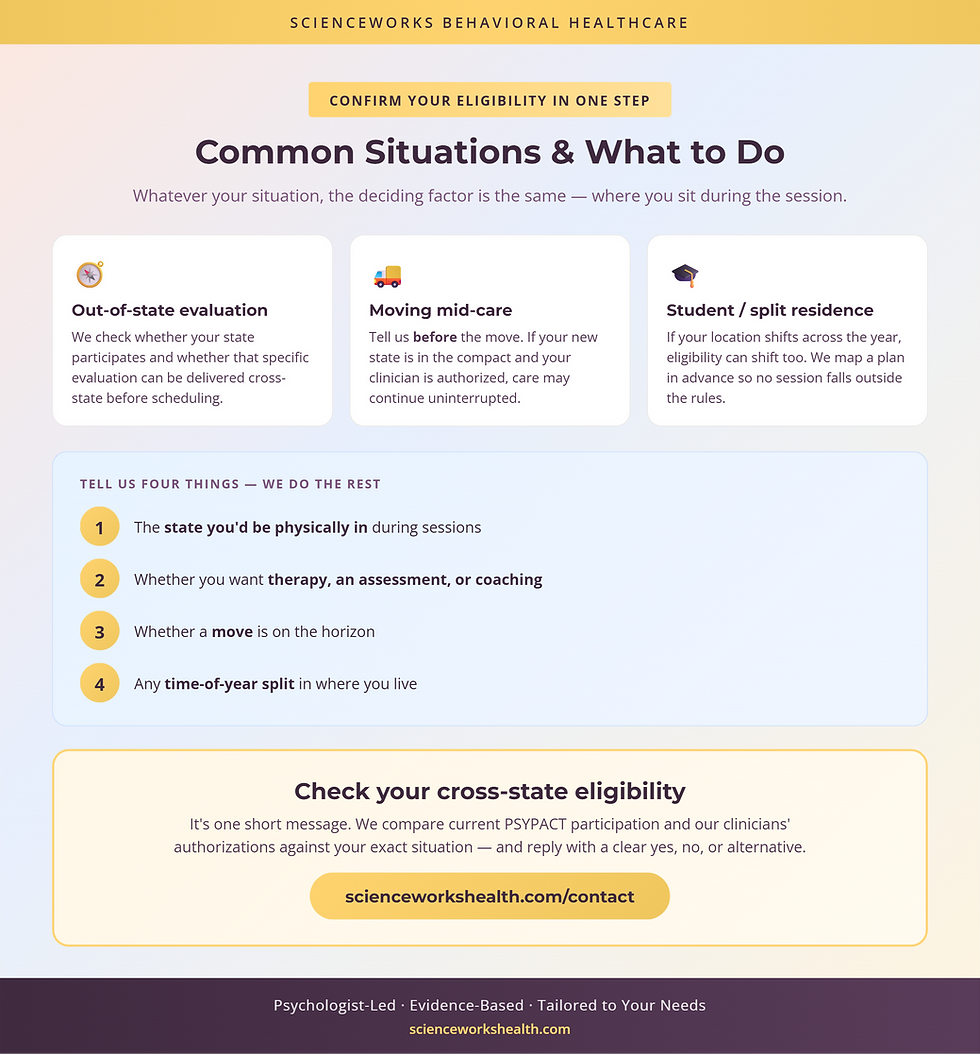
Most cross-state questions come down to a handful of real-life scenarios. Here is how each tends to play out, with the same theme running through all of them: your physical location during sessions is the deciding factor.
You live out of state and want an evaluation
Say you live in another state and want a psychological assessment with a Tennessee-based clinician. The first thing we check is whether your state participates in PSYPACT and whether the specific evaluation can be delivered cross-state given how its instruments must be administered. You walk through your week feeling like something is off — focus, organization, follow-through — and you have found a practice you trust, but you are three states away. That is a common and solvable starting point. The answer hinges on your state and the evaluation type, which is exactly the pairing we confirm before scheduling so you are not left in limbo halfway through.
You're moving states mid-care
Maybe you are already working with a clinician and a move is coming. This is one of the most important times to speak up early, because the moment your physical location changes, your eligibility can change with it. If you start therapy while living in a participating state and then relocate to another participating state where your clinician is authorized, care may continue uninterrupted. If your new state is not in the compact, we help you plan a referral or a clean transition rather than discovering the gap after you have moved. Tell us before the move, not after — that single step usually determines whether care continues smoothly.
You're a student or split-residence
Students and split-residence situations are their own category, because "where you live" is genuinely ambiguous. A student may be enrolled in one state, claim residency in another, and physically sit in a dorm in a third. Someone with two homes may split the year. What governs each session is simple even when life is not: where you are physically located at the time of that session. If that location shifts across the year, your eligibility can shift too, which sometimes means care is available during part of the year and needs a plan for the rest. We would rather map that out with you in advance than have a session fall outside the rules unexpectedly. Our team and licensure overview is a good place to see who you would be working with as you sort this out.
📍 Key takeaway: In every common scenario — out-of-state evaluation, a move, or split residence — the deciding factor is the same: the state you are physically in when the session takes place.
How to confirm your eligibility in one step
Here is a simple decision rule you can apply right now, before you book anything:
If you want therapy and you are in a PSYPACT participating state, the answer is often yes — confirm your clinician's authorization and you are likely good to go.
If you want a psychological assessment, treat it as a separate question from therapy, because the evaluation's instruments and your state's rules both factor in.
If you want coaching rather than clinical care, state lines are usually less of a barrier, since coaching is not licensed psychological practice.
If you are in a non-participating state, assume cross-state licensed care is not available by default, and ask us about alternatives.
When in any doubt, ask before booking — the cost of confirming is one short message; the cost of assuming is a session that cannot happen.
A handful of specific things are worth telling us so we can give you a precise answer: the state you would be physically located in during sessions, whether you want therapy, an assessment, or coaching, whether a move is on the horizon, and any time-of-year split in where you live. With those details, we check current PSYPACT participation and our clinicians' authorizations against your exact situation and respond with a clear yes, no, or alternative path. You can start that on our contact page.
Next step — check your eligibility with our team
Cross-state telehealth rules sound complicated, and the underlying law genuinely is — but your part is not. You do not need to memorize which states are in PSYPACT or untangle which credential covers what. You only need to tell us where you would be sitting during sessions and what kind of support you are looking for. From there, confirming eligibility is something we do, not something you have to solve.
If you have been wondering whether a Tennessee-based practice can work with you where you live, the most useful next move is simply to ask. Share your state and the service you want, and we will tell you plainly whether we can help, and if not, point you toward a sensible alternative.
Frequently Asked Questions
Can a Tennessee psychologist see me if i live in another state?
Often, yes — but it depends on the state you are physically in during the session, not where the clinician sits. Under PSYPACT, an eligible psychologist holding the required telepsychology authorization can see clients located in other participating states. Some states are not in PSYPACT, so the honest answer is that eligibility is case-by-case. The fastest way to know is to tell our team the state you would be in for sessions and let us confirm.
Does PSYPACT cover psychological assessment the same as therapy?
Not automatically. PSYPACT governs telepsychology broadly, but assessment is the most license-sensitive service because some test publishers, score interpretation, and state rules add constraints beyond the compact itself. A therapy session and a full psychological evaluation can have different cross-state answers even for the same person. We confirm assessment eligibility separately from therapy before scheduling, so nothing gets started that cannot be completed.
Is executive function coaching the same as licensed therapy across state lines?
No. Executive function coaching is not licensed psychological practice, so it is not governed by PSYPACT or state psychology licensure in the same way therapy and assessment are. That generally gives coaching more flexibility to cross state lines. Coaching also is not diagnosis or treatment of a mental health condition. If you need a diagnosis or clinical care, that is a licensed service and the state rules above apply.
What happens to my care if I move to another state mid-treatment?
Tell us as early as you can, because your eligibility is tied to where you are physically located during sessions. If your new state is a PSYPACT participating state and your clinician holds the required authorization, care may continue without interruption. If it is not, we will help you plan a referral or transition so there is no gap. The key is flagging the move before it happens rather than after.
How do I confirm whether you can see me in my state?
Share the state you would be physically in during sessions and the service you want — therapy, a psychological assessment, or coaching — through our contact page. We check current PSYPACT participation and our clinicians' authorizations against that specific combination and give you a clear yes, no, or alternative. It takes one short message, and it prevents booking something we are not able to deliver where you live.
About ScienceWorks
ScienceWorks Behavioral Healthcare was founded by Dr. Kiesa Kelly, a licensed clinical psychologist with more than 20 years of experience in psychological assessment and evidence-based treatment. Our clinical team provides telehealth-forward care for adults and adolescents, with specializations spanning ADHD and autism evaluations, OCD, anxiety, trauma, and insomnia — the kinds of services that most often raise cross-state and telehealth-eligibility questions.
We are based in Tennessee and built around a telehealth model, which means logistics like licensure, state rules, and what can be delivered remotely are things we work through with clients regularly. Every article we publish is reviewed by a licensed clinician for accuracy before it goes live, and questions about whether we can see you in your specific state are answered by our team against current rules rather than a static list.
References
1. Association of State and Provincial Psychology Boards (ASPPB). Practicing Telepsychology Under PSYPACT — E.Passport. https://asppb.net/credentials-related-records/epassport/
2. Psychology Interjurisdictional Compact (PSYPACT). Practicing Telepsychology Under PSYPACT. https://psypact.gov/page/telepsychology
3. Psychology Interjurisdictional Compact (PSYPACT). PSYPACT Map of Participating States. https://psypact.gov/page/psypactmap
4. Psychology Interjurisdictional Compact (PSYPACT). Final PSYPACT Legislation. https://psypact.gov/page/statelegislation
5. Tennessee Department of Health, Board of Psychology. Multistate (PSYPACT) Regulations. https://www.tn.gov/health/health-program-areas/health-professional-boards/psychology-board/psych-board/multistate-regulations.html
6. Psychology Interjurisdictional Compact (PSYPACT). Frequently Asked Questions. https://psypact.gov/page/FAQs
7. American Psychological Association Services. PSYPACT: Interstate Practice and Telehealth. https://www.apaservices.org/practice/legal/technology/psypact-interstate-practice-telehealth
8. Psychology Interjurisdictional Compact (PSYPACT). About PSYPACT. https://psypact.gov/page/About
9. Association of State and Provincial Psychology Boards (ASPPB). E.Passport Quick Guide. https://cdn.ymaws.com/psypact.gov/resource/resmgr/handouts/e.passport_app_quick_guide_2.pdf
Disclaimer
This article is for informational purposes only and does not constitute legal, medical, or clinical advice. Telehealth licensure rules, PSYPACT participation, and individual clinician authorizations change over time and vary by state and by service. Nothing here guarantees that any particular service can be provided in your state. Whether ScienceWorks can work with you depends on your specific situation and current regulations — please confirm your eligibility directly with our team before scheduling. If you are experiencing a mental health emergency, call or text 988 (the Suicide and Crisis Lifeline) or call 911.